
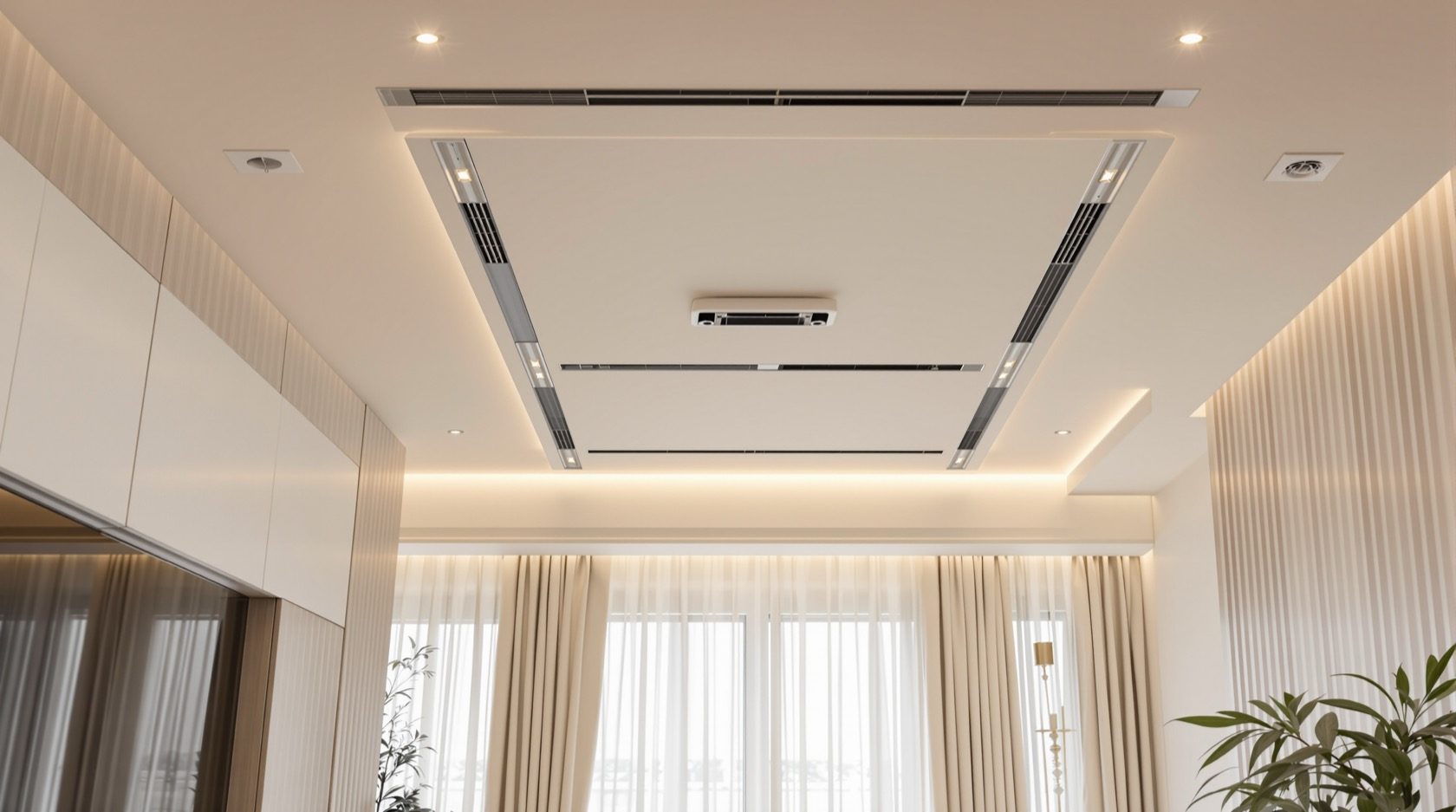
Ducted & Cassette AC: Concealed Cooling for a Clean Ceiling
When you want the cooling but not the wall units — how ducted and cassette air conditioners hide in the ceiling to deliver even, discreet comfort, how each works, where each fits, and why they must be planned into the ceiling before it closes.
Some spaces want the cooling but not the hardware on the walls — a minimalist living room, a premium office, a large hall where several wall units would look cluttered. The answer is concealed cooling: ducted and cassette air conditioners that hide in the ceiling and deliver air through discreet grilles, leaving the walls clean and the temperature even. They cost and demand more than a wall split, and they must be planned into the ceiling before it closes — but the result is invisible, uniform comfort. This guide explains both, and when each fits.
It builds on the Split AC and Building HVAC Design guides, part of the HVAC Knowledge Hub.
The safety line & scope. Concealed systems are more involved than a wall split — design, ducting, installation and commissioning are qualified HVAC work, coordinated with the false-ceiling and interior design. This guide helps you understand and specify; the work is professional.
The two ways to conceal cooling
Ducted AC
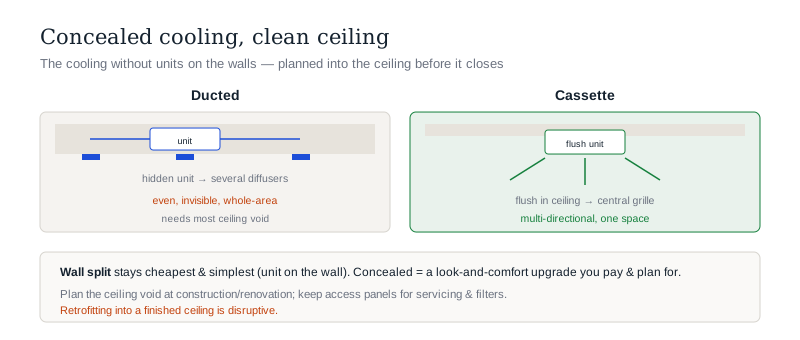
- A concealed indoor unit sits in the ceiling void and pushes cooled air through ducts to several diffusers across a space (and draws air back through a return grille).
- The whole space is cooled evenly from multiple discreet outlets — no visible unit at all, just slim ceiling grilles.
- Best for even, invisible cooling of a whole room, floor or several rooms from one concealed unit; the premium, cleanest look.
- Needs ceiling void depth for the unit and ducts — decided at construction/renovation.
Cassette AC
- A single square/rectangular unit set flush into the ceiling, blowing cooled air out through vents on two, three or four sides from a central grille.
- No ducts (or minimal) — the unit itself is in the ceiling, distributing air directly to the space below.
- Best for a single larger space — an office cabin, a shop, a hall, a large room — where a wall unit would be awkward and even, multi-directional throw is wanted.
- Needs enough ceiling void for the cassette body, but less duct planning than a fully ducted system.
In short: ducted = a hidden unit feeding many diffusers (whole-area, invisible); cassette = a flush ceiling unit blowing from a central grille (single space, multi-directional).
Ducted vs cassette vs wall split
Where each fits:
| Wall split | Cassette | Ducted | |
|---|---|---|---|
| Visibility | Unit on the wall | Flush grille in ceiling | Only slim diffusers |
| Air distribution | One direction | Multi-directional | Even, from many points |
| Best for | A room, budget | A single larger space | Whole area, premium look |
| Ceiling void needed | No | Some | More |
| Cost & install | Lowest | Higher | Highest |
- Wall split — cheapest, simplest, per room; the default.
- Cassette — clean ceiling look for one larger space without heavy duct work.
- Ducted — the most invisible and even, for whole areas and premium interiors, at the highest cost and planning.
When to choose concealed cooling
- You want a clean, minimalist look — no wall units, only ceiling grilles.
- Even temperature across a whole area — ducted excels at this.
- A large single space — cassette suits offices, halls and shops.
- You're building or doing a major renovation — the moment to plan the ceiling void and ducts.
- Premium homes and interiors where the invisible result justifies the cost.
If the walls being visible doesn't bother you, or budget/ceiling space is tight, a wall split is simpler and cheaper — concealed cooling is a look-and-comfort upgrade you pay and plan for.
Planning concealed cooling
Because it hides in the ceiling, it must be designed in:
- Plan at construction/renovation — the false-ceiling design must accommodate the unit and ducts; retrofitting into a finished ceiling is disruptive.
- Ceiling void depth — confirm there's room for the unit and ducts.
- Duct and diffuser layout — positions for even air throw and returns, coordinated with lights and other services.
- Access panels — for servicing the concealed unit and filters (essential — you still must clean filters).
- Load and unit selection — sized to the space by a professional.
- Coordinate with interior, electrical and structure — like all new-home HVAC.
The one-line answer
Ducted and cassette ACs deliver concealed cooling — the comfort without units on the walls. A ducted system hides a unit in the ceiling void and feeds several discreet diffusers for even, invisible cooling of a whole area (the premium, cleanest look, needing the most ceiling depth and planning); a cassette sets a single unit flush into the ceiling, blowing multi-directionally from a central grille, ideal for one larger space with less duct work. Both cost and demand more than a wall split and, crucially, must be planned into the ceiling before it closes — so they're a build-or-major-renovation decision, coordinated with the false-ceiling, interior, electrical and structure, with access panels for the servicing you'll still need. Choose them for a clean minimalist look and even comfort; stick with a wall split if budget, ceiling space or simplicity rule.
Where to go next
- The default alternative: Split AC Guide.
- The multi-room system that can feed them: VRF & VRV Systems Guide.
- Plan the ceiling void: HVAC Planning Guide for New Homes.
- Size it: AC Capacity Calculator.
References
- IS 8148 : 2018, Ducted & Package Air-Conditioners — Specification, Bureau of Indian Standards.
- IS 1391 (Parts 1 & 2 : 2023) Room Air Conditioners; Bureau of Energy Efficiency (BEE) — Star Labelling: https://beeindia.gov.in/
- National Building Code of India, SP 7 (Part 8 — Building Services; verify current edition), BIS.
Concealed system design, ducting, installation and commissioning are qualified HVAC work, coordinated with the ceiling and interior design. Verify any standard's current status via the BIS catalogue before relying on it.
Export this guide
Related Guides — Deep-dive reading
HVAC Drawings Explained
Cooling, heating and fresh air on paper — how to read indoor and outdoor unit positions, refrigerant and drain routes, ducts and diffusers, the reflected ceiling plan, and ventilation.
Construction DrawingsMinimalist Door Designs in India (2026): Flush, Frameless & Concealed-Frame Doors
The clean-line, no-architrave, hidden-hardware door language behind modern Indian apartments and designer interiors — flush-to-wall doors, concealed hinges, recessed pulls, tall leaves and what the look really costs.
Home Doors & EntrancesResidential Electrical Systems: The Complete Guide for Indian Homes
How the electricity in an Indian home actually works — from the utility supply and meter through the distribution board, circuits, wiring, earthing and protection, to lighting, safety, energy efficiency, smart controls, solar and backup — written so a homeowner can understand, plan and judge it, and know exactly where a licensed electrician must take over.
Electrical & WiringRelated Tools — Try Free
Home Building & Interior Cost Calculator — 20 Cities
Construction + interior costs for 20 Indian cities across kitchen, wardrobes, flooring, painting, ceiling.
Cost CalculatorRenovation vs New Build Calculator
Compare renovating vs building new interiors city-wise across 13 work scopes with GST and per-sqft rates.
Cost ComparisonElectrical Safety & Load Audit
Home electrical audit — 10 categories, 65+ checkpoints across earthing, RCCB, MCB, wiring, switchboards, appliance circuits, DG/inverter backup.
Safety Audit