
Window AC Guide: The Simple, Affordable Single-Room Cooler
The case for the window AC — the all-in-one unit that's cheapest to buy and easiest to install, where it still makes sense over a split, what you give up in noise and efficiency, and how to choose and fit one well.
The window AC is the original air conditioner — a single box that sits in a window, cooling one room. Splits have overtaken it, but the window unit hasn't disappeared, because it does two things better than anything: it's the cheapest to buy and the simplest to install. For a rented flat, a single room, a tight budget or where an outdoor-unit spot is impossible, the humble window AC is still the sensible answer. This guide is the honest case for the window unit — where it fits, what you trade off, and how to choose one.
It applies the Air Conditioning Basics to the window unit, and is part of the HVAC Knowledge Hub.
The safety line & scope. This guide helps you choose and fit a window AC sensibly. The mounting (secure support, sealing, electrical) is best done by a professional — a window unit is heavy and must be safely and squarely supported. Filter cleaning and thermostat use are yours.
What a window AC is
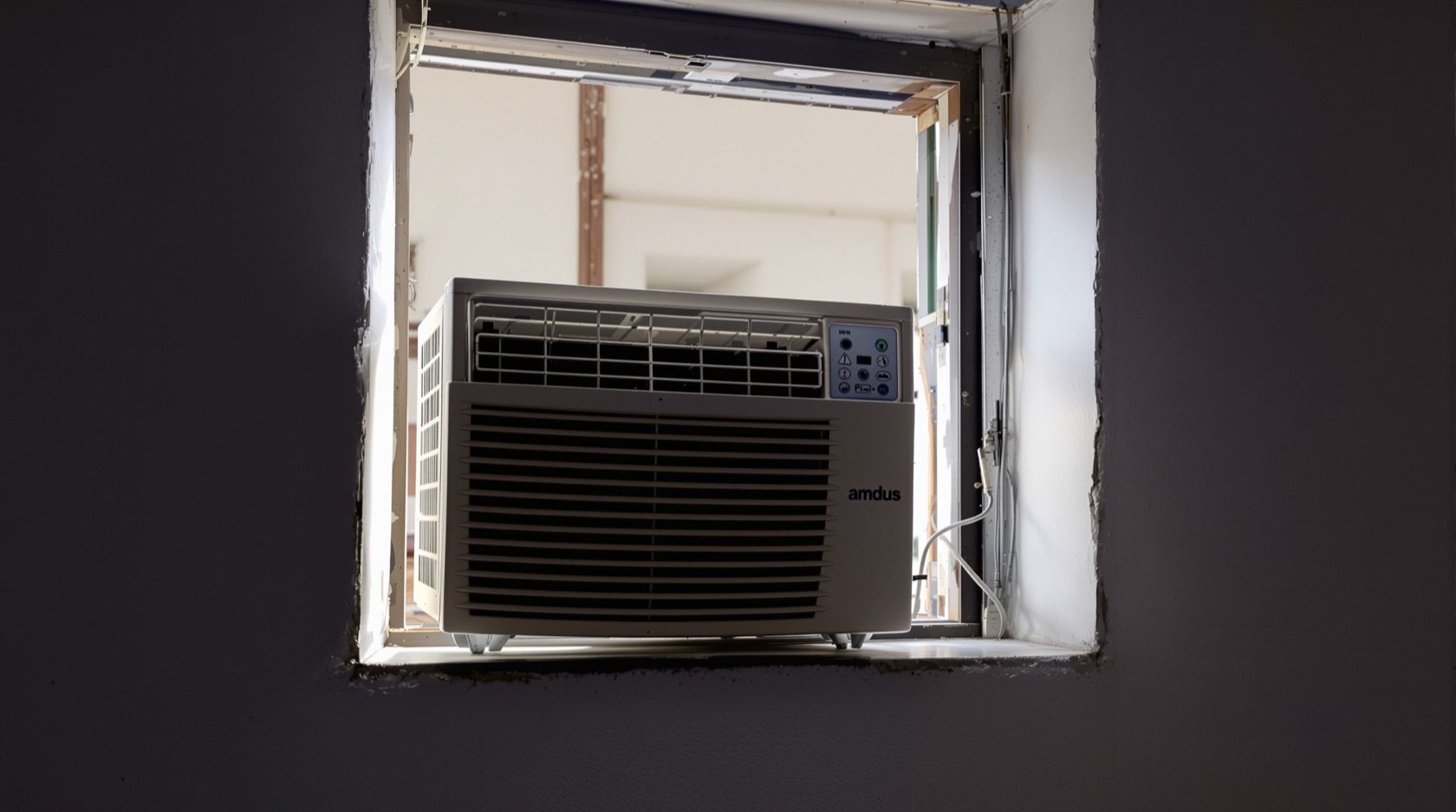
A window AC is an all-in-one unit — compressor, condenser, evaporator, fan and controls in a single box:
- The whole refrigeration system is in one enclosure that sits in a window or a wall opening, with the back half (hot side) outdoors and the front half (cold side) indoors.
- No separate outdoor unit, no refrigerant piping to run — it comes pre-charged and self-contained, which is exactly why it's so simple to install.
- The single-box design is its strength (simplicity, cost) and its weakness (the compressor noise is in the room, and it needs a suitable window).
Where a window AC still makes sense
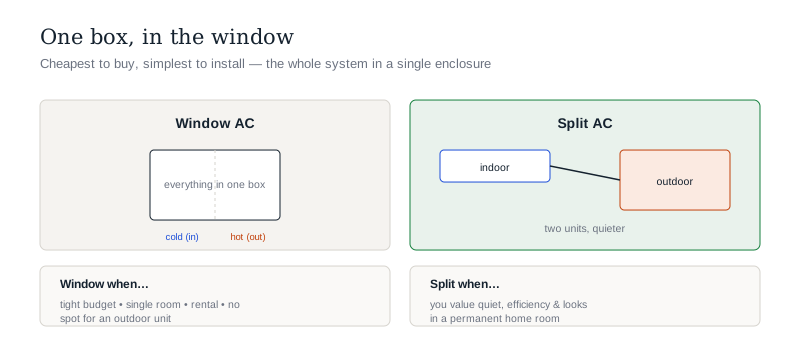
The window unit is the right choice when:
- Budget is tight — it's the cheapest cooling that works.
- It's a single room with a suitable window or wall opening.
- You rent or want something easy to install and take with you.
- There's no good spot for a split's outdoor unit — no wall, no balcony, no permission (common in some flats).
- Simplicity matters — fewer parts, one unit, straightforward.
For a permanent home room where you value quiet, efficiency and looks, a split is usually worth the extra; the window AC wins on cost, simplicity and the no-outdoor-unit situation.
What you trade off
Being honest about the compromises:
- Noise — the compressor is in the box in your room, so a window unit is noisier than a split.
- Efficiency — window units generally reach lower star ratings/ISEER than the best splits, though efficient (even inverter) window models exist.
- Looks & the window — it occupies a window (losing light/view) and is more visible.
- Air distribution — a single fixed unit throws air less flexibly than a well-placed split.
None of these are dealbreakers for the right use — they're the price of simplicity and low cost.
Choosing and fitting a window AC
- Tonnage — right-sized to the room (see the AC Capacity Calculator); the same don't-oversize rule applies.
- Star rating / ISEER — even on a budget unit, a higher star rating cuts running cost; consider an inverter window model if available.
- A suitable opening — a window or wall opening of the right size, that can take the unit's weight and be sealed against heat and rain.
- Secure, level mounting — the unit is heavy and must be firmly supported and slightly tilted so condensate drains outward, professionally fitted.
- Sealing — gaps around the unit let hot air (and insects) in; seal them well.
- A proper electrical point — a suitable socket/circuit for the load.
- Reputable brand, warranty, IS 1391 conformity.
The one-line answer
The window AC is the original, all-in-one air conditioner — the whole refrigeration system in a single box in your window — and it survives because it's the cheapest to buy and simplest to install, with no outdoor unit or refrigerant piping to run. It's the right choice for a tight budget, a single room, a rental, or where a split's outdoor unit has nowhere to go; you trade off more noise (the compressor is in the room), lower efficiency than the best splits, and a used-up window. Choose it right-sized with the best star rating you can (even an inverter model), fitted securely, level and sealed into a suitable opening with a proper electrical point — and for a permanent home room where quiet, efficiency and looks matter, weigh a split instead.
Where to go next
- The fundamentals: Air Conditioning Basics Guide.
- The quieter, efficient alternative: Split AC Guide.
- Size it right: AC Capacity Calculator.
- The electrical point it needs: Home Electrical Planning Guide.
References
- IS 1391 : Part 1 : 2023, Room Air Conditioners — Unitary Air Conditioners, Bureau of Indian Standards.
- Bureau of Energy Efficiency (BEE) — Star Labelling & ISEER for room air conditioners: https://beeindia.gov.in/
A window AC is heavy and must be securely, squarely supported and sealed — have it professionally fitted. Verify the current BEE label and any standard's status via the BIS catalogue.
Export this guide
Related Guides — Deep-dive reading
Split AC Guide: The Indian Home's Default Air Conditioner
Everything on the split AC — how the indoor and outdoor units work together, why it's quieter and more efficient than a window unit, how to choose tonnage, stars and features, where to place both units, and what installation and upkeep it needs.
HVAC & CoolingHow to Choose an Air Conditioner: The Buyer's Decision Guide
Cut through the showroom confusion — the decisions that actually matter when buying an AC in India, in order: the right type, the right tonnage, inverter, the star rating that pays back, the refrigerant, the few features worth having, and the gimmicks to ignore.
HVAC & CoolingHow to Choose a CCTV Camera (2026): The Homeowner's Decision Guide for India
Cut through the spec-sheet noise and choose the right CCTV camera for each spot around an Indian home. What actually matters — sensor and low-light performance, lens and field of view, form factor, IP and IK ratings, honest smart features — and the marketing claims to ignore.
SecurityRelated Tools — Try Free
Window Cleaning Cost Calculator
Estimate professional window cleaning cost per visit and per year by access and frequency.
Window CalculatorAcoustic Privacy (STC) Visualizer
Indian healthcare acoustic visualizer — compare wall assemblies and noise sources, see received SPL after STC attenuation, and check FGI 2018 / IS 1950 / NABH speech-privacy compliance with live dual-canvas waveform.
Acoustic ToolInterior Budget Allocation Map
How ₹5L / ₹10L / ₹20L budgets should be distributed across rooms with visual charts and tier breakdown.
Reference Guide