

How to Choose an Air Conditioner: The Buyer's Decision Guide
Cut through the showroom confusion — the decisions that actually matter when buying an AC in India, in order: the right type, the right tonnage, inverter, the star rating that pays back, the refrigerant, the few features worth having, and the gimmicks to ignore.
Buying an AC should be simple, but showrooms make it confusing — a wall of models, competing star ratings, and features you've never heard of. The truth is that a handful of decisions decide whether you get the right AC, and the rest is noise. This guide is the buyer's checklist: the decisions that actually matter, in order, so you walk in knowing exactly what to look for and walk out with the right unit for your room and budget.
It applies Air Conditioning Basics to the purchase, and is part of the HVAC Knowledge Hub.
The safety line & scope. This guide helps you choose. Installation, refrigerant charging and servicing are a qualified HVAC technician's work. Filter cleaning and thermostat use are yours.
The decisions that matter — in order
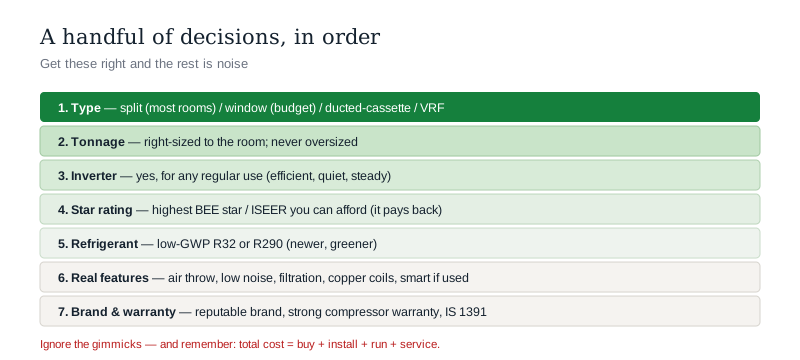
1. The right type
- Split — the default for most rooms: quiet, efficient, good-looking.
- Window — cheapest and simplest, for a tight budget, single room, rental, or no outdoor-unit spot.
- Ducted/cassette — concealed, for a clean ceiling (a build/renovation decision).
- VRF — many rooms from one outdoor unit (villas, offices).
For most homes, room by room, a split is the answer; the others suit specific situations.
2. The right tonnage — don't oversize
- Right-size to the room using the AC Capacity Calculator (area + sun + floor + occupancy).
- Bigger is not better — an oversized AC cools fast but leaves the room clammy and wastes energy. Match it to the room.
3. Inverter (yes, for regular use)
- Inverter — variable-speed, efficient, quiet, steady, better at low voltage. For any regularly-used room, choose inverter; fixed-speed only for very occasional use on a tight budget.
4. The star rating that pays back
- Buy the highest BEE star / ISEER you can afford on a unit you'll run for years — a 5-star inverter uses far less power, and the running-cost saving pays back the premium.
- Ratings are revised over time — check the current label.
5. The refrigerant
- Prefer newer low-GWP refrigerants (R32 or R290) over older R410A — greener and efficient.
6. The few features worth having
- Good air throw for the room shape, quiet operation (check the noise level, especially for a bedroom), decent filtration, and Wi-Fi/smart control if you'll actually use it.
- Copper coils (durable, easy to service).
- Skip the gimmicks — exaggerated "special" modes and marketing that don't change the fundamentals.
7. Brand, warranty and conformity
- A reputable brand, a solid compressor warranty (compressors are the costly part), reliable local service, and ISI/BIS conformity to IS 1391.
A quick buyer's summary
In practice, for a home room: a right-sized inverter split AC, with the highest BEE star rating you can afford, an R32/R290 refrigerant, decent air throw and low noise, copper coils, from a reputable brand with a good compressor warranty. That covers 95% of the decision — the rest is preference. And remember the total cost is buy + install + run + service (see the cost guide), so a cheap inefficient unit is often the expensive one.
Don't forget installation
The best AC installed badly underperforms:
- Professional installation — correct outdoor-unit placement (ventilated, shaded), proper refrigerant piping and charge, good condensate drainage, and testing.
- Plan placement — indoor unit for air throw and filter access, outdoor unit in open air (see the split AC guide).
- The electrical point — a suitable circuit for the load.
The one-line answer
Choosing an AC comes down to a handful of decisions, in order: the right type (a split for most rooms; window for budget/single-room; ducted/VRF for specific needs), the right tonnage (right-sized, never oversized), inverter for any regular use, the highest BEE star rating you can afford (it pays back), a low-GWP R32/R290 refrigerant, and a few real features (good air throw, low noise, filtration, copper coils, smart control if you'll use it) from a reputable brand with a strong compressor warranty and IS 1391 conformity — ignoring the marketing gimmicks. That's 95% of the decision. Factor the total cost (buy + install + run + service), and get it professionally installed with proper placement, piping, charge and drainage — because the best AC fitted badly underperforms.
Where to go next
- The fundamentals: Air Conditioning Basics Guide.
- Size it: AC Capacity Calculator.
- What it all costs: HVAC & AC Cost Guide · AC Running Cost Calculator.
- Keep it running: AC & HVAC Maintenance Guide.
References
- IS 1391 (Part 1 : 2023 & Part 2 : 2023) Room Air Conditioners, Bureau of Indian Standards.
- Bureau of Energy Efficiency (BEE) — Star Labelling & ISEER for room air conditioners: https://beeindia.gov.in/
- Refrigerant transition (R32/R290) under the Kigali Amendment to the Montreal Protocol.
Efficiency ratings and refrigerant rules evolve; verify the current BEE label and any standard's status via the BIS catalogue. Installation and refrigerant handling are a qualified HVAC technician's work.
Export this guide
Related Guides — Deep-dive reading
How to Choose an Exhaust Fan in India: CFM Sizing, Noise, Features & Budget Tiers
A buyer's guide to picking the right bathroom exhaust fan for your room — calculate the CFM you actually need, match wall vs ceiling vs inline to your layout, judge noise in sones, decide which extras earn their price, and spot the underpowered cheap fans that never clear the steam.
BathroomsSplit AC Guide: The Indian Home's Default Air Conditioner
Everything on the split AC — how the indoor and outdoor units work together, why it's quieter and more efficient than a window unit, how to choose tonnage, stars and features, where to place both units, and what installation and upkeep it needs.
HVAC & CoolingHow to Choose a Bathtub in India: Size, Material, Fit & Budget (2026 Buyer's Guide)
A buyer's decision guide to picking a bathtub for an Indian home — the first checks on bathroom size, floor load and geyser capacity, freestanding vs built-in vs corner by space, acrylic vs cast iron vs FRP, whether a whirlpool is worth it, good/better/best rupee tiers, delivery and install, warranty, and how to spot thin flexing acrylic.
BathroomsRelated Tools — Try Free
Window Cleaning Cost Calculator
Estimate professional window cleaning cost per visit and per year by access and frequency.
Window CalculatorDoor Cost Calculator
Estimate the all-in cost of a door — leaf, frame, hardware, fitting and GST — by type, material and size.
Door CalculatorRenovation vs New Build Calculator
Compare renovating vs building new interiors city-wise across 13 work scopes with GST and per-sqft rates.
Cost Comparison