
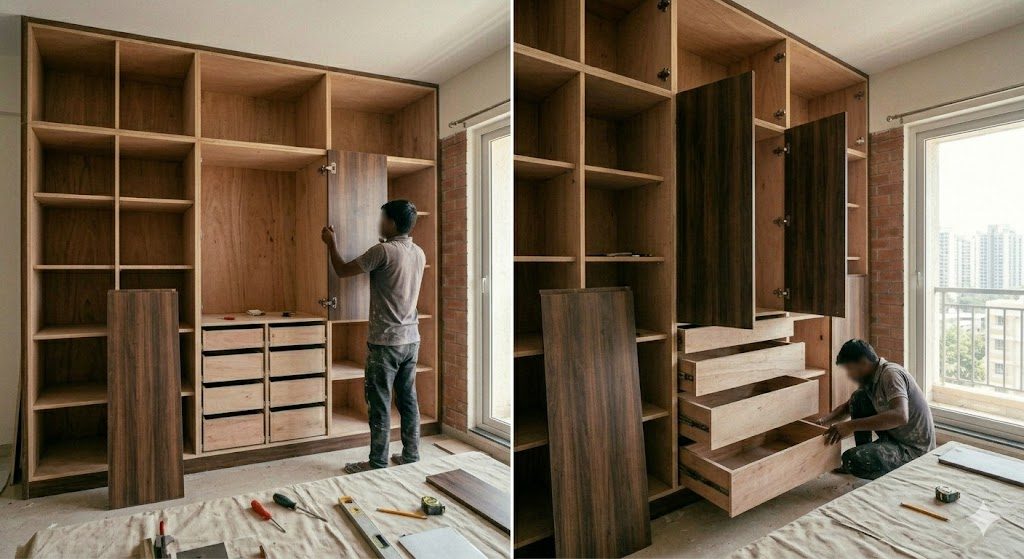
Wardrobe Cost Guide (India 2026)
What a built-in wardrobe really costs per sqft — by type, material and finish
You signed off the interior contract, and the wardrobes looked like a rounding error on the quote — "₹1.2 lakh for the master, ₹90,000 for the kids' room." Three months later the same wardrobe, now built and standing, has cost ₹1.85 lakh, because the shutters quietly became acrylic, the soft-close hinges became Hettich, and a loft you forgot about got added at "actuals." Nobody lied to you. You just never understood how a wardrobe is priced in India.
This guide gives you the rupee figures almost nobody publishes: how Indian carpenters and modular brands actually price a wardrobe (per sqft of shutter area — and why that number confuses everyone), the 2026 ₹/sqft bands by carcase material, by shutter finish, and by configuration, what hardware and accessories really add, and a fully worked 7ft x 8ft master-wardrobe cost at three tiers. By the end you will be able to read any wardrobe quote line by line and know exactly where the money is going — and where it is leaking.
The core idea: a wardrobe quote is not one number, it is five — carcase, shutters, hardware, accessories, and loft — and Indian quotes almost always bundle them into a single misleading ₹/sqft figure that hides which of the five you are actually overpaying for.
How wardrobes are actually priced in India
Almost every carpenter, contractor and modular brand in India prices a built-in wardrobe on the shutter (front) area — the height times the width of the wardrobe face, in square feet. A wardrobe 7 feet wide and 8 feet tall has a front area of 56 sqft, and the quoted ₹/sqft rate is multiplied by that 56.
This convention trips up homeowners because the price you pay per "front sqft" is actually paying for the entire box behind it: both side panels, the back, top and bottom, all internal shelves and partitions, the shutters, the hardware and the labour. So when a carpenter says "₹1,600 per square foot," he does not mean 1,600 for one flat panel — he means 1,600 for every front-square-foot of a fully built, fully fitted wardrobe of standard ~22-24 inch depth. Increase the depth, add a lot of internal drawers, or specify exotic hardware, and the same "₹1,600/sqft" carpenter will quietly revise the rate.
There is a second, older convention still common with traditional carpenters: pricing per running foot (per foot of wardrobe width, for a standard height, usually 7 feet). A "₹1,100 per running foot" quote for a 7ft-wide unit means roughly ₹7,700 plus extras — but running-foot quoting hides height entirely, so a 9ft-tall wardrobe and a 7ft-tall one can be quoted at the same running-foot rate. Always convert any quote to ₹/sqft of front area before comparing — it is the only rate that is honest across vendors.
| Pricing convention | How it is measured | Typical 2026 quote phrasing | Watch-out |
|---|---|---|---|
| Per sqft of shutter/front area | Width x height in feet | "₹1,400-2,800/sqft" | Confirm carcase depth and whether hardware is included |
| Per running foot | Width only, fixed height (~7 ft) | "₹900-1,800/running ft" | Hides height; loft and tall units underpriced |
| Lump sum per wardrobe | One number | "₹1.4 lakh, master bedroom" | Impossible to compare; demand a per-sqft breakup |
If a vendor will not give you a ₹/sqft of front area and a separate line for hardware and loft, you are not getting a quote — you are getting a number to sign.
₹/sqft 2026 by configuration: openable vs sliding
The single biggest configuration choice is openable (hinged) vs sliding shutters, and it moves the base rate more than most homeowners expect.
Openable (also called hinged or swing-door) wardrobes are the default and the cheaper option. You get full access to the interior, cheaper hardware (hinges cost a fraction of sliding track systems), and you can use any finish on the shutter. The downside is the door-swing clearance they need in front.
Sliding wardrobes cost meaningfully more — typically 20-40% more per sqft — because the sliding track-and-roller system, the heavier shutter frames, and the soft-close dampers are inherently more expensive than hinges, and because sliding shutters are usually larger panels that demand better finishes (acrylic or lacquered glass) to look right. The merit you pay for is zero swing clearance, which is why sliding dominates small bedrooms.
| Configuration | Installed ₹/sqft of front area (2026 band) | What drives the rate |
|---|---|---|
| Openable, basic laminate | ₹1,300 - 1,800 | Hinges, particle/MR carcase, laminate shutter |
| Openable, mid (BWP/HDHMR + soft-close) | ₹1,800 - 2,600 | Better carcase + branded soft-close hinges |
| Openable, premium finish | ₹2,600 - 4,500 | Acrylic/PU/veneer shutter, full accessory kit |
| Sliding, mid | ₹2,200 - 3,200 | Track system + dampers + larger panels |
| Sliding, premium (glass/acrylic) | ₹3,200 - 5,500 | Profile shutters, soft-close track, mirror/glass |
Assumptions: standard ~600mm depth, full-height to ~8 ft, metro/Tier-1 city labour, GST extra. Tier-2 cities run roughly 8-15% lower on labour.
Carcase material: where durability is decided
The carcase is the box — the panels you never see once clothes are inside — and it is the single most important driver of how long the wardrobe survives Indian humidity. It is also where the most invisible cost-cutting happens, because the customer is looking at the shutter finish, not the back panel.
The materials, from cheapest and worst to costliest and best:
- Particle board — cheapest, weakest, swells and crumbles on any water contact. Acceptable only for dry-zone, low-budget, short-life builds.
- MR (Moisture Resistant) plywood — the workhorse. "MR" resists humidity, not standing water. Fine for bedroom wardrobes away from wet walls.
- HDHMR (High-Density High-Moisture-Resistance board) — denser and flatter than ply, excellent for taking laminate/paint, good screw-holding, increasingly the modular-industry default.
- MDF — smooth and cheap to machine, takes membrane and lacquer beautifully, but poor moisture and screw-holding behaviour; fine for shutters, risky for structural carcase.
- BWP (Boiling Water Proof / marine) plywood — the gold standard for Indian wardrobes, especially anything near a bathroom wall or an external wall prone to seepage. Costs more but is the one upgrade that genuinely pays back.
| Carcase material | Material ₹/sqft (board only, 2026) | Carcase contribution to wardrobe ₹/sqft | Verdict |
|---|---|---|---|
| Particle board | ₹55 - 80 | adds ₹150 - 250 | Avoid for long-life |
| MR plywood | ₹85 - 130 | adds ₹250 - 400 | Solid default |
| HDHMR | ₹95 - 150 | adds ₹300 - 450 | Flat, modern default |
| MDF (shutter use) | ₹60 - 100 | adds ₹200 - 350 | Shutters only, not carcase |
| BWP / marine ply | ₹140 - 220 | adds ₹450 - 650 | Best for humid / wet-wall zones |
Carcase figures are the board's share inside a built wardrobe; the per-board ₹/sqft is the bare sheet rate at ~18mm. The single highest-ROI decision most homeowners can make is specifying BWP ply for the carcase even on a budget build — it is the layer that determines whether your wardrobe lasts 8 years or 18. For the deeper failure modes, see why wardrobes become inefficient.
Shutter finish: the visible money
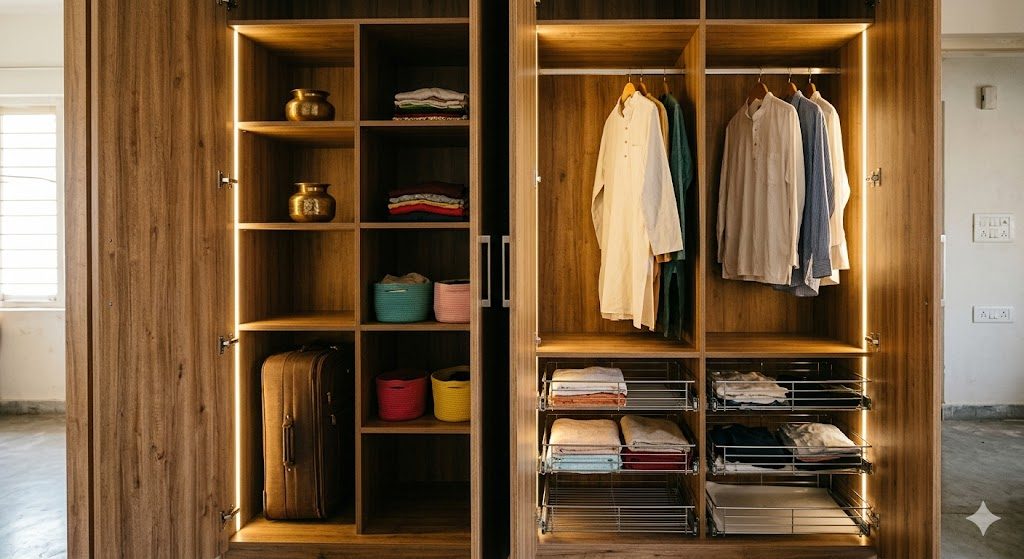
The shutter finish is what you see and touch, and it is where homeowners are most often upsold. The same carcase can wear a ₹120/sqft laminate or a ₹600/sqft lacquered-glass shutter — a 5x swing on the most visible layer. Here are the realistic 2026 installed bands, expressed as the finish's contribution to the wardrobe's ₹/sqft of front area.
| Shutter finish | Finish ₹/sqft (2026) | Look & feel | Durability | Best for |
|---|---|---|---|---|
| Laminate | ₹120 - 350 | Matte/gloss, vast catalogue | Excellent, scratch-tough | Budget & high-use rooms |
| Membrane (PVC foil) | ₹200 - 450 | Seamless, shaker profiles | Good; can peel at edges in heat | Soft, classic looks |
| Acrylic | ₹400 - 750 | High-gloss mirror sheen | Good; shows fingerprints | Modern glossy bedrooms |
| PU (polyurethane paint) | ₹450 - 900 | Any colour, premium matte/gloss | Very good; repairable | Designer, custom colour |
| Veneer | ₹500 - 1,100 | Real wood grain, warm | Good with PU top-coat | Premium natural look |
| Lacquered glass | ₹550 - 1,100 | Deep glass reflection | Excellent surface, brittle on edges | Sliding, statement units |
These are finish contributions, not the whole wardrobe rate — add the carcase and hardware bands to reach the all-in ₹/sqft. Laminate remains the value champion in India: 80% of the appeal of acrylic at a fraction of the cost, and far tougher in a house with children. For the design-and-aesthetic angle on these finishes, see wardrobe finish ideas; for the PU-vs-laminate money question specifically, see PU finish vs laminate cost comparison.

Hardware: the smallest line that decides everything
Hardware — hinges, channels, sliding tracks, handles, dampers — is usually the smallest rupee line on the quote and the one that determines whether the wardrobe still feels good in year five. A wardrobe with a flawless veneer shutter and ₹15 local hinges will sag, rub and rattle long before the finish ages.
The choice is between local/unbranded hardware and the three premium brands Indian interiors default to: Hettich, Blub (Blum) and Hafele. The premium soft-close hinge does not just close quietly — it carries the shutter weight without sag, survives tens of thousands of cycles, and keeps the door aligned for the life of the wardrobe. That is why cheap hardware is the classic false economy.
| Hardware tier | Soft-close hinge (each) | Drawer channel pair | Sliding track (per shutter) | Net add to wardrobe |
|---|---|---|---|---|
| Local / unbranded | ₹40 - 90 | ₹150 - 350 | ₹600 - 1,200 | adds ₹80 - 150/sqft |
| Branded (Hettich/Hafele/Blum) | ₹180 - 450 | ₹900 - 2,500 | ₹2,500 - 6,000 | adds ₹200 - 400/sqft |
A typical master wardrobe has 8-12 hinges, 2-4 drawer pairs and (if sliding) 2-3 tracks, so moving from local to branded hardware adds roughly ₹8,000-18,000 on a single wardrobe — real money, but spread over 15 years it is the cheapest insurance you will buy. This is exactly the trap covered in why cheap hardware destroys expensive interiors: a ₹600 hardware saving wrecks a ₹1.5 lakh wardrobe.
Loft, accessories and lighting
Two big line items get added "later," after you have anchored on the headline number.
Loft (overhead storage). The loft is the box above the main wardrobe, from ~7 ft up to the ceiling — prime storage for suitcases and off-season bedding. It is quoted at the same ₹/sqft of front area, but because it is shallow-access and shutter-heavy it usually runs at a slightly lower or equal rate to the main body. For a 7ft-wide wardrobe with a 2ft loft, that is 14 sqft of front area — at ₹1,600/sqft, roughly ₹22,000. Skipping the loft is a common way to hit a budget; adding it after the fact, at "actuals," is a common way to blow one.
Internal accessories. This is the fastest-inflating part of any modern wardrobe quote.
| Accessory | Typical 2026 cost (each / per unit) |
|---|---|
| Soft-close drawer (built) | ₹2,500 - 5,500 |
| Pull-out trouser / tie rack | ₹2,500 - 6,000 |
| Pull-out wire basket | ₹1,800 - 4,500 |
| Mirror (on shutter / pull-out) | ₹2,000 - 7,000 |
| Profile / strip LED lighting | ₹150 - 400 per running ft + driver |
| Lock / wardrobe safe locker | ₹1,500 - 12,000 |
Accessories are where "Premium" tiers earn their premium — and where homeowners overspend most easily, adding pull-outs they will use twice. To size your storage before you spend, run the wardrobe storage capacity calculator.
Worked example: a 7ft x 8ft master wardrobe at three tiers
Here is the figure the whole guide builds toward — a real master wardrobe (7 feet wide, 8 feet tall, ~56 sqft of front area, openable, with a 14 sqft loft for 70 sqft total) costed three ways. All-in, materials plus labour, 2026 metro pricing, GST extra.
| Line item | Essential | Comfort | Premium |
|---|---|---|---|
| Carcase | MR ply | BWP ply | BWP ply |
| Shutter finish | Laminate | Acrylic | PU / veneer |
| Hardware | Local soft-close | Hettich basic | Hettich/Blum full |
| Base rate (₹/sqft, front) | ₹1,500 | ₹2,400 | ₹3,600 |
| Main body (56 sqft) | ₹84,000 | ₹1,34,400 | ₹2,01,600 |
| Loft (14 sqft) | ₹19,000 | ₹30,000 | ₹46,000 |
| Accessories (drawers, pull-outs, mirror, LED) | ₹8,000 | ₹22,000 | ₹45,000 |
| All-in total (GST extra) | ₹1,11,000 | ₹1,86,400 | ₹2,92,600 |
| ₹/sqft effective (over 70 sqft) | ₹1,586 | ₹2,663 | ₹4,180 |
The Essential build is a genuinely good wardrobe — MR ply, laminate, soft-close — that will serve a decade. The jump to Comfort is mostly BWP carcase and acrylic shutters with branded hardware; the jump to Premium is finish and accessories, the most discretionary money on the page. Most homeowners get the best value by building Comfort-tier carcase and hardware with Essential-tier finish — durability where it is invisible, restraint where it is visible. To stress-test the spread against your own room, use the cost calculator.

Sliding vs openable: the real trade
On the same 56 sqft master wardrobe, switching from openable to sliding typically adds ₹25,000-45,000 — the track system, dampers and the better finish sliding demands. What you buy is the elimination of door-swing clearance, which in a tight bedroom can be the difference between a usable walkway and a blocked one.
| Factor | Openable (hinged) | Sliding |
|---|---|---|
| Base ₹/sqft | ₹1,300 - 4,500 | ₹2,200 - 5,500 |
| Floor clearance needed | Door swing (~600mm) | None |
| Interior access | Full, both doors open | Half at a time |
| Finish flexibility | Any finish | Best with acrylic/glass |
| Hardware cost | Low (hinges) | High (tracks + dampers) |
| Best for | Standard & large rooms | Small or narrow bedrooms |
If the room has the clearance, openable is the better-value, fuller-access choice. Pay the sliding premium for space, not for looks.
Readymade vs custom vs modular brand
The last fork is who builds it. Three routes, three cost-and-control profiles.
| Route | Typical cost (master-equiv.) | Control over fit/finish | Lead time | Best for |
|---|---|---|---|---|
| Readymade (flat-pack / showroom) | ₹25,000 - 70,000 | Low — fixed sizes, gaps to wall | Days | Rentals, quick needs |
| Site carpenter (custom) | ₹1.0 - 2.5 lakh | High — any size, any finish | 3 - 6 weeks | Wall-to-wall built-ins |
| Modular brand (Godrej, Spacewood, HomeLane, Livspace, etc.) | ₹1.5 - 3.5 lakh | Medium-high — factory finish, designed | 4 - 8 weeks | Warranty + finish certainty |
Readymade wins on speed and price but loses the wall-to-wall fit Indian bedrooms need. Site carpentry gives total control and the best price-for-spec if your carpenter is good — but quality is entirely person-dependent. Modular brands like Godrej Interio, Spacewood, HomeLane and Livspace charge a premium for factory-pressed finishes, engineered hardware and a warranty, and are the safe default when you cannot personally supervise the work. For the broader build-vs-brand economics, see budget vs premium interiors.
Where people overspend
The five most common wardrobe money-leaks, in order of how often we see them:
1. Over-finishing the shutters — paying acrylic/glass rates on a kids' room or a low-light corner where laminate would look identical.
2. Accessory creep — ₹40,000 of pull-outs and organisers that get used once. Buy storage you will actually fill.
3. Premium finish on a cheap carcase — spending visibly, saving invisibly; the wardrobe looks great and dies young.
4. Lofts and accessories at "actuals" — items left off the quote to hit a number, then billed at full margin later.
5. Sliding for looks, not space — paying a ₹35,000 premium in a room that had plenty of swing clearance.
For the full catalogue of regret-inducing spends, see the most expensive interior mistakes.
How to read a wardrobe quote
Make every quote answer these before you sign:
- ₹/sqft of front area stated, with the front-area maths shown (width x height) — not a lump sum.
- Carcase material named (MR / BWP / HDHMR) and thickness (ideally 18mm) — not just "ply."
- Shutter finish and brand named with its ₹/sqft.
- Hardware brand named (Hettich / Hafele / Blum / local) — hinges, channels, tracks.
- Loft shown as a separate line with its own sqft, not "extra."
- Accessories itemised — each drawer, pull-out, mirror, LED run priced, not bundled.
- GST shown separately so you are comparing pre-tax rates across vendors.
How to budget it, in order
1. Measure the front area of each wardrobe (width x height in feet) and add lofts — this is your sqft base.
2. Lock the carcase first. Choose BWP for any wardrobe on a wet or external wall, MR/HDHMR elsewhere. This is non-negotiable durability.
3. Choose hardware tier next. Branded soft-close on anything you want to last 10+ years; it is cheap insurance.
4. Then pick the finish to suit budget and room — laminate is the value default; reserve acrylic/PU/veneer for the rooms that earn it.
5. Decide configuration by clearance, not fashion — sliding only where swing space is genuinely tight.
6. Add accessories you will fill, not the full catalogue. Drawers and one mirror first; pull-outs only if you will use them.
7. Price the loft up front so it is in the budget, not a later surprise.
8. Get the quote per-sqft and itemised, then compare two or three vendors on the honest ₹/sqft number.
DesignAI can turn your room plan into an itemised wardrobe BOQ — front-area sqft, carcase, finish, hardware and accessories costed at 2026 city rates — so you walk into vendor conversations already knowing the right number. Pair it with the interior cost breakdown room by room and the smart budget allocation guide to fit wardrobes into the whole-home plan.
References
1. CIDC — Construction Industry Development Council, schedule of carpentry & joinery labour rates (2025-26 reference bands).
2. CPWD Delhi Schedule of Rates — woodwork, plywood and board specifications and labour norms.
3. IS 303:1989 (BIS) — Plywood for general purposes, MR and BWP grade definitions.
4. IS 710:2010 (BIS) — Marine plywood (Boiling Water Proof) specification.
5. BMTPC — Building Materials & Technology Promotion Council, board and panel material guidance.
6. NBC 2016 (BIS) — National Building Code, internal fit-out and joinery references.
7. Hettich / Hafele / Blum India 2026 hardware catalogues — soft-close hinge, channel and sliding-track price references.
Plan the rest of your spend with interior cost breakdown room by room, smart budget allocation for Indian homes and the wardrobe storage capacity calculator.
Export this guide
Related Guides — Deep-dive reading
Wardrobe Doors in India: Hinged vs Sliding vs Bi-fold, Finishes & Cost
How to pick the right wardrobe door for your room — hinged for full access, sliding to save floor space, bi-fold for tight corners — and which shutter finish survives Indian humidity.
Home Doors & EntrancesThe Design Decisions With the Biggest Cost Consequences
A cost-leverage map of Indian home interiors — the handful of decisions that swing your total budget the most, so you spend your attention where a single choice has an outsized rupee impact.
Cost & MoneyThe Truth About Cost Per Square Foot
Why a ₹/sqft interior quote is the most misleading number in Indian home costing — and how to convert it into a real BOQ
Cost & MoneyRelated Tools — Try Free
False Ceiling Cost Estimator
Live ₹/sqft across 8 ceiling types — POP, gypsum, designer, metal, PVC, wooden — with cove and spot lighting for 20 Indian cities.
Cost CalculatorMaterial Comparison Sheet
India's interior material cheatsheet — plywood, finishes, hardware, countertops, paints, waterproofing.
Reference GuideMaterial Schedule Generator
Generate a room-wise finish schedule — walls, floors, ceilings, trim, and joinery by location.
Material Schedule