
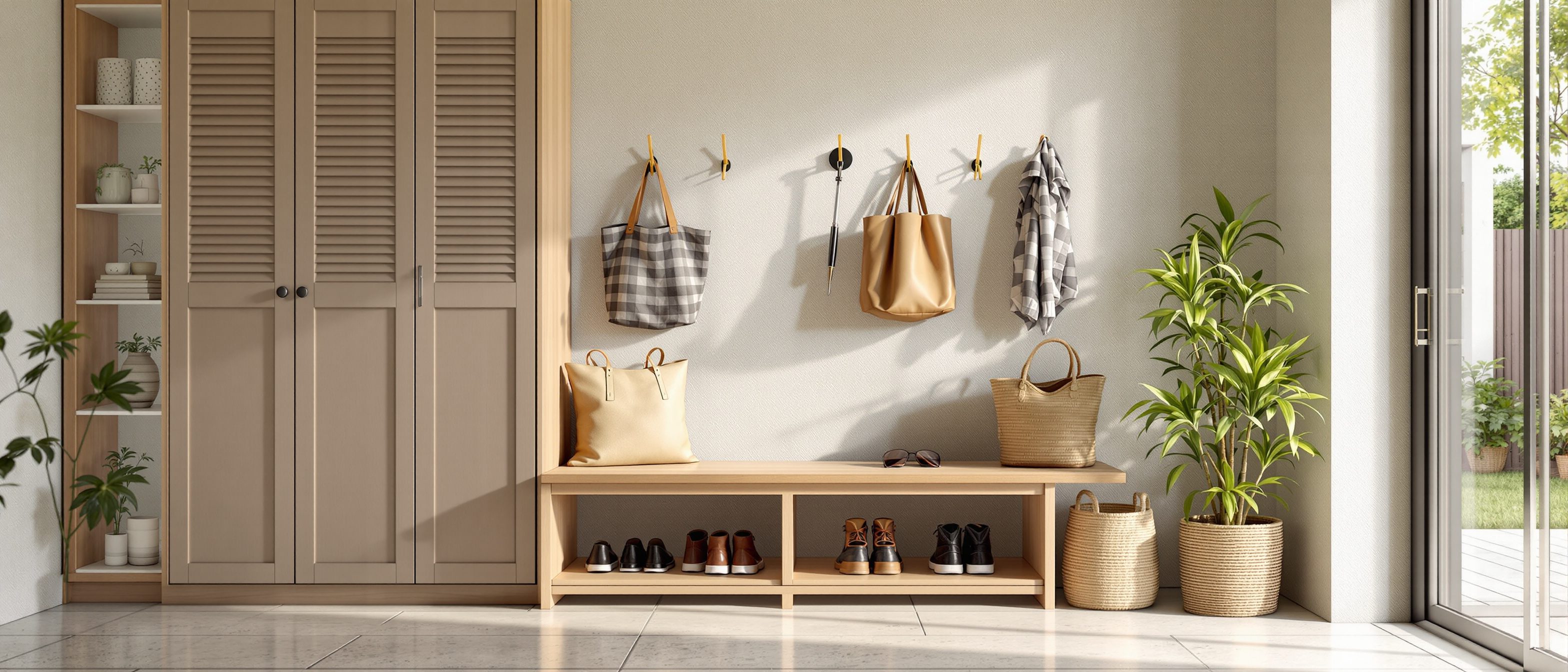
Mudrooms for Indian Homes
The threshold where the outside is left behind — designing a real shoes, dust and wet-weather drop-zone, from a slim niche in a flat to a proper mudroom in a house.
Watch what really happens at an Indian front door during the monsoon. A family of four comes home one by one — wet umbrella dripping, chappals caked with the brown slush of a half-paved lane, a school bag, a helmet, a polythene bag of vegetables, a phone, keys. There is, in most homes, no plan for any of it. The umbrella gets propped in a corner where it pools onto the marble. The shoes pile up in a damp, smelly heap behind the door. The helmet ends up on the dining table. And the mud — fine, gritty, monsoon mud — gets walked straight across the living room before anyone has had a chance to stop it.
Now add the rest of Indian life to that doorway. The cook arrives at 7am and the maid at 9, each needing somewhere to leave their footwear. A delivery rider hands over a parcel; an Amazon box waits to be opened. There is the post-COVID habit, still alive in many homes, of leaving masks, a sanitiser bottle and even outside clothes at the threshold. There is the diwali season when everyone is in and out with sweets boxes and gift bags. The front door is not a thin line you cross once — it is a busy little frontier that the outside world keeps trying to push past.
Most Indian flats and even many bungalows hand this frontier exactly nothing. The builder gives you a door, a wall, and a marble floor that shows every footprint. So the family improvises — a plastic shoe rack here, a row of hooks screwed in crookedly there — and the entrance stays permanently, low-grade chaotic.
A mudroom is not a luxury imported from cold countries with snow boots — it is the single most useful square metre in an Indian home, because it is the one place designed to stop dust, mud and wet at the door instead of letting them in.
1. Why the mudroom matters more in India than almost anywhere
The idea travelled here from cold climates, where it was a place to shed snow boots and dripping coats. We have borrowed the word, but our reasons are our own, and they are stronger.
First, we remove our shoes at the door — almost universally, as a matter of cleanliness and respect. That single custom demands infrastructure that Western homes never needed: a clean dry spot to stand, a bench to sit and unbuckle, and a place to store footwear right there, because it does not travel deeper into the home. A heap of chappals on the landing is not a quirk; it is a design failure.
Second, the dust. Indian air, especially in the dry months and in any town near a road under perpetual construction, carries a relentless load of fine dust. Every entry is a chance for it to ride in on soles and bags. Stop it at the door and you halve your sweeping.
Third, the monsoon. For three to four months, everything that comes through the door is wet or muddy — umbrellas, raincoats, shoes, the dog. Without a designed wet-zone, that water goes onto the floor, the cushions, the cupboards.
Fourth, the traffic of others — cook, maid, driver, delivery riders, the courier, the plumber. An Indian door sees far more daily crossings by non-family than a private Western home does, and each one needs a graceful place to pause, leave footwear, hand something over.
"In so many cultures the house has a transition... an intermediate place which is both inside and outside, and which makes the connection between the two." — Christopher Alexander, A Pattern Language (Pattern 112, "Entrance Transition"). The mudroom is that intermediate place made practical.
2. Mudroom vs foyer — two different jobs at one door
It is worth being precise, because these two words get muddled. The foyer is about arrival and welcome — the first impression, the nameplate, the rangoli, the sightline that pulls a guest gracefully into the home. We cover that aesthetic, ceremonial side in entry and foyer design. The mudroom is about function — the unglamorous, essential work of stopping dirt and parking the day's clutter. One is the face you show; the other is the boots-and-buckets reality behind it.
In a large house they can be two separate things: a gracious front foyer for guests, and a humbler mudroom off the car-porch or kitchen side where the family actually comes and goes. In a flat they usually have to be the same one to two metres — a single zone that must look composed enough to greet a guest yet work hard enough to absorb a wet, muddy family. The art is making the functional kit (ventilated shoe store, hooks, bench) handsome enough that it doubles as the welcome.
3. What a mudroom actually holds
Before you size or style anything, list what genuinely lands at your door. It is more than shoes. Walk your own family's last week of comings and goings and you will recognise most of this.
| What the mudroom holds | Storage type | Working dimension |
|---|---|---|
| Daily-use chappals / shoes (whole family) | Open ventilated rack, one shelf per person | Shelf 300mm deep, 160–180mm clear per pair |
| Weekly / formal shoes | Louvred closed cabinet | 350mm deep × 1100–1400mm high |
| Helpers' / visitors' footwear | Open low shelf or a defined mat outside the door | 300mm deep, floor-level |
| Umbrellas (wet) | Slim stand or hook over a drip tray / drain | Tray 250 × 250mm; hooks at 1500mm |
| Raincoats / jackets | Wall hooks or a short rail | Hook rail at 1500–1700mm |
| Bags — handbag, laptop, school, shopping | Hooks + a console shelf | Hooks at 1400mm; shelf 300mm deep |
| Helmets | Open shelf or large hook (air them out) | Shelf 350mm deep, 280mm clear height |
| Keys, sanitiser, mask, sunglasses, coins | Shallow tray / niche on a console | Tray 300 × 150mm at 900mm |
| Pet gear — leash, towel, paw-wipe | Hook + a low cubby | Hook at 1200mm; cubby 300mm |
| Sports / cycle bits, kids' outdoor toys | Floor cubby or basket | Cubby 350–450mm cube |
| Parcels awaiting open / return | A defined ledge or basket | Ledge 350mm deep |
The discipline is the same one that governs all good storage: a home for everything, sized to what it actually holds. For the larger logic of designing storage before you choose finishes, see the cluster pillar, storage planning before interior design, and for the professional view of storage as a design discipline, storage planning as design discipline.
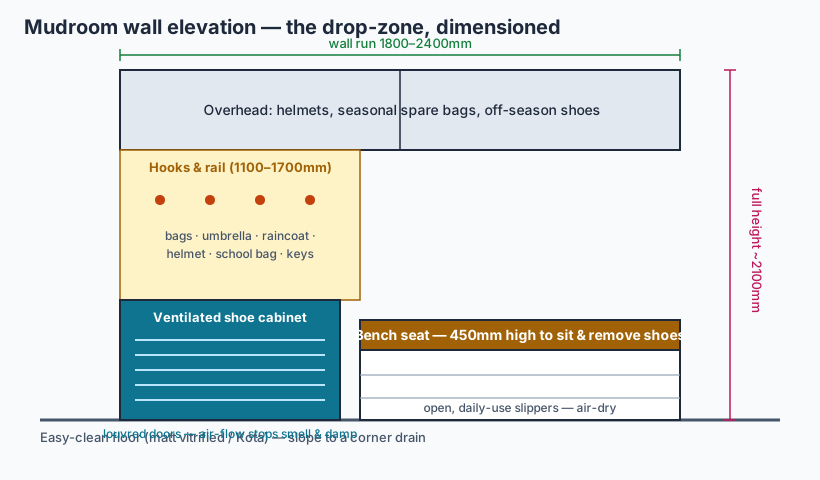
Figure 1: A mudroom wall does four things at once — sit (bench at 450mm), store low (ventilated shoe cabinet and open rack), hang (hooks at hand height, 1100–1700mm), and stow high (overhead for helmets and seasonal goods). Louvred shoe doors are non-negotiable in India: air-flow is what keeps damp chappals from turning the cabinet sour.
4. Ventilation is the whole game — never seal Indian footwear
The most common and most expensive mistake is a sealed, solid-door shoe cabinet. In our climate, shoes go in damp — from sweat, from rain, from a wash — and a closed box turns that moisture into smell, fungus and ruined leather within a season. Every shoe store at the door should breathe.
Practical rules:
- Louvred or perforated doors, or simply leave the daily rack open. The slats in Figure 1 are not a style choice — they are the air path.
- A small cross-ventilation gap at top and bottom of any closed shoe cabinet lets convection do the drying.
- Keep the very wettest things — a dripping umbrella, just-washed shoes — on an open shelf or over a drip tray, not inside the cabinet at all.
- During the monsoon, a sachet of silica gel or a small camphor/charcoal pack in the cabinet keeps the worst of the damp and odour down.
This is also why a mudroom should sit on a floor that does not mind water — and why, in a house, a small floor drain in the mudroom (as in Figure 2) is worth every rupee.
5. Sizing it: the slim niche for a flat vs the full room for a house
You do not need a dedicated room to have a mudroom. You need a defined zone with the four functions of Figure 1. What changes with space is how generous each function gets.
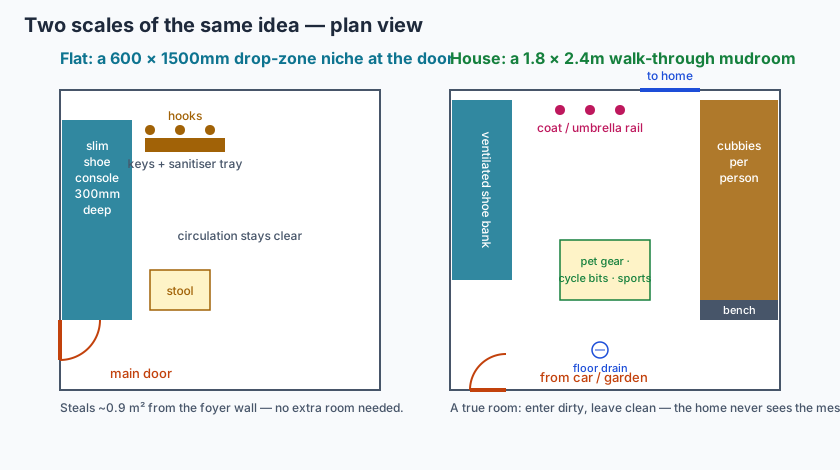
Figure 2: Same idea, two scales. The flat version steals under a square metre from the foyer wall and asks nothing of the floor plan. The house version is a genuine walk-through room — enter dirty from the car or garden, leave clean into the home — so the mess never reaches a living space.
| Flat: the drop-zone niche | House: the full mudroom | |
|---|---|---|
| Footprint | 0.4–1.0 m² of wall, no extra room | 3–6 m² walk-through or pocket room |
| Shoe storage | Slim 300mm console, 6–10 pairs | Ventilated bank, 20–40 pairs + per-person cubbies |
| Bench | A stool or a 350mm ledge | A built-in bench with storage beneath |
| Hooks | A 3–5 hook strip | A full coat-and-umbrella rail |
| Wet handling | Drip tray, mat | Floor drain + washable walls |
| Extras | Key/sanitiser tray only | Pet gear, sports, parcels, charging point |
| Where it goes | The wall beside the main door | Between car-porch / garden door and kitchen |
| Best for | 1–3 BHK flats, builder units | Independent houses, plots, villas |
In a flat, the move is to mount everything on one wall beside the door and keep the floor clear — a slim console no deeper than 300mm so the corridor still breathes, hooks above it, a tray at hand height, and a stool that tucks under. This is exactly the hidden-in-plain-sight thinking explored in hidden storage solutions for Indian homes, where shoe storage often disappears into a console or a shoe-tilt cabinet. To check how many pairs and how much hanging your chosen run will actually hold, run the numbers through the storage calculator.
In a house, the prize is a walk-through: position the mudroom on the route you actually use every day — almost always the car-porch or garden side, not the formal front door — so you arrive, drop, clean up, and only then step into the home. This is the same back-entry logic that the foyer guide flags as the entry people forget to design.
6. The dirt barrier — design it as a sequence, not a single mat
A mudroom works because it stops the outside in stages. No single mat or floor can do the whole job; each step removes a bit more, so that by the time anyone reaches the clean interior, almost nothing of the lane is left on them.
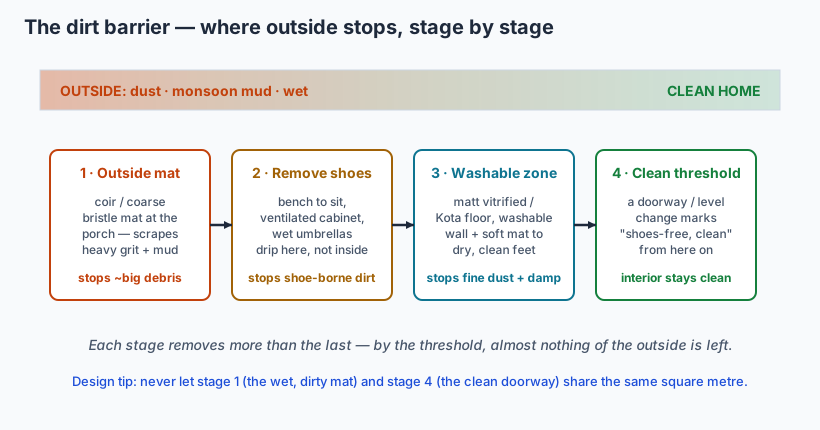
Figure 3: The barrier is a sequence. The single most important design rule hides in plain sight here — never let stage 1 (the wet, dirty mat) and stage 4 (the clean doorway into the home) share the same square metre. Give the dirt room to fall away before the clean line.
In practice that means:
- Outside the door: a coarse coir or bristle mat to scrape mud and grit. This belongs outside or right at the porch, never inside on your good floor.
- At the threshold zone: the bench and ventilated shoe store, plus somewhere for the wet umbrella to drip — ideally a tray or, in a house, near the floor drain.
- Just inside: a washable floor (more below) and a softer mat to take the last dust off clean feet.
- The clean line: a doorway, an arch, or even a subtle change in floor material that everyone in the family reads as "shoes off, clean from here." A psychological line works as well as a physical one.
7. Materials that take dust and water without complaint
The mudroom is the one zone where you choose finishes for cleanability over softness. Marble, untreated wood and pale grouting are the wrong instincts here.
| Surface | Good choice | Avoid | Why |
|---|---|---|---|
| Floor | Matt anti-skid vitrified, Kota, or leather-finish granite | Polished marble, glossy tiles | Mud + wet on gloss is a slip risk and shows every mark |
| Skirting / lower wall | Tiled or laminate-clad to ~600mm; PU-coated | Plaster + emulsion alone | Splash and wet-bag marks wipe clean instead of staining |
| Shoe cabinet body | Marine / BWR ply with laminate; louvred shutters | MDF, particle board | MDF swells with the monsoon damp; ply survives |
| Bench top | Solid or ply with laminate / a wipeable cushion | Upholstered fabric | Wet clothes and muddy hands ruin fabric fast |
| Mat | Coir (outside) + a washable cotton dhurrie (inside) | Deep-pile rug | Has to be beaten and washed, not vacuumed gently |
For the broader question of which boards and laminates survive Indian humidity — and why BWR/marine ply earns its premium near any wet zone — the materials cluster goes deeper; here, just remember the rule: near the mudroom, assume everything will get wet and choose accordingly. This same wet-and-dirty thinking governs the laundry and service spaces covered in designing utility rooms for Indian homes — a mudroom and a utility area often share a wall and the same robust palette.
8. Integrating it with the foyer without the clutter showing
The fear, especially in a flat, is that a working drop-zone will look like a working drop-zone — a wall of clutter greeting every guest. The answer is to contain and conceal without sealing.
- One closed element, one open. Put the bulk and the mess (the shoe pile, the random bits) behind a louvred shutter; keep one curated open shelf or console top for the things you want seen — a plant, a brass bowl for keys, the nameplate energy.
- A console that floats keeps the floor visible beneath, which reads as tidy even when shoes sit under it, and lets you sweep through.
- Hooks, not heaps. Five good hooks at 1400–1700mm take bags off the floor and off chairs; a hung bag looks intentional, a dropped one looks like mess.
- A drawer or tray for the smalls. Keys, masks, sanitiser, sunglasses and coins are visual noise; one shallow drawer or covered tray absorbs all of it.
- A mirror above the console does double duty — last-look before leaving, and it bounces light into what is usually a dim entry, making the whole zone feel larger.
Done this way, the functional mudroom and the welcoming foyer become the same handsome metre of wall — the kit disappears into joinery, and a guest sees a composed entry, not your family's wet shoes.
Sources & further reading
- Christopher Alexander, Sara Ishikawa & Murray Silverstein, A Pattern Language (Oxford University Press, 1977) — Patterns 110 ("Main Entrance") & 112 ("Entrance Transition").
- Julie Morgenstern, Organizing from the Inside Out (Owl Books, 2nd ed., 2004) — the principle of storing things at their point of use, which is why footwear belongs at the door.
- Bureau of Indian Standards / National Building Code of India 2016 — circulation widths and door clearances that govern how much an entry zone can take without blocking movement.
- Julius Panero & Martin Zelnik, Human Dimension & Interior Space — anthropometric data behind bench, hook and shelf heights.
- Marie Kondo, The Life-Changing Magic of Tidying Up (Ten Speed Press, 2014) — on giving every category a single, decided home, applied here to the chaos of the entrance.
This guide is part of the Studio Matrx storage cluster. For the discipline of planning all your storage up front, start with storage planning before interior design; for making shoe and entry storage vanish into the joinery, see hidden storage solutions for Indian homes; and for the service and wet spaces a mudroom often shares a wall with, read designing utility rooms for Indian homes.
Export this guide
Related Guides — Deep-dive reading
Designing Low-Stress Living Spaces
The practical design moves that lower everyday stress at home — from hidden storage and a restrained palette to acoustic calm, soft light and a place to retreat — tuned for Indian flats, joint families and multi-use rooms.
Healthy HomesHome Organization Through Design
Why a tidy home is built, not willed. The Indian guide to making order the path of least resistance — through point-of-use storage, drop-zones and design that maintains itself.
StorageSequential Progressions: Why the Order of Spaces Matters
A home is experienced as a journey in time, not a plan seen all at once — and arranging that journey, with compression, release and thresholds from public street to private inner room, is what makes a house feel right.
Design PrinciplesRelated Tools — Try Free
Acoustic Privacy (STC) Visualizer
Indian healthcare acoustic visualizer — compare wall assemblies and noise sources, see received SPL after STC attenuation, and check FGI 2018 / IS 1950 / NABH speech-privacy compliance with live dual-canvas waveform.
Acoustic ToolApartment vs Villa Interior Planning Guide
Compare ceiling height, structural flexibility, lighting, storage, and services between apartments and villas.
Planning GuideCross-Ventilation Analyzer
Estimate airflow and air changes per hour (ACH) from room size, window areas, layout, and local wind — with NBC 2016 Part 8 compliance check.
Ventilation Calculator