
Green Building Ratings & HVAC: IGBC, GRIHA and LEED
Green-building certifications reward HVAC that goes beyond code — how IGBC, GRIHA and LEED credit energy efficiency, commissioning, indoor air quality and low-impact refrigerants, and what chasing a rating actually means for HVAC design in India.
Beyond the mandatory energy codes sit voluntary green-building certifications — IGBC, GRIHA and LEED — that reward buildings for going further than the minimum. Because HVAC is usually a building's biggest energy user and a major driver of indoor comfort and health, it's central to earning a green rating: efficiency, commissioning, air quality and refrigerant choice all score points. For developers chasing a rating and engineers designing to one, understanding how HVAC contributes is essential. This guide explains how green ratings credit HVAC and what pursuing one means for design.
It builds on the HVAC Standards & Regulations Guide and Sustainable HVAC Guide, part of the HVAC Knowledge Hub.
Scope. This explains how ratings treat HVAC to inform design intent. Actual certification is a formal, documented process run with accredited professionals against the specific rating system and version.
The rating systems
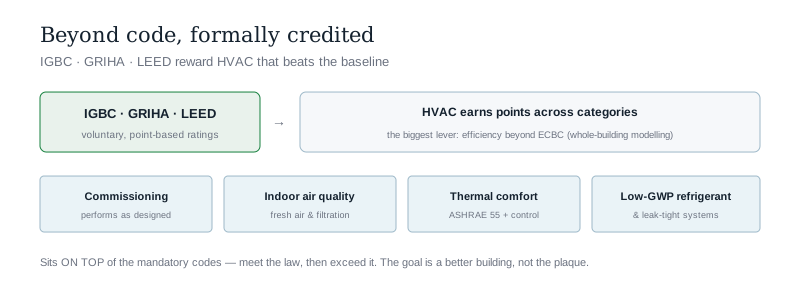
Three main rating systems operate in India, all voluntary, all point-based:
- IGBC (Indian Green Building Council) — India's widely-used rating family (part of CII) with systems for many building types; points across energy, water, materials, IAQ and more.
- GRIHA (Green Rating for Integrated Habitat Assessment) — India's national rating system (TERI & MNRE), a 5-star system well-aligned to Indian conditions and often used for government/institutional projects.
- LEED (India) — the internationally recognised US system, widely used for corporate and commercial buildings seeking global recognition.
- Common structure — all award points/credits across categories; enough points earn a certification level (e.g. Certified/Silver/Gold/Platinum, or 1–5 stars for GRIHA).
They differ in detail and emphasis, but all reward HVAC that beats the baseline.
How HVAC earns credits
HVAC contributes to several credit categories at once:
- Energy efficiency — the biggest lever: HVAC efficiency beyond ECBC/baseline (efficient chillers, VSDs, recovery, low PUE) earns the most points, usually shown by whole-building energy modelling against a baseline.
- Commissioning — points for properly commissioning the HVAC (and often ongoing/re-commissioning), ensuring it actually performs as designed — a credit that directly improves real efficiency.
- Indoor air quality — credits for fresh-air rates above minimum, good filtration, CO₂/demand-controlled ventilation, and low-emitting materials.
- Thermal comfort — credits for meeting comfort standards (e.g. ASHRAE 55) and giving occupants control.
- Refrigerants — credits for low-GWP/low-ODP refrigerants and leak-tight systems, rewarding the climate-friendly choice.
- Renewables & recovery — solar, heat recovery and passive strategies contribute.
So a green-rated building's HVAC is typically efficient, well-commissioned, well-ventilated and low-refrigerant-impact — good engineering, formally credited.
What chasing a rating means for design
- Model early — energy-efficiency credits hinge on whole-building simulation, so modelling should start at concept, shaping the HVAC design.
- Design for commissioning — build in metering, access and documentation so the commissioning credits (and real performance) are achievable.
- Integrated design — the biggest ratings come from envelope + HVAC + controls + renewables working together (the efficiency ladder), not from one gadget.
- Don't confuse the plaque with performance — a rating is a means to a genuinely better building; the goal is real efficiency, comfort and health, which good HVAC delivers whether or not certified.
- Beyond code, not instead of it — green ratings sit on top of mandatory codes (ECBC/ENS); you still meet the law, then exceed it.
The one-line answer
Voluntary green-building ratings — IGBC (CII, India's widely-used family), GRIHA (TERI/MNRE, India's 5-star national system), and LEED (the international US system) — reward buildings for going beyond mandatory codes, and since HVAC is usually the biggest energy user and a major driver of comfort and health, it's central to earning one. HVAC scores across several credit categories at once: energy efficiency beyond ECBC (the biggest lever, shown by whole-building modelling), commissioning (proving the system performs as designed), indoor air quality (fresh air, filtration, demand-controlled ventilation), thermal comfort, low-GWP/low-ODP refrigerants and leak-tight systems, and renewables/recovery. Pursuing a rating means modelling early (efficiency credits shape the design from concept), designing for commissioning (metering, access, documentation), and integrated design (envelope + HVAC + controls + renewables together, not one gadget) — all sitting on top of the mandatory codes, not instead of them. The point isn't the plaque but a genuinely better building — which good HVAC delivers, formally credited.
Where to go next
- The framework: HVAC Standards & Regulations Guide.
- The design toolkit: Sustainable HVAC Guide · HVAC Energy Efficiency Guide.
- The mandatory baseline: ECBC Compliance Guide · Eco Niwas Samhita Guide.
- The refrigerant credit: HVAC Refrigerants Guide.
References
- IGBC (Indian Green Building Council, CII); GRIHA Council (TERI & MNRE); USGBC/GBCI — LEED — rating systems and HVAC-related credits.
- ASHRAE Standards 90.1 (energy modelling baseline), 62.1 (ventilation), 55 (comfort); Guideline 0/1.1 (commissioning).
- Bureau of Energy Efficiency (BEE) — ECBC/Eco Niwas Samhita as the mandatory baseline green ratings build upon: https://beeindia.gov.in/
This guide informs design intent. Actual certification is a formal, documented process run with accredited professionals against the specific rating system and version. Verify current credit requirements before relying on them.
Export this guide
Related Guides — Deep-dive reading
Designing a Naturally Energy-Efficient Indian Home
Comfort first, gadgets last — passive design, orientation, insulation, ventilation and the climate wisdom that cuts Indian energy bills
SustainabilitySolar Energy Mandates in Buildings: Where India Requires Solar
Solar water heating and rooftop PV requirements in building bye-laws and energy codes, and how they differ from subsidies
Building Regulations & ComplianceGRIHA & IGBC Water-Efficient Bathroom India: How Bathrooms Earn Green-Building Credits
A professional's reference to how the bathroom earns points under India's two national green-building rating systems — IGBC (Green Homes / Green New Buildings) and GRIHA — through water-efficient fixtures, low-flow flush and flow-rate caps, metering, greywater and rainwater reuse, and low-VOC indoor-environment credits, and how to target them.
BathroomsRelated Tools — Try Free
Cross-Ventilation Analyzer
Estimate airflow and air changes per hour (ACH) from room size, window areas, layout, and local wind — with NBC 2016 Part 8 compliance check.
Ventilation CalculatorBrise-Soleil Visualizer
Interactive horizontal-louvre cut-off angle calculator — sun altitude, louvre depth, and spacing inputs with a live shadow preview. Computes θ = arctan(spacing/depth) for façade shading, ECBC envelope compliance, hospital daylight design, and tropical sun-control detailing.
Sun Shading ToolGreen Building Water Score Calculator
Score a building's water efficiency 0–100 from treated-water reuse, rainwater harvesting, low-flow fixtures and metering, with an IGBC/GRIHA-style rating and your biggest improvement lever.
Sustainability