
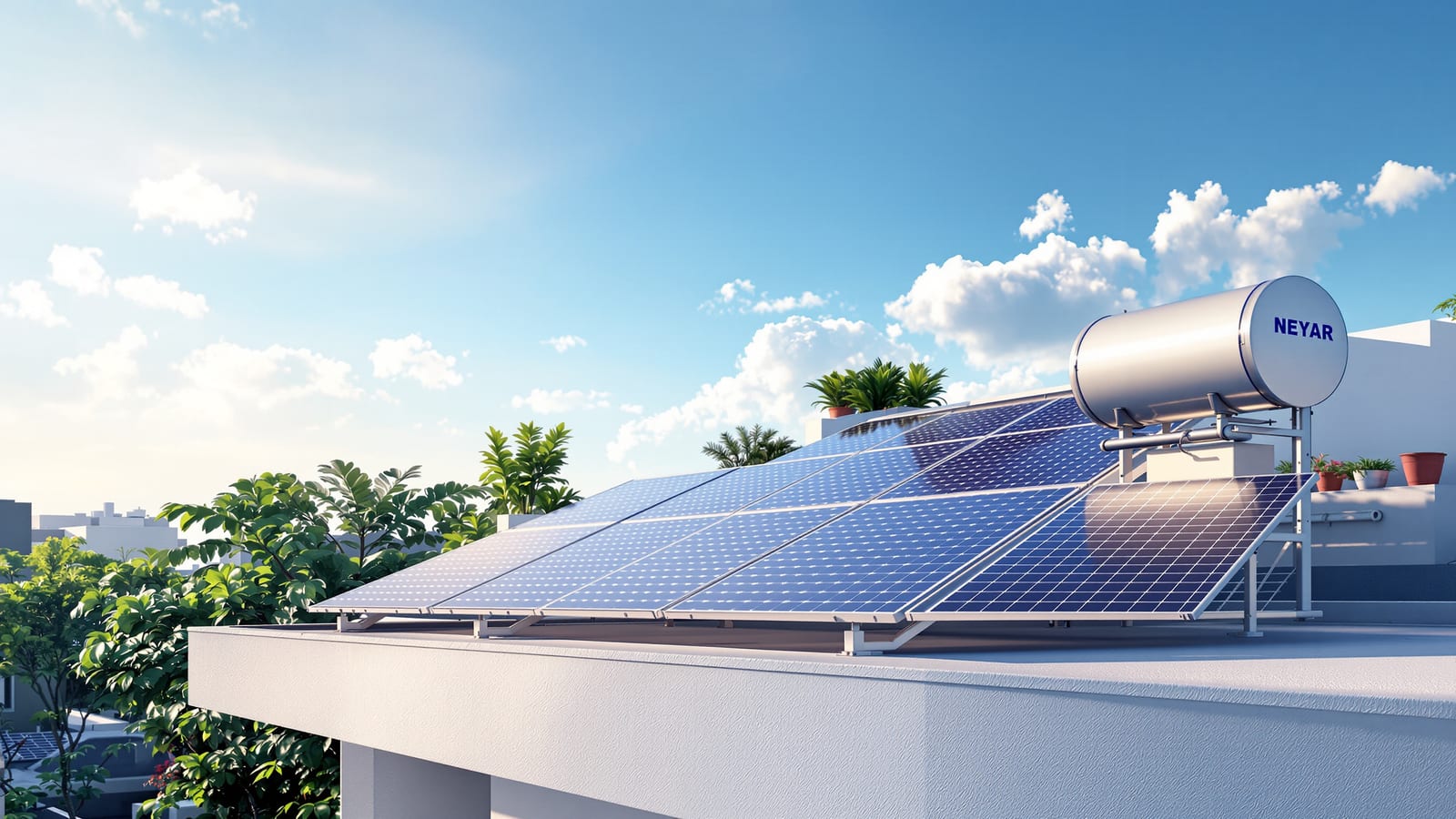
Solar Energy Mandates in Buildings: Where India Requires Solar
Solar water heating and rooftop PV requirements in building bye-laws and energy codes, and how they differ from subsidies
You have probably heard two very different things about solar in India. One is "the government pays most of the cost, so go solar." The other is "you have to put solar on your building before they will give you approval." Both can be true at the same time, but they are not the same thing, and confusing them costs people money and time.
This guide is about the second one: where Indian building rules actually require solar, as opposed to merely encouraging it. We will keep the encouragement side, the subsidies, deliberately short and point you to a companion guide for the money math. Here, the question is simpler and more practical: for your plot and your building type, is solar a choice or a condition of getting your building sanctioned and occupied?
The honest short answer is that it depends heavily on where you build, how big the building is, and what it is used for. Solar water heater requirements are genuinely common in many state and city building bye-laws. A blanket rooftop solar-PV requirement on every small home is not the norm. The rest of this guide separates the two cleanly so you know what to check.
1. Mandate versus incentive: the distinction that matters
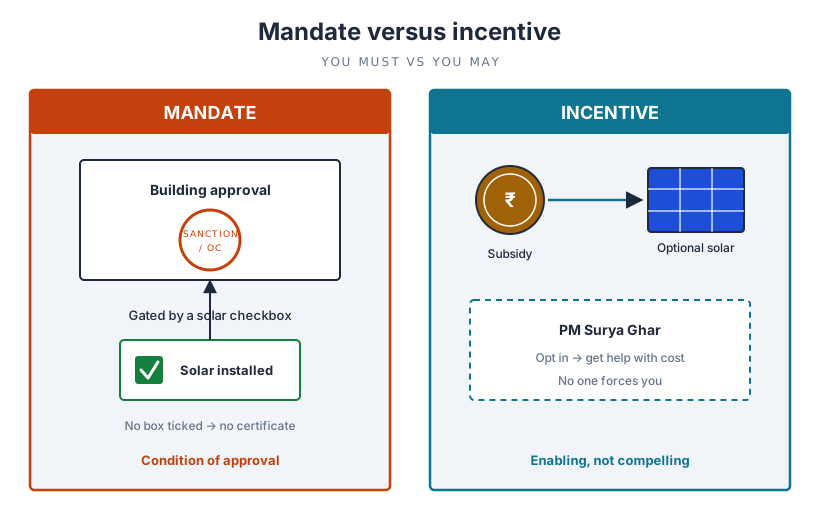
A mandate means you must do it. If the rule applies to your building, installing solar is a condition. In several cities, the building authority can refuse your sanction or, more commonly, withhold the occupancy certificate (OC, also called a completion certificate) until the solar installation is in place and inspected. No OC means, legally, no occupation, no clean property paperwork, and trouble at resale.
An incentive means you may do it, and if you do, the government helps with the cost. The flagship example is PM Surya Ghar: Muft Bijli Yojana, the central rooftop-solar subsidy scheme. Nobody forces you to apply. If you choose to, you get a subsidy and cheap financing. That is enabling, not compelling.
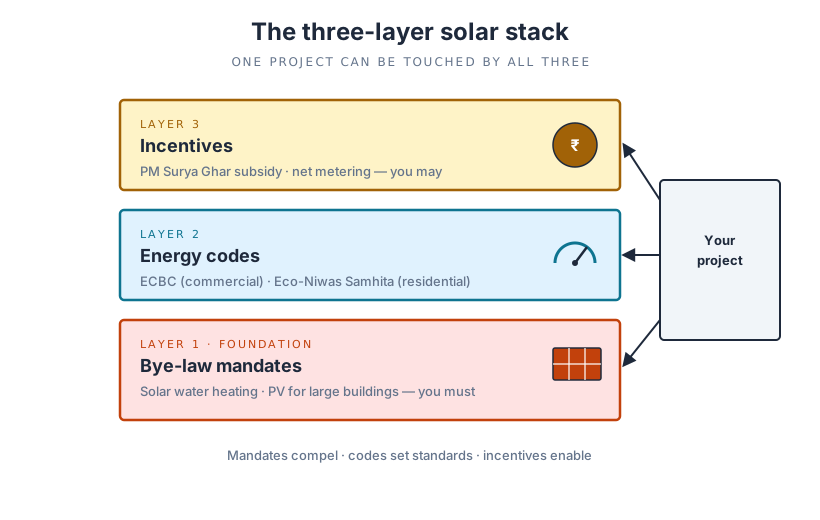
The two layers sit side by side. A city might mandate a solar water heater for large homes (you must) while the centre offers a PV subsidy for anyone who wants it (you may). Reading a news headline like "solar mandatory" without checking which layer it refers to, and which building size it applies to, is where most confusion starts.
2. The most common real mandate: solar water heating
If there is one solar requirement you are genuinely likely to meet as a homeowner or small builder, it is the solar water heating system (SWHS), sometimes written as solar-assisted water heating. Many state and city building bye-laws have, for years, required new buildings above a certain size or of certain types to provide solar water heating, and to reserve hot-water load for it instead of relying entirely on electric geysers.
This sits in the bye-laws partly because the technology is mature, cheap, and well suited to Indian sunshine, and partly because heating water is one of the biggest electrical loads in a home. The Model Building Bye-Laws 2016, the central template that states adapt, includes provisions for solar water heating and solar readiness within its green-building chapter. States and urban local bodies then write their own versions.
What triggers the requirement varies by state. Common triggers, all illustrative of the pattern rather than universal numbers, include plot or built-up area above a threshold (you will see figures expressed in square metres, square yards or square feet depending on the state), the building type (group housing, hostels, hotels, hospitals, guest houses), and the expected hot-water demand. Do not assume any specific number applies to you; the only reliable figure is the one in your own city's current bye-laws.
3. Rooftop solar PV: where it is required, and where it is not
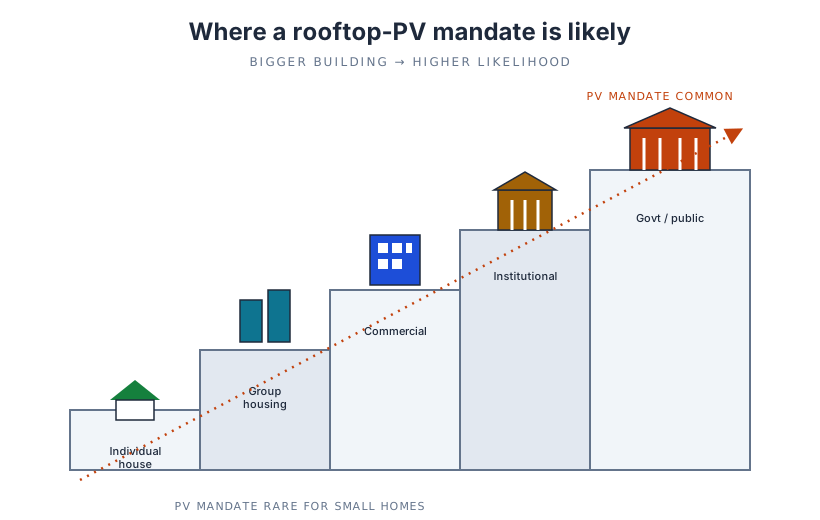
Rooftop solar photovoltaic (PV), the panels that generate electricity, is a different story. A genuine mandate to install grid-tied PV is most common for large, high-consumption buildings: government and public buildings, large commercial and institutional buildings, big educational and healthcare campuses, and increasingly large residential complexes and group housing above a size threshold. For these, several states and authorities require a minimum solar PV provision, sometimes expressed as a fraction of roof area or as a capacity tied to connected load.
For an ordinary individual house, a blanket "you must install rooftop PV" mandate is far less common across India. It exists in some places and for some building sizes, and the direction of policy is clearly towards more such requirements over time, but it is not a settled, country-wide rule for small homes. Be sceptical of anyone who tells you every home in India must now install PV; ask which rule, which city, which size.
This is exactly why the incentive layer matters for homes: the government's strategy for getting solar onto small rooftops is mostly to subsidise it heavily (so people choose it), not to compel it.
4. A quick map: who has to do what
The table below shows the pattern across the country. Treat every trigger as illustrative; the binding number is whatever your local bye-law currently says.
| Mandate type | Who it typically applies to | Typical trigger (illustrative) | Often tied to |
|---|---|---|---|
| Solar water heating | Large homes, group housing, hostels, hotels, hospitals, guest houses | Plot or built-up area above a state threshold, or high hot-water demand | Building sanction or OC in cities that enforce it |
| Rooftop solar PV | Government, public, large commercial, institutional buildings; large residential | Connected load, roof area, or building category above threshold | Sanction or OC; sometimes a separate compliance certificate |
| Energy code (ECBC) | Commercial buildings | Connected load or contract demand above a threshold (often around 100 kW / 120 kVA) | State notification; sanction in adopting states |
| Energy code (Eco-Niwas Samhita) | Residential buildings | Built-up area / plot size as states notify | Becoming mandatory as states notify rules |
| Solar readiness | Varies; often larger buildings | Provision for future panels even if not installed now | Bye-law green-building provisions |
Notice that the same physical thing (solar) appears as a hard requirement, a code-driven requirement, and a readiness requirement depending on the layer. That is normal in India, where buildings are a state subject and each state assembles its own mix.
5. The energy-code layer: ECBC and Eco-Niwas Samhita
Above the bye-law level sits a second layer that increasingly pushes solar indirectly: the building energy codes.
The Energy Conservation Building Code (ECBC) sets minimum energy-efficiency standards for commercial buildings, typically those above a connected-load or contract-demand threshold (you will often see figures in the region of 100 kW or 120 kVA). It covers the building envelope, lighting, air-conditioning and, importantly, renewable energy, nudging or requiring larger commercial buildings towards on-site solar.
Its residential counterpart is the Eco-Niwas Samhita (ENS), launched in 2018 by the Bureau of Energy Efficiency (BEE) under the Ministry of Power. ENS sets efficiency standards for homes, apartments and townships, starting with the building envelope. The Energy Conservation (Amendment) Act, 2022 created the legal basis to make these codes mandatory, after which each state notifies its own rules to bring them into force.
The key point for you: energy codes are state-adopted. A code being launched nationally does not automatically make it enforceable on your plot. It becomes binding only when your state notifies and your local body enforces it. Many states have adopted ECBC; ENS adoption for homes is still rolling out. So your real question is always "has my state notified this, and does my building cross the threshold?"
6. The incentive layer: PM Surya Ghar and net metering (briefly)
Sitting alongside the mandates is the enabling layer that makes solar attractive even where it is not required.
PM Surya Ghar: Muft Bijli Yojana is the central rooftop-solar subsidy scheme for homes, run through the Ministry of New and Renewable Energy (MNRE). It offers a capital subsidy on residential rooftop PV up to a few kilowatts, plus access to low-interest loans, with the aim of putting solar on a very large number of homes. It is voluntary: a benefit if you opt in, not an obligation.
Net metering and related arrangements (net billing, gross metering, depending on the state) are the mechanism that lets your rooftop system export surplus power to the grid and credit it against your bill. These are governed by state electricity regulators and your DISCOM, and they are what make rooftop PV financially worthwhile for a household.
We are deliberately not repeating the cost and payback numbers here. For the full economics, subsidy amounts, system sizing and return-on-investment, see our companion guide on solar power for homes in India (costs, ROI, PM Surya Ghar). This guide stays on the mandate side: even where the subsidy is generous, a separate question is whether your building must install solar regardless.
7. How a solar mandate connects to your building approval
A mandate only bites where it is enforced, and the strongest enforcement point is the approval workflow. Two checkpoints matter.
The first is the building sanction or plan approval. In some authorities, your sanctioned drawings must show the solar provision (a water-heating system, a PV area, or a reserved solar zone) for the plan to be cleared. If it is not on the drawings, the file does not move.
The second, and more commonly used, is the occupancy or completion certificate. In cities that take this seriously, the local body will not issue the OC until the solar installation is physically present and, in stricter regimes, inspected. Because the OC is the document that legally lets you occupy the building and is checked at resale and during home loans, this is a powerful lever. Reports from cities that link solar to the OC show that enforcement is uneven and awareness is low, which is precisely why you should not rely on "everyone ignores it" as a strategy. Rules can be enforced at any time, and a missing OC is expensive to fix later.
8. What you should actually check for your plot
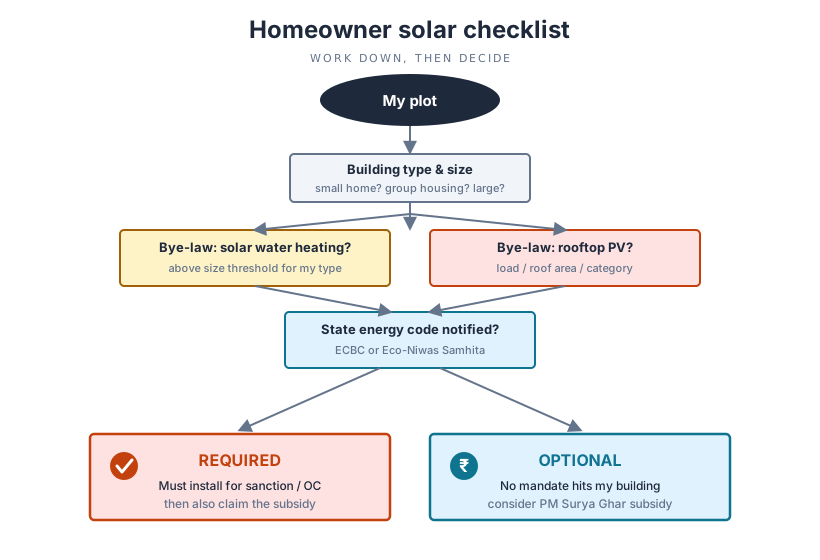
Before you assume anything, run through this short checklist with your architect or licensed engineer, or directly with the local body.
First, identify your authority. Building rules come from your municipal corporation, development authority or panchayat, not from a national document. Find whose bye-laws govern your plot.
Second, find the current bye-law clause. Ask specifically: does this bye-law require solar water heating or solar PV for a building of my type and size? Get the clause, not a verbal assurance.
Third, check the trigger against your project. Compare the threshold (area, load, building category) with your actual building. A small individual house and a 12-flat apartment block can fall on opposite sides of the same rule.
Fourth, ask how it is enforced. Is the requirement checked at sanction, at OC, or both? Is an inspection or compliance certificate needed?
Fifth, check the energy code. Ask whether your state has notified ECBC or Eco-Niwas Samhita and whether your building crosses its threshold.
Sixth, separate the subsidy question. Whatever the mandate says, decide independently whether to apply for PM Surya Ghar, because the subsidy can make even a required system much cheaper.
What this means for you
If you are building or buying an ordinary individual home, the solar requirement you are most likely to actually meet is a solar water heater, in states and cities whose bye-laws demand it above a size threshold, and it may be tied to your occupancy certificate. A hard requirement to install rooftop PV on a small home is much less common, though it is spreading and is the clear direction of policy.
If you are building something larger, group housing, a commercial or institutional building, or anything on a government plot, treat both solar water heating and rooftop PV as live possibilities, and add the energy code (ECBC or Eco-Niwas Samhita) to your checklist, because larger buildings are where mandates concentrate.
In every case, do not guess the numbers. Building rules are a state and city matter, thresholds change, and a confidently quoted figure from a neighbour or a vendor is not a substitute for your own bye-law clause. Confirm in writing what applies to your plot, whether it is checked at sanction or at OC, and only then decide. And remember the second layer: even where solar is required, the PM Surya Ghar subsidy and net metering can turn an obligation into one of the better-value parts of your build.
For the cost and payback side, see solar power for homes in India (costs, ROI, PM Surya Ghar). For how this fits the wider rulebook, see understanding building bye-laws, the closely related rainwater harvesting regulations across India, and the future of building regulations. To find your state's nodal agency and rules, start at the India Regulatory Atlas.
Sources
- Ministry of New and Renewable Energy (MNRE), PM Surya Ghar: Muft Bijli Yojana guidelines and scheme information, mnre.gov.in and pmsuryaghar.gov.in
- Bureau of Energy Efficiency (BEE), Energy Conservation Building Code (ECBC) and Eco-Niwas Samhita (ENS) 2018, beeindia.gov.in
- Ministry of Power, The Energy Conservation (Amendment) Act, 2022
- Town and Country Planning Organisation (TCPO), Ministry of Urban Development, Model Building Bye-Laws 2016, green building and sustainability provisions
- State new and renewable energy / energy development agencies (state nodal agencies), for state solar policy and bye-law adoption (for example HAREDA, PEDA and equivalents)
- News reporting on solar water heater and rooftop solar requirements tied to occupancy certificates in Indian cities (illustrative of enforcement practice, not a source of binding thresholds)
Export this guide
Related Guides — Deep-dive reading
Rooftop Rainwater Harvesting Rules in India: Where It's the Law
In much of India, a rooftop rainwater harvesting system is not a green extra — it is a condition of your building sanction, completion and occupancy certificate. What the rule typically requires, the standard it points to (IS 15797), who designs and certifies it, and why the exact threshold, rebate and penalty are set by your city, not the country.
RoofingRainwater Harvesting Rules in India: When RWH Is Mandatory & How to Comply
A plain-English guide to India's mandatory rainwater-harvesting rules for homeowners — why so many states and cities require RWH for buildings above a certain size, how it becomes a condition for plan sanction and completion certificate, and why the exact trigger, structure and rebate always come from your own local bye-laws.
PlumbingRooftop Solar Approvals & Net Metering in India: The Permissions You Actually Need
The approvals side of putting solar on an Indian roof — not how solar works, but the permissions: the DISCOM net-metering application and feasibility, an empanelled installer, the structural load check, the electrical safety inspection, the PM Surya Ghar subsidy, and metering and commissioning. These are DISCOM, state and MNRE rules — not one national IS code — so amounts and caps change; always confirm the current rule locally.
RoofingRelated Tools — Try Free
Rainwater Tank Sizer
How big should your rainwater tank be? Computes annual harvest, recommended tank capacity in litres, water-bill savings, and payback — for 10 Indian cities.
RWH CalculatorPre-Possession Inspection Checklist
Inspect your flat before registration — 10 categories, 70+ checkpoints across legal, carpet area, structure, finishes, and deviations.
Homebuyer ChecklistApartment Interior Planning Checklist
51-item checklist across structural, ceiling, lighting, furniture, storage, electrical, kitchen, bathroom.
Checklist