
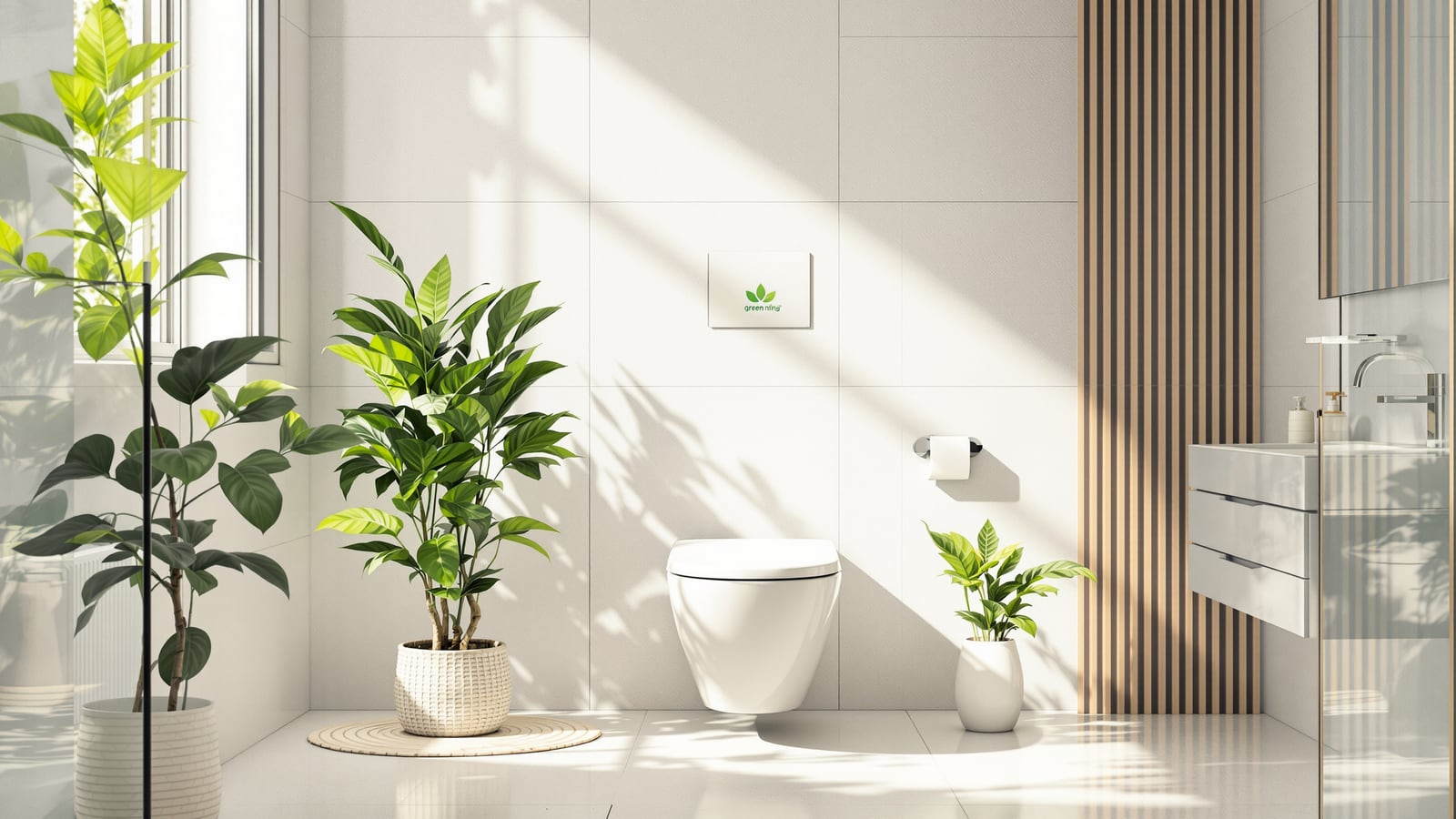
GRIHA & IGBC Water-Efficient Bathroom India: How Bathrooms Earn Green-Building Credits
A professional's reference to how the bathroom earns points under India's two national green-building rating systems — IGBC (Green Homes / Green New Buildings) and GRIHA — through water-efficient fixtures, low-flow flush and flow-rate caps, metering, greywater and rainwater reuse, and low-VOC indoor-environment credits, and how to target them.
The bathroom is where a home's water story is won or lost. In a typical Indian dwelling the toilet, taps and shower together account for the majority of indoor water use, so when a project chases a green-building rating, the bathroom is one of the densest sources of easy points on the scorecard. Both of India's national rating systems — the Indian Green Building Council (IGBC) family and GRIHA — reward the same handful of moves you would make anyway in a well-designed bathroom: fixtures that flush and flow with less water, water you can measure, water you catch and reuse, and materials that do not off-gas into a small sealed room.
This is a professional reference in the Studio Matrx bathroom hub. It assumes you already understand the plumbing and code baseline — read it alongside the bathroom building regulations guide for India, which covers the National Building Code and municipal bye-laws that apply whether or not you certify, and the bathroom water-efficiency standards guide for the fixture flow-rate detail. For the design and material side, see the eco-friendly bathroom guide and the low-VOC bathroom materials guide.
Codes and rating systems are revised and re-versioned regularly, and exact credit weightings differ between IGBC Green Homes, IGBC Green New Buildings and each GRIHA version. Municipal bye-laws also mandate some of these measures outright. Treat the figures below as indicative, and verify the current rating manual, the current code and your local authority — or a licensed green-building consultant / accredited professional — before you rely on any of it.
The two rating systems, in one breath
India has two established, credible green-building rating programmes, and a bathroom can earn credits under either.
- IGBC — run by the Confederation of Indian Industry (CII). It publishes a family of rating systems, including IGBC Green Homes (individual residences and residential developments) and IGBC Green New Buildings (commercial, institutional and mixed-use). IGBC ratings are points-based, and the total earned lands the project at one of four levels: Certified, Silver, Gold or Platinum.
- GRIHA — the Green Rating for Integrated Habitat Assessment, developed by TERI and adopted as India's national rating system with the Ministry of New and Renewable Energy. GRIHA scores a project on a 100-point scale and awards a rating of one to five stars, with variants such as SVAGRIHA for smaller buildings and versions for existing buildings and affordable housing.
Both systems organise their points into thematic categories. The bathroom touches three of them almost everywhere: water (conservation, efficiency and reuse), materials and indoor environmental quality (low-emitting finishes, healthy air, daylight and ventilation), and innovation. The rest of this guide walks each one.
Water: the bathroom's biggest credit block
Every green rating in India carries a water category worth a meaningful slice of the total, and the bathroom is where most of the points live. The logic is the same across systems: compare the building's fixtures against a conventional baseline, and reward a percentage reduction in indoor water demand.
Low-flow fixtures and flow-rate caps
The primary move is specifying fixtures that use less water per use, measured at a reference supply pressure. Ratings do not care about the brand — they care about the flow rate (litres per minute, LPM) for taps and showers, and the flush volume (litres) for WCs and urinals. The table below shows the direction of travel; the exact thresholds a rating rewards, and the percentage-reduction bands, come from the current manual.
| Fixture | Typical conventional | Efficient / green target (indicative) |
|---|---|---|
| Wash-basin tap (aerated) | 10-12 LPM | 3-6 LPM |
| Kitchen / utility tap | 12-15 LPM | 5-6 LPM |
| Showerhead | 12-20 LPM | 6-9 LPM |
| WC — dual-flush | 10-13 L single flush | 6/3 L (premium 4.5/3 L or 4/2.5 L) |
| Urinal | 3-6 L per flush | 1 L per flush or waterless |
| Health faucet | around 8 LPM | 4-5 LPM aerated |
Aerators, flow restrictors, pressure-compensating cartridges and dual-flush cisterns are the cheap, high-yield specifications. A dual-flush WC at 6/3 litres is now a baseline expectation rather than a differentiator — many municipal bye-laws already mandate it — so premium 4.5/3 L or 4/2.5 L pans and sensor / metering taps are where extra credit is found.
Metering and monitoring
Both systems reward the ability to measure water, because you cannot manage what you do not meter. Credits are available for:
- Sub-metering domestic supply, flushing supply and any recycled-water line separately, so consumption is visible and leaks show up.
- BMS or smart monitoring on larger projects — continuous logging of consumption against a target.
For the bathroom this means running the flushing circuit and the freshwater circuit on separate, metered lines. See the bathroom water monitoring guide for the hardware.
Greywater and rainwater reuse
The largest single water credit is usually reducing dependence on fresh municipal water by treating and reusing water on site.
- Greywater — the relatively clean wastewater from wash basins and showers can be filtered / treated and reused for flushing and landscape irrigation. Feeding treated greywater to the dual-flush cistern closes the loop the rating rewards most. The greywater recycling guide covers the systems.
- Rainwater harvesting — catchment, storage and/or groundwater recharge. This is both a rating credit and, in most Indian cities, a statutory requirement above a certain plot size under municipal bye-laws and Central Ground Water Authority norms.
- Wastewater treatment and reuse — an on-site sewage treatment plant (STP) whose output serves flushing and gardens scores heavily on larger residential and mixed-use projects.
Materials and indoor environment: the quieter credits
Beyond water, the bathroom contributes to the materials and indoor environmental quality (IEQ) categories — the credits that protect the people who use the room.
- Low-emitting materials. Both systems award points for low-VOC paints, coatings, adhesives and sealants, and for low-formaldehyde composite wood (E1 / E0 grade boards) in vanities and storage. A bathroom is the smallest, most airtight, steamiest room in the house, so this matters more here than anywhere — the detail is in the low-VOC bathroom materials guide.
- Certified and responsible materials. Credits reward products carrying recognised ecolabels — IGBC's own GreenPro product certification is the common route in India — plus recycled content, regional / local sourcing, and rapidly renewable materials.
- Daylight and ventilation. IEQ credits reward natural light and fresh-air ventilation. A bathroom with an openable window or a well-sized exhaust that meets air-change norms contributes to occupant-comfort and ventilation credits.
- Durability and low maintenance. Long-life, low-maintenance surfaces (good ceramic tiles to IS 15622, quality vitreous-china sanitaryware to IS 2556) reduce replacement churn, which supports the life-cycle thinking both systems favour.
The standards and rating systems, at a glance
The table below maps the real Indian standards and rating systems a green bathroom touches. IS codes give you the product-quality baseline; the rating systems sit on top and reward going beyond it.
| Standard / rating | What it covers | Key requirement / figure |
|---|---|---|
| IS 774 | Flushing cisterns for water closets | Dual-flush cisterns, typically 6/3 L (full / reduced) |
| IS 2556 | Vitreous china sanitary appliances | Quality and dimensions of WC pans, wash basins, urinals |
| IS 15622 | Pressed ceramic floor and wall tiles | Classification by water absorption / strength for durable surfaces |
| NBC 2016, Part 9 | Plumbing Services | Water supply, drainage and water-conservation design provisions |
| NBC 2016, Part 11 | Approach to Sustainability | National framework for green / sustainable building incl. water and materials |
| CPHEEO Manual | Water-supply norms | Domestic demand benchmark around 135 litres per capita per day (LPCD) |
| IGBC Green Homes / Green New Buildings | Voluntary green rating | Points-based → Certified, Silver, Gold, Platinum |
| GRIHA (current version) | National green rating | 100-point scale → 1 to 5 stars |
| GreenPro | IGBC product ecolabel | Third-party certification of a product's green credentials |
How a homeowner or architect actually targets the points
The path to certification is procedural, and the bathroom decisions are made early.
1. Register the project with IGBC or GRIHA under the correct rating system for the building type, before or during design.
2. Set a target level. Certified / Silver / Gold / Platinum for IGBC; the star count for GRIHA. This fixes how aggressive your fixture and reuse strategy must be.
3. Model the water baseline. Calculate conventional-fixture demand, then the reduction your specified low-flow fixtures, dual-flush WCs and reuse systems achieve. The percentage reduction maps directly to credits.
4. Specify to the target. Lock in fixture flow rates and flush volumes, separate metered flushing and freshwater lines, a greywater / rainwater strategy, and low-VOC / GreenPro-certified finishes. Keep manufacturer datasheets — flow rates and VOC content must be documented, not asserted.
5. Pre-certify at design stage (where the system offers it), then submit as-built documentation — datasheets, purchase invoices, commissioning and metering records — for final certification after construction.
6. Chase innovation credits for anything exemplary: sensor faucets, smart leak monitoring, or beating the water baseline by an outstanding margin.
The reassuring part is that almost none of this is exotic. Dual-flush WCs, aerated taps, a rainwater pit and low-VOC paint are ordinary, affordable specifications; the rating simply pays you — in points and in lower running bills — for choosing them deliberately and proving you did.
References
- National Building Code of India, NBC 2016 — Bureau of Indian Standards; Part 9 Plumbing Services, Part 11 Approach to Sustainability.
- IS 774 — Flushing cisterns for water closets and urinals, Bureau of Indian Standards.
- IS 2556 — Vitreous china sanitary appliances, Bureau of Indian Standards.
- IS 15622 — Pressed ceramic tiles, Bureau of Indian Standards.
- CPHEEO Manual on Water Supply and Treatment — Ministry of Housing and Urban Affairs (domestic demand norms).
- IGBC Green Homes and IGBC Green New Buildings rating systems — Indian Green Building Council (CII); certification levels Certified / Silver / Gold / Platinum; GreenPro product certification.
- GRIHA — Green Rating for Integrated Habitat Assessment (TERI / Ministry of New and Renewable Energy), 100-point / 1-to-5-star national rating, including SVAGRIHA and existing-building variants.
- Central Ground Water Authority rainwater-harvesting norms and local municipal building bye-laws.
Rating systems are re-versioned and codes are amended regularly, and municipal bye-laws vary by city. Verify the current rating manual, the current IS codes and your local authority — or engage a licensed professional / accredited green-building consultant — before relying on any figure here.
Export this guide
Related Guides — Deep-dive reading
Water Efficiency Standards Bathroom India: Flow Limits, Dual-Flush & Green Credits
A professional reference to the water-efficiency standards and norms that govern Indian bathrooms — dual-flush cistern volumes, low-flow tap and shower limits, BIS/ISI marking for fixtures, IGBC and GRIHA water credits, and CGWB rainwater and greywater rules.
BathroomsLow VOC Bathroom Materials India: Healthy Paints, Sealants & Boards for Better Indoor Air
An India-first guide to low-VOC and formaldehyde-free bathroom materials — paints, sealants and adhesives whose fumes matter in a small unventilated room, E1/E0 boards for vanities, recycled and natural finishes, and the GreenPro, IGBC and GRIHA certifications worth checking before you buy.
BathroomsGreywater Recycling India: Reusing Bathroom Water for Flushing & Gardens
How to recycle the basin and shower greywater from an Indian bathroom — simple diversion versus filtered and disinfected systems, the separate drainage you must plan at construction, storage, dual-plumbing to the WC cistern, and honest numbers on cost, payback and health.
BathroomsRelated Tools — Try Free
Rainwater Tank Sizer
How big should your rainwater tank be? Computes annual harvest, recommended tank capacity in litres, water-bill savings, and payback — for 10 Indian cities.
RWH CalculatorCross-Ventilation Analyzer
Estimate airflow and air changes per hour (ACH) from room size, window areas, layout, and local wind — with NBC 2016 Part 8 compliance check.
Ventilation CalculatorWindow Size Calculator
Get the right window size, glazing area and openable area for any room using NBC daylight rules.
Window Tool