
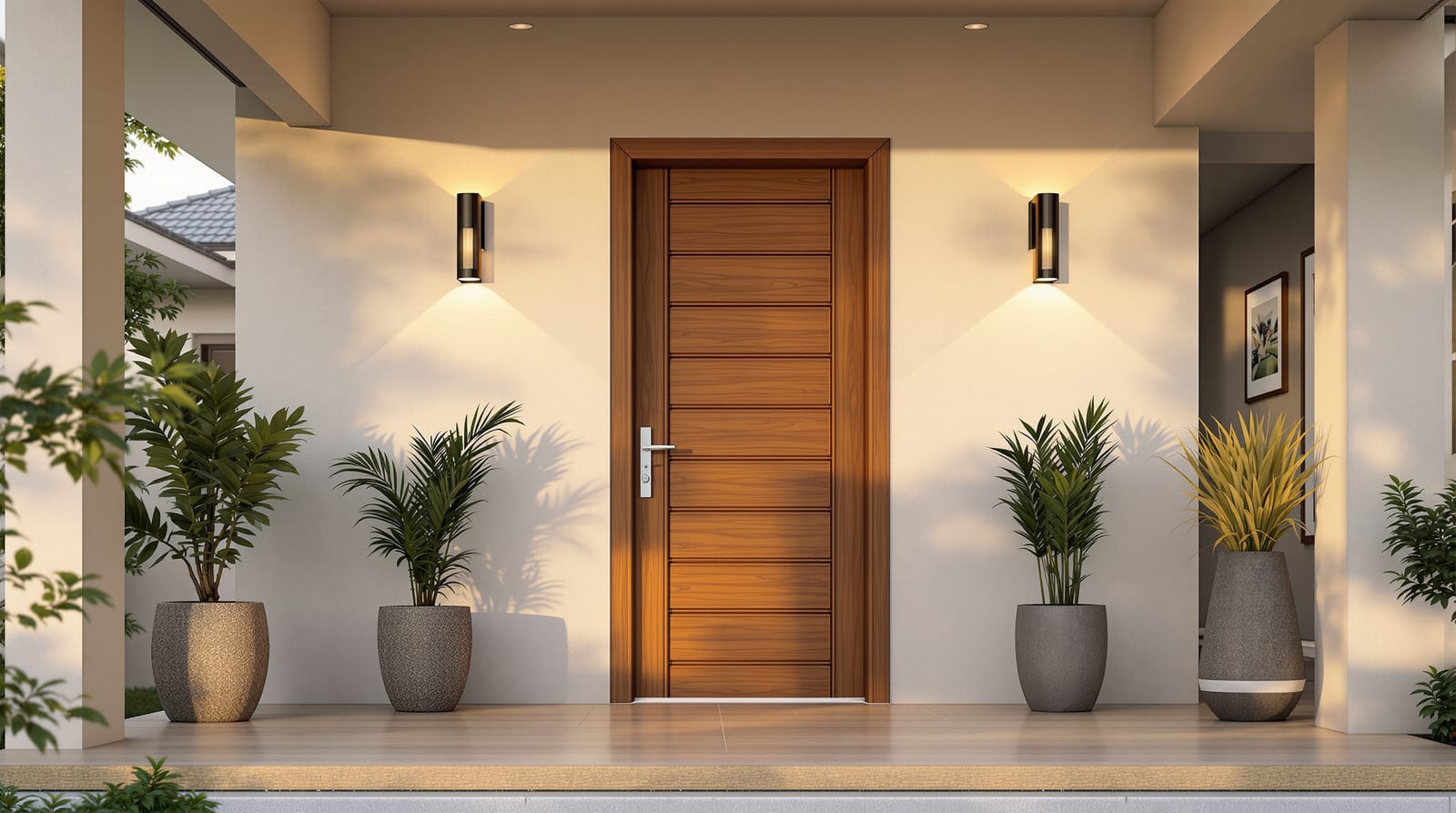
Composite Doors in India: Engineered Main Doors for Security & Weather (2026)
How GRP-skinned, foam-core composite doors combine the strength of timber, the weatherproofing of uPVC and the security of steel for the Indian main entrance.
A composite door is not one material pretending to be another — it is several materials engineered into a single leaf so that each does the job it is best at. A glass-reinforced plastic (GRP) skin shrugs off rain and sun, an insulated foam core kills heat and noise, and a structural timber-and-uPVC subframe carries the locks and hinges. For an Indian main door that must survive monsoon swelling, summer warp, coastal salt and a determined burglar all at once, that layered logic is genuinely appealing. The catch: composite doors are still a niche, premium and often imported category here, so it pays to understand exactly what you are buying before you spend ₹6,000–20,000 a set.
What a composite door actually is
The word "composite" simply means the leaf is built from multiple bonded materials rather than carved from one. In a mainstream UK-style composite door — the design most imports and the few Indian makers follow — the cross-section runs:
- Outer skin: GRP (glass-reinforced plastic, i.e. fibreglass) moulded with a woodgrain texture and colour pressed through the surface, not painted on top. GRP does not rot, rust, corrode, peel or fade quickly, and it resists scratches and dents far better than uPVC or thin steel skins.
- Subframe / edge banding: a rigid perimeter of timber (often laminated hardwood) combined with uPVC reinforcement. This is the structural spine — it gives the door its rigidity and the solid material into which the multipoint lock, hinges and letter plate are screwed.
- Core: a high-density insulating foam (typically polyurethane / PU) filling the cavity. This is what delivers the thermal and acoustic insulation and the reassuring solid "thud" when the door closes.
- Glazing units (optional): decorative double or toughened glazed panels bonded into moulded apertures.
Bonded together under heat and pressure, the result is a leaf around 44–48 mm thick that feels far heavier and more solid than a uPVC or FRP door — closer to a quality timber door, but without timber's appetite for swelling and warping.
A quick terminology note for the Indian market: many shops loosely label any moulded fibreglass door a "composite" or "FRP" door. A true composite door has the multi-layer GRP-skin-plus-foam-core-plus-reinforced-subframe build described above. A plain FRP door is usually a hollow or honeycomb-filled fibreglass shell aimed at bathrooms and budget uses. Ask for the cross-section before you pay composite-door money — see our door materials comparison for the full material map.
The layered cross-section
The strength of a composite door is in its stack. Each layer is doing a specific job:
Because the lock and hinges land in the dense timber subframe rather than in foam or hollow plastic, a composite door holds a multipoint locking system properly — three to five locking points engaging up and down the frame on one key turn. That is a meaningful security upgrade over a single mortise lock in a hollow door, and it is the main reason composite doors are pitched as premium front doors.
Why composite doors suit Indian conditions
Run a typical Indian door through a year of weather and the composite build starts to make sense:
- Monsoon swelling and warp: GRP and foam do not absorb water, so the leaf does not swell, sag or jam in July the way an under-sealed timber or low-grade flush door can. No annual planing of the bottom edge.
- Coastal salt: unlike a steel door, there is no metal skin to rust and streak. GRP is inherently corrosion-proof, which is why composite (and FRP) doors are recommended for Goa, Kerala, Chennai and Mumbai seafronts — see best door material for India.
- Termite and rot: the skin and core are inorganic; only the internal timber edge banding is organic and it is sealed inside, so there is little for termites or fungus to attack — a real advantage over solid wood in humid zones.
- Heat and noise: the PU foam core slows heat transfer through the leaf and damps street noise, helping in both AC-cooled bedrooms and noisy urban entrances. It will not match a dedicated soundproof door, but it comfortably beats a hollow flush door.
- Looks: the moulded woodgrain reads as timber from a step away and comes in stable factory colours, so you get the main-door presence of wood without the maintenance.
The trade-off is fire behaviour and repairability: GRP and PU are plastics, so a true composite is not a fire-check door (for that you need an IS 3614 rated steel or timber fire door), and a deep gouge in the skin is harder to invisibly repair than a sanded-and-revarnished timber scratch.
How composite differs from uPVC, FRP and solid wood
These four are constantly confused on the showroom floor. The short version:
| Feature | Composite (GRP + foam core) | uPVC | FRP / fibreglass | Solid wood / teak |
|---|---|---|---|---|
| Security (lock holding) | High — multipoint into solid subframe | Low–medium — hollow chambers | Low–medium — usually hollow shell | High — solid timber, but warp can misalign locks |
| Thermal / acoustic insulation | High — dense PU foam core | Medium — air chambers | Low–medium — depends on fill | Medium–high (mass) |
| Weather / warp / rot | Excellent — no swell, no rot | Excellent — but skin can sag in extreme heat | Excellent — rust/rot proof | Poor–good — needs sealing, can warp |
| Termite resistance | Excellent (sealed timber only) | Excellent | Excellent | Poor without treatment |
| Maintenance | Very low — wipe clean | Very low | Very low | High — periodic polish/varnish |
| Look / feel | Solid, convincing woodgrain | Plasticky, lighter | Lighter, can look moulded | Premium, natural, repairable |
| Indicative cost (set) | ₹6,000–20,000 | ₹400–700/sq ft of opening | ₹1,500–4,000 (bath grade up) | ₹10,000–25,000+ (teak far higher) |
So: pick uPVC for cheap, light, weatherproof secondary doors where security is not critical (see uPVC doors in India); pick FRP for wet, corrosive or budget locations like bathrooms and back doors (see FRP doors in India); pick solid wood/teak when you want a genuinely natural, repairable, high-status leaf and will maintain it (see teak wood doors); and pick a composite when you specifically want a low-maintenance, well-insulated, secure-looking main door that imitates wood and survives the climate. Costs across every type are benchmarked in our door cost guide.
Cost, availability and brands in India
Composite doors remain a niche category in India. Most stock is imported (UK and Chinese GRP composite slabs) or supplied as part of premium window-and-door fabricator packages, with a smaller number of domestic FRP/composite manufacturers. Expect:
- Door set (leaf only or leaf + frame, factory-finished): roughly ₹6,000–20,000, with glazed and designer slabs at the top of that band and imported premium sets going higher. All figures indicative, varies by city, vendor and import duty.
- Frame / subframe: composite doors are usually hung in a matching uPVC or aluminium subframe; a separate door frame adds cost if not bundled.
- Hardware: a multipoint lock, handle set and hinges add roughly ₹1,500–8,000 depending on grade — budget for this, since the multipoint lock is the whole point of going composite.
- Installation: fitting labour runs ₹800–3,000 per door; composite sets need accurate frame fixing, so use a fitter who has hung them before.
- GST: add 18% on materials, typical for this category.
Availability is best in metros and coastal cities through uPVC/aluminium fabricators, premium door studios and a handful of online sellers; in smaller towns you may have to special-order, and a local carpenter cannot fabricate a true composite leaf the way they can knock together a panel door. Always confirm the cross-section, skin thickness, core type and lock spec in writing — the label "composite" is not yet standardised in the Indian retail market. Compare options quickly with the door material comparison tool and price a set with the door cost calculator.
For the main entrance, also reconcile your choice with main-door security and, where it matters to the household, Vastu for the main door — composite doors come in even-panel and single-leaf designs, open inward, and accept a threshold, so they sit comfortably within traditional preferences. For the bigger picture of every door in the home, start from the complete guide to home doors in India.
Frequently asked questions
Are composite doors better than uPVC for a main door?
For a main entrance, generally yes. A composite door has a dense foam core and a solid timber-and-uPVC subframe that holds a multipoint lock far better than uPVC's hollow chambers, so it is more secure and feels more solid. uPVC remains the cheaper, lighter choice for low-risk secondary doors.
Is a composite door the same as an FRP door?
No. Both use a fibreglass (GRP) skin, but a true composite door adds an insulated foam core and a reinforced timber/uPVC subframe, making it heavier, better insulated and far more secure. Plain FRP doors are usually hollow or honeycomb shells aimed at bathrooms and budget uses. Always ask to see the cross-section.
How much does a composite door cost in India?
Indicatively ₹6,000–20,000 per set, with glazed, designer and imported slabs at the higher end; add 18% GST, plus a multipoint lock (₹1,500–8,000) and fitting (₹800–3,000). Prices vary by city, vendor and import duty, so get a written quote with the skin and core spec.
Will a composite door warp or swell in the monsoon?
No — the GRP skin and foam core do not absorb water, so the leaf will not swell, sag or jam in the rains the way an under-sealed timber or low-grade flush door can. The only organic part, the internal timber edge, is sealed inside the leaf.
Is a composite door fireproof?
No. A standard composite door uses plastic (GRP) skins and a PU foam core and is not a rated fire-check door. If you need fire protection — for example a flat door opening onto a common lobby — specify an IS 3614 rated steel or timber fire door of the appropriate 30/60/90-minute rating instead.
Export this guide
Related Guides — Deep-dive reading
Reinforced Wooden Doors in India (2026): Making the Timber Main Door Actually Secure
A homeowner's decision guide to choosing or upgrading the wooden main or flat door most Indian homes actually have, so it genuinely resists a break-in, without pretending a hollow flush door is secure.
SecurityThe Complete Home Door Guide for Indian Homes (2026): Types, Materials, Cost, Security & Vastu
Everything an Indian homeowner needs to specify the right door for every opening — from main entrance to bathroom — with real 2026 prices, IS/NBC standards and Vastu sense.
Home Doors & EntrancesCoastal Region Door Buying in India 2026: Salt-Air Guide
Why cheap flush and MDF doors fail near the sea, and which water-resistant materials and corrosion-proof hardware actually last.
Home Doors & EntrancesRelated Tools — Try Free
Window Material Comparison Tool
Compare uPVC, aluminium, wood, steel and composite windows on cost, life, upkeep and insulation.
CompareDoor Material Comparison Tool
Compare 2–4 door materials on cost, durability, maintenance, security and moisture resistance.
Comparison ToolWindow Cost Calculator
Estimate window price plus installation by type, frame material, size, glass and quantity.
Window Calculator