
Fire-Rated Rolling Shutters & Fire Curtains India 2026
Galvanised steel-lath shutters and fabric fire curtains for large openings — ratings, gravity fail-safe descent, IS standards and motorisation explained for specifiers.
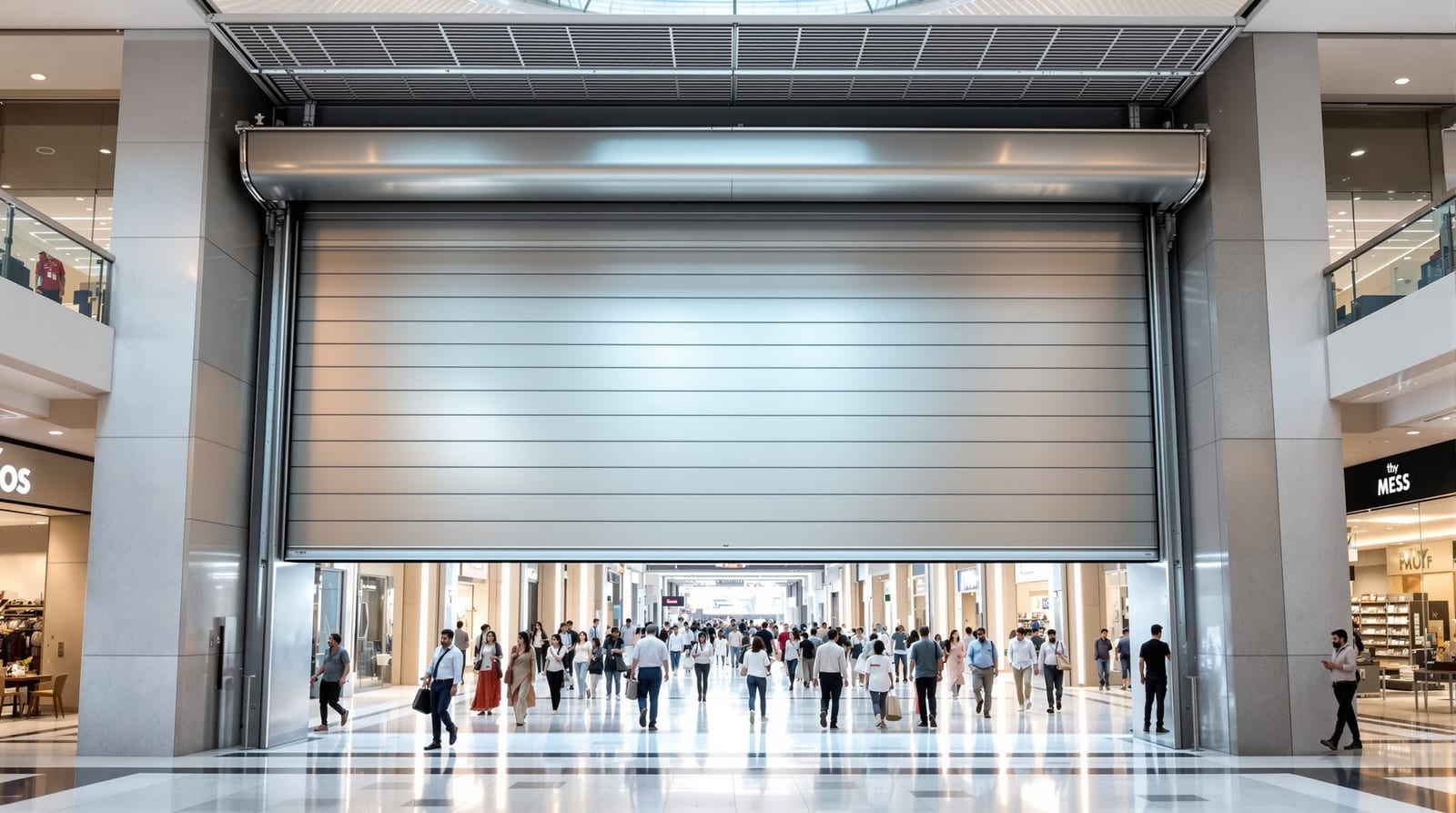
When a fire compartment line crosses an opening too wide for a swing leaf — a warehouse despatch bay, a mall shopfront, an atrium void, a lift lobby — the answer is rarely a hinged fire door. It is a fire-rated rolling shutter or a fabric fire curtain: a vertically descending barrier of galvanised steel lath or woven glass-fibre cloth that closes the breach automatically when heat or smoke is detected, holding the compartment for 2 to 4 hours. These products are the workhorses of large-opening passive fire protection in Indian commercial and industrial buildings, and they fail safe by gravity — power loss makes them close, not open. This guide explains how they are rated, where they beat hinged fire doors, the IS standards that govern them, realistic ₹ bands, and the motorisation and battery-descent detailing a specifier must get right.
Why a shutter or curtain, not a hinged fire door
A certified hinged fire door (see fire-rated doors India) tops out around a 2.4 m wide double leaf before the assembly becomes impractical and the rating hard to hold. Compartment openings in logistics, retail and transport buildings are routinely 4-12 m wide and often equally tall. A rolling shutter coils into a barrel above the lintel and occupies no floor swing; a fire curtain stores in a slim headbox and weighs a fraction of steel, so it can span very large atrium and mall voids where a rigid shutter would be too heavy or visually brutal.
The trade-off is function. A hinged fire door is a door — people use it daily and it self-closes. A fire shutter or curtain is a barrier — normally parked open, it descends only in a fire and you must provide a separate adjacent escape route, because a closing or closed shutter is not a means of escape. NBC 2016 Part 4 and the local fire NOC will dictate where each is allowed; the rule of thumb is doors for openings people pass through, shutters/curtains for openings that are mostly logistical or architectural. For the wider family of related products see specialty doors and industrial door types India.
How fire-rated rolling shutters are built
A fire shutter is a curtain of interlocking galvanised steel lath (typically 0.9-1.6 mm gauge), rolled onto a steel barrel above the opening and running in heavy steel guide channels bolted to a fire-rated masonry or concrete reveal. The fire rating is an assembly property: the lath curtain, the guides, the bottom rail, the lintel/hood, the masonry surround and the closing mechanism are tested together. Mixing components voids the certificate exactly as it does for a hinged fire door.
Ratings are expressed as integrity (E) — the time the barrier resists flame and hot-gas passage. Pure steel-lath shutters are generally rated for integrity only; where the brief also demands insulation (I) — limiting the unexposed-face temperature rise so the cold side stays survivable — you specify an insulated fire shutter (double-skin lath with a fire core, or a deluge water-curtain over a single shutter). Insulation versions are heavier and dearer.
Gravity fail-safe descent
The defining safety feature is gravity fail-safe closure. The shutter is held open by a motor or a counterbalanced clutch; on a fire signal — a fusible link that melts at ~70°C, a smoke/heat detector via the fire alarm panel, or a manual break-glass — the holding mechanism releases and the curtain descends under its own weight at a controlled, governed speed (a centrifugal brake or governor caps descent to a safe rate, typically well under 0.3 m/s, so the bottom rail cannot guillotine). A two-stage descent (partial drop for smoke, full drop for fire) is common at lift lobbies and escalator voids so smoke is held while people clear. Crucially this works with no power at all — the fusible link and gravity need no electricity, which is why fire shutters fail closed.
Rating tiers and where they are used
| Rating (integrity E) | Typical product | Where used in India |
|---|---|---|
| 60 min (E60) | Single steel-lath shutter | Small godowns, internal compartment lines, shop units |
| 120 min (E120) | Heavier lath, rated guides/hood | Warehouses, factories, mall shopfronts, basement car parks |
| 180 min (E180) | Double-skin / deluge-assisted | High-hazard storage, large logistics, separating walls |
| 240 min (E240) | Engineered insulated / water-curtain | Major godowns, transformer/plant rooms, party walls |
| EI-rated (insulation) | Insulated double-skin or deluge | Where the cold-side temperature must stay survivable |
Fire curtains (fabric) typically cover the E30 to E120 band and are favoured for atria, escalator and stair voids, lift lobbies, and concealed shopfront lines in malls where a steel shutter would be too heavy or visually intrusive. See fire curtain doors India for the fabric-barrier deep-dive, smoke control doors India for the smoke-specific cousins, and fire-rated rolling shutters' own application contexts in warehouse door India and factory door India.
Fire shutter vs fire curtain — how to choose
The selection logic is simple: span and weight push you toward fabric; robustness, security and abuse-resistance push you toward steel. A despatch dock that also needs daily security and impact tolerance wants a steel shutter; a mall atrium void that must look invisible until a fire wants a concealed fabric curtain. Where the opening is also a daily traffic route, you keep a hinged or sliding fire door alongside and use the shutter/curtain only for compartmentation.
IS standards and code basis
There is no single dedicated Indian fire-shutter product standard as comprehensive as IS 3614 is for fire doors, so Indian practice uses a stack of references:
| Reference | What it governs |
|---|---|
| NBC 2016, Part 4 | Where compartmentation and rated barriers are required; fire NOC basis |
| IS 3614 (Part 2) | Metallic fire-check assemblies — the nearest Indian product analogue |
| BS 476 Part 22 | Fire-resistance test for non-loadbearing elements (widely cited for shutters) |
| EN 1634-1 | European fire-resistance test for door/shutter assemblies |
| BS EN 16034 / BS 7273-4 | Performance and actuation of powered fire shutters/curtains |
| State Fire Service / local NOC | Final authority having jurisdiction (AHJ) sign-off |
Because the Indian standard landscape is thinner than for hinged doors, insist on a third-party test certificate (a UL, BS 476 Part 22 or EN 1634 report from an accredited lab) for the specific assembly — curtain, guides, barrel, hood and fixings as tested. A certificate for a different width or a different lath voids the claim. Engage a fire consultant to confirm the rating against the NBC compartment strategy and the AHJ's expectations, exactly as you would coordinate fire door ratings India and fire door maintenance & inspection India.
Motorisation, controls and battery descent
Most large fire shutters are motorised for daily operation (a tubular or side-mounted geared motor opens and closes them like a normal rolling shutter; see shutter doors India). The fire function is layered on top and must remain independent of mains power:
- Fusible link — purely mechanical, melts at ~70°C, releases the brake; works with zero power and is the irreducible fail-safe.
- Fire-alarm interface — a signal from the building fire panel (heat/smoke detection) releases the holding device, allowing detection-before-flame descent. BS 7273-4 actuation categories define how critical this interface is for escape routes.
- Battery back-up (controlled descent unit) — a battery-backed control box governs the descent speed and powers any audible/visual warning, so even on a fire-alarm trip with mains down the shutter lowers at the safe governed rate rather than slamming. For two-stage descent this battery unit manages the timed pause.
- Manual override — a hand chain or crank to reset and to operate during maintenance and power cuts.
Specify an audible and visual warning during descent and, for routes near people, photoelectric safety sensors / a soft bottom edge that pause or slow the closure if an obstruction is detected — while never overriding the fire-safe closure once committed. Coordinate the actuation strategy with the alarm cause-and-effect matrix. A descent-speed governor and a fire door requirement checker help confirm where rated barriers are mandated; budget the assembly with the door cost calculator.
Cost bands (India 2026)
Fire shutters and curtains are project-engineered, made to opening size, so treat these as indicative; a vendor quotes against your exact width, height, rating and motorisation. Prices exclude 18% GST and the masonry/structural reveal works, which are often a material extra.
| Product | Rating | Indicative band (supply) |
|---|---|---|
| Steel-lath fire shutter | E60-E120 | ₹2,200-4,500 / sqft |
| Insulated / deluge fire shutter | E180-E240 (EI) | ₹4,500-9,000+ / sqft |
| Fabric fire curtain | E60-E120 | ₹1,800-4,000 / sqft |
| Motor + fire control + battery descent | per opening | ₹35,000-1,50,000+ |
| Annual maintenance (AMC) | per door | ₹3,500-12,000 / year |
Distinguish supply-only from installed — installation, structural fixing into a fire-rated reveal, alarm interfacing and commissioning can add 25-50% — and budget the AMC, because fire shutters and curtains must be drop-tested periodically (typically at least annually, often half-yearly for life-safety routes) and the certificate is only valid while the assembly is maintained as tested. Indian suppliers active in this space include Gandhi Automations, Shakti Hörmann, Hörmann, ASSA ABLOY and Avians; get a written spec and the test report from whoever you appoint. Schedule the drop-tests with an industrial door AMC scheduler.
For the full cluster context, return to the complete door guide, and for adjacent industrial products see industrial doors India, loading dock door India and cold storage door India.
Frequently asked questions
Does a fire shutter need power to close in a fire?
No — and that is the point. A fire-rated rolling shutter or curtain fails safe by gravity. A fusible link or fire-alarm signal releases the holding mechanism and the curtain descends under its own weight at a governed speed, with no mains power required. Battery back-up is used to control descent speed and run warnings, not to power the closure itself.
Can a fire shutter be used as a means of escape?
No. A closing or closed fire shutter or curtain is a compartmentation barrier, not an exit. NBC 2016 requires a separate, clearly identified escape route adjacent to the opening; never count a fire shutter as part of the egress capacity.
What rating do I need — 2, 3 or 4 hours?
It is set by the compartment line the barrier protects, defined in the NBC 2016 fire strategy and confirmed by the AHJ/fire consultant — not by preference. As a rule of thumb, internal compartment lines and shop units use E60-E120, while major separating walls, high-hazard storage and party walls push to E180-E240, sometimes with insulation (EI).
Are fire shutters covered by an Indian Standard?
There is no single comprehensive IS product standard for fire shutters; Indian practice references NBC 2016 Part 4, IS 3614 (Part 2) for metallic fire-check assemblies, and test methods such as BS 476 Part 22 or EN 1634-1. Always demand a third-party test certificate for the exact assembly and have a fire consultant confirm it against the AHJ's requirements.
How is a fire shutter different from an ordinary security rolling shutter?
An ordinary rolling shutter is built for security and weather and has no rating, no governed gravity descent and no fire-alarm interface. A fire-rated shutter is a tested assembly — rated lath, guides, barrel, hood and fixings — with a fusible link, controlled fail-safe descent and certification. They look similar; only the certificate makes one a fire barrier.
Do fire shutters need regular testing?
Yes. They must be drop-tested and inspected on a schedule — at least annually, and often half-yearly on life-safety routes — by a competent person, with the fusible link, descent speed, warnings and alarm interface verified. The fire rating is only valid while the assembly is maintained as tested, so budget an AMC from the outset.
Export this guide
Related Guides — Deep-dive reading
Fire Curtain Doors in India: Flexible Barriers (India 2026)
How fabric fire and smoke curtains compartmentalise atria, voids and big retail where a solid door simply will not fit.
Home Doors & EntrancesAutomatic Swing Door Operators: Retrofit Guide India 2026
How to retrofit a normal hinged door to open by itself — full-energy vs low-energy operators, activation, safety and cost for Indian buildings.
Home Doors & EntrancesFire Dampers in India (2026): Stopping Fire and Smoke Travelling Through the Ducts
How fire, smoke and combination dampers close where HVAC ducts pierce a fire-rated wall or floor, restoring the compartment barrier the ductwork breaks - the passive device Indian buildings most often seize, remove or forget.
SecurityRelated Tools — Try Free
Fire Door Rating Checker
See the likely fire-door rating (30/60/90/120 min) and components a location needs per IS 3614 / NBC — guidance, confirm with your architect.
Compliance ToolFire Door Requirement Checker
See where fire doors are required and what rating and egress hardware your building needs, per NBC 2016 and IS 3614.
Door ToolMotorized Curtain Cost Calculator
Estimate the all-in cost to motorise curtains — motors, tracks, hub and installation.
Cost Calculator