
Industrial Doors in India: The Heavy-Duty Door Menu and How to Choose (2026)
High-speed roll-up, sectional overhead, rolling shutters, strip curtains, fire shutters and dock doors - the complete industrial door menu, ranked by the driver that decides it (cycle speed, load and size, thermal and dust separation, fire compartmentation, security and durability), with indicative per-door costs.
An industrial door is rarely chosen for how it looks. It is chosen for what it does to the operation behind it - how fast it cycles, how much heat or dust it keeps out, how big a truck it lets in, how long it survives a forklift that misjudges the gap, and whether it holds fire back from the rest of the plant. Get the type wrong and the cost shows up every single shift: in lost cold air, in conditioned-air bills, in queues at the dock, in dust on the line, or worst of all, in a fire-compartment breach the factory inspector will not sign off.
This guide is the heavy-duty door menu. It walks through the seven door families a warehouse, factory or logistics shed actually uses, names the driver that decides each one, and gives indicative 2026 rupee costs by type and size. It complements the space-specific guides - read this to understand the door types, then follow the links to spec the building itself.
The drivers that decide an industrial door
Before any product name, fix the question. Almost every industrial door choice is driven by one or two of these:
- Cycle speed and throughput - how many times an hour does the opening cycle, and does the operation queue behind a slow door? A busy logistics cross-dock or a clean production cell needs a door that opens and closes in seconds; a once-a-week external shutter does not.
- Load and size - the clear opening for a container truck, a reach truck, or a wide assembly is very different from a personnel-sized industrial door. Bigger and heavier means a sturdier mechanism and motor.
- Thermal and dust separation - cold stores, AC plants, food and pharma lines, and paint shops all pay to keep one side of the door different from the other. Insulation, gasket seals and fast closing protect that difference.
- Fire compartmentation - the building's fire scheme divides the plant into compartments, and the door across that line must hold fire for a rated time. This is a code item, not a comfort one.
- Security - external openings facing a yard or street need a robust barrier against theft and forced entry after hours.
- Automation and durability - high-cycle openings need motorisation, safety sensors and a mechanism rated for hundreds of thousands of cycles before failure.
Hold these six in mind and the menu below sorts itself.
1. High-speed roll-up doors - the throughput door
A high-speed door is a flexible PVC or fabric curtain that rolls up vertically at high speed - typically 1 to 3 metres per second, opening a bay in a few seconds. It exists for one reason: cycle speed. Where an opening cycles dozens of times an hour - internal traffic between zones, a busy cross-dock, the entrance to a clean production cell or a chilled pick area - a slow shutter becomes the bottleneck and an open door bleeds conditioned air all day.
Because it closes fast, it is also a separation door: it minimises the time the opening is open, so it limits dust ingress, insect entry and air exchange. Models come for internal traffic, for clean rooms and food/pharma (washable, smooth, sometimes with vision panels), and as external high-speed doors with insulation and wind resistance. They are almost always motorised with safety photocells and a self-repairing curtain that re-inserts after a forklift hit. This is the door to specify wherever speed and clean separation matter more than raw security or fire rating.
2. Sectional overhead doors - the insulated loading bay door
A sectional overhead door is made of horizontal panels hinged together that lift up and run back along the ceiling on tracks. It is the insulated loading-bay and large-opening door of choice because the panels are double-skinned steel with a foam core, giving real thermal and acoustic performance, and because lifting overhead wastes no side wall and leaves the opening fully clear when up.
Sectional doors suit dispatch and receiving bays, AC-conditioned production halls, and any large vehicle opening where you want insulation and a clean, weather-tight seal. Paired with a dock leveller and dock shelter, the sectional door is the standard interface between a truck and a temperature-controlled warehouse. They are motorised for larger sizes, accept vision panels and pedestrian wicket doors, and seal far better than a plain rolling shutter. When the brief says "insulated" and "large vehicle access," this is usually the answer.
3. Rolling shutters - the workhorse
The rolling shutter is the default external industrial door across India - galvanised or mild-steel (MS) interlocking laths that coil onto a barrel above the opening. It earns its place on security, simplicity, low cost and the ability to span very wide openings. Variants tune it to the job: plain MS for general security, insulated double-skin shutters where some thermal performance is needed, and grille or perforated shutters where you want security with daylight and ventilation (common at showroom and warehouse street frontages).
Shutters can be manual (push-up or chain) for small or low-cycle openings, or motorised for large and frequent ones. They are the right call for external perimeter security, infrequent vehicle access, and wide openings on a budget - but they are slow, they seal and insulate poorly compared with a sectional door, and they are not built for high cycle counts. For the full mechanism, sizing and motorisation detail, see shutter doors in India.
4. Strip curtains - cheap separation
A strip curtain is a row of overlapping clear PVC strips hung in an opening. It is the cheapest separation device on the menu and earns its keep where you need to keep one zone broadly different from the next without stopping traffic - reducing cold loss, dust, fumes and insects while letting forklifts and people pass straight through. It is the standard low-cost partner at the threshold of a chilled area, between a dusty and a clean zone, or across an internal opening that cannot be doored.
A strip curtain is not a security door, not a fire door and not airtight - it is a soft, low-cost buffer, often used in front of, or instead of, a more expensive door where the duty is light. In cold stores it frequently works alongside an insulated door for the slow, sealed close and the strip curtain for the constant traffic.
5. Fire shutters and fire-rated doors - compartmentation
Where the building's fire strategy draws a compartment line across a large opening, the door across it must hold fire for a rated period. A fire shutter is a steel rolling shutter built and certified to resist fire (commonly held open and released to close automatically on a fire-alarm or fusible-link signal), used to seal large openings between fire compartments. For personnel and smaller openings - plant rooms, electrical and battery rooms, stairwells, the escape route off the shop floor - the answer is a fire-rated swing door to IS 3614 (30 / 60 / 90 / 120-minute ratings) with intumescent seals and a self-closing device.
This is the one family on the menu that is a legal and life-safety item, inspected as part of the fire NOC, not a productivity choice. Never wedge it open and never compromise its rating with an unrated vision panel or lock. The ratings, certification and detailing are covered in fire-rated doors in India.
6. Dock-leveller doors and the dock interface
A loading dock is a door-plus-equipment system, not a single product. The typical interface is an insulated sectional door over the bay, a dock leveller (a hinged plate that bridges the height gap between the dock floor and the truck bed), and a dock shelter or seal that closes the gap around the parked truck so the cold or conditioned air, and the rain, stay out. The door and the leveller are sequenced so the door only opens once the truck is docked and sealed.
This is where throughput, insulation and safety meet. For the full dock specification - leveller capacities, shelters, bumpers, traffic lights and the door choice - see loading dock doors in India.
7. Mesh and ventilated doors
Where security must coexist with airflow and daylight - a naturally ventilated shed, a covered yard, a stores frontage that needs to breathe - a grille rolling shutter or a mesh/expanded-metal door gives a robust barrier you can see and breathe through. It trades insulation and weather-sealing for ventilation and visibility, and it is a common partner to a solid door (solid for cold or secure hours, mesh for ventilated working hours).
Comparison - door type, use, speed, insulation and cost
Indicative 2026 supply-plus-fit costs; varies widely by clear opening size, insulation, motorisation, wind class and city; add 18% GST. Industrial doors are priced per square metre of opening far more than per "door," so treat these as ranges for a typical bay.
| Door type | Best use | Cycle speed | Insulation / seal | Indicative cost (₹) |
|---|---|---|---|---|
| High-speed roll-up | High-traffic internal / clean cell / busy dock | Very fast (1-3 m/s) | Low-moderate (some insulated) | 2,50,000-9,00,000+ per door |
| Sectional overhead | Insulated loading bays, AC halls, large vehicle access | Moderate (motorised) | High (foam-core panels, seals) | 1,80,000-7,00,000+ per door |
| Rolling shutter (MS / insulated / grille) | External security, wide openings, infrequent access | Slow | Low (insulated variant moderate) | 1,200-4,500 per sq m (manual); motorised + ₹40,000-1,50,000 |
| Strip curtain | Cheap zone separation, constant pass-through | Instant (no cycle) | Low (buffer only) | 6,000-30,000 per opening |
| Fire shutter | Large opening across a fire compartment line | Auto-close on alarm | Rated for fire, not thermal | 2,500-6,000+ per sq m |
| Fire-rated swing door (IS 3614) | Plant/electrical rooms, stairwells, escape route | Self-closing | Rated for fire | 12,000-45,000+ per door |
| Dock-leveller door system | Truck loading/unloading interface | Sequenced with leveller | High (sectional + shelter) | 3,50,000-12,00,000+ per bay (door + leveller + shelter) |
| Mesh / ventilated grille | Security + airflow + daylight | Slow | None (ventilated) | 1,500-4,000 per sq m |
Model your own schedule with the industrial door selector and the commercial door cost calculator.
Inline figure - high-speed roll-up vs sectional vs shutter
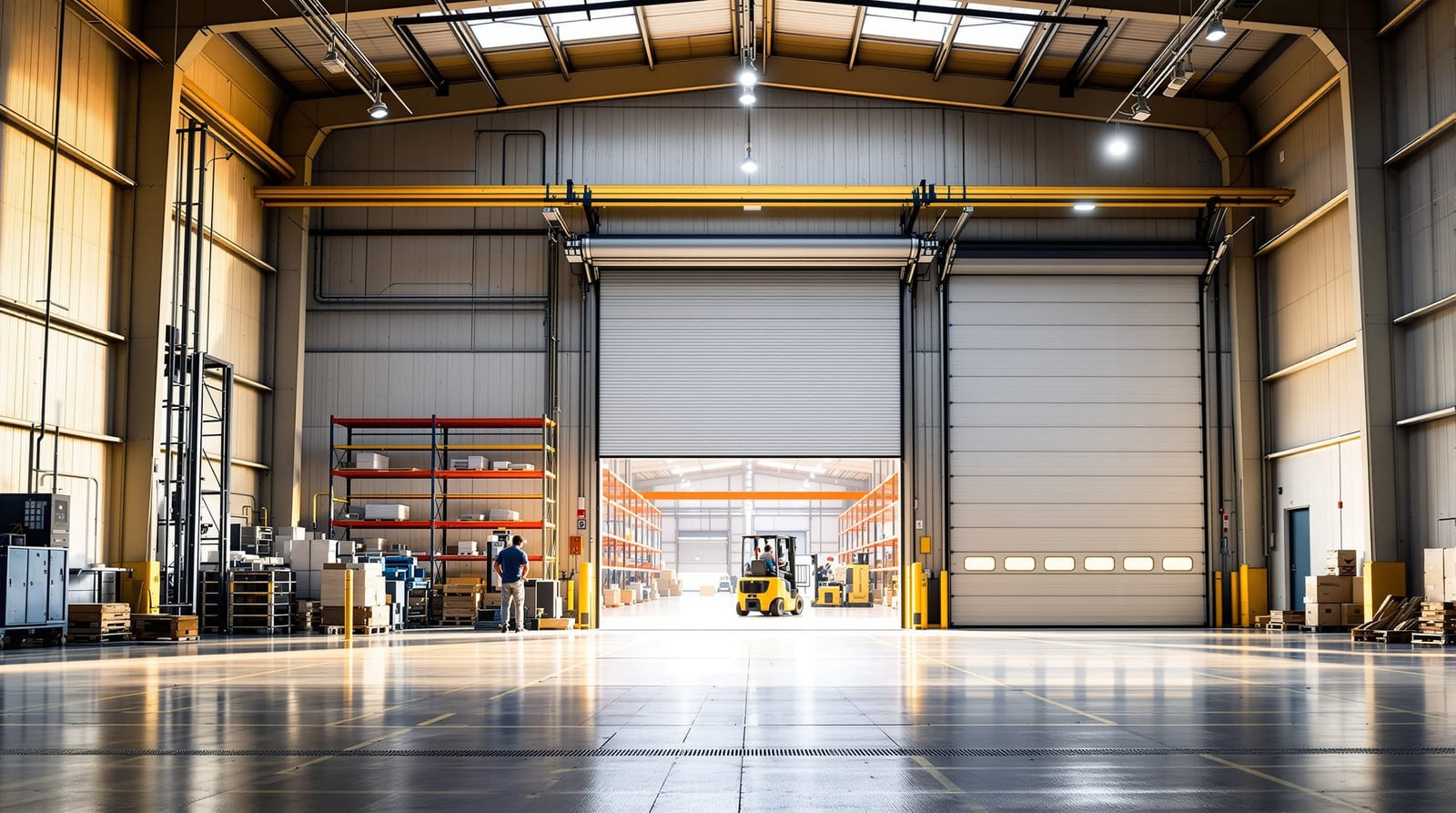
The figure compares the three large-opening doors that get confused most often: the high-speed roll-up (curtain coils fast, for throughput), the sectional overhead (insulated panels lift to the ceiling, for sealed loading bays), and the rolling shutter (steel laths coil for security and wide spans).
How to choose - a quick decision path
- Does the opening cycle many times an hour? If yes, a high-speed roll-up pays for itself in throughput and saved conditioned air, regardless of size.
- Is it a loading bay or a large insulated opening? Default to a sectional overhead door, paired with a dock leveller and shelter if a truck docks there.
- Is it an external opening that mainly needs security and rarely opens? A rolling shutter is the cheapest robust answer; pick the insulated or grille variant if thermal or ventilation matters.
- Do you only need to soften the transition between two zones? A strip curtain does it for a few thousand rupees, often alongside a real door.
- Does the opening sit on a fire-compartment line? It must be a fire shutter (large openings) or a fire-rated swing door to IS 3614 (personnel and rooms) - this overrides every other preference.
- Must you have airflow and security together? Use a mesh or grille door, usually backing up a solid door for closed hours.
This decision logic is exactly what the building guides apply: see factory doors in India for a production-line plant, warehouse doors in India for storage and logistics sheds, cold storage doors in India for chilled and freezer rooms, and loading dock doors in India for the truck interface. For the whole spectrum of buildings and spaces, see the doors-by-space guide for India.
Standards quick reference
- NBC 2016 - egress and exit widths by occupancy load, and exit doors opening in the direction of escape. A large vehicle shutter is never an egress door; provide compliant personnel fire exits separately.
- IS 3614 - fire-resistance ratings (30 / 60 / 90 / 120 min) for fire-check doors at compartment lines, plant rooms, electrical/battery rooms and stairwells; fire shutters carry their own certification.
- Factory and fire NOC - the local factory inspectorate and fire department govern escape routes, fire compartmentation and the number and width of personnel exits. Vehicle doors do not substitute for these.
- RPwD 2021 - where staff and visitor routes must be accessible, personnel doors need a clear width of at least 900 mm, lever handles and a threshold not exceeding 12 mm.
- Safety on powered doors - motorised industrial doors need photocell or light-curtain protection, a safety bottom edge, and a manual release for power failure.
Do and don't
- Do match the door to the cycle count - a high-cycle opening on a plain shutter will fail early and queue the operation; a low-cycle external opening on a high-speed door is wasted money.
- Do seal the dock as a system - door plus leveller plus shelter - or the insulated door alone still bleeds air around the truck.
- Do keep fire shutters and fire-rated doors clear of obstructions and never wedge them; a blocked drop zone fails inspection and defeats compartmentation.
- Don't treat a vehicle shutter as a fire exit - provide separate compliant personnel egress with panic hardware.
- Don't specify a single uninsulated shutter for a cold or conditioned space; pair an insulated door with a strip curtain for the constant traffic.
- Do specify safety photocells, a safety edge and a manual release on every powered door, and a maintenance contract for high-cycle units.
Frequently asked questions
What is the difference between a high-speed door and a sectional overhead door?
They solve different problems. A high-speed roll-up door exists for cycle speed - it opens and closes in seconds for high-traffic internal openings, busy docks and clean cells, but it insulates only moderately. A sectional overhead door exists for insulation and large clear openings - foam-core panels lift overhead and seal a loading bay or conditioned hall well, but it cycles more slowly. Busy and clean leans high-speed; insulated and large leans sectional, and many plants use both.
Which industrial door is the cheapest?
For zone separation, the strip curtain is by far the cheapest at a few thousand rupees an opening, but it is only a soft buffer. For a real closing door, the mild-steel rolling shutter is the lowest-cost robust barrier per square metre, which is why it is the default external door across Indian sheds - at the cost of slow operation and poor sealing. See shutter doors in India for the variants.
When is a fire shutter or fire-rated door legally required?
Wherever the building's fire scheme draws a compartment line across an opening. Large openings between fire compartments get a certified fire shutter that closes automatically on alarm; personnel openings, plant rooms, electrical and battery rooms and stairwells get a fire-rated swing door to IS 3614. These are inspected as part of the fire NOC and cannot be value-engineered away. Details in fire-rated doors in India.
How do I keep a cold store sealed while forklifts pass through constantly?
Use a layered approach: an insulated, gasket-sealed door for the slow, fully sealed close, and a strip curtain (or a high-speed door on a busy opening) for the constant traffic so the insulated door is not held open. The dedicated specification is in cold storage doors in India.
How are industrial doors priced - per door or per size?
Per opening size, far more than per "door." Large doors are quoted by the square metre of clear opening, with motorisation, insulation, wind class and safety devices added on top. A 4 x 4 m insulated sectional costs many times a 2 x 2 m one. Model your specific openings with the industrial door selector and the commercial door cost calculator.
Export this guide
Related Guides — Deep-dive reading
Fire-Rated Rolling Shutters & Fire Curtains India 2026
Galvanised steel-lath shutters and fabric fire curtains for large openings — ratings, gravity fail-safe descent, IS standards and motorisation explained for specifiers.
Home Doors & EntrancesWarehouse Door in India: Loading Dock, High-Speed Roll-Up and Fire Shutters for Logistics (2026)
A throughput-first guide to specifying doors for a warehouse or distribution centre in India - the loading-dock sectional door with leveller and seal at the core, high-speed roll-ups for fast forklift cycles, perimeter shutters, fire compartmentation and personnel exits - with indicative per-door and per-system costs.
Home Doors & EntrancesFactory Door in India: Material Gates, Production-Floor Roll-Ups, Personnel and Fire-Compartment Doors (2026)
A zone-by-zone guide to doors for a manufacturing plant in India - the big sliding or sectional material gates for trucks and forklifts, the high-speed and strip-curtain doors that separate dusty, hot or clean production zones, the steel and FRP personnel doors beside them, and the IS 3614 fire-compartment and panic-barred fire-exit doors - with indicative per-door and per-gate costs.
Home Doors & EntrancesRelated Tools — Try Free
Cross-Ventilation Analyzer
Estimate airflow and air changes per hour (ACH) from room size, window areas, layout, and local wind — with NBC 2016 Part 8 compliance check.
Ventilation CalculatorIndustrial Door Selector
Find the right industrial door by use — loading dock, high-speed, rolling shutter, cold-store or fire shutter.
Door ToolMotorized Curtain Cost Calculator
Estimate the all-in cost to motorise curtains — motors, tracks, hub and installation.
Cost Calculator