
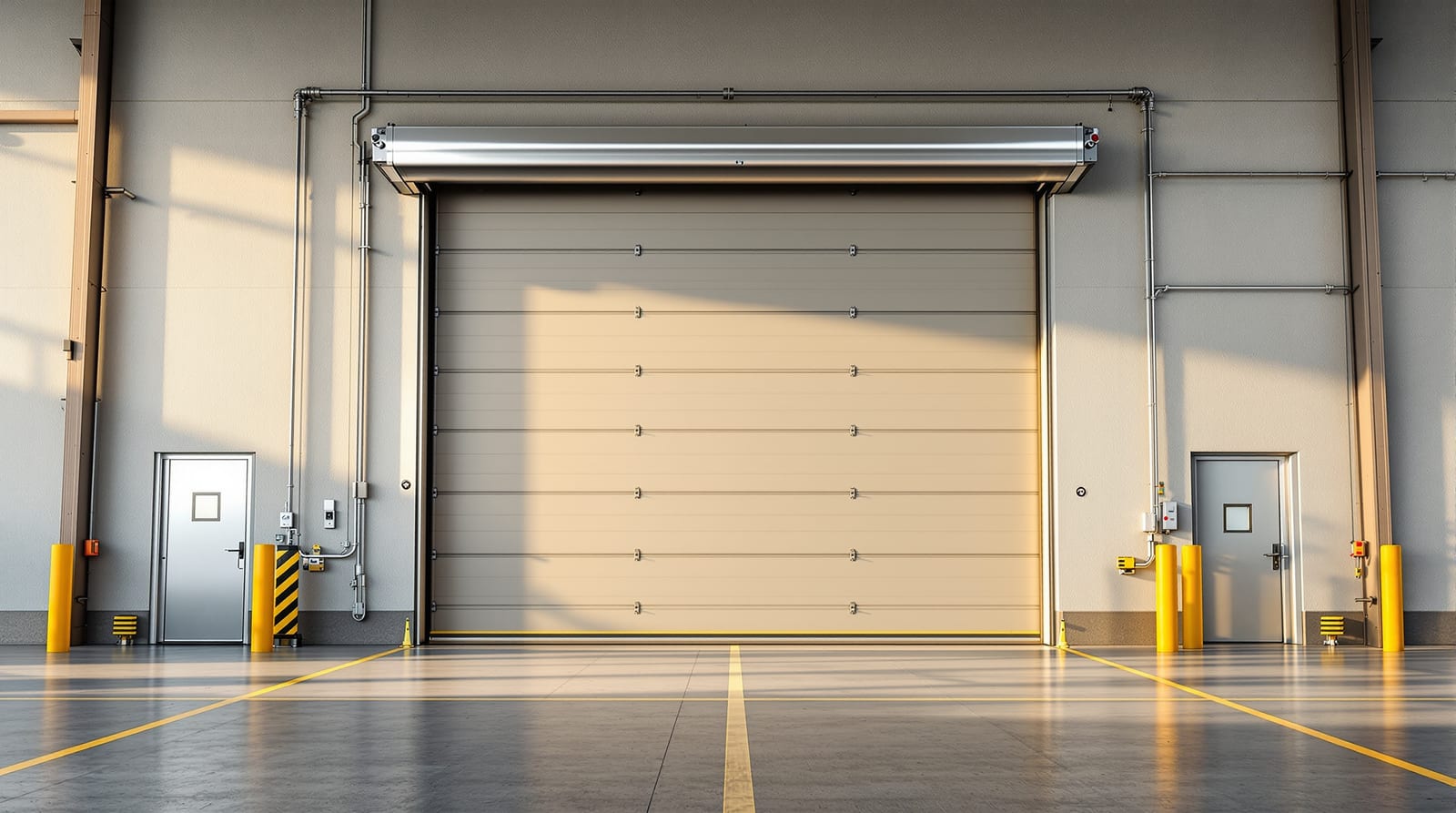
Factory Door in India: Material Gates, Production-Floor Roll-Ups, Personnel and Fire-Compartment Doors (2026)
A zone-by-zone guide to doors for a manufacturing plant in India - the big sliding or sectional material gates for trucks and forklifts, the high-speed and strip-curtain doors that separate dusty, hot or clean production zones, the steel and FRP personnel doors beside them, and the IS 3614 fire-compartment and panic-barred fire-exit doors - with indicative per-door and per-gate costs.
A factory is not one space with one door; it is a chain of zones - goods-in, raw-material store, the production floor itself, finishing and packing, electrical and utility rooms, offices and the perimeter - and each zone moves something different through its openings. Trucks and forklifts move pallets through the material gates. Dust, heat, fumes and air-pressure differences must be held back between production stages. Workers move on foot beside the machinery. And in an emergency, a hundred or more people have to get out of a building full of fire load in seconds. No single door does all of that, which is why specifying factory doors means walking the plant zone by zone and asking, for each opening, what passes through it, how fast, how often, and what must be kept on the other side. Pick the wrong door and you get a bottleneck that slows the whole line, a dust breach that scraps a batch, a forklift-smashed leaf that never closes again, or - worst of all - a fire compartment that fails. This guide ranks the right door for each factory zone, the driver behind each choice, the Indian codes that govern them, and what each costs in 2026. For the wider logic of matching a door to a building type, start with the master overview on choosing a door by space; this is its heavy-duty manufacturing application, and it sits right beside the broader industrial doors guide and the warehouse door guide.
The forces that shape every factory door
Every factory opening is decided by where it sits on these competing demands, and the balance shifts sharply from the truck dock to the clean packing room:
- Vehicle and forklift throughput. The dominant driver at the material gates. The door must be wide enough for a truck or a loaded forklift, open and close fast enough not to choke the line, and survive thousands of cycles a day. A slow or narrow gate is a permanent production bottleneck.
- Zone separation - dust, temperature, fumes and pressure. Inside the plant, doors exist to hold conditions apart: keep grinding dust out of the paint shop, keep the air-conditioned clean room sealed, stop hot-process heat bleeding into the assembly floor, maintain a pressure difference. This is what drives high-speed roll-ups and strip curtains.
- Worker safety and fire egress. Non-negotiable and code-bound. People on foot need their own personnel doors, never to walk through a forklift gate; and the building needs enough fire-rated compartment doors and panic-barred fire exits to evacuate the full occupant load fast under NBC 2016 and the Factories Act.
- Durability against industrial abuse. A factory door is hit, scraped, splashed with coolant, exposed to dust and chemicals, and cycled relentlessly. It must take that punishment for years, which rules out delicate finishes and rewards steel, FRP, galvanised slats and impact-tolerant high-speed fabric.
- Security. The perimeter and the finished-goods store hold value and must be locked down out of hours - heavy sliding gates, rolling shutters and multi-point steel doors form the secure skin.
- Fire compartmentation. A plant is divided into fire compartments so a blaze in one cannot spread; the doors between them must be IS 3614 fire-rated, self-closing, and never wedged open.
No product scores high on all of these, so a factory uses a different door for almost every zone - the table below ranks them.
Factory zones and the door each one needs
Read the plant as a flow of material from the dock through the floor to packing and despatch, wrapped in a secure, fire-compartmented skin with people moving on foot through it. The table below ranks the door for each zone against its dominant driver.
| Factory zone / opening | Recommended door | Dominant driver | Indicative ₹ (2026) |
|---|---|---|---|
| Main material gate (truck + forklift, slow) | Industrial sliding gate or rolling shutter, motorised | Wide vehicle access + perimeter security | 30,000-2,50,000+ by size/type |
| High-traffic material gate (rapid cycling) | Sectional overhead or high-speed roll-up door | Throughput + dust/temperature seal | 1,20,000-6,00,000+ |
| Production-zone separation (dust / temp / pressure) | High-speed PVC roll-up door | Fast cycling + tight zone seal | 1,50,000-5,00,000+ |
| Light dust / temperature break (no door needed) | PVC strip curtain | Cheap, instant pass-through, partial seal | 4,000-30,000 per opening |
| Personnel door beside a gate | Steel (MS) or FRP flush door, self-closing | Worker on-foot access, durability | 6,000-30,000 |
| Wet / chemical / wash-down area | FRP door | Corrosion + moisture resistance | 5,000-14,000 |
| Fire compartment (floor to floor / zone to zone) | IS 3614 fire-rated steel door, self-closing | Stop fire spread between compartments | 12,000-45,000+ |
| Fire exit / escape route | Fire-rated steel door + panic / push bar, outward swing | Fast egress of full occupant load | 14,000-45,000+ |
| Electrical / utility / server room | Fire-rated steel door, lockable | Fire isolation + restricted access | 12,000-35,000 |
| Finished-goods store / despatch | Rolling shutter or sectional door + steel personnel door | Security + bulk movement | 15,000-1,50,000+ |
The material gates: throughput and security
The material gates are where the factory meets the truck and the forklift, and the single biggest mistake is treating them as one type. How often the gate cycles decides everything.
A slow, occasional perimeter or despatch gate - opened a handful of times a shift for an incoming lorry - is best served by a motorised industrial sliding gate or a heavy rolling shutter. It is wide, strong, cheap relative to the alternatives, and doubles as the secure perimeter skin out of hours. The mechanics of sizing and motorising a shutter are in the shutter doors guide, and the broader span of heavy industrial openings is covered in the industrial doors guide.
A high-traffic internal or dock gate - cycled dozens or hundreds of times a shift as forklifts shuttle pallets - needs a sectional overhead door or a high-speed roll-up, because a slow shutter at this opening becomes the plant's worst bottleneck and bleeds conditioned or dust-controlled air every time it sits open. The sectional door panels lift overhead on tracks, insulate well and survive heavy use; the high-speed roll-up trades insulation for sheer cycle speed, opening in a second or two so the gap is open for the shortest possible time. For a plant that also feeds a loading bay, pair these with the despatch detailing in the warehouse door guide.
Whichever gate you choose, never make workers walk through it. A vehicle gate that people also use on foot is a serious crush and impact hazard, which is the whole reason for the personnel door below.
Production-floor separations: holding the zones apart
Inside the plant, the job of a door changes completely - it is no longer about vehicles, it is about keeping conditions on one side from contaminating the other while still letting forklifts and pallet trucks pass through constantly.
The premium answer is the high-speed PVC roll-up door. Its flexible curtain shoots up and drops in a second or two on photocell or loop-sensor triggers, so the opening between, say, a dusty grinding floor and a clean assembly bay, or an air-conditioned packing room and the general shop, is open only for the instant a forklift is actually passing. That tight, fast seal is what protects a clean zone, holds a temperature or pressure difference, and stops dust drifting between processes - and because the curtain is soft, a forklift that clips it usually breaks away and re-seats rather than wrecking the door. It is the most expensive interior factory door, but on a busy boundary it pays for itself in conditioned air saved and batches not scrapped.
Where the separation is lighter - a mild dust break, a modest temperature step, a pass-through that does not justify a powered door - the cheap and effective tool is the PVC strip curtain: overlapping flexible strips a forklift or worker simply pushes through, that fall back to close the gap. Strip curtains cost a few thousand rupees per opening, need no power, and partially hold back dust, draughts, insects and noise. Many plants combine the two - a high-speed door on the critical clean boundary, strip curtains on every minor internal opening. For fume- or heat-heavy openings, a louvered or ventilated leaf may also be used; see the louvered doors guide.
Personnel, FRP and utility-room doors
Beside almost every big material gate there must be a personnel door - the on-foot route so a worker never walks through a moving-vehicle opening. In a factory this is almost always a steel (MS) flush door or an FRP door, both chosen for durability rather than looks: a self-closing leaf that takes knocks, resists the plant environment, and meets the at-least-900 mm clear width a habitable working opening needs under NBC 2016 and RPwD 2021, with a lever handle and a low threshold. The case for steel as the factory workhorse is in the steel doors guide.
For wet, chemical, wash-down and corrosive areas - electroplating, food and pharma wet processes, battery rooms, areas hosed down daily - the better personnel door is FRP (fibre-reinforced plastic), which does not rust, swell or rot, shrugs off moisture and many chemicals, and wipes clean. It is detailed in the FRP doors guide.
Electrical, utility and server rooms inside a plant are a special case: they are fire-isolated and access-restricted, so they take a fire-rated steel door, lockable, often the same IS 3614 leaf used for compartmentation. A transformer or panel room fire must be contained, and only authorised staff should enter.
Fire compartment and fire-exit doors: the doors that save lives
A manufacturing plant carries heavy fire load and high occupancy, so it is divided into fire compartments - and the doors between them are life-safety equipment, not convenience. Under IS 3614 these are fire-rated steel (or treated-timber) leaves with intumescent seals, rated 30, 60, 90 or 120 minutes, fitted self-closing so they are never left open, placed between fire compartments, on stairwells and escape routes, and on electrical and server rooms. The single most common - and most dangerous - violation in Indian factories is a fire compartment or fire-exit door wedged, chained or blocked open; it defeats the entire compartmentation strategy. The ratings and selection logic are in the fire-rated doors guide.
The fire exits themselves must let the plant's full occupant load out fast. Under NBC 2016 they are fire-rated steel doors fitted with panic / push bars, swinging outward in the direction of escape, sized for the occupancy load, never locked from the inside, and kept clear of stored material. The rule that overrides every security instinct: a fire exit must release instantly from the inside even though it resists or is monitored from outside - so it may be alarmed, but never chained. The egress detailing is covered in the fire-exit doors guide.
Costs in 2026 (indicative, varies by size, type and city)
| Door / gate | Indicative cost | Notes |
|---|---|---|
| Industrial sliding gate / heavy rolling shutter | ₹30,000-2,50,000+ | By width, slat type, motorised vs manual |
| Sectional overhead door | ₹1,20,000-5,00,000+ | Insulated panels, overhead tracks |
| High-speed roll-up door (interior or dock) | ₹1,50,000-6,00,000+ | Fast cycle, dust/temperature seal |
| PVC strip curtain | ₹4,000-30,000 per opening | Cheap partial dust/draught/insect break |
| Personnel door - steel (MS) | ₹6,000-30,000 | Self-closing, durable, beside the gate |
| Personnel door - FRP (wet/chemical) | ₹5,000-14,000 | Rust- and moisture-proof, wipe-clean |
| Fire compartment / fire-exit door | ₹12,000-45,000+ | IS 3614, self-closing; panic bar on exits |
| Electrical / utility / server room door | ₹12,000-35,000 | Fire-rated steel, lockable |
| Finished-goods store shutter / sectional | ₹15,000-1,50,000+ | Security + bulk movement |
Add 18% GST on supply. The big-ticket items are the high-speed and sectional doors; strip curtains and steel personnel doors are modest. Price the gates, personnel and fire doors with the commercial door cost calculator, and check which openings legally need a fire-rated leaf with the fire-door requirement checker.
Do and don't for factory doors
- Do specify the material gate by how often it cycles - a slow shutter for an occasional perimeter gate, a sectional or high-speed door for any opening forklifts use constantly.
- Do fit a separate steel or FRP personnel door beside every vehicle gate so workers never walk through a moving-vehicle opening.
- Do use high-speed roll-ups and strip curtains to hold dust, temperature and pressure between production zones - the fast seal saves conditioned air and scrapped batches.
- Do choose FRP for wet, chemical and wash-down areas and steel for general durability.
- Do keep every IS 3614 fire compartment and fire-exit door self-closing, outward-swinging at exits, and panic-barred - sized for the full occupant load.
- Don't ever wedge, chain or block a fire compartment or fire-exit door open or shut - it is the most common and most lethal factory door violation.
- Don't let a slow gate at a high-cycle opening become the line's bottleneck, or a rigid door sit where a forklift will eventually smash it - use a break-away high-speed leaf.
For the related building-type applications of these same ideas, the industrial doors guide covers the full heavy-duty door family, the warehouse door guide covers storage and despatch, and the doors-by-space master guide places this factory logic in the wider family of commercial and industrial spaces. To shortlist the right product for each opening, run the industrial door selector.
Frequently asked questions
What type of door is best for a factory material gate in India?
It depends on how often the gate cycles. A slow, occasional perimeter or despatch gate is best served by a motorised industrial sliding gate or heavy rolling shutter - wide, strong and secure out of hours. A high-traffic gate that forklifts use constantly needs a sectional overhead door or a high-speed roll-up, because a slow shutter there becomes the plant's worst bottleneck and bleeds dust-controlled or conditioned air every time it sits open.
How do factories keep dust and temperature from spreading between zones?
With high-speed PVC roll-up doors on the critical boundaries and PVC strip curtains on the minor ones. A high-speed door opens and shuts in a second or two as a forklift passes, so the gap between, say, a dusty floor and a clean packing room is open only for an instant. Strip curtains are overlapping flexible strips you simply push through - cheap, powerless, and good for a light dust, draught or insect break.
Do factory workers use the same doors as forklifts?
No, and they must not. A vehicle gate that people also walk through is a serious crush and impact hazard. Every big material gate should have a separate personnel door - usually a steel (MS) or FRP self-closing flush door at least 900 mm clear - right beside it, so workers on foot have their own safe route.
Which factory doors must be fire-rated in India?
Under IS 3614 and NBC 2016, fire-rated self-closing doors are required between fire compartments, on stairwells and escape routes, on electrical, transformer and server rooms, and at fire exits (where they also need panic / push bars and outward swing). They carry 30-, 60-, 90- or 120-minute ratings by location. They must never be wedged, chained or blocked open - doing so defeats the whole compartmentation strategy and is the most common factory fire violation.
How much does a factory door cost in India in 2026?
Indicatively: an industrial sliding gate or heavy rolling shutter ₹30,000-2,50,000+, a sectional overhead door ₹1,20,000-5,00,000+, a high-speed roll-up ₹1,50,000-6,00,000+, a PVC strip curtain ₹4,000-30,000 per opening, a steel or FRP personnel door ₹5,000-30,000, and an IS 3614 fire/fire-exit door ₹12,000-45,000+. Add 18% GST. Figures are indicative and vary by size, type, city and vendor.
Export this guide
Related Guides — Deep-dive reading
Industrial Doors in India: The Heavy-Duty Door Menu and How to Choose (2026)
High-speed roll-up, sectional overhead, rolling shutters, strip curtains, fire shutters and dock doors - the complete industrial door menu, ranked by the driver that decides it (cycle speed, load and size, thermal and dust separation, fire compartmentation, security and durability), with indicative per-door costs.
Home Doors & EntrancesFire Exit Doors in India: NBC 2016 Egress, Panic Bars & Costs (2026)
How fire exit and emergency egress doors must be sized, swung, hardware-fitted and signed to NBC 2016 Part 4 in Indian buildings, and what they cost.
Home Doors & EntrancesEmergency Exit Planning in India (2026): Number of Exits, Travel Distance & Two-Way Escape
The building-scale means of egress that a home escape plan sits inside: why you need two independent, remote exits, how travel distance and exit width scale with occupant load, and why exits must open outward, discharge to safety, and never be locked.
SecurityRelated Tools — Try Free
Fire Door Rating Checker
See the likely fire-door rating (30/60/90/120 min) and components a location needs per IS 3614 / NBC — guidance, confirm with your architect.
Compliance ToolFire Door Requirement Checker
See where fire doors are required and what rating and egress hardware your building needs, per NBC 2016 and IS 3614.
Door ToolAccessible Door Checker
Check a door against wheelchair-accessibility guidance — clear width, threshold, handle and closer force per RPwD 2021.
Compliance Tool