
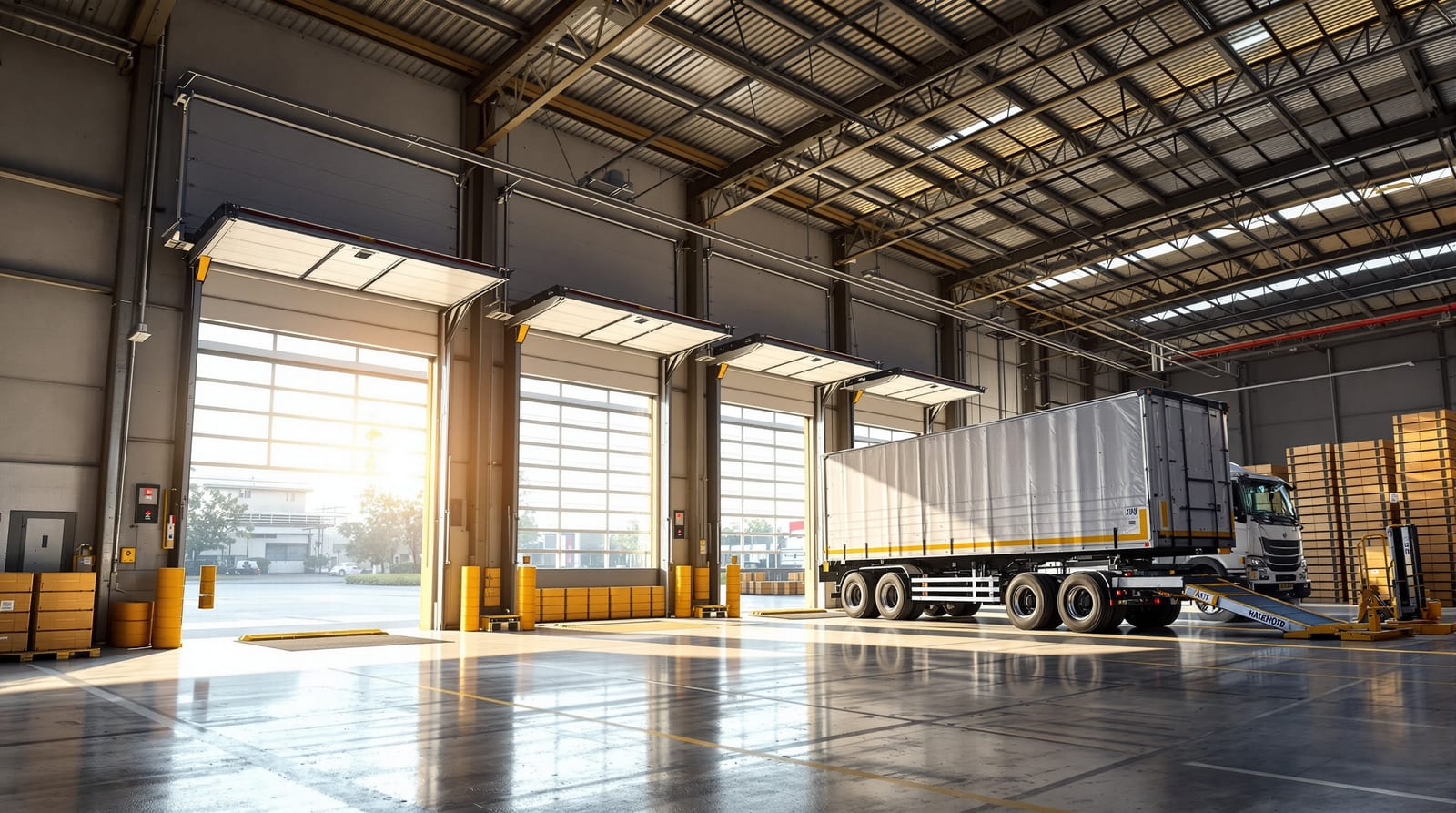
Warehouse Door in India: Loading Dock, High-Speed Roll-Up and Fire Shutters for Logistics (2026)
A throughput-first guide to specifying doors for a warehouse or distribution centre in India - the loading-dock sectional door with leveller and seal at the core, high-speed roll-ups for fast forklift cycles, perimeter shutters, fire compartmentation and personnel exits - with indicative per-door and per-system costs.
In a warehouse, a door is not a piece of architecture - it is a valve in a flow of goods, and every second it costs is multiplied by hundreds of cycles a day. A distribution centre with a forklift crossing an internal opening every ninety seconds cannot afford a door that is slow to open, leaks conditioned air, jams under traffic or fails to seal a backed-in trailer against rain and pilferage. So the warehouse door is chosen on one ruthless metric above all: throughput - how fast goods get in and out without losing energy, security or safety. The most important door is not at the perimeter at all; it is the loading dock, where the sectional overhead door, the dock leveller and the dock seal work as one system to bridge a truck to the building. Around that core sit high-speed roll-ups for rapid internal forklift cycles, rolling shutters for night security, fire shutters that stop a fire spreading across a vast open shed, and personnel and fire-exit doors for the people. This guide walks the warehouse opening by opening, ranks the right door for each, gives the Indian codes, and prices each in 2026. For the broader logic of matching a door to its building type, start with the master overview on choosing a door by space; the warehouse is its highest-throughput, most load-driven application, and it shares much with the factory door and the wider industrial doors family.
The forces that shape every warehouse door
A warehouse door is decided by where it sits on these competing demands, and the balance shifts from the dock to the interior to the perimeter:
- Dock throughput and sealing. The defining force at the loading bay. The door must open fast, bridge cleanly to the trailer bed via a leveller, and seal the gap around the truck against rain, heat, dust, insects and pilferage so a forklift can run straight in and out. A poorly sealed dock bleeds money in damaged goods and lost cooling on every load.
- Fast cycle speed for forklift traffic. The dominant driver on internal openings. Where a forklift crosses dozens or hundreds of times a shift, the door has to open and close in two or three seconds - hence high-speed roll-ups - both to keep traffic moving and to keep climate-separated zones from sharing air.
- Thermal and energy separation. Warehouses increasingly run temperature-controlled zones, and Indian electricity and diesel-genset costs make air leakage expensive. Insulated panels, fast cycling and tight seals keep cold (or simply cooler) air where it belongs - the logic in the energy-efficient doors guide.
- Fire compartmentation. A warehouse is a single enormous volume packed with combustible stock, so NBC 2016 demands that openings between fire compartments and across escape routes can be sealed by fire-rated shutters and doors so a fire cannot run the length of the shed.
- Perimeter security. A shed full of unattended saleable goods overnight needs a hard, pry-resistant skin - rolling shutters and steel doors that lock the building down.
- Durability and impact resistance. Forklifts hit doors. Tracks fill with dust and grit. A warehouse door must survive years of knocks, heavy duty cycles and an abrasive environment without constant downtime.
No single product scores high on all of these, which is exactly why a warehouse uses a layered set of doors - a dock system at the bays, fast roll-ups inside, fire shutters across the compartments, and a hard shutter-and-steel skin at the perimeter.
The loading dock: the core warehouse door system
The loading dock is the warehouse's whole reason for existing, and its door is never one product - it is a three-part system that has to work together, sized to the trucks you receive:
- The dock door itself is almost always a sectional overhead door - horizontal insulated panels that lift on tracks and stack flat against the ceiling, so they take no floor or side space and clear the forklift path completely. Insulated panels (typically 40 mm polyurethane-filled steel) keep heat and dust out and any conditioned air in; a vision panel or full-glazed section lets the dock crew see the truck. The sectional door is preferred over a plain rolling shutter at the dock precisely because it insulates and seals far better. Its mechanics are covered in the shutter doors guide, which includes sectional and roll-up types.
- The dock leveller is the hinged or telescopic-lip steel platform that bridges the height difference and the gap between the raised dock floor and the trailer bed, so a forklift can drive straight from warehouse to truck and back. Without it, every load is hand-bombed. Levellers are sized by capacity (6-10 tonne typical) and travel.
- The dock seal or dock shelter is the cushioned foam pad or retractable curtain frame fitted around the door opening that the backing truck compresses against, closing the gap around the trailer. This is what actually keeps rain, heat, insects, dust and thieving hands out of the loaded gap - and in a chilled DC, keeps the cold in. A seal suits one trailer size; a shelter flexes to many.
Specify all three to the trucks you handle. A dock without a leveller is slow; a dock without a seal leaks weather and security on every load. Many Indian DCs also add a dock light, wheel chocks or a vehicle restraint, and a traffic light so the forklift driver and truck driver coordinate safely - the door is the centre of a small safety choreography, not a standalone panel.
Warehouse openings and the door each one needs
Read the warehouse as a perimeter skin, a set of dock bays, an internal flow of forklift traffic across zones, and a fire-compartment grid laid over the whole shed. The table below ranks the door for each opening against its dominant driver.
| Opening | Recommended door | Function / why | Indicative ₹ (2026) |
|---|---|---|---|
| Loading dock bay | Insulated sectional overhead door + dock leveller + dock seal/shelter | Bridge and seal truck to building; throughput + weather + security | Sectional door 60,000-2,50,000; leveller 1,50,000-5,00,000+; seal/shelter 40,000-1,50,000 |
| Internal high-traffic opening (forklift) | High-speed roll-up door (PVC/fabric) | 2-3 sec cycle; keeps traffic moving + zones separated; self-repairing | 1,50,000-6,00,000+ |
| Cold / temperature zone opening | Insulated high-speed or cold-room sliding door + strip curtain | Thermal separation, fast cycle, gasket seal | 2,00,000-8,00,000+ (see cold-storage guide) |
| Perimeter goods / vehicle entry | Motorised MS rolling shutter | Wide vehicle access by day, hard lockdown by night | 25,000-2,00,000+ by size/motor |
| Fire-compartment opening | IS 3614 fire-rated rolling shutter / fire door | Seals on alarm; stops fire spreading across the shed | 45,000-3,00,000+ by width/rating |
| Personnel / wicket door | Flush or steel single door (often a wicket in the shutter) | People in/out without raising the big door | 4,000-30,000 |
| Fire exit | IS 3614 fire-rated steel door + panic bar, outward swing | Egress only; instant release inside, resists entry | 14,000-45,000+ |
| Office / mezzanine doors | Flush or glass partition doors | Admin areas, supervisor cabins | 3,000-25,000 |
High-speed doors: the throughput door for the interior
Where a forklift crosses an opening dozens or hundreds of times a shift, the right door is a high-speed roll-up - a flexible PVC or fabric curtain that rolls up and down in two to three seconds, far faster than any rigid panel. Its job is throughput and separation: it stays shut almost all the time so the two sides of the opening keep their own temperature, dust level and pressure, then snaps open the instant a forklift or AGV approaches (triggered by a loop, radar or remote) and snaps shut behind it. The speed is the point - a slow door that sits open while a forklift queues bleeds conditioned air and stalls traffic. Good high-speed doors are self-repairing: if a forklift hits the curtain, it pops out of its guides and re-seats on the next cycle instead of being wrecked, which matters enormously in a busy aisle. They are the standard internal door between a chilled and ambient zone, between a clean despatch area and a dusty bulk-store, and at busy internal bay openings.
For genuinely temperature-controlled work - chilled and frozen rooms - the high-speed door is insulated and paired with a gasket-sealed cold-room door and strip curtains; that whole specification, including frost control and the cold/freezer door types, lives in the cold storage door guide. Treat the high-speed door as the warehouse's internal-flow workhorse and the sectional as its external-dock workhorse.
Perimeter security, fire compartmentation and personnel doors
Perimeter security skin. Beyond the docks, a warehouse needs a hard night skin over its vehicle and goods openings. The default is a motorised mild-steel rolling shutter - wide enough to admit a truck or a goods trolley by day, dropped and locked at night to turn the shed into a sealed box. Size, slat type and motorisation are covered in the shutter doors guide; cost and size it with the rolling shutter cost calculator. Pedestrian-scale perimeter and service openings use heavy steel security doors with multi-point locks - see the steel doors guide.
Fire compartmentation. Because a warehouse is one vast volume of combustible stock, NBC 2016 and the local fire NOC require that openings in fire walls and across escape routes close automatically in a fire. That means IS 3614 fire-rated rolling shutters (released by fusible link or the fire-alarm panel) across large compartment openings, and fire-rated doors on stairwells, the office block and any high-hazard store. The full fire-door specification - ratings, intumescent seals, self-closers - is in the fire-rated doors guide, and the egress logic in the fire exit doors guide. The shutter must never be obstructed by racking or pallets in its drop zone.
Personnel and wicket doors. Staff should never have to raise a big sectional or shutter just to walk in and out, so each major opening gets a personnel door - often a hinged wicket door built into the shutter or sectional leaf - and the building has its own fire-exit doors with panic bars opening outward in the direction of escape, per NBC occupant-load rules. Keep at least 900 mm clear width on accessible personnel routes, lever or push hardware, and a threshold under 12 mm where people and pallet trucks pass, per RPwD 2021 and the accessible doors guide.
Costs in 2026 (indicative, varies by size, spec and city)
| Door / system | Indicative cost | Notes |
|---|---|---|
| Insulated sectional dock door | ₹60,000-2,50,000+ | Per bay; 40 mm insulated panels, vision section, manual or motorised |
| Dock leveller | ₹1,50,000-5,00,000+ | Hydraulic/mechanical; by capacity (6-10 t) and travel |
| Dock seal / dock shelter | ₹40,000-1,50,000+ | Foam seal (one trailer size) or retractable shelter (many) |
| High-speed roll-up door | ₹1,50,000-6,00,000+ | PVC/fabric, self-repairing, by size and cycle speed |
| Insulated / cold-zone high-speed door | ₹2,00,000-8,00,000+ | Thermal curtain; see cold-storage guide |
| Motorised MS rolling shutter (perimeter) | ₹25,000-2,00,000+ | By size; motor adds cost over push-up |
| Fire-rated rolling shutter / fire door | ₹45,000-3,00,000+ | IS 3614; by width and rating (60/90/120 min) |
| Personnel / wicket door | ₹4,000-30,000 | Flush or steel; wicket within shutter costs more |
| Fire exit door (panic bar) | ₹14,000-45,000+ | IS 3614 steel, outward swing, push bar |
Add 18% GST on supply. The dock system (door + leveller + seal) is the single biggest line per bay, and it is repeated for every bay - a ten-bay DC is a major capital item, so size the trucks and throughput before you specify. Price the docks, shutters and fire shutters together with the commercial door cost calculator, and shortlist the right door for each opening against its driver with the industrial door selector.
Do and don't for warehouse doors
- Do treat the loading dock as a three-part system - sectional door plus leveller plus seal/shelter - sized to the trucks you actually receive, not as a bare door.
- Do use high-speed roll-up doors on busy internal forklift openings - the two-to-three-second cycle pays back in throughput and in conditioned air kept in its zone.
- Do insulate the dock and cold-zone doors and add strip curtains where temperature separation matters; air leakage is a running cost in Indian heat and on chilled stock.
- Do put fire-rated shutters across fire-compartment openings and keep their drop zones permanently clear of racking and pallets.
- Do give every big opening a personnel or wicket door so staff never raise the main leaf to walk through, and provide code-compliant outward-swinging fire exits with panic bars.
- Don't fit a plain uninsulated rolling shutter at a loading dock and call it done - it leaks weather, energy and security around the truck.
- Don't let a high-speed door sit open as a workaround for a slow trigger, and don't block any shutter's track or drop path with stored goods.
- Don't chain or lock fire exits "for security"; it is illegal and lethal, and a separate locked perimeter shutter already gives you the security.
For the related building-type applications of these same ideas, the factory door guide covers production-floor and process openings, the industrial doors guide gives the full mechanism family, the loading dock door guide goes deeper on the dock system itself, the cold storage door guide covers temperature-controlled stores, and the doors-by-space master guide places this warehouse logic in the wider family of commercial and industrial spaces.
Frequently asked questions
What is the best door for a warehouse loading dock in India?
An insulated sectional overhead door, paired with a dock leveller and a dock seal or shelter, sized to the trucks you receive. The sectional door insulates and seals far better than a plain rolling shutter, lifts flat to the ceiling to clear the forklift path, the leveller bridges the height gap to the trailer bed, and the seal closes the gap around the backed-in truck against rain, heat, dust and pilferage. The three work as one system.
Why use a high-speed door instead of a normal shutter inside a warehouse?
Throughput and energy. A high-speed roll-up opens and closes in two to three seconds, so a forklift crossing an opening dozens or hundreds of times a shift never queues, and the door stays shut between cycles to keep each zone's temperature, dust and pressure separate. Most are self-repairing - if a forklift clips the curtain it re-seats on the next cycle instead of being destroyed - which a rigid shutter cannot do.
What fire-door rules apply to a warehouse in India?
A warehouse is a large combustible volume, so NBC 2016 and the local fire NOC require openings in fire walls and across escape routes to close automatically in a fire. That means IS 3614 fire-rated rolling shutters (released by fusible link or alarm) across compartment openings and fire-rated doors on stairwells and the office block, plus outward-swinging fire-exit doors with panic bars sized to the occupant load. Keep shutter drop zones clear and never lock or chain a fire exit.
Do I need to insulate warehouse doors?
If you run any temperature-controlled zone, or simply want to limit cooling and energy loss in Indian heat, yes. Insulated sectional dock doors, insulated high-speed doors between zones and gasket-sealed cold-room doors with strip curtains all keep conditioned air where it belongs. For ambient bulk storage the priority shifts to speed, durability and security rather than insulation.
Export this guide
Related Guides — Deep-dive reading
Industrial Doors in India: The Heavy-Duty Door Menu and How to Choose (2026)
High-speed roll-up, sectional overhead, rolling shutters, strip curtains, fire shutters and dock doors - the complete industrial door menu, ranked by the driver that decides it (cycle speed, load and size, thermal and dust separation, fire compartmentation, security and durability), with indicative per-door costs.
Home Doors & EntrancesCold Storage Doors in India: Insulated Cold-Room and Freezer Doors That Actually Seal (2026)
How to specify cold-room and freezer doors for Indian warehouses, food plants and pharma stores - PUF-insulated sliding and hinged doors, heated-frame sub-zero freezer doors, high-speed insulated roll-ups for traffic, strip and PVC curtains as a buffer, pressure-relief ports and the inside safety release that stops anyone being trapped - with indicative per-door costs by temperature band.
Home Doors & EntrancesHigh-Speed Doors in India: Rapid Roll-Up Guide (India 2026)
How rapid roll-up and spiral doors opening at 1-3 m/s cut energy loss, dust and downtime in Indian cold-chain, pharma and factory plants.
Home Doors & EntrancesRelated Tools — Try Free
Industrial Door Selector
Find the right industrial door by use — loading dock, high-speed, rolling shutter, cold-store or fire shutter.
Door ToolAccessible Door Checker
Check a door against wheelchair-accessibility guidance — clear width, threshold, handle and closer force per RPwD 2021.
Compliance ToolFalse Ceiling Cost Estimator
Live ₹/sqft across 8 ceiling types — POP, gypsum, designer, metal, PVC, wooden — with cove and spot lighting for 20 Indian cities.
Cost Calculator