
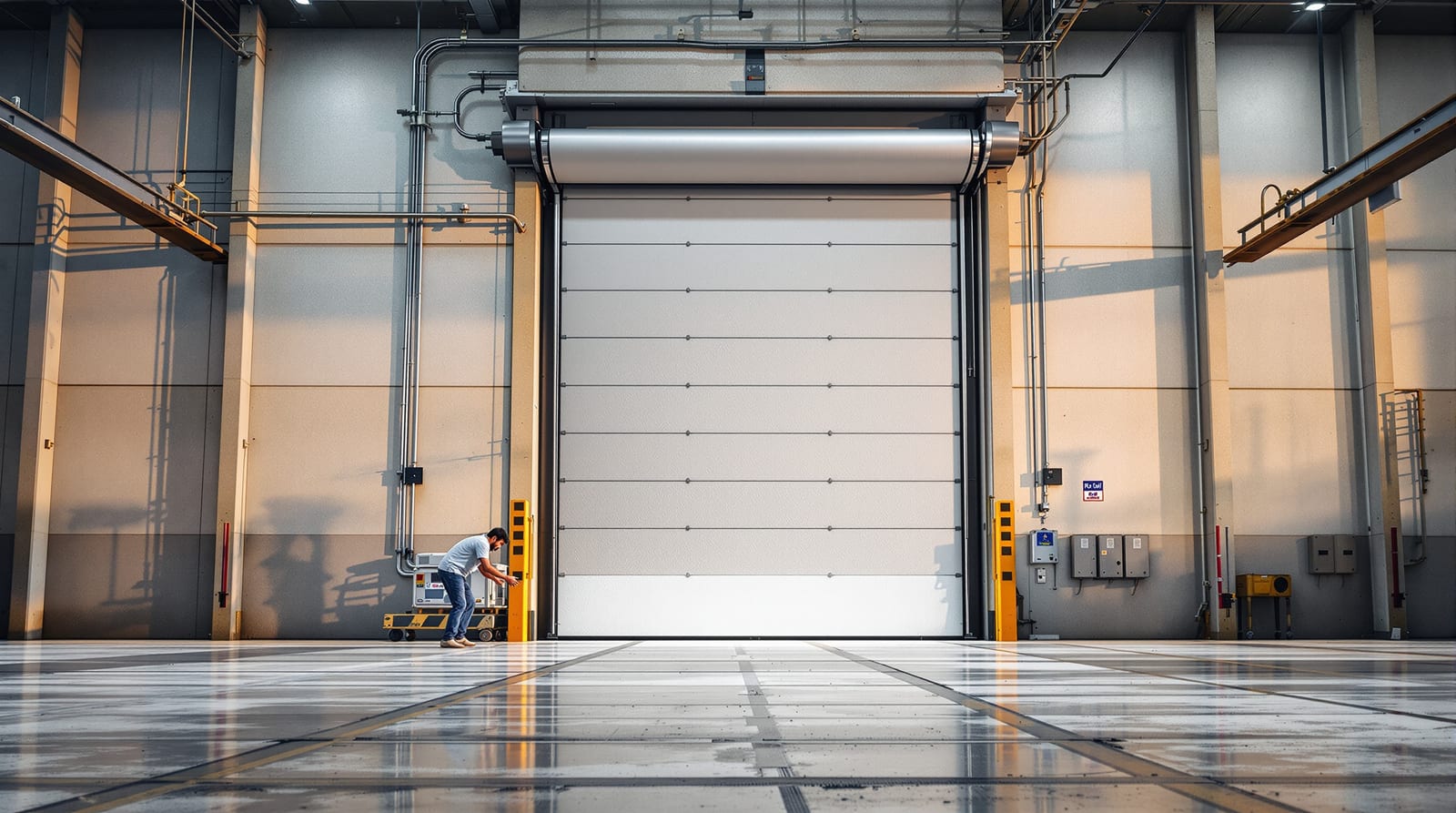
Cold Storage Doors in India: Insulated Cold-Room and Freezer Doors That Actually Seal (2026)
How to specify cold-room and freezer doors for Indian warehouses, food plants and pharma stores - PUF-insulated sliding and hinged doors, heated-frame sub-zero freezer doors, high-speed insulated roll-ups for traffic, strip and PVC curtains as a buffer, pressure-relief ports and the inside safety release that stops anyone being trapped - with indicative per-door costs by temperature band.
In a cold store the door is not a door - it is a section of the insulated envelope that happens to move. Every time it opens, warm humid Indian air rushes in, the refrigeration plant fights to pull the temperature back down, and ice starts forming on the frame, the floor and the gasket. A badly chosen cold-room door is the single biggest energy leak and the commonest reason a freezer slowly frosts itself shut. For pharma and food chains it is also a compliance line item: the cold chain only holds if the door holds. This guide tells you exactly how to specify cold storage and freezer-room doors in India - the insulation, the seal, the heated frame, the traffic buffer and the inside safety release - with indicative rupee costs by temperature band.
What a cold storage door actually has to do
Treat the door as six overlapping jobs, ranked by what hurts the cold chain fastest:
1. Insulate (hold the R-value of the wall it sits in). The leaf must match the panel insulation - typically a PUF or PIR core, 60-150 mm thick depending on the room temperature. A thin door in a thick wall is a permanent thermal short circuit.
2. Seal airtight, every cycle. A continuous perimeter gasket (and a heated gasket below zero) is what stops warm air infiltration. The seal, not the panel, is where most real-world energy is lost.
3. Stop ice-locking below zero. In freezer rooms the frame, gasket and threshold are electrically heated so condensation cannot freeze the door shut. Without a heated frame, a minus-20 door welds itself closed within days.
4. Buffer traffic. Forklifts and trolleys move constantly. A fast-acting or hands-free door plus a strip/PVC curtain keeps the opening time and the air exchange minimal.
5. Manage pressure. Cooling a sealed room creates a partial vacuum that can make the door almost impossible to open; rapid temperature swings build pressure. A pressure-relief (vacuum-relief) port equalises it.
6. Keep people safe. Nobody must ever be trapped inside a cold or freezer room. An inside safety release (glow handle / push-to-exit that overrides any lock) is non-negotiable, plus a man-trapped alarm in walk-in freezers.
Hygiene and durability ride alongside all six: food-grade GI or stainless skins, washable finishes, and impact protection where trolleys hit.
The door types, ranked for cold storage
There is no single cold-room door. You pick by temperature band and by how heavy the traffic is. Most facilities use a combination - a sealed insulated main door plus a high-speed door or strip curtain for the working opening.
Insulated hinged (swing) cold-room door. The workhorse for chillers and small to mid cold rooms (around 0 to 8 °C), and for personnel access. PUF/PIR core, GI or stainless skins, a cam-lift hinge that lifts and presses the leaf onto a continuous gasket, and an inside safety release as standard. Simple, cheap, reliable.
Insulated sliding cold-room door. The standard for larger openings and forklift traffic, chiller or freezer. Slides clear of the opening, so it suits wide pallet doors. Below zero it gets a heated frame and heated gasket. Can be manual, push, or motorised with a pull-cord / motion sensor for hands-free trolley access. This is usually the right answer for the main pallet opening of a cold store.
Freezer (sub-zero) door. A sliding or hinged door built specifically for minus-18 to minus-25 °C blast and storage freezers: thicker core (often 125-150 mm), low-temperature silicone gaskets that stay flexible when frozen, and a fully heated perimeter frame, threshold and gasket to defeat ice-locking. Always paired with a pressure-relief port and an inside release.
High-speed insulated roll-up door. The traffic door. An insulated fabric or panel curtain that opens and closes in 1-2 seconds on a sensor or pull-cord, drastically cutting air exchange on busy openings. Often fitted just behind a main sliding door, or as the working face with the slider as the night/secure door. The cold-chain version is insulated and, for freezers, heated.
Strip / PVC curtain (the buffer, not the door). Overlapping flexible PVC strips - low-cost, hung in the opening behind or in front of the real door. They are a buffer that cuts air exchange while a door is open or while forklifts pass, not a seal in themselves. Use freezer-grade (low-temperature) PVC below zero so the strips do not crack.
Insulated sectional / dock door. Where the cold store meets the outside or a loading bay, an insulated sectional overhead door with a dock leveller and an inflatable dock shelter keeps the temperature line at the truck. See loading dock door in India for the bay side of this junction.
For the leaf material logic behind the food-grade skins and FRP options, see steel doors in India and FRP doors in India; for the wider heavy-door menu these sit within, industrial doors in India and warehouse door in India.
Inline section: how a cold-room door is built
Recommendation table: which cold storage door for which room
Match the door to the room temperature and the traffic. Costs are indicative, per door, 2026, including frame, gasket and basic fitting; add about 18% GST and the heating element / motorisation where noted. Costs vary widely by size, skin material and city.
| Room / use | Temp band | Door type | Insulation core | Indicative cost (₹ per door) | Why this one |
|---|---|---|---|---|---|
| Personnel / small chiller | +2 to +8 °C | Insulated hinged cold-room door | 60-100 mm PUF/PIR | 18,000 - 55,000 | Cheap, reliable, inside release; fine for low traffic |
| Main chiller pallet opening | 0 to +8 °C | Insulated sliding door (manual/motorised) | 80-100 mm PUF | 45,000 - 1,40,000 | Clears wide opening for forklifts; hands-free option |
| Freezer / cold room | -18 to -25 °C | Sub-zero sliding/hinged + heated frame | 100-150 mm PUF/PIR | 90,000 - 3,00,000+ | Heated frame, gasket and threshold stop ice-locking |
| Blast freezer | -30 to -40 °C | Heavy heated sliding freezer door | 150 mm+ PIR | 1,80,000 - 5,00,000+ | Maximum insulation + full heating; relief port essential |
| Busy traffic opening | Any | High-speed insulated roll-up | Insulated curtain | 2,00,000 - 6,00,000+ | 1-2 s cycle cuts air exchange; pairs with a main door |
| Buffer in any opening | Any | Strip / PVC curtain (freezer-grade below 0) | n/a | 4,000 - 40,000 | Buffer, not a seal; reduces exchange during traffic |
| Cold-store dock / external | Any | Insulated sectional + dock shelter | 40-80 mm panel | 1,20,000 - 4,00,000+ | Holds the temperature line at the truck |
For a like-for-like baseline on the leaf prices these build on, see door cost in India 2026; the cold-room premium is the insulation, the heated frame and the motorisation, not the leaf alone.
The four details people get wrong
Heated frame on anything below zero. This is the difference between a freezer door that lasts ten years and one that frosts shut in a week. Below 0 °C the frame, the gasket channel and the threshold all carry a thermostatic low-wattage heating cable. Skip it and condensation freezes in the gasket, the seal fails, ice builds, and the door cannot be opened without a mallet - which tears the gasket and restarts the cycle.
Pressure-relief port. A room that has just been cooled - or whose door was slammed - develops a vacuum or over-pressure across the leaf, so the door needs huge force to crack open or it bursts. A small heated pressure-relief (vacuum-relief) port in the wall or door equalises the pressure so it opens with normal effort.
Inside safety release - the life-safety rule. No one must ever be trapped inside a cold or freezer room, even when it is locked from outside. Every cold-room and freezer door needs an inside emergency release that overrides any external lock - a glow-in-the-dark push handle reachable in the dark - plus, for walk-in freezers, a man-trapped alarm. Build it in from day one; it is the first thing a safety auditor checks.
The traffic buffer. The main insulated door seals the room when closed; it is not meant to be opened hundreds of times a shift. Pair it with a high-speed door or strip curtain so the slow, well-sealed door stays shut while the fast buffer handles traffic. Hands-free operation (pull-cord, motion sensor, foot control) stops forklift drivers leaving doors propped open.
Hardware and operation
- Cam-lift / cam-rise hinges or sliding gear that physically press the leaf onto the gasket when shut - the seal needs compression, not just contact.
- Motorisation with auto-close timers for traffic doors (motion sensor, pull-cord or remote), and hands-free access for forklifts - link the operation logic in automatic sliding doors in India.
- Door heaters (frame, gasket, threshold and relief-port) on a dedicated thermostatic circuit for any sub-zero door, plus freezer-grade strip-curtain rails behind the working opening.
- Inside emergency release + man-trapped alarm on every walk-in cold/freezer door.
- Vision panel (heated, double/triple-glazed) only where supervision is needed - it is a thermal weak point, so heated glazing is mandatory below zero.
For the energy logic behind why all of this pays back, see energy-efficient doors in India; a leaky cold-room door is the most expensive door in any building because the plant pays for it every hour.
Where cold storage doors meet the rest of the building
A cold store is rarely standalone. The pallet line runs from the cold room through a warehouse door in India and out via a loading dock door in India to the refrigerated truck. The non-cold service openings use ordinary shutter doors in India. For a food plant, the cold store sits next to processing and kitchens, where the door story is different again - hygienic double-swing impact doors and washdown finishes, covered in restaurant doors in India. To plan the whole building's door schedule space by space, start from the doors by space guide in India, and to shortlist the right industrial leaf quickly, use the industrial door selector at /utilities/industrial-door-selector.
Standards and compliance to quote
- FSSAI / cold-chain hygiene - for food cold stores, surfaces in contact with the storage environment must be food-grade, non-toxic, washable and corrosion-resistant (GI or stainless skins). Specify the skin and finish to this.
- CDSCO / WHO-GDP - for pharma cold chain, the door is part of a validated, mapped temperature envelope; document the seal, the heating and the alarm in the qualification.
- NBC 2016 (fire and egress) - a cold store is still a building space: provide a compliant means of escape, and where the cold store abuts other fire compartments, the boundary may need a fire-rated assembly per fire-rated doors in India. Cold and fire ratings can be combined but must be specified together.
- Occupational safety - inside emergency release and man-trapped alarms on walk-in freezers are an operational-safety requirement, not an optional extra.
- Energy / refrigeration design - the door's U-value and air-infiltration must be part of the room's cooling-load calculation; under-specifying the door over-sizes the plant for the life of the store.
Do and don't
Do match the door insulation to the wall panel - never let the door be the thin spot. Do specify the heated frame, gasket and threshold on every sub-zero door at the same time as the leaf. Do add a pressure-relief port to any tightly sealed freezer. Do fit an inside emergency release and, on walk-in freezers, a man-trapped alarm. Do pair a slow main door with a fast buffer (high-speed door or strip curtain) for traffic.
Don't use an uninsulated or warm-store door on a freezer - it will ice-lock within days. Don't treat strip curtains as a seal; they are only a buffer. Don't forget the threshold - the floor line is where ice-locking and air leakage start. Don't prop the main door open for traffic; that is what the high-speed door is for. Don't ever specify a cold-room door without an inside release - it is the one detail that can cost a life.
Frequently asked questions
What is the difference between a cold-room door and a freezer door?
Both are insulated, gasket-sealed doors, but a freezer door (typically minus-18 to minus-25 °C and below) adds three things a chiller door does not need: a thicker insulation core (often 125-150 mm), low-temperature silicone gaskets that stay flexible when frozen, and an electrically heated frame, gasket and threshold to stop the door icing itself shut. A freezer door also almost always needs a pressure-relief port. A chiller / cold-room door (around 0 to 8 °C) can often skip the heating.
Why does a freezer door need a heated frame?
Because warm humid air condensing on a sub-zero frame freezes, and that ice builds up in the gasket channel and along the threshold. Within days an unheated freezer door welds itself shut; forcing it open then tears the gasket, which makes the next freeze worse. A low-wattage thermostatic heating cable in the frame, gasket and threshold keeps those surfaces just above freezing so condensation drains instead of icing.
What is a pressure-relief port and do I need one?
When you cool a tightly sealed room, the air contracts and creates a partial vacuum across the door - which can make it almost impossible to open. A pressure-relief (vacuum-relief) port is a small, heated, self-equalising valve in the wall or door that lets the pressure balance so the door opens with normal effort and does not get stressed. Any well-sealed freezer or blast freezer should have one.
How do I stop staff getting trapped inside a freezer?
Every cold-room and freezer door must have an inside emergency release that overrides any external lock - usually a glow-in-the-dark push handle reachable in the dark - so a person inside can always get out, even if the door is locked from outside. Walk-in freezers should also have a man-trapped alarm (an internal call button plus a personnel/temperature alarm). This is a non-negotiable life-safety requirement.
Do strip curtains replace a real cold-room door?
No. Strip and PVC curtains are a buffer that reduces air exchange while the real door is open or while forklifts pass through - they cannot seal a room. Use them in addition to an insulated, gasketed door, and choose freezer-grade (low-temperature) PVC below zero so the strips do not crack. For busy openings, a high-speed insulated door is a better traffic buffer than strips alone.
Export this guide
Related Guides — Deep-dive reading
Industrial Doors in India: The Heavy-Duty Door Menu and How to Choose (2026)
High-speed roll-up, sectional overhead, rolling shutters, strip curtains, fire shutters and dock doors - the complete industrial door menu, ranked by the driver that decides it (cycle speed, load and size, thermal and dust separation, fire compartmentation, security and durability), with indicative per-door costs.
Home Doors & EntrancesFlexible Impact Doors in India 2026: Traffic Door Guide
How tough double-swing PVC and ABS traffic doors take forklift and trolley hits, self-close and keep cold rooms and wet areas sealed.
Home Doors & EntrancesDoor and Window Security Assessment for Indian Homes
Go opening by opening and rate the hardware itself — leaf and frame, hinges and locks, strike plates, grilles, glazing and latches — so you can grade each door and window's real resistance while never trapping anyone behind it.
SecurityRelated Tools — Try Free
Material Schedule Generator
Generate a room-wise finish schedule — walls, floors, ceilings, trim, and joinery by location.
Material ScheduleDoor Security Rating Calculator
Score your main door out of 100 across leaf, frame, lock and hardware — and see the top upgrades.
Security ToolElectrical Safety & Load Audit
Home electrical audit — 10 categories, 65+ checkpoints across earthing, RCCB, MCB, wiring, switchboards, appliance circuits, DG/inverter backup.
Safety Audit