
Fire Curtain Doors in India: Flexible Barriers (India 2026)
How fabric fire and smoke curtains compartmentalise atria, voids and big retail where a solid door simply will not fit.
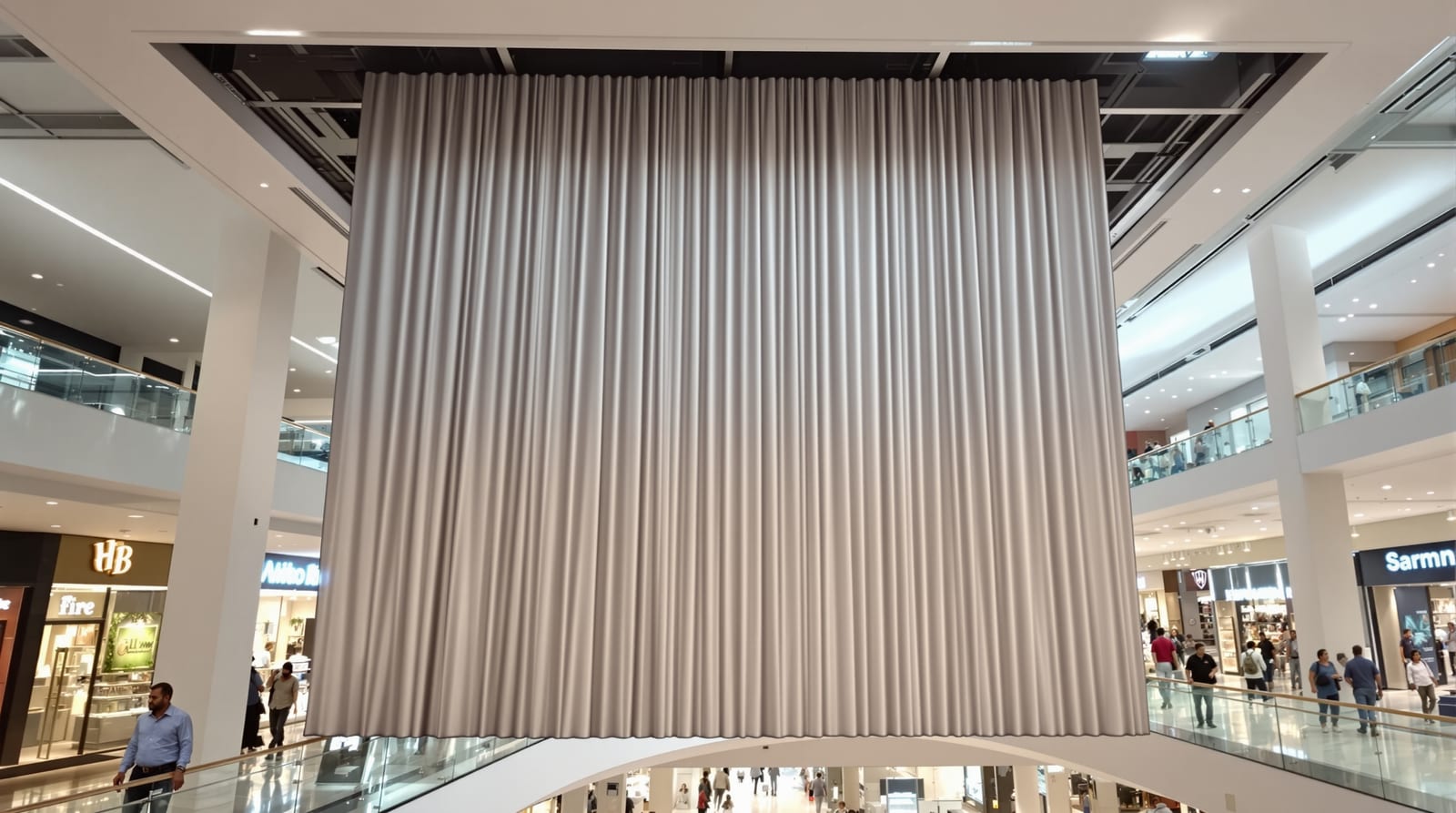
When a fire compartment line runs across a 12-metre atrium, an open-plan mall or the head of an escalator, no hinged or rolling steel door can sensibly close it. Fire curtain doors solve this: a coated glass-fibre fabric stored in a slim ceiling cassette that drops on demand to seal the opening against flame, hot gas and smoke, then retracts out of sight when the alarm clears. They preserve the architectural openness clients pay for while still delivering the compartmentation that NBC 2016 demands. This guide is specifier-grade — for the broader picture see our complete door guide and the specialty doors overview.
What a fire curtain door actually is
A fire curtain is a flexible barrier, not a leaf. The active element is a woven glass-fibre cloth — usually stainless-steel-wire reinforced and coated (intumescent or vermiculite-loaded) — wound onto a barrel inside a powder-coated steel headbox or cassette concealed above the ceiling. Side guides (steel channels, often with intumescent or graphite seals) restrain the fabric edges so hot gas cannot bypass it. On a fire signal the barrel releases and the curtain descends, sealing the opening across its full height.
Because the cloth is light and rolls tight, the cassette can be as shallow as 150-300 mm, and a single curtain can span openings several metres wide and high that a solid fire-rated door could never cover. The trade-off is honest: a fabric curtain gives integrity (E) — it holds back flame and smoke — but limited or no insulation (I), so the unexposed face gets hot. Where people must shelter directly against the barrier, a rated solid assembly or an insulating multi-layer curtain is needed instead.
Fire curtain vs smoke curtain
The two look similar but do different jobs. A smoke curtain is a non-fire-rated (or lightly rated) fabric screen that channels and contains smoke for the smoke-management strategy — it forms reservoirs under a roof, holds smoke off escape routes, and works with extract fans. A fire curtain is fire-tested to an E rating and forms part of the compartment line itself. Many projects use both: smoke curtains to manage the layer, fire curtains to close compartment boundaries.
Integrity ratings and how they are tested
India has no dedicated fabric-curtain product standard, so curtains are almost always supplied with EN 1634-1 (or BS 476 Part 22) fire-test evidence, the same families referenced for European fire doors, and assessed against the smoke/fire-curtain provisions of EN 12101-1. NBC 2016 Part 4 governs where compartmentation and smoke control are required; the curtain is the engineered product that satisfies it. Always treat the rating as belonging to the tested system — fabric, cassette, guides, motor and controls together — exactly as you would a fire-door assembly rating.
| Curtain type | Typical rating | What it resists | Where used |
|---|---|---|---|
| Smoke curtain | DH / smoke-tight (no E) | Cold + hot smoke layer | Atrium reservoirs, escape-route screening |
| Fire curtain (integrity) | E 60 to E 120 | Flame + hot gas (radiates heat) | Compartment lines, escalator voids, large retail |
| Insulating fire curtain | EI 30 to EI 60 (multi-layer + water drench) | Flame, gas + radiated heat | Where occupants shelter close to the barrier |
| Concertina / vertical-and-horizontal | E 60 to E 120 | Flame + gas across plan or slope | Roof voids, irregular openings |
Ratings of E 60, E 90 and E 120 are the common workhorses. EI ratings on fabric usually require a multi-layer construction plus an integral water-drench (deluge) system that wets the exposed face — a significant cost and maintenance step, so specify it only where the fire strategy genuinely demands insulation.
Descent control — gravity, controlled and obstruction logic
How the curtain comes down matters as much as the fabric.
- Gravity fail-safe descent: loss of power or a fire signal releases the brake and the curtain falls under its own weight. This is the safety baseline — the barrier deploys even in a power cut.
- Controlled / governed descent: a centrifugal brake or motor governs speed so the curtain does not slam — important where people may be below.
- Obstruction / two-stage descent: the curtain pauses at a safe head height (often ~2 m), allowing escape beneath, then completes its drop after a delay or a second signal. Standard practice over escape routes and shopfronts.
- Retraction: a tubular motor rewinds the curtain when the system resets; many use a battery/UPS back-up so they can still deploy if mains fails.
Controls tie into the building fire-alarm panel and, for smoke-management curtains, into the smoke-control matrix. Group addressing lets a row of curtains form a continuous compartment line or smoke reservoir.
Fire curtain vs fire-rated rolling shutter
The nearest rigid cousin is the fire-rated rolling shutter — interlocking steel laths that roll down to close an opening. The choice usually comes down to weight, headroom, aesthetics and whether you ever need insulation.
| Factor | Fire curtain (fabric) | Fire-rated rolling shutter (steel) |
|---|---|---|
| Element | Coated glass-fibre cloth | Steel/galvanised laths |
| Cassette / headbox | Slim (150-300 mm), easily concealed | Bulky steel barrel + box |
| Weight & structure | Light — minimal support steel | Heavy — needs structural support |
| Rating type | E 60-120 (EI only with drench) | E 60-240; some EI versions |
| Span / size | Excellent for very wide/tall openings | Good, but heavy at large sizes |
| Aesthetics when open | Invisible above ceiling | Visible box / guide rails |
| Security when closed | None (cuttable fabric) | Provides physical security too |
| Typical use | Atria, voids, escalators, malls | Shopfronts, industrial doors, service openings |
In short: use a curtain when openness and span dominate and security is not the point; use a shutter when you also want a physical/security barrier or a higher insulating rating. For shopfronts that must double as theft protection, a shutter or a security shutter is the better pick.
Where fire curtains earn their keep
- Atria: the classic case — a continuous line of curtains drops to seal the atrium edge at each floor, restoring compartmentation that the open void breaks.
- Escalator and stair voids: curtains close the floor-to-floor opening that escalators create, a job no door can do.
- Large retail and malls: curtains form tenant-demise compartment lines and shopfront closures while keeping the mall open-plan.
- Lobbies and reception: smoke curtains channel smoke away from the main escape stair.
They pair naturally with other smoke-control measures and with rated boundary doors such as fire exit doors on the escape route itself.
Indian cost bands and what drives them
Fire curtains are project-engineered and made to size, so quote against the opening, the rating and the descent logic — not a catalogue. As a rule of thumb (supply-only ranges, plus 18% GST; installation, structural support and controls are extra):
| Item | Indicative band (₹) | Notes |
|---|---|---|
| Smoke curtain (per sqm) | ₹6,000-12,000 | Lower rating, lighter system |
| Fire curtain E 60-120 (per sqm) | ₹12,000-25,000 | Most common; rating + span drive it |
| Insulating EI curtain with water drench | ₹30,000-55,000+ per sqm | Multi-layer + deluge + plumbing |
| Controls / interface per zone | ₹40,000-1,50,000+ | Alarm interface, UPS, sequencing |
| Annual maintenance (AMC) per curtain | ₹6,000-20,000 | Mandatory functional testing |
Cost rises sharply with insulation (drench systems), very large spans, two-stage logic and the number of control zones. Lead times of 6-12 weeks are normal because the fabric, cassette and guides are cut to the opening. Treat every figure here as a planning band — get a written vendor spec against the fire strategy.
Specification, install and maintenance
Never buy a fire curtain in isolation. The fire engineer or fire consultant must define which lines need compartmentation versus smoke management, the rating, and the descent behaviour over escape routes; the vendor then supplies a tested system to match. Critical points:
- Specify the whole tested system (fabric, cassette, guides, motor, controls) — mixing components voids the rating, exactly as with a fire door.
- Confirm gravity fail-safe descent and the two-stage / obstruction logic wherever the curtain crosses an escape route.
- Provide a secondary power supply (UPS/battery) so the curtain still deploys and retracts on mains failure.
- Coordinate the ceiling and structure early — the cassette and side guides need framing and access for service.
- Schedule periodic functional testing (the AMC) — curtains that are never tested are the ones that fail in a fire. Build it into the facility's wider door maintenance and fire-door inspection regime.
To scope rating and budget quickly, our fire-door rating selector helps you frame the integrity target, and the specialty-door cost estimator gives a planning range before you brief a vendor.
Frequently asked questions
Do fire curtains provide insulation like a fire door?
Usually not. A standard fabric fire curtain gives integrity (E) only — it holds flame and hot gas but radiates heat through the cloth, so the unexposed face gets hot. Insulation (EI) needs a multi-layer curtain plus an integral water-drench system, which is far more expensive. If occupants must shelter directly against the barrier, specify an EI curtain or a rated solid door.
Are fire curtains allowed under NBC 2016?
NBC 2016 Part 4 sets where compartmentation and smoke control are required; it does not prohibit engineered fabric curtains as the means of achieving them. They are accepted as part of a fire strategy when supplied with valid fire-test evidence (commonly EN 1634-1 / EN 12101-1 or BS 476 Part 22) and signed off by the fire consultant and authority. Always route the design through your fire engineer.
What is the difference between a fire curtain and a smoke curtain?
A smoke curtain channels and contains smoke for the smoke-management system — forming reservoirs and holding smoke off escape routes — and is not fire-rated to an integrity standard. A fire curtain is fire-tested to an E rating and forms part of the compartment boundary itself. Many buildings use both together.
Will the curtain still drop if the power fails?
Yes, if specified correctly. Fire curtains use gravity fail-safe descent: loss of power or a fire signal releases the brake and the curtain falls under controlled speed. A UPS or battery back-up lets it also retract or re-deploy on mains failure. Confirm this behaviour in the vendor's tested-system documentation.
Fire curtain or fire-rated rolling shutter — which should I choose?
Choose a fire curtain when openness, span and a concealed cassette matter and you do not need physical security — atria, voids, escalators. Choose a fire-rated rolling shutter when you also want a security/physical barrier or a higher insulating rating, such as shopfronts and service openings. Compare both against the same opening before deciding.
How often must fire curtains be tested?
They require periodic functional testing under an AMC — typically including regular drop tests and an annual full inspection of fabric, guides, motor and controls. Untested curtains are the ones that fail when needed, so build testing into the building's planned maintenance and keep records for the fire authority.
Export this guide
Related Guides — Deep-dive reading
Fire-Rated Rolling Shutters & Fire Curtains India 2026
Galvanised steel-lath shutters and fabric fire curtains for large openings — ratings, gravity fail-safe descent, IS standards and motorisation explained for specifiers.
Home Doors & EntrancesSmoke Barriers in India (2026): Holding Back the Smoke That Kills First
Smoke, not flame, disables and kills most fire victims and travels far faster and further - this guide explains the walls, doors and curtains that hold smoke back and keep escape routes tenable.
SecurityEmergency Lighting Testing in India (2026): The Function Test, the Duration Test and the Battery That Quietly Dies
Emergency lighting is what gets people out of a building in a power cut or a fire — and it is useless if its batteries have silently gone flat. This professional guide covers what emergency lighting is, the two tests that keep it honest (the short frequent function test and the longer periodic duration test that catches dying batteries), what to test across escape routes, stairs and exit signs, the statutory test log, and the safe split of who does what.
SecurityRelated Tools — Try Free
Security System Cost Estimator
Estimate the all-in capex with GST, annual running cost and 5-year total cost of ownership of a home or building security system.
Cost EstimatorClient Brief Generator
8-section questionnaire that produces a professional design brief PDF with signature lines.
Brief GeneratorFalse Ceiling Cost Estimator
Live ₹/sqft across 8 ceiling types — POP, gypsum, designer, metal, PVC, wooden — with cove and spot lighting for 20 Indian cities.
Cost Calculator