
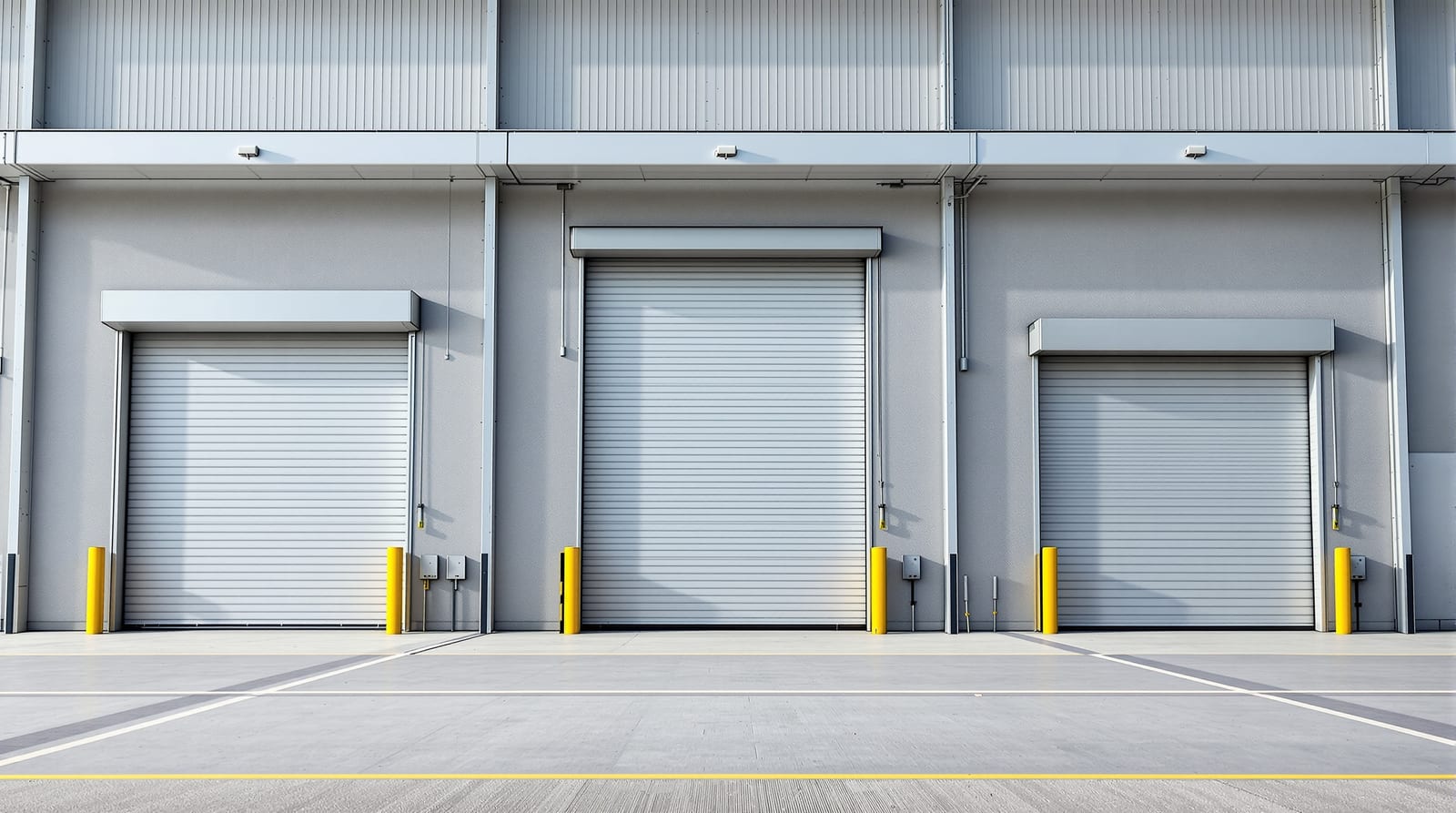
Industrial Door Types in India 2026: Selector & Comparison
A by-mechanism comparison of sectional overhead, rolling shutter, high-speed, sliding-folding, strip-curtain and dock doors for Indian factories and warehouses.
Choosing among industrial door types is rarely about looks — it is about throughput, sealing, cycle life and the climate behind the wall. The same loading bay can take a slow steel rolling shutter, a smooth insulated sectional overhead door, or a 2 m/s high-speed roll-up; each shifts your energy bill, door-down time and maintenance budget in a different direction. This guide is the by-mechanism product comparison: it ranks the main industrial door types on speed, cycles, insulation, security and ₹, then gives you the selection logic. For a plain-language overview of the category and where it sits in a facility, read the industrial doors overview; this page goes deeper on choosing between mechanisms. Final sizing and price always come from a vendor spec against your opening, wind zone and duty cycle — treat the bands below as planning figures.
The eight industrial door types at a glance
Industrial doors split by how the leaf moves and stores. That mechanism dictates almost everything downstream — how fast it opens, how often it can cycle, how well it seals and what it costs. The eight families below cover the vast majority of Indian factory, warehouse and cold-chain openings.
| Door type | Mechanism | Open speed | Insulation | Security | Indicative cost (installed) |
|---|---|---|---|---|---|
| Rolling shutter / grille | Slats coil overhead | Slow (0.1–0.2 m/s) | Low (grille: none) | High (solid slat) | ₹350–900/sqft |
| Sectional overhead | Panels lift to ceiling | Medium (0.2–0.5 m/s) | Good (PUF panels) | Medium-high | ₹650–1,500/sqft |
| High-speed roll-up | PVC fabric coils fast | Very fast (1–3 m/s) | Low-medium | Low-medium | ₹85,000–2,75,000/door |
| Sliding-folding | Leaves fold/slide aside | Slow, manual common | Medium | Medium | ₹450–1,200/sqft |
| PVC strip curtain | Overlapping flexible strips | Instant (push-through) | Low (air barrier) | None | ₹2,500–9,000/opening |
| Dock shelter / leveller seal | Compressible frame seal | n/a (static seal) | Seals gap | n/a | ₹35,000–1,50,000/bay |
| Flexible impact (swing) | Double-action PVC leaves | Instant (push) | Low | None | ₹18,000–80,000/door |
| Insulated (cold-store/freezer) | PUF leaf, sliding/hinged | Slow-medium | Very high | Medium | ₹18,000–90,000/door |
These are supply-and-install bands for typical Indian sizes; add 18% GST, and expect custom leaves, large spans and branded automation to run higher. Specialty insulated and high-speed units are project-engineered and lead-time driven.
Reading the trade-offs
Speed vs cycle life
If forklifts cross the opening hundreds of times a shift, slow doors become the bottleneck and a draughty, often-open hole in the envelope. A steel rolling shutter cycling all day will fatigue springs and slats; high-speed PVC roll-up doors are built for lakhs of cycles and open in 1–3 seconds, which is why cold-chain and pharma logistics favour them. The cheap, instant alternative is to leave a slow door open and hang a PVC strip curtain or air curtain across the gap, but that only buys you a partial air barrier, not security or full insulation.
Insulation vs throughput
Insulation and speed pull against each other. A 100 mm PUF freezer door seals beautifully but moves slowly; a high-speed fabric door barely insulates but cuts air exchange by being shut 95% of the time. The modern cold-store answer is a two-door logic: an insulated sliding leaf for off-hours and an inner high-speed door for active picking. Sectional overhead doors with PUF-filled panels are the balanced middle for ambient warehouses that still want some thermal control.
Security vs daily use
Solid rolling shutters and steel sectional doors give the best after-hours security; grilles and strip curtains give none. For facilities needing both — a secure outer skin and fast daytime flow — pair a shutter or sectional perimeter door with an internal high-speed door, and reserve heavy security shutters for the points that need them.
Selection logic by application
The table below maps the common Indian use-cases to a primary recommendation. It is a starting point; openings near loading docks, in coastal wind zones, or in classified GMP areas have extra requirements.
| Application | Primary recommendation | Pair with | Why |
|---|---|---|---|
| General factory bay | Sectional overhead or rolling shutter | Strip curtain | Security + decent seal, low cost |
| High-traffic warehouse internal | High-speed roll-up | — | Throughput, energy, dust control |
| Loading dock | Sectional + dock shelter + leveller | High-speed inner | Tight truck-to-bay seal |
| Cold storage / freezer | Insulated sliding leaf | High-speed inner door | Thermal integrity, frost control |
| Pharma / cleanroom logistics | High-speed + interlocked airlock | — | Hygiene, pressure, particle control |
| Hangar / very large span | Sliding-folding or fabric | — | Spans beyond panel/coil limits |
| Food production line opening | Flexible impact (swing) | Strip curtain | Hands-free, washdown PVC |
Climate, wind and code notes for India
Large industrial leaves are wind-loaded structures. In coastal and high-wind zones, sectional and rolling doors need wind-bar reinforcement and the opening sized to IS 875 (Part 3) wind pressures — a point your vendor and structural consultant must close out, not the door catalogue. For ambient warehouses in hot Indian climates, even modest panel insulation on sectional doors reduces solar heat gain at the bay; for any temperature-controlled space, the door is part of the cold-chain envelope and its U-value and gasket heating matter as much as the wall. Where doors form part of a fire compartment line, you need a rated assembly, not a standard industrial door — see fire-rated rolling shutters, which are tested and certified, not interchangeable with ordinary shutters.
For the broader engineering-grade door families — radiation, blast, hygiene, acoustic and water — start from the specialty doors hub, and use the cluster complete door guide to navigate residential and commercial door topics. To narrow your shortlist quickly, run the industrial door selector and, for budgeting, the door cost calculator; they translate the bands here into an opening-specific estimate.
Putting it together
For most Indian facilities the right answer is a layered one: a secure, weather-rated perimeter door (sectional or shutter), a fast internal door (high-speed roll-up) where forklifts run all day, and cheap air-barriers (strip curtains, air curtains) wherever a door must stay open. Cold-chain and classified spaces add insulated leaves and interlocks. Because every specialty industrial door is project-engineered to span, cycle, wind zone and climate, the bands here are for planning only — get a vendor spec and, where relevant, a structural or facility consultant to sign off the final selection.
Frequently asked questions
Which industrial door type is fastest?
High-speed roll-up (PVC fabric) doors are fastest, opening at roughly 1–3 m/s — seconds rather than the slow crawl of a steel rolling shutter. They are the default for high-traffic warehouse and cold-chain openings where forklift throughput and air exchange matter, and they are rated for lakhs of cycles.
Sectional overhead or rolling shutter — which should I choose?
Choose a sectional overhead door when you want better insulation and a smoother, faster panel action and have headroom to store panels at the ceiling. Choose a rolling shutter when budget and after-hours security dominate and ceiling/back-room space is tight, since the shutter coils into a compact overhead drum.
Do I need both a fast door and a strip curtain?
Often, yes. A strip curtain or air curtain is a cheap air barrier for an opening that stays open, while a high-speed or insulated door provides actual sealing and security when shut. Pairing them is the standard cold-chain and high-traffic approach in India.
How much do industrial doors cost in India?
As a rule of thumb: rolling shutters from about ₹350–900/sqft, sectional overhead doors ₹650–1,500/sqft, high-speed roll-up doors ₹85,000–2,75,000 per door, and insulated cold-store doors ₹18,000–90,000 per door, all plus 18% GST. These are installed planning bands; large spans, branded automation and custom insulation push them higher. Confirm with a vendor quote.
Are industrial doors covered by Indian standards?
The doors themselves are largely vendor-engineered, but openings must respect IS 875 (Part 3) wind loads, and any door on a fire compartment line must be a tested, certified fire-rated assembly rather than a standard industrial door. Always close out wind and fire compliance with your structural and fire consultants.
Export this guide
Related Guides — Deep-dive reading
Industrial Doors in India: The Heavy-Duty Door Menu and How to Choose (2026)
High-speed roll-up, sectional overhead, rolling shutters, strip curtains, fire shutters and dock doors - the complete industrial door menu, ranked by the driver that decides it (cycle speed, load and size, thermal and dust separation, fire compartmentation, security and durability), with indicative per-door costs.
Home Doors & EntrancesHigh-Speed Doors in India: Rapid Roll-Up Guide (India 2026)
How rapid roll-up and spiral doors opening at 1-3 m/s cut energy loss, dust and downtime in Indian cold-chain, pharma and factory plants.
Home Doors & EntrancesCold Storage Doors in India: Insulated Cold-Room and Freezer Doors That Actually Seal (2026)
How to specify cold-room and freezer doors for Indian warehouses, food plants and pharma stores - PUF-insulated sliding and hinged doors, heated-frame sub-zero freezer doors, high-speed insulated roll-ups for traffic, strip and PVC curtains as a buffer, pressure-relief ports and the inside safety release that stops anyone being trapped - with indicative per-door costs by temperature band.
Home Doors & EntrancesRelated Tools — Try Free
Industrial Door Selector
Find the right industrial door by use — loading dock, high-speed, rolling shutter, cold-store or fire shutter.
Door ToolCurtain Thermal Calculator
Estimate the solar heat-gain a curtain or blind cuts by orientation, glass and treatment — and the cooling saving.
Thermal ToolDoor Cost Calculator
Estimate the all-in cost of a door — leaf, frame, hardware, fitting and GST — by type, material and size.
Door Calculator