
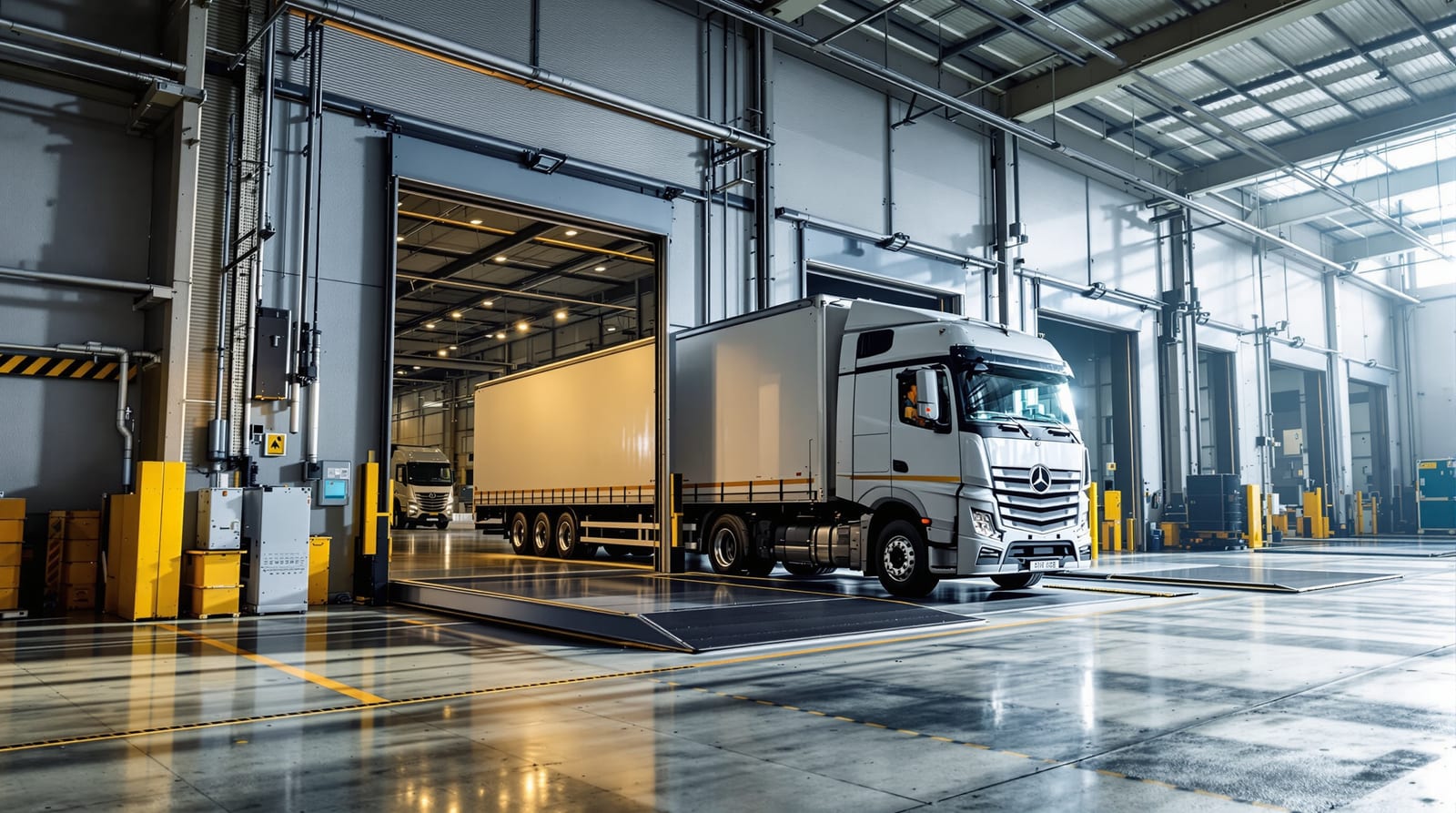
Loading Dock Door in India: The Truck-to-Building Interface - Sectional Door, Dock Leveller, Seal and Restraint (2026)
How an Indian loading dock actually works as one system - the insulated sectional overhead door at each bay, the dock leveller that bridges the gap to the truck bed, the dock shelter or seal that weatherproofs around the vehicle, bumpers, vehicle restraints and the high-speed door behind - sized to your trucks and containers, with indicative per-dock costs.
The loading dock is the one place in a building where a moving vehicle has to become, for twenty minutes, a part of the structure. A truck reverses up, and the gap between its tail and your floor - usually a metre of fresh air, a height mismatch and a draughty edge - has to disappear so a forklift can drive straight from the warehouse into the trailer. No single product does that. The dock is a small system of cooperating machines: a door that closes the opening, a leveller that bridges the height, a seal that wraps the truck, bumpers that absorb the impact and, increasingly, a restraint that stops the truck rolling away while it is being loaded. Get the system right and a bay cycles a forty-foot container in under half an hour, dry, safe and without bleeding conditioned air. Get one component wrong - a leveller too short for your trucks, a seal sized for the wrong trailer - and the whole bay underperforms for its entire life. This guide treats the dock as the integrated truck-to-building interface it actually is. For the wider menu of heavy doors it draws on, start with the overview of industrial doors, and for the logic of matching any door to its space, the master guide on choosing a door by space.
The five drivers that decide a dock
A loading dock is specified by where it sits on five demands. Read your operation against these before you price anything:
- The truck and container interface. This is the master driver. Trailer bed heights in India vary enormously - a rigid 14-foot tata-body truck, a 32-foot multi-axle, a 20- or 40-foot ISO container on a flatbed all present different bed heights, widths and door positions. The leveller range and the door opening must cover your real vehicle mix, not an average.
- Weather and energy sealing. The dock is a hole in the envelope. For ambient warehouses it is about keeping monsoon rain, dust and pigeons out; for cold or air-conditioned facilities it is about not pumping conditioned air into a Chennai car park. The shelter or seal closes the perimeter gap around the parked truck.
- Throughput and cycle time. How many trucks per bay per day? High-volume distribution centres need fast doors, powered levellers and a layout that lets a forklift turn straight in. Low-volume despatch can run manual equipment.
- Safety. Docks are statistically among the most dangerous spots in any warehouse - falls from the edge, trucks pulling away early, forklifts tipping off an unsupported leveller. Restraints, lights, edge protection and interlocks are not optional extras.
- Durability and load. Forklifts pound a dock leveller hundreds of times a day; bumpers take repeated truck impacts. Everything here is rated in tonnes and cycles, not in years.
No bay scores high on all five for free. The skill is reading your traffic and climate, then sizing each component to the trucks you actually run.
How the components work together
A finished dock is read from the truck inward. Here is the sequence, and the job each part does.
The sectional overhead door is the building's actual closure - an insulated panel door at each bay that lifts up under the ceiling, clearing the opening completely so nothing intrudes into the forklift path. Insulated double-skin panels (40-80 mm, polyurethane-cored) are the standard for any conditioned or even ambient warehouse in India because they cut heat gain, seal far better than a rolling shutter and look the part on a modern distribution centre. It can be hand-chain operated on a low-traffic bay or motorised with a three-phase operator on a busy one. This is a door type in its own right - read the sectional overhead door logic inside the industrial doors guide for the panel and operator detail; here it is one component of the dock.
The dock leveller is the bridge. Because a truck bed almost never lines up with your floor, the leveller is a hinged steel platform set into a pit (or surface-mounted) at the dock edge. Its lip swings out onto the truck bed and the deck ramps up or down to take out the height difference, so a forklift drives across smoothly. Hydraulic levellers (push-button) suit high throughput; mechanical (spring, pull-chain) suit lower volumes and tighter budgets. The critical spec is the working range - the height difference it can bridge above and below dock level - which must cover your full vehicle mix.
The dock shelter or seal closes the gap around the parked truck. A shelter is a fabric-and-frame canopy the truck reverses into; foam or inflatable seals press against the trailer's sides and top. Both stop rain, dust, insects and - for cold or AC facilities - conditioned air from escaping around the trailer while the door is open and loading is in progress.
Dock bumpers are the sacrificial rubber blocks bolted to the dock face that absorb the truck's reversing impact, protecting the building, the leveller and the truck. Vehicle restraints mechanically hook or clamp the truck's rear chassis to the dock so it cannot creep or pull away while a forklift is inside the trailer - the single most important safety device on the dock.
Behind the dock door, many Indian DCs add a high-speed roll-up door or strip curtain at the internal threshold, so the conditioned or clean zone stays sealed independently of how long the outer dock door is open. The dock door manages the truck; the high-speed door manages the building's internal climate separation.
The dock components, their function and cost
This is the heart of a dock budget. Cost a dock component by component, then multiply by the number of bays. Figures are indicative for 2026, exclude civil pit work and 18% GST, and vary widely by size, brand and city.
| Component | Function at the dock | Typical spec | Indicative ₹ per dock (2026) |
|---|---|---|---|
| Insulated sectional overhead door | Closes the opening; thermal + weather seal; clears forklift path | 40-80 mm PU panels, motorised on busy bays | 90,000 - 3,50,000+ |
| Dock leveller | Bridges truck-bed-to-floor height; carries forklift load | Hydraulic 6-10 T, ~2000 x 2000-2500 mm, telescopic/hinged lip | 1,50,000 - 5,00,000+ |
| Dock shelter / seal | Weather + energy seal around parked truck | Fabric retractable shelter or foam/inflatable seal | 35,000 - 2,00,000 |
| Dock bumpers (pair) | Absorb reversing impact; protect building + leveller | Laminated rubber or moulded, bolt-on | 4,000 - 25,000 |
| Vehicle / wheel restraint | Locks truck chassis so it cannot pull away early | Hook restraint with signal lights, or wheel chock | 60,000 - 3,00,000 |
| Dock light + traffic signal | Driver/forklift safety, red/green status | LED dock arm light + signal interlock | 8,000 - 40,000 |
| High-speed door behind (optional) | Internal climate / clean separation independent of dock door | 1.0-2.5 m/s roll-up, self-repairing | 2,50,000 - 7,00,000+ |
A complete, mid-spec ambient bay - insulated sectional door, hydraulic leveller, fabric shelter, bumpers and lights - typically lands around 4-8 lakh per dock installed; a high-throughput cold or AC bay with restraints and a high-speed door behind can run 12-20 lakh or more. The single most expensive mistake is buying any of these to the wrong dimension, so sizing comes next.
Sizing the dock to your trucks and containers
Every dimension on a dock traces back to the vehicles. Pin these down before specifying anything:
- Dock height (floor above apron). Standard dock heights in India sit around 1100-1300 mm above the truck drive so that floors and truck beds roughly align. If you handle a mix of small rigid trucks and tall multi-axle trailers, the leveller's range absorbs the difference - which is exactly why range matters.
- Door opening width and height. The opening must comfortably pass your widest trailer and tallest load on the leveller. A 3000 x 3000 mm opening is common for general goods; container handling often needs taller. Always check against the loaded forklift mast height passing through.
- Leveller working range. Specify the range above and below dock level the leveller must serve. Telescopic-lip levellers give more reach for trucks parked short or with deep beds. Under-sized range is the classic dock failure - the lip will not reach a low container bed and loading stalls.
- Seal vs shelter choice. Foam seals suit a fleet of similar-width trailers (they press on fixed contact strips). Shelters suit a varied fleet because the truck reverses into a flexible curtain that adapts to different trailer sizes - the usual choice for third-party logistics with mixed vehicles.
- Drive-through vs reverse-in. Most Indian docks are reverse-in. If you handle 40-foot containers that must drive through, your apron, turning circle and ramp gradient need designing around that, not just the door.
For the door-leaf sizing conventions and the NBC and IS dimensional norms that frame all of this, see the door width and size standards for India; a dock opening is an industrial extreme of the same logic.
Safety: the part you cannot value-engineer away
Loading docks injure and kill more warehouse workers than almost any other zone, and nearly every serious dock accident traces to one of three causes - a truck pulling away while a forklift is inside it (a "trailer creep" or "early departure"), a fall from an open dock edge, or a forklift tipping off an unsupported or out-of-range leveller. Build the dock to defeat all three:
- Vehicle restraints with interlocked signal lights. A hook restraint engages the truck chassis and shows red to the driver (do not move) and green inside to the forklift operator (safe to load). This is the highest-value safety spend on any dock.
- Edge protection when the door is open and no truck is docked. A raised leveller lip, safety gate or barrier stops a forklift or person reversing off an open edge.
- Powered, load-rated levellers that cannot be driven onto until fully bridged, with the correct tonnage rating for your heaviest loaded forklift.
- Dock lights and clear traffic signals so reversing trucks and internal forklifts coordinate.
- Fire and egress remain in force: a wall full of dock doors does not count as a fire exit. Provide proper fire-exit doors with panic hardware on the escape routes per NBC 2016, separate from the loading bays, and IS 3614 fire shutters where the dock crosses a fire compartment.
Automation and the smart dock
A busy distribution centre increasingly runs the dock as one interlocked, motorised sequence rather than five hand-operated parts. The driver-side and operator-side signals talk to each other: the restraint must be engaged (green) before the door will open; the leveller will not deploy until the door is up; the door cannot close until the leveller is stored. Add motion-activated or scan-triggered door opening, sensors that detect a docked trailer, and a building-management link that logs every bay's cycle time, and you get faster, safer turnarounds with fewer human errors. For ambient bays this is over-specification; for cold-chain and large e-commerce DCs handling hundreds of trucks a day it pays back quickly in throughput and avoided incidents.
Where the dock door sits among neighbouring spaces
The dock is one zone in a larger goods-handling envelope, and it shares its logic with several sibling spaces:
- A warehouse typically has a row of these docks along one face, plus internal high-speed and personnel doors - the dock is the warehouse's loading edge.
- A factory uses the same dock kit for despatch, alongside material gates and production-zone doors.
- A cold storage facility needs the insulated-and-sealed version of every dock component, with refrigerated dock doors and tighter shelters to hold the cold chain across the truck interface.
- The broader heavy-door menu the dock draws on - sectional, high-speed, rolling shutter, fire shutter - is in the industrial doors overview.
- For the protective grilles and shutters that secure a despatch yard after hours, see shutter doors.
- To place this dock against every other building type, the master doors-by-space guide maps them all.
To narrow your specific dock door and equipment choice quickly, run your traffic, climate and vehicle mix through the industrial door selector.
Do and don't for an Indian loading dock
- Do size the leveller's working range to your full vehicle mix, including the lowest container bed you will ever receive - not an average truck.
- Do fit vehicle restraints with interlocked lights on any bay where forklifts enter trailers; treat it as core safety, not an upgrade.
- Do specify insulated sectional doors, not bare rolling shutters, for any conditioned or cold facility - the energy saving and seal quality pay back.
- Do plan the apron, gradient and turning circle around your largest vehicle before fixing dock positions.
- Don't treat the dock wall as a fire exit; provide separate compliant egress with panic hardware.
- Don't mix a foam seal with a varied trailer fleet - use a shelter that adapts to different widths.
- Don't under-spec bumpers; a worn or missing bumper transfers truck impact straight into the leveller and door.
- Don't skip edge protection for the times a door is open with no truck docked.
Frequently asked questions
What does a complete loading dock cost per bay in India in 2026?
A mid-spec ambient bay - insulated sectional door, hydraulic leveller, fabric shelter, bumpers and dock lights - typically runs around 4 to 8 lakh installed, excluding civil pit work and GST. A high-throughput cold-chain or e-commerce bay with vehicle restraints and a high-speed door behind can reach 12 to 20 lakh or more. Always price component by component and multiply by the number of bays, because options and trailer mix swing the total widely.
What is the difference between the dock door, the leveller and the dock seal?
They do three separate jobs. The dock door (an insulated sectional overhead door) is the building's closure that seals the opening when no truck is present. The dock leveller is the hinged steel bridge that takes out the height difference between your floor and the truck bed so a forklift can drive across. The dock seal or shelter is the perimeter weather-and-energy seal that wraps around the parked truck while the door is open and loading is happening. A working dock needs all three.
Do I need a vehicle restraint, or is a wheel chock enough?
For any bay where forklifts drive into trailers, an interlocked mechanical vehicle restraint is strongly recommended over a manual wheel chock. Chocks can be forgotten, kicked loose or driven over, and they are the weak link in most early-departure accidents. A hook restraint engaging the truck chassis, wired to red/green signal lights for driver and forklift operator, removes the human error that causes the most serious dock incidents.
How do I size the dock door and leveller to my trucks?
Work backwards from your real vehicle mix. The door opening must pass your widest trailer and tallest load on a raised leveller; common general-goods openings are around 3000 x 3000 mm. The leveller's working range must bridge from your highest truck bed to the lowest container bed you receive, so favour telescopic-lip levellers if your fleet varies. Confirm dock height (around 1100-1300 mm above the apron) and turning circle before fixing bay positions.
Should the dock door be an insulated sectional door or a rolling shutter?
For any conditioned, air-conditioned or cold facility, an insulated sectional overhead door is the standard choice - its polyurethane-cored panels seal far better, cut heat gain and clear the forklift path cleanly. A bare rolling shutter is cheaper and acceptable only on a low-value ambient despatch bay where energy sealing does not matter. Many modern Indian DCs also add a high-speed door behind the dock door to keep the internal climate separated independently.
Export this guide
Related Guides — Deep-dive reading
Industrial Doors in India: The Heavy-Duty Door Menu and How to Choose (2026)
High-speed roll-up, sectional overhead, rolling shutters, strip curtains, fire shutters and dock doors - the complete industrial door menu, ranked by the driver that decides it (cycle speed, load and size, thermal and dust separation, fire compartmentation, security and durability), with indicative per-door costs.
Home Doors & EntrancesWarehouse Door in India: Loading Dock, High-Speed Roll-Up and Fire Shutters for Logistics (2026)
A throughput-first guide to specifying doors for a warehouse or distribution centre in India - the loading-dock sectional door with leveller and seal at the core, high-speed roll-ups for fast forklift cycles, perimeter shutters, fire compartmentation and personnel exits - with indicative per-door and per-system costs.
Home Doors & EntrancesFactory Door in India: Material Gates, Production-Floor Roll-Ups, Personnel and Fire-Compartment Doors (2026)
A zone-by-zone guide to doors for a manufacturing plant in India - the big sliding or sectional material gates for trucks and forklifts, the high-speed and strip-curtain doors that separate dusty, hot or clean production zones, the steel and FRP personnel doors beside them, and the IS 3614 fire-compartment and panic-barred fire-exit doors - with indicative per-door and per-gate costs.
Home Doors & EntrancesRelated Tools — Try Free
Industrial Door Selector
Find the right industrial door by use — loading dock, high-speed, rolling shutter, cold-store or fire shutter.
Door ToolFire Door Rating Checker
See the likely fire-door rating (30/60/90/120 min) and components a location needs per IS 3614 / NBC — guidance, confirm with your architect.
Compliance ToolMaterial Schedule Generator
Generate a room-wise finish schedule — walls, floors, ceilings, trim, and joinery by location.
Material Schedule