
Automatic Swing Door Operators: Retrofit Guide India 2026
How to retrofit a normal hinged door to open by itself — full-energy vs low-energy operators, activation, safety and cost for Indian buildings.
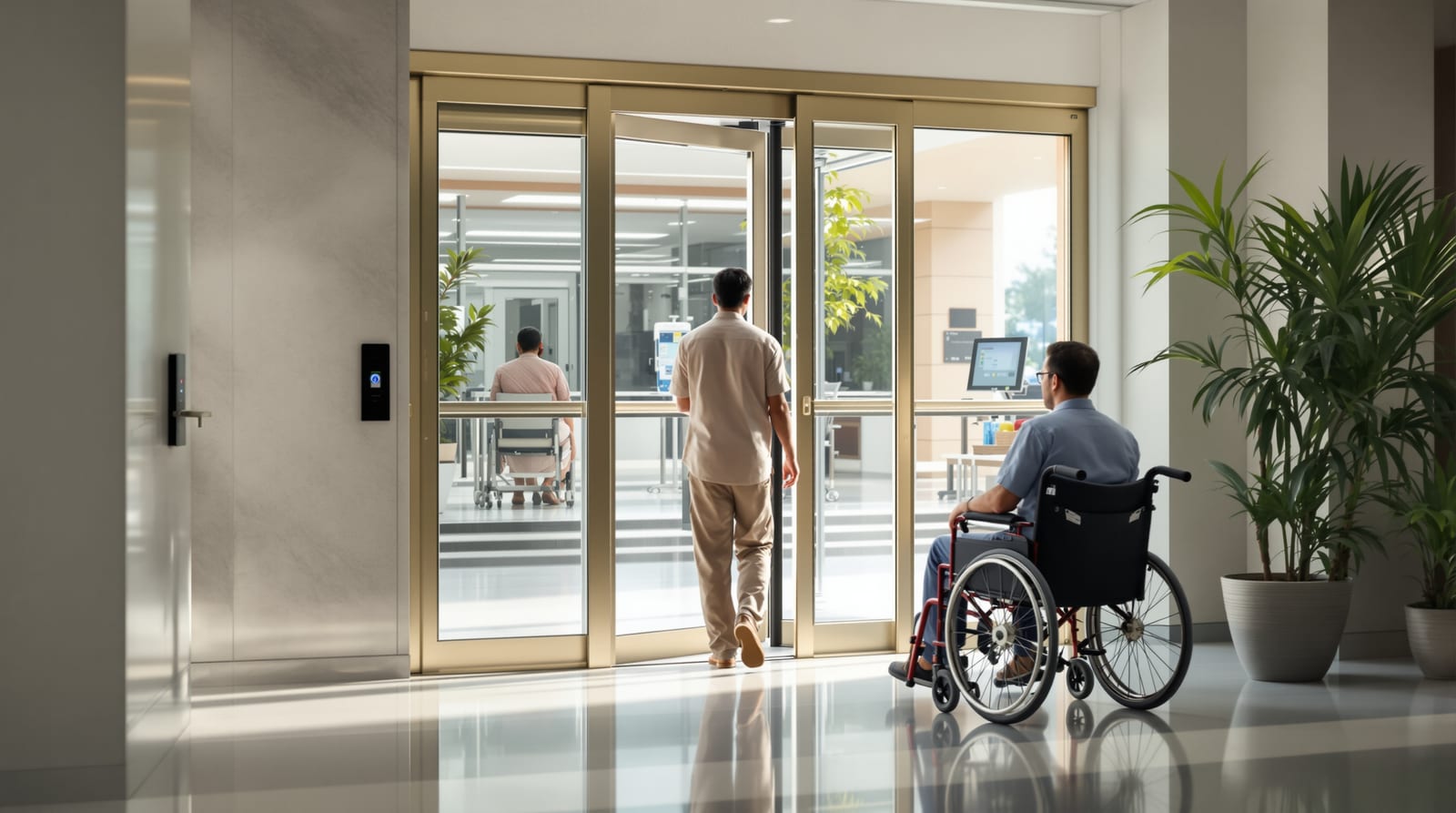
Almost any existing hinged door can be motorised. Automatic swing door operators are compact header-mounted units that pull an ordinary leaf open and close it under controlled torque — the cheapest, least disruptive way to add touch-free, accessible entry without replacing the door frame. For clinics, offices, building lobbies and homes for elderly residents, a swing operator turns a heavy fire-rated or solid-core door into something a wheelchair user, a person carrying a child, or a delivery rider can pass through hands-free. This guide covers how the operators work, the critical full-energy versus low-energy distinction, activation, double-leaf logic, safety, power-cut planning and 2026 India cost bands — written for architects, facility managers and integrators specifying real installations.
How automatic swing door operators work
A swing operator is an electromechanical drive (motor, gearbox and control board) housed in a slim header that sits above the door, transom or frame. It connects to the leaf either by a push arm (rigid arm, operator on the pull side, pushing the door open) or a slide/track arm (a guide channel, operator on the push side, pulling the door — neater, lower-profile, better for narrow reveals). On activation the motor drives the leaf open to a set angle (typically 80–95°), holds it, then closes it under a controlled, spring-assisted return.
Crucially, most quality operators are fully retrofit: you keep the existing door and frame and bolt the header on. This is what makes them attractive in India — you upgrade an accessible entrance for a fraction of the cost of an automatic sliding installation, with no glazing or structural change. For the sliding alternative, see automatic sliding door mechanism.
Full-energy vs low-energy — the choice that defines safety
This is the single most important decision and it is governed by who triggers the door and how fast it moves.
| Attribute | Low-energy operator | Full-energy (high-energy) operator |
|---|---|---|
| Typical opening time | Slow, 3–6 s to full open | Fast, under 3 s |
| Activation | Knowing act — push-plate, button, wave switch | Automatic sensor (motion/presence) detecting approach |
| Force / kinetic energy | Inherently limited, low impact | Higher; can injure on contact |
| Mandatory guard sensors | Generally not required (energy is self-limiting) | Required — presence/safety sensors on both sides |
| Best use | Accessibility retrofits, clinics, offices, homes | High-traffic entrances, hospitals, retail |
| RPwD accessibility fit | Ideal — the default for accessible doors | Possible but needs full guarding |
Low-energy operators are the accessibility workhorse. Because they open slowly and with limited force, a person who is struck does not get hurt, so they can be activated by a deliberate "knowing act" — a push-plate or button — without needing a full ring of safety sensors. This is exactly what the Harmonised Guidelines under the RPwD Act 2016 envisage for accessible entrances: a low-energy, push-button operated door with adequate hold-open time. For most Indian clinics, government offices and homes for the elderly, specify low-energy.
Full-energy operators open fast for throughput and are triggered automatically by approach sensors. Because they move quickly they must be protected by presence sensors that stop or reverse the leaf if someone is in the swing path. Reserve them for genuinely high-traffic doors.
Activation methods
How the operator is triggered shapes both safety class and user experience.
- Push-to-go (power-assist): the door senses a manual nudge and then takes over the swing. No button, no sensor needed at rest — useful for low-traffic accessible doors.
- Push-plate / wave switch: a wall- or bollard-mounted stainless plate or a no-touch IR wave sensor (₹1,500–6,000). The post-COVID default for clinics; touch-free and hygienic. Provide one at standing height and one low for wheelchair users.
- Motion / presence sensors: header-mounted microwave or active-infrared units (₹3,000–15,000) that detect approach (motion) and presence (safety). Standard for full-energy doors. See automatic door sensors.
- Access-controlled trigger: the operator opens only after a valid credential — card, PIN, face or app. This is where automation meets access control systems: the controller releases the lock and signals the operator. Plan the door automation wiring so the unlock and the open are sequenced, not simultaneous.
Single leaf vs double leaf
A single-leaf operator drives one door. A double-leaf (pair) entrance needs two operators with a synchronisation / sequencing controller so the leaves open and, critically, close in the correct order — the leaf carrying the astragal or rebate must close last, or the doors jam. For fire-rated double doors this sequencing is mandatory for the fire rating to hold. Always specify a sequence selector for pairs; never run two operators independently.
Hold-open and obstruction safety
Hold-open time is the dwell the door stays fully open before closing. For accessibility it should be generous — long enough for a slow walker or wheelchair user to clear the threshold. Many operators offer a separately adjustable longer hold for the push-plate input.
Obstruction safety is non-negotiable on any powered door:
- The closing leaf must detect resistance and stop or reverse if it meets a person or object.
- Full-energy doors need presence sensors covering the swing path on both sides.
- A "door-in-use" / safety beam prevents the leaf swinging into someone standing in the arc.
- Pinch and shear points at the hinge edge should be guarded or set back.
For a full treatment of guarding and reversal logic, see automatic door safety.
Mounting, power and backup
The operator mounts on the header — the frame, transom or wall directly above the door. It needs a clean, solid fixing substrate; flimsy partition headers may need reinforcement. Specify a header that matches the door width and weight, because operator models are rated by maximum leaf weight and width (a heavy fire door needs a higher-torque unit).
Power is mains 230 V to the control board. Two India-specific realities must be designed in:
1. Power-cut behaviour. On power loss the door must remain manually openable — the clutch should disengage so a person can push the leaf by hand. This is the automation equivalent of free egress. Plan it deliberately; read door access power backup.
2. Backup battery / UPS. For doors that must keep cycling through outages (clinics, lobbies), add an integrated battery pack or feed the operator from a UPS. Without it, the door reverts to manual during the very outages when an elderly or disabled user most needs help.
Use a licensed electrician to bring the supply and isolate it during service. The control board itself is usually integrator-installed and commissioned.
Where swing operators are used
| Setting | Recommended class | Typical activation |
|---|---|---|
| Clinic / diagnostic centre entrance | Low-energy | Touch-free wave + push-plate |
| Government / corporate office accessible door | Low-energy | Push-plate (two heights) |
| Home for elderly residents / aged-care | Low-energy + push-to-go | Button or remote |
| Hospital ward / department door | Full-energy | Motion + presence sensors |
| Secured office door (badge-in) | Low-energy + access control | Card/face release then auto-open |
| Building main lobby (moderate traffic) | Full-energy | Motion sensor |
For the wider scope of automatic entrances, see automatic door operators and the phase pillar door automation; for accessibility-first specification read low-energy door operators and our accessible doors and wheelchair accessible doors guides.
Cost in India (2026)
Indicative, installed, before 18% GST. Automated kit is project-engineered — get an integrator quote.
| Item | Indicative band (₹) |
|---|---|
| Single-leaf swing operator (supply) | 30,000 – 1,50,000 |
| Add second operator + sequencing (double leaf) | + 35,000 – 1,60,000 |
| Push-plate (wired) | 1,500 – 6,000 |
| No-touch wave / IR switch | 2,500 – 8,000 |
| Motion + presence safety sensors (full-energy) | 3,000 – 15,000 |
| Backup battery / UPS provision | 4,000 – 20,000 |
| Wiring, mounting reinforcement, commissioning | 5,000 – 25,000 |
As a rule of thumb, budget around ₹50,000–80,000 for a credible single-leaf low-energy accessible door fully fitted, and roughly double for a sequenced pair. Estimate your own configuration with the door automation cost calculator and shortlist a unit with the automatic door operator selector.
The legal must: free egress on escape routes
If an automatic swing door sits on a designated fire-escape route, it must allow free egress at all times — people must be able to leave by simple manual push, without power, without a credential, and the door must release on the fire alarm. Under NBC 2016 life-safety provisions, no automation or access control may trap occupants. Where the door is also access-controlled, integrate the operator and any electric lock with the fire-alarm system so both release together. See fail-safe vs fail-secure locks and the cluster pillar complete door guide. For ongoing reliability, an door automation AMC keeps the safety functions tested.
Frequently asked questions
Can I automate my existing wooden or fire-rated door?
Usually yes. Swing operators are designed as header-mounted retrofits and keep your existing leaf and frame, provided the header substrate is solid and the operator is rated for the leaf's weight and width. A heavy fire door simply needs a higher-torque unit, and the fire rating and self-closing function must be preserved.
Low-energy or full-energy — which should I choose?
For accessibility (clinics, offices, homes for elderly), choose low-energy: it opens slowly with limited force, can be triggered by a push-plate, and is the RPwD-aligned default. Choose full-energy only for high-traffic doors that need fast automatic sensor opening — and budget for the mandatory presence safety sensors.
What happens during a power cut?
A correctly specified operator lets you push the door open manually when power is lost — automation never overrides free egress. For doors that must keep cycling through Indian outages, add an integrated backup battery or feed the operator from a UPS so it keeps working for elderly and disabled users.
Do I need safety sensors on a push-button door?
Low-energy doors triggered by a knowing act (push-plate/button) generally do not require a full ring of presence sensors because their force is self-limited, but obstruction detection that stops or reverses the leaf is still expected. Full-energy automatic doors always need presence sensors on both sides of the swing.
How do I make an access-controlled swing door safe on an escape route?
Integrate the operator and any electric lock with the fire-alarm panel so both release on alarm, ensure manual push-egress always works without a credential, and use a fail-safe locking device. This satisfies NBC 2016 free-egress requirements while keeping the door secured in normal use.
Export this guide
Related Guides — Deep-dive reading
Fail-Safe vs Fail-Secure Locks: The Guide (India 2026)
Why fail-safe vs fail-secure is the single most important access-control decision, and how to get it right for every door.
Home Doors & EntrancesLow-Energy Door Operators for Accessibility in India 2026
Gentle, push-activated automatic operators that open doors safely for wheelchair users and the elderly without full safety-sensor arrays.
Home Doors & EntrancesFire-Egress Compatibility for Smart Locks in India (2026): Never Trap Anyone
How to make sure a smart lock or access-controlled door on an escape route always lets people out in a fire or emergency: fail-safe hardware, free egress, fire-rated doors, and the fire-alarm interlock.
SecurityRelated Tools — Try Free
Access-Control Battery-Backup Calculator
Size the standby battery so an access system keeps running through a power cut, with an egress life-safety note.
Battery BackupHealing View Impact Calculator
Evidence-Based Design dashboard quantifying the recovery impact of nature view + daylight factor on analgesic use, length of stay, and HCAHPS patient-experience uplift. Calibrated against Ulrich 1984 (Science), Park & Mattson 2008, and the CHD EBD evidence base.
EBD CalculatorAccessible Door Checker
Check a door against wheelchair-accessibility guidance — clear width, threshold, handle and closer force per RPwD 2021.
Compliance Tool