
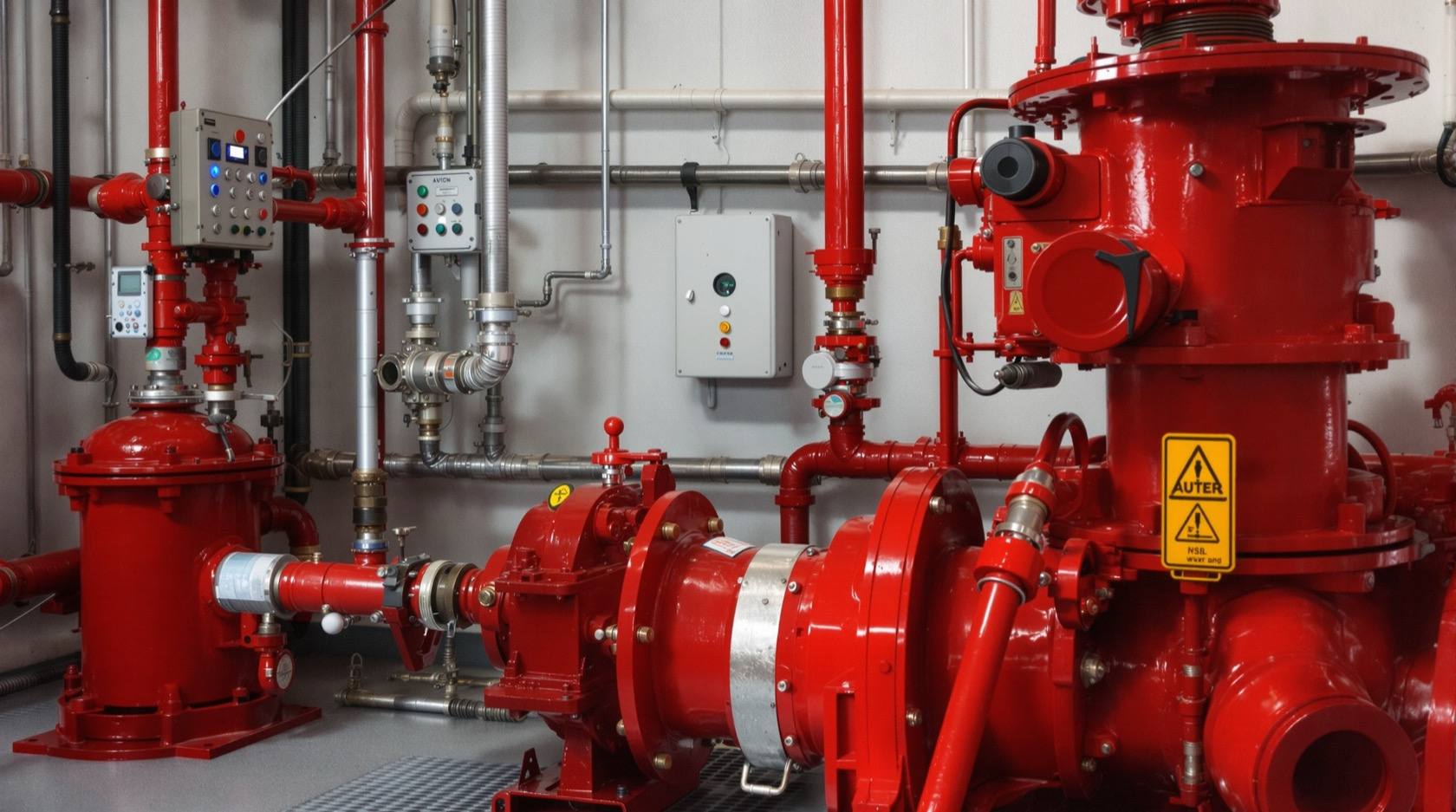
Fire Pump Maintenance in India (2026): Run Tests, Diesel Upkeep and the AUTO Rule
The fire pump is what gives sprinklers, hydrants and hose reels their pressure and flow. This professional upkeep guide covers the pump SET (main electric, diesel and jockey pumps and the controller), the weekly run test, auto-start checks, diesel engine and battery care, the DIY-safe vs contractor split, and the one rule that defeats everything if broken: leave the controller in AUTO.
Every sprinkler head, every hydrant riser and every hose reel in a building is quiet plumbing until something gives it pressure and flow. That something is the fire pump. It is the heart of the fire-water system, and it has one job that it does rarely and must never fail: on the day a fire drops the water pressure in the mains, it must start, come up to duty pressure, and keep water moving to the point of the fire. If the pump does not start, the sprinklers dribble, the hydrant is a dead pipe, and the most expensive fire-protection system in the building is worthless. The failure is total and it is silent right up until the moment it matters.
The cruelty of fire pumps is that they look fine while quietly dying. A diesel pump with a flat starter battery, a controller nudged into MANUAL after a test and forgotten, a fuel tank gone low, a closed suction valve nobody reopened, a jockey pump masking a leak by running all day, corroded battery terminals, a seized relief valve. None of these show on a walk-past. Every one of them means the pump does not do its job the night the building is on fire. This is why fire pump upkeep is not about looking at the pump. It is about starting it, on a schedule, and recording that it started.
This guide is written for the people responsible for a building's fire pump: facility managers, building engineers, security and safety consultants, and the maintenance teams who run the pump room. It covers the whole pump SET, the testing regime that keeps it honest, the diesel engine care that is the commonest point of failure, who is allowed to do what, and the single discipline that undoes all the rest if it slips.
Scope & safety. This is an upkeep and coordination guide, not an installation or repair manual. It draws a firm line between routine tasks a competent facility team can safely do (running the weekly test, daily and weekly visual and gauge checks, keeping fuel and coolant topped, keeping the logbook, confirming the controller is in AUTO) and work that is strictly for a qualified fire contractor or competent person (flow testing to duty, engine servicing, opening the controller, electrical work, and statutory testing for the fire NOC). Fire pump upkeep is LIFE-SAFETY maintenance and is statutory in India under fire regulations and the National Building Code (NBC = SP 7:2026); it is scheduled and it is not optional. This is not a price or buying guide; for choosing and specifying a pump see the linked fire-pumps guide, and budget for a proper AMC.
Why the pump set, not just the pump
A fire pump is never one machine. It is a SET, and every part of the set has to be maintained, because a fault in any one of them can stop water reaching a fire. Treating the pump room as a single item is the first mistake.
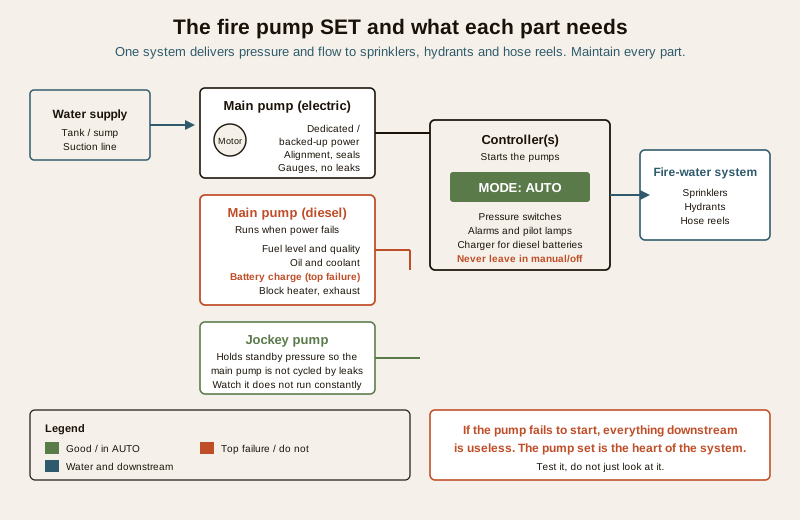
- The main pump. This is the workhorse that delivers the design flow and pressure to the system. It is commonly electric-driven; in many Indian installations there is also, or instead, a diesel-driven main pump so that the system still works when mains power fails, which is exactly when many fires start or spread. Some buildings run both: an electric duty pump and a diesel standby.
- The jockey (pressure-maintenance) pump. A small pump that keeps the system topped up to standby pressure so that minor leaks and normal seepage do not repeatedly start the big main pump. When the jockey can no longer hold pressure, a further drop is what calls the main pump into action. A jockey that runs constantly is telling you there is a leak to find, not that all is well.
- The controller. One controller per pump, and this is the brain. It watches system pressure, starts the pump automatically on a pressure drop, runs the alarms and indicator lamps, and, for a diesel pump, keeps the starter batteries charged. The controller's mode switch is the most important switch in the pump room, and it belongs in AUTO.
Maintenance means keeping all of this ready at once: the electric pump and its power supply, the diesel engine and its batteries and fuel, the jockey and its pressure setting, the controller and its charger, plus the shared essentials of suction water, open valves, sound gauges, and no leaks. For the wider selection and design picture, the fire pumps guide is the companion to this upkeep guide.
The regime that keeps a pump honest: run tests
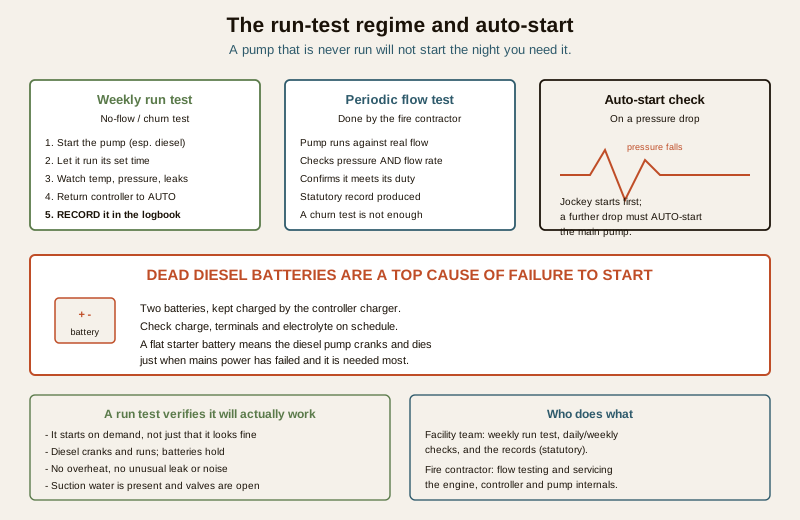
You cannot maintain a fire pump by inspection alone. The only way to know it will start is to start it. The core of fire pump maintenance is therefore a regime of run tests at set frequencies, and the diesel pump especially must be exercised or it will not start in an emergency.
The weekly no-flow (churn) test
The classic requirement is a short weekly run. The pump is started and allowed to run against a closed system (no flow, hence "churn" or "no-flow") for its set period while someone watches it. The purpose is simple: prove it starts, prove it runs, and catch anything wrong before it matters.
During the weekly test the facility team should:
- Confirm it actually starts from the controller in the correct sequence, without excessive cranking on the diesel.
- Watch the gauges for the pump reaching and holding its expected pressure.
- Watch for overheating, unusual noise, vibration or leaks while it runs; a pump churning hot for too long with no flow is itself a fault to note and stop.
- Check the diesel engine cranks cleanly, runs steadily, and that oil pressure and temperature are normal, with no alarm on the controller.
- Return the controller to AUTO the moment the test ends, and record the test in the logbook.
The weekly run is a facility-team task and is safe to do with the right training. It is also the single most valuable thing you can do for a fire pump, because it turns "we assume it works" into "we saw it work last week."
The periodic flow test
A churn test proves the pump starts and builds pressure, but it does not prove the pump can deliver its rated FLOW. Only running water through it does that. A periodic flow test, run by the fire contractor against a measured flow, confirms the pump still meets its duty of pressure and flow together, checks the relief valve, and produces the statutory record. This is contractor work: it involves opening the system to flow, reading performance against the pump's duty, and interpreting the result. Do not skip it on the strength of a good weekly churn test; they prove different things.
The auto-start check
The pump must not only run when someone presses start; it must start itself when the system pressure drops, because in a real fire nobody is standing at the controller. As part of the routine, confirm the auto-start works: with the controller in AUTO, a controlled pressure drop should start the jockey first and, on a further drop, auto-start the main pump. A pump that runs on the manual button but never auto-starts is a pump that will sit still during a fire. Setting up and adjusting the pressure switches is contractor work; confirming the auto-start functions is part of the routine test.
Diesel upkeep: where fire pumps fail most
If a fire pump fails to start in an emergency, the odds are it is the diesel pump and the odds are it is the batteries. Diesel upkeep is the part of fire pump maintenance that gets neglected and the part that most often decides whether water reaches the fire.
Life-safety, do not skip. Dead or weak diesel starter batteries are one of the most common causes of a fire pump failing to start. Mains power has often already failed in a fire, so the diesel pump is the last line, and it depends entirely on its batteries to crank. Treat battery care as a first-order task, not an afterthought.
The diesel routine, mostly facility-team checks with contractor servicing on schedule:
- Batteries. A diesel pump normally has two starter batteries kept charged by the controller. Check the charge state, the terminals for corrosion and tightness, and the electrolyte where applicable. Confirm the controller's charger is actually charging. Weak batteries are replaced on a schedule, not run to failure.
- Fuel level and quality. Keep the day tank full to the required level; a diesel pump that runs out of fuel mid-fire is a catastrophe. Diesel degrades and grows contamination over time, so fuel quality and water in the tank matter, and stale fuel should be managed by the contractor.
- Oil and coolant. Check engine oil level and condition and coolant level; a pump that overheats will trip or seize. These are day-to-day checks with proper oil and coolant changes done at service.
- Block heater / jacket heater. Where fitted, the heater keeps the engine warm so it starts readily; confirm it is working, especially in cooler regions.
- Exhaust, belts and the crank path. The exhaust must be clear and vented, drive belts sound, and nothing must obstruct the engine starting.
The electric main pump has its own, shorter list: a dedicated and backed-up power supply so a tripped feeder does not silence it, the motor and starter healthy, and the controller's phase and supply monitoring not in fault. If the power supply to the electric pump is not reliable, the diesel standby is not a luxury; it is the reason the system still works.
The shared essentials: water, valves, gauges and leaks
Whichever pump drives the system, some things must be true for any of them to work, and these are quick daily-to-weekly checks:
- Suction water is available. The pump can only push what it can draw. Confirm the tank or sump level and that the suction line and its valve are in order; a pump running dry is a pump destroying itself and delivering nothing.
- Valves are in the right position. The commonest silent killer after batteries is a closed valve on the suction or discharge that someone shut for work and never reopened. Confirm the isolating valves are open and, where fitted, locked or supervised open.
- Gauges read sensibly. The suction and discharge gauges tell you the standby pressure and whether it is holding. A pressure that keeps falling and restarting the jockey points to a leak; a gauge reading nonsense is itself a fault.
- No leaks, sound alignment. Look for leaks at seals, glands and joints, and for signs of misalignment or vibration. Persistent leaks and any alignment work are contractor tasks.
Who does what: the critical split
Fire pump maintenance divides cleanly into what a competent facility team can safely do and what must be left to a qualified fire contractor or competent person. Keeping this line clear is what makes the upkeep both effective and safe.
Facility team (routine, safe with training):
- The weekly no-flow run test, watching the pump and returning the controller to AUTO.
- Daily and weekly visual and gauge checks: fuel level, oil and coolant level, battery charge indication, gauge readings, valve positions, leaks, and that the controllers show AUTO with no alarm.
- Topping up fuel and coolant to level, keeping the pump room clean, dry, ventilated and accessible.
- Keeping the logbook and raising a contractor call the moment something is wrong.
Qualified fire contractor / competent person (do not DIY):
- Periodic flow testing to duty and relief-valve testing.
- Engine servicing (oil and filter changes, injectors, fuel-system work), battery replacement, and coolant changes.
- Opening or adjusting the controller, setting pressure switches, and any mains electrical work.
- Alignment, seal and internal pump work, and statutory testing for the fire NOC.
Call a professional. Anything inside the controller, any mains electrical work, opening the pump or engine, working on the pressurised system, or statutory testing is strictly for a qualified fire contractor under a proper AMC. The facility team's job is to run the routine test, keep the daily checks and records, and know when to call. Do not improvise repairs on life-safety equipment.
The one rule that defeats everything: leave it in AUTO
Everything in this guide can be done perfectly and the pump can still fail for one reason: the controller is not in AUTO. A pump left in MANUAL, OFF, or a test mode after servicing will sit silent while the building burns, no matter how well it is maintained, because it is waiting for a human hand that is not there.
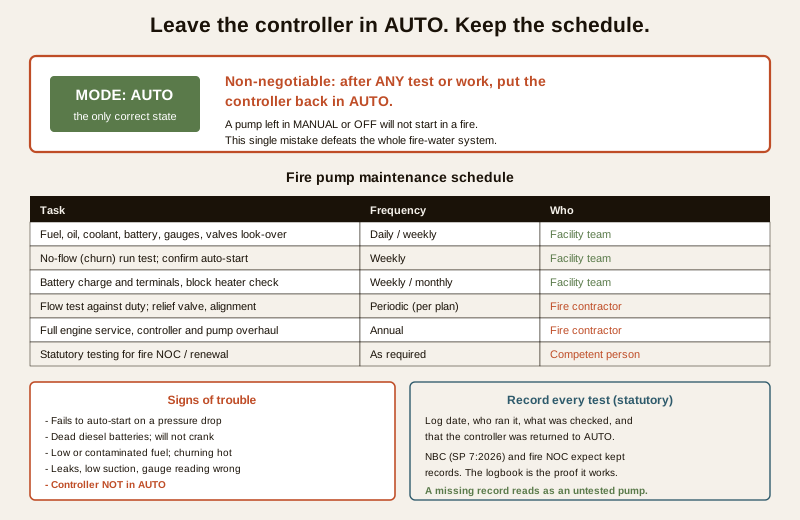
This is the discipline that ties every test to a safe ending: after any run test, any inspection, any piece of contractor work, the very last action is to confirm the controller is back in AUTO, and to record that it is. More real-world fire pump failures come from a switch left in the wrong position after maintenance than from any mechanical fault. The habit that prevents it is to treat "controller in AUTO" as the final line of every logbook entry, checked by a second pair of eyes wherever possible.
The maintenance schedule
A workable frequency for a typical Indian installation; align the exact intervals with your fire contractor's AMC and your fire NOC conditions.
| Task | Frequency | Who |
|---|---|---|
| Visual look-over: fuel, oil, coolant, battery indication, gauges, valve positions, leaks, controller in AUTO | Daily to weekly | Facility team |
| No-flow (churn) run test; watch the pump; confirm auto-start | Weekly | Facility team |
| Diesel battery charge, terminals and electrolyte; block heater; charger working | Weekly to monthly | Facility team |
| Fuel quality check and top-up; coolant condition | Monthly | Facility team / contractor |
| Flow test to duty; relief valve; alignment and seals | Periodic (per AMC) | Fire contractor |
| Full engine service, controller check, pump overhaul as needed | Annual | Fire contractor |
| Statutory testing and certification for fire NOC / renewal | As required | Competent person |
Signs of trouble to act on at once
- The pump fails to auto-start on a pressure drop, or only runs on the manual button.
- The diesel will not crank, or cranks weakly and dies; dead or weak starter batteries are the classic cause.
- Fuel is low or looks contaminated, or the day tank has been running near empty.
- The pump churns hot for too long, overheats, or the diesel shows an oil-pressure or temperature alarm.
- Persistent leaks, falling standby pressure, or a jockey pump running constantly pointing to a leak the system cannot hold against.
- A gauge reading wrong, a suction or discharge valve found closed, or low water in the suction tank.
- The controller is not in AUTO, shows an alarm lamp, or the battery charger is not charging.
Any of these means the pump may not deliver water in a fire. Treat them as urgent and get the fire contractor in; do not wait for the next scheduled visit.
Records: the proof it works
Fire pump testing is not finished when the pump stops; it is finished when it is written down. In India, fire-safety maintenance records are expected under the fire NOC and periodic-testing regime and by NBC (SP 7:2026), and the logbook is how you prove the pump has been kept ready. Record each test with the date, who ran it, what was checked, the pump's performance, any fault found, and confirmation that the controller was returned to AUTO. A missing record is treated, rightly, as an untested pump. The wider security maintenance logbook guide covers keeping these records well, and the fire-safety maintenance calendar sets the pump's tests within the building's full fire-safety schedule.
A short pump-room checklist
- [ ] Controllers show AUTO, no alarm lamps, chargers charging.
- [ ] Diesel batteries charged; terminals clean and tight.
- [ ] Fuel at level and sound; oil and coolant at level.
- [ ] Suction water present; suction and discharge valves open.
- [ ] Gauges holding standby pressure; jockey not running constantly.
- [ ] Weekly run test done, pump started and ran, auto-start confirmed, controller returned to AUTO.
- [ ] No leaks, no unusual noise or vibration at test.
- [ ] Test and checks recorded in the logbook, dated and signed.
- [ ] Fire contractor AMC current; flow test and service dates on the calendar.
Where the fire pump fits
The fire pump does not stand alone. It exists to serve the sprinklers, hydrants and hose reels downstream, and it is only as useful as those systems are maintained too. Keep the pump ready with these run tests and records, keep the sprinkler system maintained, keep the whole schedule together on the fire-safety maintenance calendar, and keep the records in order. This guide is one plank of the building's overall upkeep, which the security system maintenance guide pulls together.
Key takeaways
- The fire pump gives the whole fire-water system its pressure and flow — if it does not start, sprinklers, hydrants and hose reels are all useless.
- Maintain the pump SET, not just the pump — the main electric and diesel pumps, the jockey pump and the controller each have their own needs.
- Run tests are the heart of it — a weekly no-flow churn test by the facility team, a periodic flow test by the contractor, and a confirmed auto-start on pressure drop; a pump never run will not start when needed.
- Diesel upkeep is where pumps fail — dead starter batteries are a top cause of failure; keep batteries charged, fuel full and clean, oil and coolant right, and the block heater working.
- Know the split — the facility team runs the routine test, does daily checks and keeps records; the contractor does flow testing, servicing and statutory work.
- Never leave the controller out of AUTO — a pump in MANUAL or OFF will not start in a fire; making "controller in AUTO" the last step of every test prevents the commonest real failure.
- Records are statutory — log every test; a missing record is an untested pump under the fire NOC and NBC (SP 7:2026).
Where to go next
- Fire pumps — choosing, sizing and specifying the pump this guide keeps working.
- Sprinkler system maintenance — the downstream system the pump serves.
- Fire-safety maintenance calendar — the pump's tests within the building's full fire-safety schedule.
- Security maintenance logbook — keeping the statutory records that prove the pump is tested.
- The security system maintenance guide, the maintenance sub-hub, the fire-safety sub-hub and the main security hub.
References
- National Building Code of India (SP 7), Bureau of Indian Standards — fire-protection provisions including fire-water supply, pumping arrangements, testing and maintenance of installations. Verify the current edition (SP 7:2026) via the BIS catalogue: https://www.services.bis.gov.in/
- State fire-service rules and the fire NOC / periodic-testing regime — fire pump testing and record-keeping are statutory obligations for many building types; confirm the requirements and intervals applicable to your building and occupancy with your local fire authority and licensed fire contractor.
- Bureau of Indian Standards codes of practice for fire pumps, hydrant systems and automatic sprinkler installations — for installation, testing and maintenance practice. Verify the current status and number of any standard via the BIS catalogue before relying on it.
This is an educational upkeep and coordination overview for facility managers, building engineers and safety consultants — not an installation, repair or testing manual, and not legal advice. Fire pump upkeep is life-safety maintenance and is statutory; engage a licensed fire contractor under a proper AMC for flow testing, servicing and statutory certification, keep the required records, and verify any standard's current status via the BIS catalogue before relying on it.
Export this guide
Related Guides — Deep-dive reading
Sprinkler System Maintenance in India (2026): Keeping a Life-Safety System Ready
A fire sprinkler system is a life-safety installation that must work on the one day it is needed — this professional guide covers the scheduled checks, statutory tests and record-keeping that keep a wet, dry or pre-action system live: water supply and pressure, valves in the correct open position, control and alarm valves, sprinkler heads kept clear, and the roles of the competent fire contractor versus the facility manager.
SecuritySecurity System Maintenance Guide (2026): Keeping a Home Security System Working the Night It Matters
The master framework for maintaining a home or building security system in India — the layers to keep working, a daily-to-annual master schedule, the DIY-safe versus professional-only split, when an AMC earns its keep, statutory life-safety servicing, and the discipline of records that ties the whole maintenance library together.
SecurityEmergency Lighting Testing in India (2026): The Function Test, the Duration Test and the Battery That Quietly Dies
Emergency lighting is what gets people out of a building in a power cut or a fire — and it is useless if its batteries have silently gone flat. This professional guide covers what emergency lighting is, the two tests that keep it honest (the short frequent function test and the longer periodic duration test that catches dying batteries), what to test across escape routes, stairs and exit signs, the statutory test log, and the safe split of who does what.
SecurityRelated Tools — Try Free
Rainwater Tank Sizer
How big should your rainwater tank be? Computes annual harvest, recommended tank capacity in litres, water-bill savings, and payback — for 10 Indian cities.
RWH CalculatorInterior Contract Clause Checklist
16 sections and 98 checkboxes covering scope, BOQ, milestones, penalties, warranty, and disputes.
Contract ChecklistSite Inspection Checklist
57-point checklist across 8 work areas for every site visit and stage-gate inspection.
Execution Checklist