
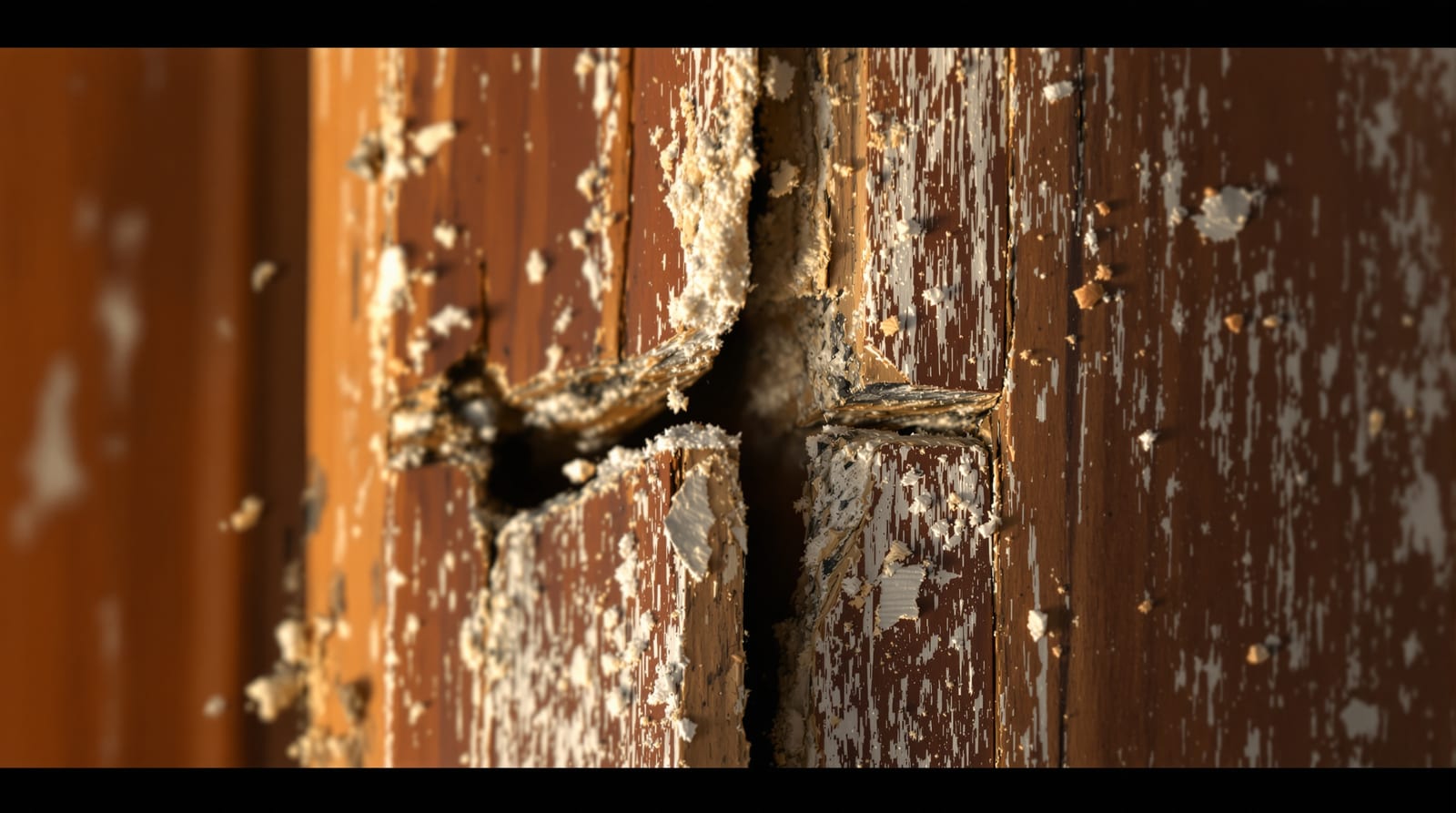
Door Frame Repair: Fix a Damaged Chowkat (India 2026)
Split jambs, kicked-in frames, loose chowkats, rotted feet and out-of-square frames — a clear DIY repair guide for Indian homes.
Door frame repair is one of those jobs that looks intimidating but is often well within reach of a careful homeowner. The frame — the chowkat — is the timber (or WPC/steel) surround fixed into the wall that the leaf hinges off and latches into. When it splits, loosens, rots at the foot, or goes out of square, the door stops closing, latching or locking properly. The good news: most frame faults are repairable with screws, filler, epoxy and patience. The honest news: a borer-riddled or badly rotted chowkat usually needs replacing, not patching. This guide walks you through the common faults, the fixes, the tools, the ₹ costs, and the moment to stop and call a carpenter.
If you are not sure your problem is the frame at all, start at the door troubleshooting flow, then come back here once you have narrowed it down.
Diagnose first: which frame fault do you have?
A chowkat fails in a handful of recognisable ways. Press, wobble and look before you reach for tools.
| Symptom | Likely cause | Where to look | Fix difficulty |
|---|---|---|---|
| Crack/split running down the jamb | Forced entry, slammed door, dried-out timber | Strike side or hinge side | Easy–Moderate |
| Frame splintered around the lock plate | Kicked-in or shoulder-forced door | Strike/latch area | Moderate |
| Whole frame rocks or pulls from wall | Anchors loosened, grout failed | Top and bottom fixings | Moderate |
| Soft, crumbly, dark frame foot | Rot, monsoon water, mopping splash | Bottom 100–200 mm of jamb | Moderate–Pro |
| Tiny holes, fine powder at base | Borer/termite attack | Frame foot, hidden faces | Pro (often replace) |
| Door binds top or bottom, gaps uneven | Frame out of square / sagged | Diagonals, head joint | Moderate–Pro |
If the timber is soft enough to push a screwdriver into easily, or you see fine sawdust (frass), treat it as rot/borer — see door borer & fungus treatment and door bottom rot repair before patching.
Tools & materials you'll need
- Screwdrivers (Phillips + flat) or a cordless drill/driver
- Wood chisel (12–25 mm) and a small hammer
- Long frame screws / structural screws 80–150 mm (₹100–300 a pack)
- Two-part epoxy wood filler or wood putty (₹150–500)
- Wood glue (Fevicol-type) and clamps or a strap clamp
- Sandpaper (80, 120, 220 grit), wood blocks for backing
- Steel ruler, spirit level, try-square, pencil
- Steel strike plate / repair plate, longer strike screws
- Drill bits + countersink; wall plugs (₹50–150)
- For rot: epoxy consolidant, hardener, a sound timber offcut for splicing
- Touch-up: primer, matching paint or wood polish, PU/melamine (see door polishing & refinishing)
Fix 1 — A split or cracked jamb
Difficulty: easy–moderate · Time: 1–2 hours + drying.
1. Open the crack gently. Use a chisel or putty knife to widen the split just enough to work glue in — don't lever it wide enough to break it further.
2. Inject wood glue deep into the crack. A glue applicator bottle or even an old syringe helps push it in.
3. Clamp it closed. Use a strap clamp around the frame, or screw a temporary batten across the face to pull the split shut. Wipe squeezed-out glue with a damp cloth.
4. Reinforce from the side. Once dry (overnight), drive 1–2 long screws across the split into solid timber or the wall behind, countersunk. Pre-drill to avoid a fresh split.
5. Fill, sand, finish. Top the screw heads and any hairline with epoxy filler, sand flush at 120 then 220 grit, prime and paint or polish to match.
DIY cost: ₹200–600 in consumables. Carpenter: ₹400–800 for a visit.
Fix 2 — A kicked-in / forced frame around the strike
This is the classic after a break-in attempt or a hard slam: the latch side splinters where the strike plate sits.
Difficulty: moderate · Time: 2–3 hours.
1. Remove the broken strike plate and clear loose splinters.
2. Glue and clamp any large fractured pieces back; let dry.
3. Fill the void behind the strike with epoxy wood filler so the screws have something solid to bite. For a strong rebuild, glue in a small hardwood block first, then mortise the strike into it.
4. Reinforce with a longer/heavier strike plate — a box strike or security strike spreads the load. Switch the short screws for 75–100 mm screws that reach into the wall stud or the wall behind the frame, not just the frame timber.
5. Re-mortise and fit so the strike sits flush; test the latch engages cleanly. Align it using the method in door strike plate alignment.
This is also your chance to upgrade security — see door security.
Fix 3 — A loose frame pulling away from the wall
If the whole chowkat rocks, the fixings into the masonry have failed (common where the original frame was only grouted, or the plugs have crumbled).
Difficulty: moderate · Time: 2–4 hours.
1. Find the gap. Push the frame and watch where it lifts off the wall — usually top corners or the foot.
2. Drill through the frame into the masonry at the loose points, then insert a wall plug and drive a long frame screw (concrete/frame screws are ideal). Two or three per side is plenty.
3. Pack the gap. Where the frame has pulled away, inject expanding PU foam or pack with cement grout / mortar behind the frame to re-bed it, then tighten the screws to pull it home.
4. Hide the heads. Countersink, fill with epoxy, sand and finish. A timber pellet over the screw gives the neatest result.
5. Re-check the door swings and latches; re-bedding can shift the frame slightly.
Fix 4 — Rotted or borer-eaten frame foot
The bottom 100–200 mm is where water and insects do their worst — mopping, monsoon splash and rising damp all attack the chowkat foot.
Difficulty: moderate–pro · Time: half a day + curing.
- If the rot is shallow/firm-edged: scoop out the soft timber, brush in an epoxy consolidant to harden the remaining fibres, then rebuild the profile with two-part epoxy filler. Shape, sand and finish. Durable and waterproof.
- If a whole section is gone (a "Dutchman" splice): chisel out the bad timber to a clean square shoulder, cut a matching hardwood offcut to fit, glue and screw it in, then blend with filler and finish.
- If a screwdriver sinks in easily or you see frass: the frame is structurally compromised. Treat the cause first (door borer & fungus treatment) and budget to replace the chowkat — patching rotten timber rarely lasts.
For the leaf's matching damage, see fix water-damaged door.
Fix 5 — A frame out of square
When the head or a jamb has shifted, the door binds at one corner and the gaps go uneven.
Difficulty: moderate–pro · Time: 2–4 hours.
1. Measure the diagonals corner to corner — equal diagonals mean square; a difference of more than a few mm means it has racked.
2. Check the easy causes first: loose hinges and a sagged leaf mimic an out-of-square frame. Rule them out via fix sagging door before touching the frame.
3. Re-anchor to pull it true. Loosen the frame fixings on the high side, gently push/clamp the frame back toward square (a long screw and packers behind the jamb act as a jack), then re-fix.
4. Pack behind the jamb with thin timber shims at the screw points to hold the corrected line, trim the shims flush and finish.
5. If the wall itself has moved (settlement, a sagging lintel), this is structural — stop and get a professional opinion.
When the whole chowkat needs replacing
Don't throw good filler after a bad frame. Replace rather than repair when:
- Borer/termite has hollowed multiple faces, or frass keeps returning.
- More than a third of a jamb is rotten or crumbling.
- The frame is cracked through at a joint and won't hold a screw.
- The wall/lintel has moved and re-squaring won't hold.
| Job | DIY parts | Carpenter (labour + small parts) |
|---|---|---|
| Glue & screw a split jamb | ₹200–600 | ₹400–800 visit |
| Strike-area rebuild + new strike | ₹300–900 | ₹600–1,200 |
| Re-anchor a loose frame | ₹300–800 | ₹800–1,500 |
| Epoxy/splice a rotted foot | ₹500–1,500 | ₹1,200–3,000 |
| Re-square a racked frame | ₹300–900 | ₹1,000–2,500 |
| Full chowkat replacement | — | from ₹3,500–10,000+ (timber, size, finish) |
GST 18% applies to goods; most repairs are mostly labour. For a full replacement budget and the leaf to match, see door frame cost and door replacement guide. To weigh fixing against a new frame, run the repair vs replace door calculator or get a quick number from the door repair cost estimator.
Frame anatomy and fix points
India realities to plan around
- Monsoon swelling: timber frames take up moisture and bind; don't over-plane a leaf when the real fix is a frame that will shrink back. See fix swollen door (monsoon).
- Mopping & damp: daily floor washing soaks the chowkat foot — seal and polish the bottom 200 mm, and keep a small gap off the floor.
- Borer/termite: extremely common in older sal/teak frames; treat early and inspect annually as part of wooden door maintenance.
- Hard water/salts near coastal homes accelerate corrosion of frame screws — use stainless fixings where you can.
Keep the whole door healthy with the complete door guide and plan upkeep with the home door maintenance planner.
Frequently asked questions
Can I repair a wooden door frame without removing the door?
Yes — most jamb splits, strike rebuilds and re-anchoring jobs are done with the leaf in place. You only need to remove the door for a full chowkat replacement or a major splice on the hinge side.
How do I tell if my frame is repairable or needs replacing?
Press firmly with a screwdriver. If the timber is solid, glue/screw/epoxy will hold. If it sinks in, crumbles, or you see fine powder (frass) on more than a small area, the frame is structurally gone — replace it and treat the borer/rot first.
What screws should I use to re-anchor a loose frame?
Long frame or structural screws (80–150 mm) into a wall plug set in the masonry. Short wood screws into the frame alone won't hold; you need to reach solid wall behind. Stainless is best in damp or coastal areas.
Will epoxy filler really hold a rotted frame foot?
For shallow, firm-edged rot, an epoxy consolidant plus filler is genuinely durable and waterproof. For a missing chunk, splice in solid timber first. For widespread rot, no filler will last — replace the frame.
My door binds at the top corner — is the frame out of square?
Maybe, but check the simpler causes first: loose hinges and a sagged leaf cause the same symptom. Tighten/repack the hinges and rule out a sagging door before re-squaring the frame.
When should I stop and call a carpenter?
Call a pro if the wall or lintel has moved (structural), if more than a third of a jamb is rotten, if the frame is borer-hollowed, or if re-squaring needs the door rehung. Frame work that touches the masonry or structure is worth a professional eye.
Export this guide
Related Guides — Deep-dive reading
Door Not Closing Properly? Fix It Step-by-Step (India 2026)
A clear decision tree for a door that won't shut — latch, hinge-bind, swelling, sag, warp or a moved frame — with DIY fixes and ₹ costs.
Home Doors & EntrancesDoor Frame Security in India (2026): Anchoring the Chowkhat Break-Ins Actually Exploit
A homeowner's guide to the real weak point behind most forced entries: the frame, not the leaf or the lock, and how to anchor, pack and reinforce a chowkhat so a strong door genuinely stays in the wall.
SecurityRepair a Cracked Wooden Door: DIY Guide (India 2026)
Hairline crack, deep split or panel separation? Match the right glue, clamp and filler method to the fault and refinish like new.
Home Doors & EntrancesRelated Tools — Try Free
Door Material Comparison Tool
Compare 2–4 door materials on cost, durability, maintenance, security and moisture resistance.
Comparison ToolDoor Security Rating Calculator
Score your main door out of 100 across leaf, frame, lock and hardware — and see the top upgrades.
Security ToolWindow Maintenance Cost Calculator
Estimate annual window upkeep by frame material — yearly, per-window and 5-year cost.
Window Calculator