
Repair a Cracked Wooden Door: DIY Guide (India 2026)
Hairline crack, deep split or panel separation? Match the right glue, clamp and filler method to the fault and refinish like new.
A crack across your front door is unsettling, but most of the time you can repair a cracked wooden door yourself for the price of a tube of glue and an afternoon. The trick is to read the damage first. A fine hairline crack in the finish is cosmetic and forgiving. A deep split that runs with the grain and opens when you push it is structural and needs glue under pressure. A floating door panel that has shrunk and rattled loose is a different job again. Use the wrong fix and the crack comes back by the next monsoon, so this guide walks you through identifying the fault, choosing the method, and refinishing so the repair disappears.
First, identify what kind of crack you have
Wooden doors crack mostly because wood moves. India's swing from dry summer heat to humid monsoon makes timber expand and contract, and if the door was sealed on its faces but not on the top and bottom edges, moisture enters unevenly and the wood splits along the grain. Solid teak and sal handle this well; cheaper rubberwood, mango and seasoned softwood crack sooner. Borer and termite damage can also look like a crack until you probe it and the wood crumbles.
Look closely and run a fingernail or thin blade into the line.
| Symptom | Likely cause | Fix approach | Difficulty |
|---|---|---|---|
| Fine surface line, finish only, no depth | Polish/laminate cracking with age | Touch-up marker or spot refinish | Easy |
| Hairline crack 1-2 mm, shallow | Surface checking from drying | Wood filler + sand + refinish | Easy |
| Open split along the grain, flexes when pushed | Seasonal movement, dry timber | Wood glue + clamp | Moderate |
| Deep split through a stile or rail | Structural stress, impact | Glue + clamp + dowel/biscuit reinforcement | Pro-ish |
| Panel loose, gap around its edge | Panel shrinkage in frame | Re-seat / shim panel, do not glue solid | Moderate |
| Wood spongy, powder, tiny holes around crack | Borer or rot | Treat first, often replace | Pro |
If the wood is soft, hollow-sounding or shedding fine dust, stop and read door borer & fungus treatment and door bottom rot repair before you fill anything. Filler over rot just hides a growing problem.
Tools & materials you'll need
- Wood glue: PVA (white/yellow carpenter's glue) for clean splits; two-part epoxy or PU adhesive for outdoor/wet-area doors
- Two-part epoxy wood filler or stainable wood putty for cracks and gouges
- Bar clamps or a ratchet strap (a long luggage strap works for a whole leaf)
- Sandpaper: 80, 120, 220 grit
- Putty knife / filling blade, painter's tape, clean rags
- For deep splits: a biscuit joiner or 8-10 mm dowels + drill (optional reinforcement)
- Refinishing: matching PU/melamine polish or paint, brush, and a touch-up marker for grain
- Wood preservative/sealer for the edges you expose
A realistic DIY kit costs around ₹600-1,500. Compare that with a carpenter visit at ₹400-800 for a half-day or ₹800-1,500 for a full day, plus material; a veneer or laminate patch alone runs ₹500-2,000. GST is 18% on the goods.
Method A: Hairline cracks and shallow checks (easy, 1-2 hours + drying)
This is the most common and the easiest.
1. Clean the crack with a dry brush, then a barely damp cloth, and let it dry fully.
2. Press two-part epoxy wood filler or stainable putty into the line with a putty knife, working it across the crack so it packs in, then scrape flush. Overfill very slightly; filler shrinks a touch.
3. Let it cure per the pack (epoxy 30-60 min; some putties overnight).
4. Sand smooth: 120 grit, then 220, until you cannot feel the repair.
5. Refinish. For a small area, blend with a touch-up marker and a dab of polish; for a visible face, follow door polishing & refinishing so the sheen matches.
Time: an afternoon. When to stop: if the "hairline" opens when you press the door, it is actually a split, go to Method B.
Method B: Open splits along the grain (moderate, half a day + overnight clamp)
A split that runs with the grain is the satisfying one to fix, because glue in a tight wood-to-wood joint is stronger than the wood around it.
1. Open the crack gently with a thin blade or wedge so you can see inside, and clean out dust and old finish.
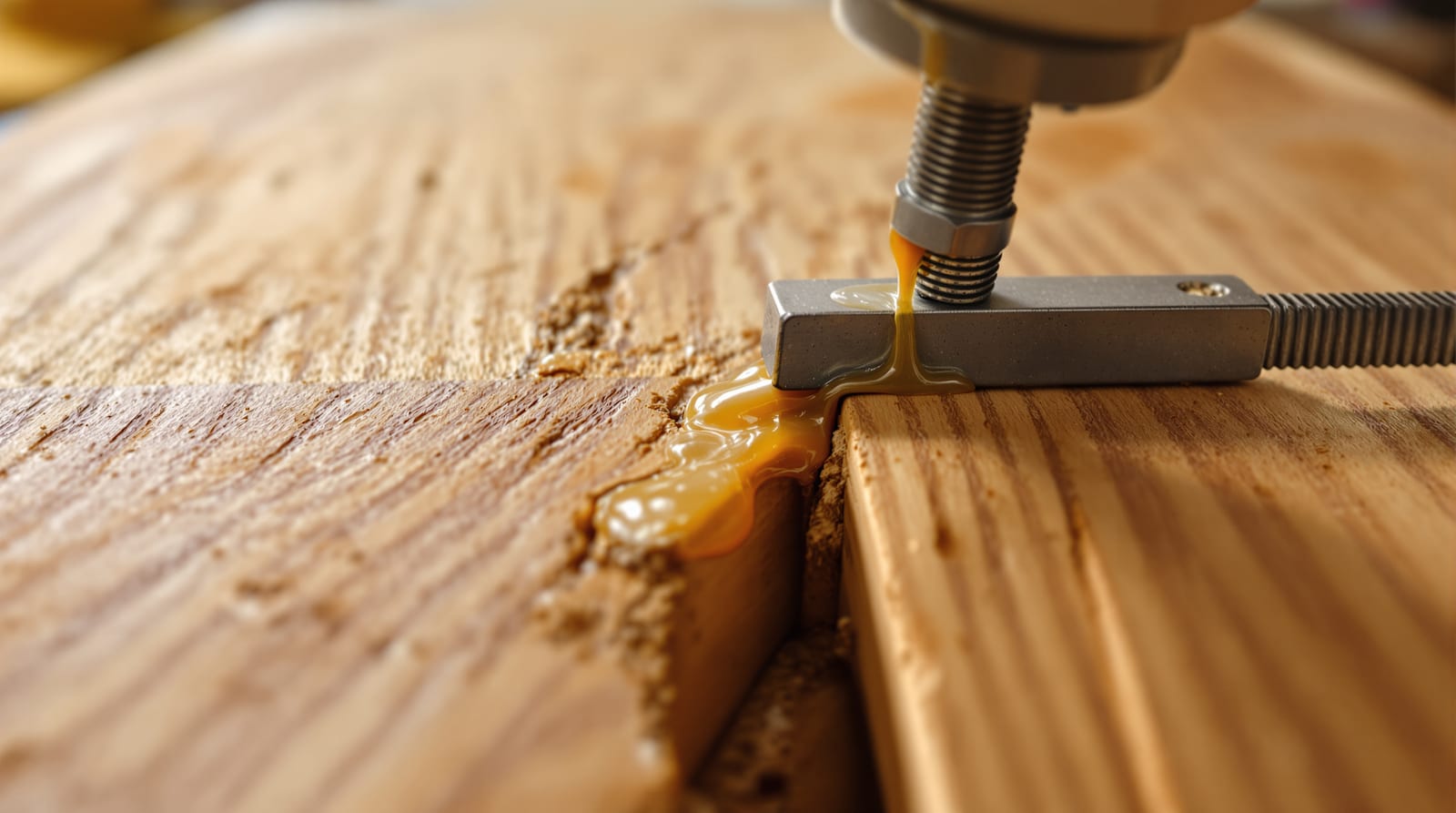
2. Work glue right into the split. Use a thin card, a syringe, or compressed air to push PVA deep along the whole crack. For an external door or a bathroom/wet zone, use waterproof PU or epoxy adhesive instead.
3. Close the split and clamp it. Lay bar clamps across the leaf, or wrap a ratchet strap around the whole door, and tighten until glue squeezes out evenly along the line. Protect the faces with offcuts so clamps do not dent the wood.
4. Wipe the squeeze-out immediately with a damp rag; dried glue resists stain.
5. Leave clamped overnight (minimum 4-6 hours, but overnight is safer in humid weather).
6. Remove clamps, sand flush, fill any remaining hairline with filler, then refinish.
Difficulty: moderate. Time: 30 minutes of work, then overnight under pressure. Cost: ₹200-500 in glue and consumables if you own clamps.
Reinforcing a deep or repeated split
If the split is deep, runs through a stile (the vertical side member) or has opened before, glue alone may not hold against the next humidity swing. Add mechanical reinforcement after gluing and clamping:
- Dowels: drill 8-10 mm holes across the crack line from the edge of the door, glue in hardwood dowels, trim flush. This pins the two sides together across the grain.
- Biscuits: if you own a biscuit joiner, slot and glue biscuits across the split for a hidden, strong joint.
This edges into carpentry. If the split is through a load-bearing rail or the door now sags, treat it as structural, see fix a sagging door, and consider replacement.
Method C: A loose or separated panel (moderate)
Traditional panelled doors have floating panels that sit in grooves and are meant to move with the seasons. When one shrinks, you see a gap or hear a rattle, and the join between panel and frame can look like a crack.
The mistake is to glue the panel solid. Lock it in place and it will split the next time it expands. Instead:
1. Confirm the panel is loose, not cracked, by pressing it.
2. Tap thin wood shims or paint-able caulk into the gap to stop the rattle while still allowing some movement, or
3. Pin a small bead of moulding over the gap on one face only.
4. Refinish the bead or caulk to match.
If the panel itself is split, glue and clamp it as in Method B before re-seating.
Prevent the next crack
Most door cracks are preventable. The single biggest cause in India is unsealed edges letting monsoon moisture in.
| Prevention step | Why it works | Cadence |
|---|---|---|
| Seal top and bottom edges with polish/primer | Stops uneven moisture uptake | Once at install, recheck yearly |
| Re-polish faces before monsoon | Keeps moisture out of the grain | Annually, pre-June |
| Keep door off direct rain splash | Reduces swell-shrink cycles | Ongoing |
| Treat for borer if you see dust | Cracks often start at borer galleries | At first sign |
| Touch up scratches and chips quickly | Bare wood absorbs water fast | As needed |
For the full routine see wooden door maintenance and, if your door swells shut in the rains, fix a swollen door in monsoon.
When to repair and when to replace
Be honest with yourself. Glue and filler fix splits and surface cracks beautifully. They do not fix a badly warped leaf, a door that is more crack than wood, or one riddled with borer or rot. A flush leaf replacement is ₹3,000-6,000 for the leaf alone, and a full leaf-plus-frame more, which is sometimes the cheaper path once you add up repeated repairs.
Use the repair vs replace door calculator and the door repair cost estimator to put numbers on it. If you decide the door is beyond saving, door replacement guide and door cost in India 2026 take you from there. For the wider picture of door faults, start at the door troubleshooting hub or the complete door guide.
Frequently asked questions
Can I just fill a deep split with putty instead of gluing it?
No. Putty has no structural strength, so a deep or flexing split will simply re-open and crack the filler. Glue and clamp the split first to bond the wood, then use filler only for the final hairline cosmetics.
Which glue should I use on an exterior or bathroom door?
Use a waterproof adhesive: polyurethane (PU) glue or two-part epoxy. Ordinary PVA carpenter's glue is fine for dry interior doors but can fail in wet or humid conditions, which is exactly where Indian doors crack most.
How long should I leave the clamps on?
Minimum 4-6 hours, but overnight is safer, especially in humid weather when glue cures slowly. Tighten until you see an even bead of glue squeeze out along the whole crack, then wipe it off before it dries.
My door cracked again in the same spot. Why?
The glue joint held but the wood is still moving, usually because the edges are unsealed and absorbing monsoon moisture, or the original timber is poorly seasoned. Re-glue, add dowel reinforcement across the crack, and seal every edge. If it keeps splitting, the leaf may need replacing.
Will the repair show after refinishing?
Done carefully, no. Sand flush through 220 grit, match the polish sheen, and blend grain with a touch-up marker. On polished teak a skilled repair is nearly invisible; on painted doors it disappears completely.
When should I stop and call a carpenter?
Call a pro if the split runs through a structural rail and the door now sags, if the wood is spongy or full of borer dust, if the leaf is warped, or if you are not confident clamping a heavy door safely. A half-day carpenter visit is ₹400-800, cheap insurance for your main door.
Export this guide
Related Guides — Deep-dive reading
Door Repair Guide India: Fix Holes, Dents, Swelling, Hinges & Locks (2026)
A fix-it reference for Indian homes: every common door problem with a quick fix, a proper repair, a replace verdict, the materials needed, and indicative rupee costs.
Home Doors & EntrancesHow to Fill Door Holes and Dents: DIY (India 2026)
Patch screw holes, dents and punched hollow-core damage with filler or epoxy, then sand, prime and paint so it disappears.
Home Doors & EntrancesFix a Water-Damaged Door: Repair Guide (India 2026)
Dry it, assess swelling vs delamination vs rot, sand and fill, re-glue veneer, seal every edge, and know when to switch to WPC or uPVC.
Home Doors & EntrancesRelated Tools — Try Free
Annual Interior Maintenance Checklist
Seasonal maintenance checklist for woodwork, paint, plumbing, electrical, and appliances.
MaintenanceDoor Cost Calculator
Estimate the all-in cost of a door — leaf, frame, hardware, fitting and GST — by type, material and size.
Door CalculatorMonsoon-Readiness Checklist
Pre-rain home audit across 9 categories — terrace, drains, waterproofing, electrical, HVAC, pest, vehicles, documents.
Seasonal Audit