
Swollen Door Monsoon Fix: DIY Repair Guide (India 2026)
Why your wooden door swells, sticks and refuses to shut every monsoon, plus the in-season quick fix and the permanent dry-season cure.
You know the feeling. The first heavy rains arrive, the air turns thick, and suddenly the bedroom door that closed sweetly all summer needs a shoulder-shove to shut, then a tug to open. A swollen door monsoon problem is probably the single most common door complaint in Indian homes, and the good news is that most cases are fixable by you in an afternoon. The trick is knowing which fix to do now, in the wet, and which to save for the dry season so it actually lasts.
This guide walks you through both: the gentle in-season fix that gets the door working again without ruining it, and the permanent dry-season cure that stops the swelling coming back. We will also be honest about when a door is too far gone to save, and when a wet area really wants a WPC or uPVC leaf instead of timber.
Why the swollen door monsoon cycle happens
Wood is hygroscopic. It drinks moisture from humid air and gives it back when the air dries out, swelling and shrinking a little each time. In a Mumbai or Kochi monsoon, indoor humidity can sit above 80% for weeks, and any timber surface that is not sealed soaks it up like a sponge.
The catch is which surfaces. When a carpenter fits and finishes a door, they almost always paint or polish the two big faces. But the four edges, especially the top edge and the bottom edge, are frequently left bare raw wood, because nobody sees them. Those unsealed edges are exactly where humidity gets in. The door grows widthways and heightways, the edges press into the frame, and you get rubbing, sticking, and a door that will not latch.
Solid timber doors swell most. Flush doors with a thin veneer or laminate swell less on the face but still take water through unsealed edges. Engineered and WPC doors barely move at all, which is the whole point of using them in bathrooms and other wet zones.
Find the rub before you touch sandpaper
Before any fix, find exactly where the door is binding. Close it slowly and watch, or slide a strip of paper around the gap: where the paper jams or where you see shiny rub marks or flaked paint, that is your contact point. Common spots are the top corner on the latch side and the latch edge itself. Mark the rub with a pencil so you only treat what is actually sticking. If you are unsure where the door is fouling, our door rubbing frame guide shows how to read the marks.
The in-season quick fix (do this now)
Difficulty: easy. Time: 30-60 minutes. Cost: under ₹300 in consumables.
In the wet season the door is at its biggest. The goal now is just to relieve the rub, lightly, so the door works, without removing so much wood that you get a big sloppy gap once everything dries and shrinks again in October.
1. Find and mark every rub point as above. Usually it is one or two spots, not the whole edge.
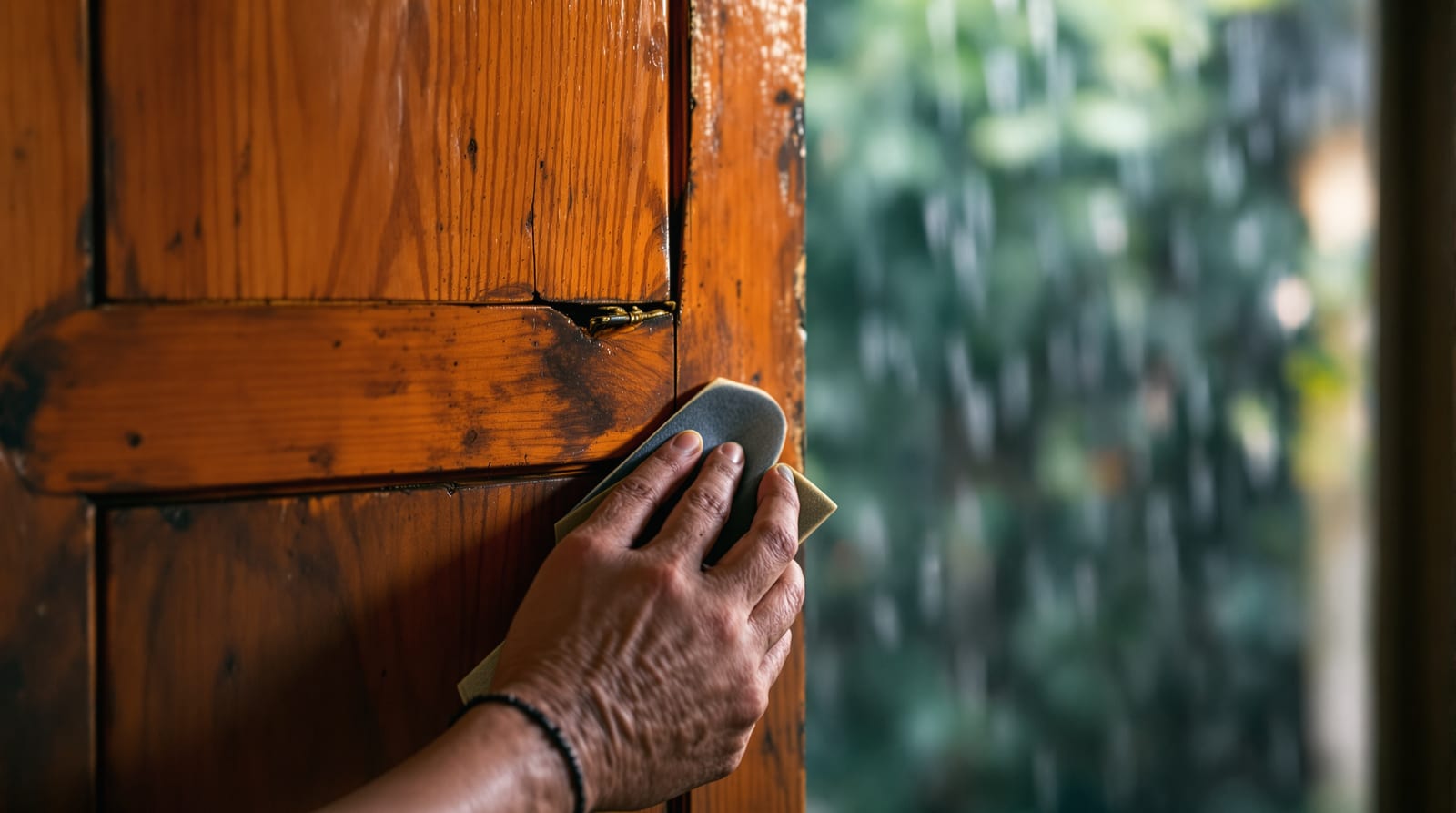
2. Sand, do not plane. Wrap medium 80-120 grit sandpaper around a sanding block and rub down only the marked high spots. A few millimetres makes all the difference. Test-close often.
3. Ease, do not gouge. Stop the moment the door clears. Resist the urge to keep going "to be safe" – you will regret it when the door shrinks back.
4. Lubricate the latch and hinges with a little silicone spray or candle wax so the swollen door moves freely while you work.
5. Run a fan or dehumidifier in the room. Dropping indoor humidity even a little shrinks the door slightly and can relieve sticking on its own – sometimes that alone fixes it.
6. Touch up the bare sanded patch with a dab of primer or paint if you can. Even a thin coat slows further soaking until you do the full job.
That is it. The door should swing and latch. The crucial discipline is minimal removal: in-season you are managing the symptom, not curing the disease.
The permanent dry-season fix (October onwards)
Difficulty: moderate. Time: 2-4 hours including drying. Cost: ₹300-1,200 DIY; ₹300-800 if a carpenter planes; repaint ₹500-1,500.
The real cure happens when the air has dried and the door has shrunk back to its smallest. Now you plane minimally if needed, and then you seal all six surfaces so it never drinks monsoon humidity again.
1. Wait for the dry season. Doing this while the door is swollen guarantees an over-cut, gappy door later.
2. Take the door off its hinges if you can (two people, or rest it on wedges). Working off the hinges lets you reach the top and bottom edges, which is the whole point.
3. Plane minimally any edge that still binds, taking off only a hair. A sharp block plane or even coarse sanding is enough. Check against the frame as you go.
4. Clean and dry all surfaces. Wipe off dust; the wood must be dry before sealing.
5. Seal every surface and edge. This is the step everyone skips and the reason doors keep swelling. Apply primer-plus-paint, PU/melamine sealer, or a good wood sealant to both faces and all four edges, the top and bottom especially. Two thin coats beat one thick one.
6. Let it cure fully per the product, then re-hang and check the gap. Aim for a 2-3 mm clearance all round – the door gap clearance checker gives the ideal numbers.
A properly sealed door takes on very little moisture, so next monsoon it stays put. If you want a polished finish rather than paint, see door polishing and refinishing.
Tools & materials you'll need
| Item | Approx ₹ (incl GST) | Used for |
|---|---|---|
| Sandpaper 80-120 grit + block | 80-200 | In-season rub relief |
| Block plane (or rent) | 400-1,200 | Dry-season minimal planing |
| Wood primer + paint, or PU/melamine sealer | 250-800 | Sealing all six surfaces |
| Silicone / candle / graphite lubricant | 100-300 | Free up latch & hinges |
| Wood filler / putty | 100-250 | Filling old gaps before sealing |
| Weatherstrip / draught seal (optional) | 150-500 | Bottom-edge protection |
| Small fan or dehumidifier | use existing | Drop indoor humidity |
Symptom, cause and the right fix
| Symptom | Likely cause | Right fix |
|---|---|---|
| Sticks only in monsoon, free in summer | Unsealed edges drinking humidity | In-season sand the rub; dry-season seal all 6 surfaces |
| Sticks all year, getting worse | Sagging hinges, not swelling | Tighten/reset hinges, see linked sagging-door guide |
| Latch won't catch in the wet | Door grown, strike misaligned | Light sand + dehumidify; adjust strike in dry season |
| Bottom edge dark, soft, peeling | Water damage / rot starting | Dry, fill, seal; if soft and crumbly, replace leaf |
| Visibly bowed / twisted | Warping, not simple swelling | Often needs replacement – see warped-door fix |
| Bathroom timber door swells yearly | Wrong material for wet area | Switch to WPC or uPVC |
Difficulty and time at a glance
| Task | Difficulty | Time | DIY cost | Carpenter |
|---|---|---|---|---|
| In-season rub sanding | Easy | 30-60 min | < ₹300 | ₹300-800 visit |
| Dry-season plane + seal | Moderate | 2-4 hr | ₹300-1,200 | ₹300-800 plane + ₹500-1,500 repaint |
| Replace swollen/rotted leaf | Pro | half day | — | ₹3,000-6,000 leaf only |
When timber is the wrong choice
If the same bathroom or balcony door swells every single year no matter how well you seal it, the door is simply in too wet a spot for timber. This is the classic case for a WPC door, which is dimensionally stable in humidity and will not swell, rot or host borer. Read WPC doors to compare, or run the door swelling risk checker to see whether your location and door material are a bad match. For external and very wet openings, uPVC and aluminium are also worth considering.
When to stop and call a carpenter
DIY is right for sanding, light planing and sealing. Stop and call a professional when:
- The door is visibly bowed or twisted – that is warping, not swelling, and planing won't fix it. See warped door fix.
- The bottom edge is soft, dark or crumbling – rot has set in and the leaf likely needs replacing.
- The door sags or the hinges are pulling out – that is a frame/hinge job, not a swelling job.
- It is a glass, automatic or fire-rated door – leave those to a specialist.
For a wider diagnosis of any door fault, start at our door troubleshooting hub, and for the full picture of buying, fitting and caring for doors see the complete door guide. Good monsoon-proofing also means good seals – door seals and weatherstripping keeps wind-driven rain off the bottom edge.
Frequently asked questions
Why does my wooden door only stick in the monsoon and work fine in summer?
Because the unsealed edges of the door absorb humidity from the wet air and swell, pressing into the frame. In summer the air dries, the wood shrinks back, and the door clears again. Sealing all six surfaces breaks the cycle.
Should I plane my door now while it is stuck?
No. Right now the door is at its maximum size. If you plane it big, you will be left with an ugly gap when it shrinks in the dry season. In the wet, only lightly sand the actual rub points. Save real planing for October.
Which surfaces of the door should I seal?
All six – both faces and all four edges, with the top and bottom edges being the most important and the most often forgotten. These bare edges are the main route moisture takes in.
Can a dehumidifier really fix a swollen door?
It can relieve a mild sticking problem. Dropping indoor humidity makes the door shrink slightly and may free it without any sanding. It is also the best way to dry the wood before you seal it.
My bathroom door swells every year. What should I do?
If sealing does not hold, the door is in too wet a spot for timber. Switch to a WPC or uPVC door, which do not absorb water, swell or rot – ideal for bathrooms and balconies.
How much does it cost to fix a swollen door?
DIY consumables are usually under ₹1,200. A carpenter visit to plane runs ₹300-800, plus ₹500-1,500 to repaint. Replacing a flush leaf that has rotted is ₹3,000-6,000 for the leaf alone.
Export this guide
Related Guides — Deep-dive reading
Fix a Water-Damaged Door: Repair Guide (India 2026)
Dry it, assess swelling vs delamination vs rot, sand and fill, re-glue veneer, seal every edge, and know when to switch to WPC or uPVC.
Home Doors & EntrancesDoor Not Closing Properly? Fix It Step-by-Step (India 2026)
A clear decision tree for a door that won't shut — latch, hinge-bind, swelling, sag, warp or a moved frame — with DIY fixes and ₹ costs.
Home Doors & EntrancesDoor Maintenance Guide India: A Seasonal Care Routine to Keep Doors Smooth for Decades
Oil the hinges, tighten the screws, lube the lock, check the seals and re-coat the finish — a simple seasonal calendar that stops Indian doors from binding in the monsoon, sagging, tarnishing on the coast or falling to termites.
Home Doors & EntrancesRelated Tools — Try Free
Door Material Comparison Tool
Compare 2–4 door materials on cost, durability, maintenance, security and moisture resistance.
Comparison ToolBathroom Door Material Selector
Get the best wet-area door material — WPC, FRP, PVC, marine ply or aluminium — ranked for your bathroom or utility.
Material SelectorDoor Paint Calculator
Estimate paint and primer litres and cost to paint your doors by size, number of doors, coats and paint type.
Door Calculator