
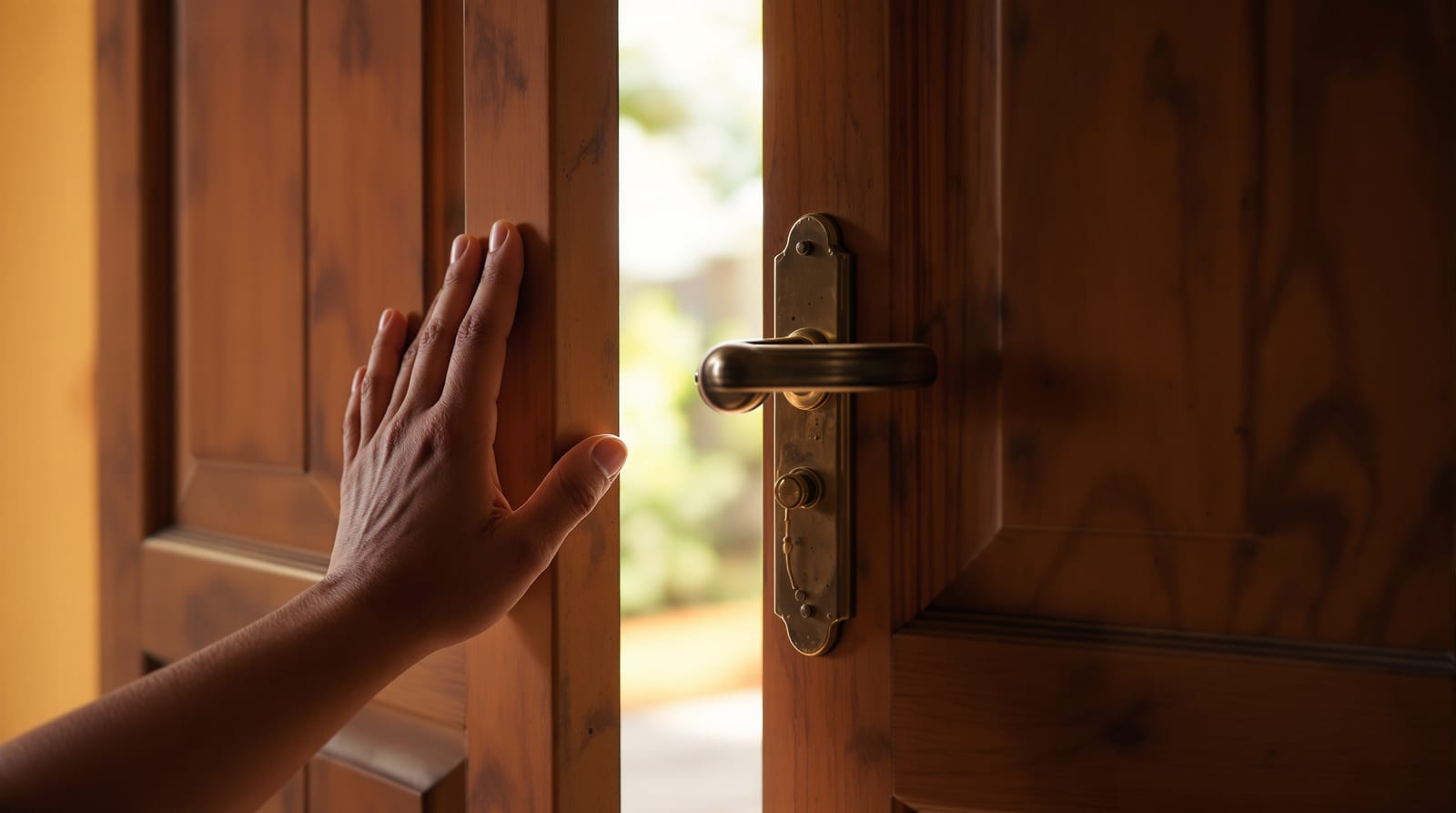
Door Not Closing Properly? Fix It Step-by-Step (India 2026)
A clear decision tree for a door that won't shut — latch, hinge-bind, swelling, sag, warp or a moved frame — with DIY fixes and ₹ costs.
A door not closing properly is one of the most common household irritations in Indian homes — and the good news is that it almost always traces back to one of about seven causes. The trick is not to start sanding or unscrewing things at random. Instead you diagnose first: watch where and when the door resists, and the fault usually announces itself. This guide gives you a quick decision tree, then a step-by-step fix for each cause, with realistic ₹ costs and an honest note on when to stop and call a carpenter.
Why a door not closing properly is usually a quick fix
The reassuring truth is that a door not closing properly is rarely the wood's fault — it is the hinges, the alignment or the seasons. Diagnose first, fix second.
First, diagnose: where does it stick?
Before you touch a single screw, do a two-minute inspection. Slowly swing the door toward the frame and watch closely. The location of the resistance is your biggest clue.
- Latch reaches the frame but won't "click" in — the latch bolt isn't lining up with the hole in the strike plate. This is a latch/strike alignment problem, not a swelling one.
- Door binds before it even reaches the frame, near the hinges — it's hinge-bound (hinges set too deep or over-tightened).
- Leaf rubs the side jamb, worse in monsoon — swelling from humidity.
- Top corner on the latch side drops and catches the floor or the jamb — the door has sagged on its hinges.
- A gap that opens diagonally; the leaf no longer sits flat — the door is warped, or the frame has shifted (common after settling or wall damp).
- Door feels gummy and tight all round, with thick edges — years of paint buildup on the edges and jamb.
Use this table to pin it down.
| Symptom | Most likely cause | Difficulty to fix | Typical time |
|---|---|---|---|
| Latch touches strike but won't catch | Strike/latch misalignment | Easy | 15–40 min |
| Resists near hinge edge, springs back | Hinge-bound (screws too deep) | Easy | 20–45 min |
| Tight on latch edge, worse in rains | Swelling / humidity | Moderate | 1–2 hr |
| Latch-side top corner drops, scrapes | Sagged on hinges | Easy–Moderate | 30–60 min |
| Diagonal gap, leaf not flat | Warp or frame movement | Pro | varies |
| Gummy, thick all round | Paint buildup on edges | Moderate | 1–2 hr |
If you'd rather answer a few questions and let a tool point you, try the door problem diagnoser; for budgeting a carpenter visit use the door repair cost estimator.
Tools & materials you'll need
Most fixes here use the same small kit. Buy once and you'll handle nearly any door fault.
| Item | Use | Indicative ₹ (incl GST) |
|---|---|---|
| Phillips + flat screwdriver set | Hinges, strike, handles | ₹150–500 |
| Cordless drill + bits | Re-drilling, pilot holes | ₹1,500–4,000 |
| Wood file / surform / block plane | Trimming swollen or rubbing edges | ₹250–900 |
| Sandpaper (120 & 220 grit) | Smoothing, paint feathering | ₹50–150 |
| Wood filler / matchsticks + fevicol | Stripped or worn screw holes | ₹80–250 |
| Longer wood screws (size 8–10, 50–65 mm) | Re-anchoring sagging hinges into the stud | ₹50–150 |
| Chisel (12–25 mm) | Deepening or shimming a mortise | ₹150–500 |
| Touch-up marker / putty + polish | Hiding the repair | ₹150–600 |
| Candle wax / graphite / silicone spray | Easing a tight latch | ₹100–300 |
The SVG: where a door binds
The diagram below maps the four edges of a door to the four most common faults — keep it in mind as you work.
Fix 1 — Latch not meeting the strike (easy)
If the door swings fully shut but the latch won't grab, the strike plate has moved relative to the latch by a millimetre or two — usually because hinges loosened slightly. Difficulty: easy. Time: 15–40 min.
1. Smear lipstick or a pencil mark on the latch bolt, close the door, and open it — the mark transfers to the strike plate, showing exactly where the bolt is hitting.
2. If it's a hair too high or low, file the strike hole larger in that direction with a round file.
3. If it's off by more, unscrew the strike plate and shift it 1–3 mm, drilling fresh pilot holes; fill the old holes with matchsticks and glue first.
4. Re-fit and test. For a full walkthrough see door strike plate alignment and door not latching.
Cost: DIY ~₹0–100; carpenter visit ₹300–600.
Fix 2 — Hinge-bound door (easy)
A hinge-bound door springs back at you and resists near the hinge side. The hinge leaves are mortised too deep or over-tightened, so the door is pinched. Difficulty: easy. Time: 20–45 min.
1. Look at the hinge gap with the door open. If the leaves are crushed tight with almost no gap, that hinge is too deep.
2. Loosen the screws slightly; sometimes that alone frees it.
3. If not, place a thin cardboard shim behind the hinge leaf (between hinge and mortise), re-screw, and the door will sit a touch further out.
4. Conversely, if the door binds on the latch side, a shim on the hinge side pulls the leaf toward the hinges.
This is the classic monsoon-season quick fix. Cost: essentially free.
Fix 3 — Swollen / rubbing leaf (moderate)
During the monsoon, timber and even some MDF-cored flush leaves absorb moisture and swell on the latch edge. Difficulty: moderate. Time: 1–2 hr.
1. Wait for a dry spell if you can — the door may shrink back, and you don't want to over-trim and leave a gap in summer.
2. Find the rub line (the shiny or scuffed band on the edge).
3. Plane or file lightly along that band only, a little at a time, checking fit often. Trim the latch edge, never the hinge edge.
4. Seal the freshly exposed timber with primer or polish so it doesn't drink moisture again.
See fix swollen door monsoon for the full method and door swelling risk checker to gauge how prone your door is. Cost: DIY ₹50–200; carpenter planing visit ₹300–800.
Fix 4 — Sagged on its hinges (easy–moderate)
If the latch-side top corner has dropped and the leaf scrapes the floor or catches the jamb diagonally, the hinges have loosened — usually the top one, where stripped screws can no longer grip. Difficulty: easy–moderate. Time: 30–60 min.
1. Tighten all hinge screws. If a screw spins freely, the hole is stripped.
2. For a stripped hole, push glued matchsticks or a wooden dowel in, let it set, then re-drive.
3. Best fix for a sag: replace one screw in the top hinge with a 50–65 mm screw that bites into the wall stud behind the frame — this physically pulls the door back up.
Detailed steps are in fix sagging door, fix loose door hinges and stripped hinge screw fix. Cost: DIY ₹50–150; carpenter ₹400–800.
Fix 5 — Warped leaf or moved frame (pro)
If the door no longer sits flat — the leaf touches at top and bottom but a gap yawns in the middle (or vice-versa) — it is warped, or the frame has shifted from settling, damp or a poorly cured wall. Difficulty: pro. Be honest here.
A mildly bowed hollow flush door can sometimes be coaxed flat by laying it on trestles with weights and a damp cloth on the convex face for a few days, but results are unreliable. A solid timber door that has truly warped, or a frame that has racked out of square, usually needs professional re-hanging or replacement. Don't keep planing — you'll only ruin the seal. Read warped door fix and door frame repair, and if it's beyond repair, the door replacement guide. Cost: carpenter ₹800–1,500/day; new flush leaf ₹3,000–6,000.
Fix 6 — Paint buildup (moderate)
Decades of repainting without sanding leave the door edges and jamb thick and gummy, so the leaf jams into a too-tight rebate. Difficulty: moderate. Time: 1–2 hr.
1. Identify the contact band, then sand back the excess paint on the edge and the jamb stop with 120-grit, finishing with 220.
2. Wipe clean, re-prime the bare patch, and apply one thin top coat. See door painting guide.
Cost: DIY ₹100–300.
When to stop and call a carpenter
DIY the alignment, hinge and minor-swelling fixes with confidence. Call a professional when: the leaf is genuinely warped or the frame has moved (structural); a heavy main door or fire door is involved; the door is glass or has an automatic operator/closer — isolate power first and never force a sensor door; or rot/borer is present at the bottom rail. For a money-led decision, the repair vs replace door calculator helps. Browse the full complete door guide and door troubleshooting for the wider picture, and grab the right kit with door repair tools.
Frequently asked questions
Why does my door close fine in summer but not in the monsoon?
Humidity. Timber and MDF-cored leaves absorb moisture and swell, usually on the latch edge. Wait for a dry spell before trimming, and seal any bare edges so they don't drink water again next year.
My latch clicks shut but the door rattles — same problem?
No, that's the opposite: the strike is slightly too far back. Bend the strike-plate tongue outward a touch, or add a thin adhesive bumper to the stop. See the strike-plate alignment guide.
Is it safe to just plane the door until it fits?
Only the latch edge, and only a little. Never plane the hinge edge, and don't keep planing a warped door or a sagged one — fix the hinges or frame first, or you'll end up with permanent gaps and draughts.
How much does a carpenter charge to fix a sticking door?
In India, a simple visit or half-day is around ₹400–800 and a full day ₹800–1,500, plus any parts. Metros run higher, tier-2 towns cheaper. Most closing faults are a labour-only job.
The whole door dropped and scrapes the floor — what's the quickest fix?
Replace one screw in the top hinge with a long 50–65 mm screw that reaches the wall stud. It pulls the leaf back up and is often a five-minute fix once you have the screw.
Export this guide
Related Guides — Deep-dive reading
How to Fix a Sagging Door in India: Diagnose, Tighten, Shim & Plane
A step-by-step repair sequence to fix a door that droops, binds on the frame, or won't latch — from a free five-minute screw fix to a last-resort plane.
Home Doors & EntrancesDoor Repair Guide India: Fix Holes, Dents, Swelling, Hinges & Locks (2026)
A fix-it reference for Indian homes: every common door problem with a quick fix, a proper repair, a replace verdict, the materials needed, and indicative rupee costs.
Home Doors & EntrancesDoor Not Latching? Fix the Strike & Latch (India 2026)
Your door shuts but pops back open — here's how to find the misalignment and get the latch clicking into the strike again.
Home Doors & EntrancesRelated Tools — Try Free
Door Paint Calculator
Estimate paint and primer litres and cost to paint your doors by size, number of doors, coats and paint type.
Door CalculatorDoor Cost Calculator
Estimate the all-in cost of a door — leaf, frame, hardware, fitting and GST — by type, material and size.
Door CalculatorDoor Problem Diagnoser
Tell us the symptom and get the likely cause, the fix, DIY difficulty and indicative cost for any door fault.
Diagnostic Tool