
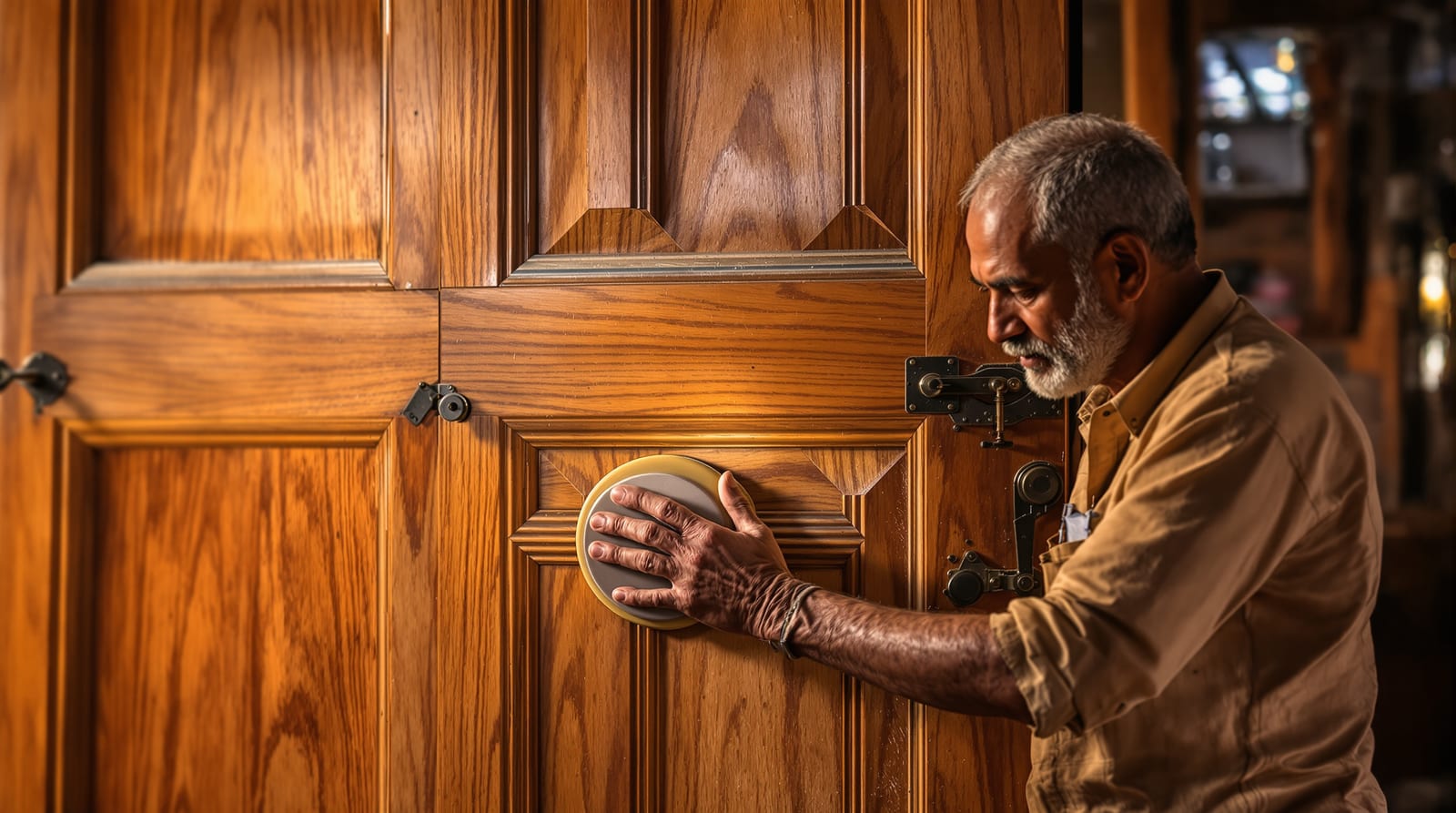
Door Polishing & Refinishing in India: Melamine, PU, Duco & Oil Finishes Compared
What melamine, PU, Duco and traditional oil-wax finishes look like, how long they last, and how to strip, sand and re-polish a tired wooden or veneer door — plus indicative ₹ per door.
A natural wood or veneer door is only as good as the film sitting on top of it. The same teak leaf can look like raw cricket-bat timber, a glassy showroom panel, or a soft hand-rubbed antique depending purely on what finish the polisher chose and how carefully it went on. That finish also decides whether the door survives a Mumbai monsoon, a Chennai summer or ten years of oily fingers around the handle. This guide explains the four finishes you will actually be offered in India - melamine, PU, Duco and traditional oil or wax - what each one looks like, how long it lasts, the sheen you can ask for, and the exact sequence to refinish a tired old door or revive a dull one without a full strip. It pairs with our broader door maintenance guide; here we go deep on the finish itself.
What "polishing" actually means on an Indian door
In Indian carpentry, "polish" is a catch-all word for any clear or coloured finish coat, not just the wax buffing it implies in English. When a contractor quotes "polishing" for a wooden door, they usually mean a sprayed or hand-rubbed lacquer system: a sealer, a stain or colour, and one or more topcoats. The finish does three jobs at once - it seals the wood against moisture so the leaf does not swell and warp in the monsoon, it adds the colour and depth that makes grain "pop," and it leaves a wearable surface that resists handprints, scuffs and cleaning.
This matters more in India than in dry climates. An unsealed or poorly sealed door drinks humidity through its end grain, swells in July, sticks in the frame, then shrinks and develops hairline cracks by March. A good finish is the cheapest insurance against that cycle - far cheaper than the rework when a door sags or binds because the timber moved. So the finish is not cosmetic; it is the door's raincoat.
The four finishes compared
Almost every wooden or veneer door in India ends up wearing one of four finishes. Painting a door a solid opaque colour is a separate subject covered in our door painting guide; here we deal with finishes that show the wood (melamine, PU, oil) plus Duco, the one opaque lacquer that behaves like a polish rather than a paint.
| Finish | Look | Sheen options | Durability (interior) | Water / monsoon | Repairability | ₹ per door (labour + material, indicative) |
|---|---|---|---|---|---|---|
| Melamine | Warm, natural, grain shows; the default "polish" | Matte, satin, gloss | 4-7 yrs | Moderate; needs topcoats outdoors | Easy - scuff and recoat | ₹1,500-4,000 |
| PU (polyurethane) | Clear, deep, hard; grain shows with a richer "wet" depth | Matte, satin, high-gloss | 7-12 yrs | High; best clear option for exteriors | Harder - usually sand back | ₹3,000-8,000 |
| Duco (opaque lacquer) | Solid colour, ultra-smooth, no grain; car-paint finish | Matte, satin, glossy | 7-10 yrs | High | Specialist spray rework | ₹4,000-12,000+ |
| Oil / wax (traditional) | Soft, low-sheen, "in the wood" natural matte | Matte / low satin only | 1-2 yrs (needs re-oiling) | Low; reapply often | Very easy - just re-oil | ₹800-2,500 |
All figures are indicative, vary by city, vendor and door size, and exclude 18% GST on branded materials. Spray application and premium brands (Asian Paints PU, MRF, Sirca, ICA) push you to the top of each range.
Melamine - the everyday default
Melamine is what most carpenters mean when they say "polish." It is a fast-drying clear (or lightly tinted) lacquer that seals well, shows the grain, dries hard in a couple of hours, and is cheap. It is the right choice for the large majority of interior doors - bedroom, study, interior doors by room - where you want natural wood at a sensible price. Its weaknesses are that it is less tough than PU, can yellow slightly over years, and is only "moderately" water-resistant, so for an exposed main door or a balcony door it needs extra topcoats or you should step up to PU.
PU - the premium clear finish
Polyurethane is the tougher, deeper, more water-resistant clear finish. It gives the "wet," glassy depth you see on showroom teak wood doors and survives sun, rain and heavy handling far better than melamine - making it the sensible pick for a main door or any exterior leaf. It costs roughly twice as much, takes longer to cure, and is harder to spot-repair (you usually sand a section back rather than just recoating), but for a door you want to look excellent for a decade, PU is worth it. Ask specifically for a PU system with a UV-stable topcoat if the door catches direct sun.
Duco - opaque lacquer, the "car finish"
Duco (nitrocellulose or PU-based opaque lacquer, sprayed in many fine coats and rubbed between them) gives a flawless, grain-free solid colour with a glass-smooth surface - the look people call "car paint." It hides the wood entirely, so it is used on MDF, membrane doors and engineered leaves rather than expensive teak. It is durable and luxurious but expensive, must be sprayed in a relatively dust-free space, and any future repair is a specialist spray job. Choose Duco when you want a modern, seamless coloured door and are not trying to show off the wood.
Oil and wax - the traditional finish
Linseed oil, tung oil, teak oil and beeswax are the old finishes, still loved for antique doors and heritage door restoration. They sit "in" the wood rather than forming a film on top, giving a soft, natural, low-sheen surface that feels like wood, not plastic. They are easy to apply and beautifully easy to repair - you simply wipe on more oil. The catch is durability: an oiled door needs re-oiling every year or two, offers little water protection, and is unsuitable for an exposed exterior door in a wet climate. Reserve oil-wax for carved, heritage or character doors where the soft natural look is the whole point.
Sheen: matte, satin or gloss
Sheen is a separate decision from finish type, and most melamine, PU and Duco systems come in all three:
- Matte (dead flat to ~10-20% gloss) - hides scratches and surface imperfections best, reads as calm and contemporary, but can show greasy fingerprints around the handle. Popular for modern minimalist doors.
- Satin / semi-gloss (~30-50%) - the most forgiving all-rounder: enough sheen to look finished and wipe clean, not so much that every dust speck shows. The default recommendation for most homes.
- Gloss / high-gloss (70%+) - rich, formal, "showroom" depth that makes grain pop, but it is unforgiving: it magnifies every dust nib, brush mark and surface dent, so it really needs spray application and a clean room. Best on premium teak or Duco doors you want to be the star of the entrance.
A practical rule for Indian homes: satin for everyday interior doors, matte for a modern look where you can tolerate fingerprints, gloss only on a feature door done by a skilled sprayer.
How a clear finish is built up
A clear polish is not one coat but a stack, and understanding the layers helps you judge a quote and the result.
From the wood up: a sanding sealer soaks in, raises and locks the grain and gives the next coats something to grip; a stain or colour (often combined with the sealer) sets the shade - walnut, mahogany, natural teak, wenge; then two or more topcoats of melamine or PU build the protective film, with light sanding between coats; the final topcoat carries the sheen (matte, satin or gloss). Skipping the sealer or rushing the inter-coat sanding is the single most common reason a polish looks patchy or peels early.
How to refinish an old door, step by step
When a door's finish has gone cloudy, flaky, scratched or sun-faded past saving, a full refinish brings it back to better-than-new. The job is the same whether you do it yourself over a weekend or hand it to a polisher; taking the door off its hinges and laying it flat gives by far the best result. If you do remove it, our door installation guide covers rehanging it cleanly afterwards.
1. Remove hardware and lay the door flat. Take off the handle, lock, hinges, viewer and any tower bolts, or mask them carefully. Rest the leaf on two trestles in a shaded, dust-controlled spot.
2. Strip the old finish. Sand the old lacquer back with 80-120 grit (machine sander for flat panels, by hand for mouldings and carved areas), or use a chemical paint/polish remover on stubborn or carved doors, then scrape and sand. Get back to clean, even bare wood. Do not gouge veneer - it is only a fraction of a millimetre thick, so on veneer doors sand very lightly and never machine-sand hard.
3. Repair and fill. Fill dents, gaps and old screw holes with a matching wood filler; let it cure and sand flush. Treat any signs of borer or termite now - see termite-proofing doors - because finishing over active infestation wastes the whole job.
4. Sand smooth and clean. Work up through the grits to 220 (320 for gloss), always with the grain. Vacuum and wipe with a tack cloth so no dust remains - dust is the enemy of every finish.
5. Seal and stain. Apply sanding sealer; once dry, key it lightly with 320 grit. Apply your chosen stain or coloured sealer evenly, wiping off the excess so the colour is uniform with no lap marks.
6. Apply the topcoats. Lay down two (or more) coats of melamine, PU or oil, sanding lightly (320-400 grit) between coats and dusting off each time. Keep coats thin and even - several thin coats beat one thick one, which sags and traps bubbles.
7. Cure and rehang. Let the finish cure fully (a day for melamine, longer for PU) before refitting hardware and rehanging. Curing in dusty, humid Indian conditions is when most finishes go wrong, so be patient and keep the area clean.
Spray vs hand-rub
Both methods are normal in India and the right one depends on the door and the finish.
- Hand-rubbed (brush, pad or rubber cloth) suits melamine and oil, carved and panelled doors, repairs and small jobs. It is cheaper, needs no booth, and a skilled hand gives a lovely warm result - but it is slower and can leave faint brush marks on a high-gloss finish.
- Spray (gun or airless) suits PU, Duco and any high-gloss finish, and large flat doors. It lays a glass-smooth, mark-free film fast, which is why Duco is always sprayed - but it needs a relatively dust-free, well-ventilated space and a skilled sprayer, and it is more expensive. For a feature main door or a coloured Duco leaf, insist on spray; for a routine interior melamine refresh, hand-rub is perfectly fine.
Reviving a dull or scratched door without a full strip
You do not always need to strip back to bare wood. If the finish is sound but just dull, lightly scuffed or faded, a "scuff and recoat" restores it for a fraction of the cost and time:
1. Clean the door with mild soapy water, then a dry wipe, to remove grease and grime.
2. Lightly key the whole surface with very fine 320-400 grit paper or a grey scuff pad - just dull the gloss, do not cut through to bare wood.
3. Wipe off all dust with a tack cloth.
4. Apply one thin fresh topcoat of the same finish family (melamine over melamine, PU over PU), matching the original sheen.
For an oil-finished door, reviving is even easier - clean it, let it dry, and wipe on a fresh coat of teak or tung oil; the door drinks it in and looks new again. For light surface scratches on a melamine door, a touch-up marker or a dab of matching polish on a cloth often hides them without recoating at all. This light revival is the kind of yearly upkeep that keeps a door off the full-refinish list for many extra years.
Costs and what to budget
Indicative 2026 polishing costs, varying by city, door size, finish and whether work is sprayed; add 18% GST on branded materials. A straightforward melamine re-polish runs about ₹1,500-4,000 per door; PU ₹3,000-8,000; Duco ₹4,000-12,000+ depending on coats and spray work; a simple oil/wax refresh ₹800-2,500. A light scuff-and-recoat revival can be as little as ₹800-1,500 because there is no stripping. Stripping a heavily painted or badly cracked old door adds labour. Premium imported systems (Sirca, ICA, MRF, Asian Paints PU) and skilled sprayers sit at the top of each range. As a rule, polishing a good door is far cheaper than replacing it - so before you consider a door replacement, price a refinish first; a tired teak leaf almost always deserves saving.
Frequently asked questions
Melamine or PU - which should I choose?
For interior doors where you want natural wood at a sensible price, melamine is the practical default. For a main door, an exterior or exposed leaf, or any door you want to look excellent for a decade with the deepest "wet" grain, choose PU - it is tougher and far more water- and UV-resistant, at roughly twice the cost. Duco is for solid coloured (grain-hidden) doors, and oil-wax for heritage or character pieces.
Can I polish over an old finish, or must I strip to bare wood?
If the old finish is sound and just dull or lightly scuffed, you can scuff-and-recoat with the same finish family - clean, key with fine paper, dust off, apply one thin matching topcoat. You only need a full strip when the finish is flaking, cracked, badly faded, or you are changing colour or finish type.
How long does a door polish last in India?
Indicatively: melamine 4-7 years, PU 7-12 years, Duco 7-10 years, and oil/wax only 1-2 years before it needs re-oiling. Exterior doors facing sun and monsoon wear faster, so they benefit from PU and a UV-stable topcoat, plus a yearly check and light revival.
Is spray polishing better than hand-rubbing?
Spray gives a smoother, mark-free, more uniform film and is essential for high-gloss and Duco finishes and large flat doors. Hand-rubbing is cheaper, needs no booth, and is ideal for melamine, oil, carved doors and repairs. For a feature main door choose spray; for a routine interior refresh, a skilled hand-rub is perfectly good.
Will polishing protect my door from the monsoon?
A good film finish (especially PU) seals the wood against moisture and greatly reduces swelling, sticking and cracking, but no finish is magic - end grain, the bottom edge and the top edge are the weak points, so make sure those are sealed too. Pair a good polish with proper weatherstripping and seals on exterior doors, and re-check the finish each year before the rains.
Export this guide
Related Guides — Deep-dive reading
Scratched Door Repair: Fix Scuffs by Finish India 2026
From a hairline scratch to a deep gouge, here is how to repair and colour-match every door finish at home and make it disappear.
Home Doors & EntrancesVeneer Doors in India (2026): Natural Wood Looks, Finishing, Cost & Care
Why a thin slice of real wood over a flush door gives the warmest premium internal-door look in Indian homes — and what it takes to keep it that way.
Home Doors & EntrancesDoor Repair Guide India: Fix Holes, Dents, Swelling, Hinges & Locks (2026)
A fix-it reference for Indian homes: every common door problem with a quick fix, a proper repair, a replace verdict, the materials needed, and indicative rupee costs.
Home Doors & EntrancesRelated Tools — Try Free
Material Decision Framework (M-Score)
Score 30+ Indian construction materials across cost, durability, climate fit, maintenance, and sustainability.
MaterialsCross-Ventilation Analyzer
Estimate airflow and air changes per hour (ACH) from room size, window areas, layout, and local wind — with NBC 2016 Part 8 compliance check.
Ventilation CalculatorWindow Cleaning Cost Calculator
Estimate professional window cleaning cost per visit and per year by access and frequency.
Window Calculator