
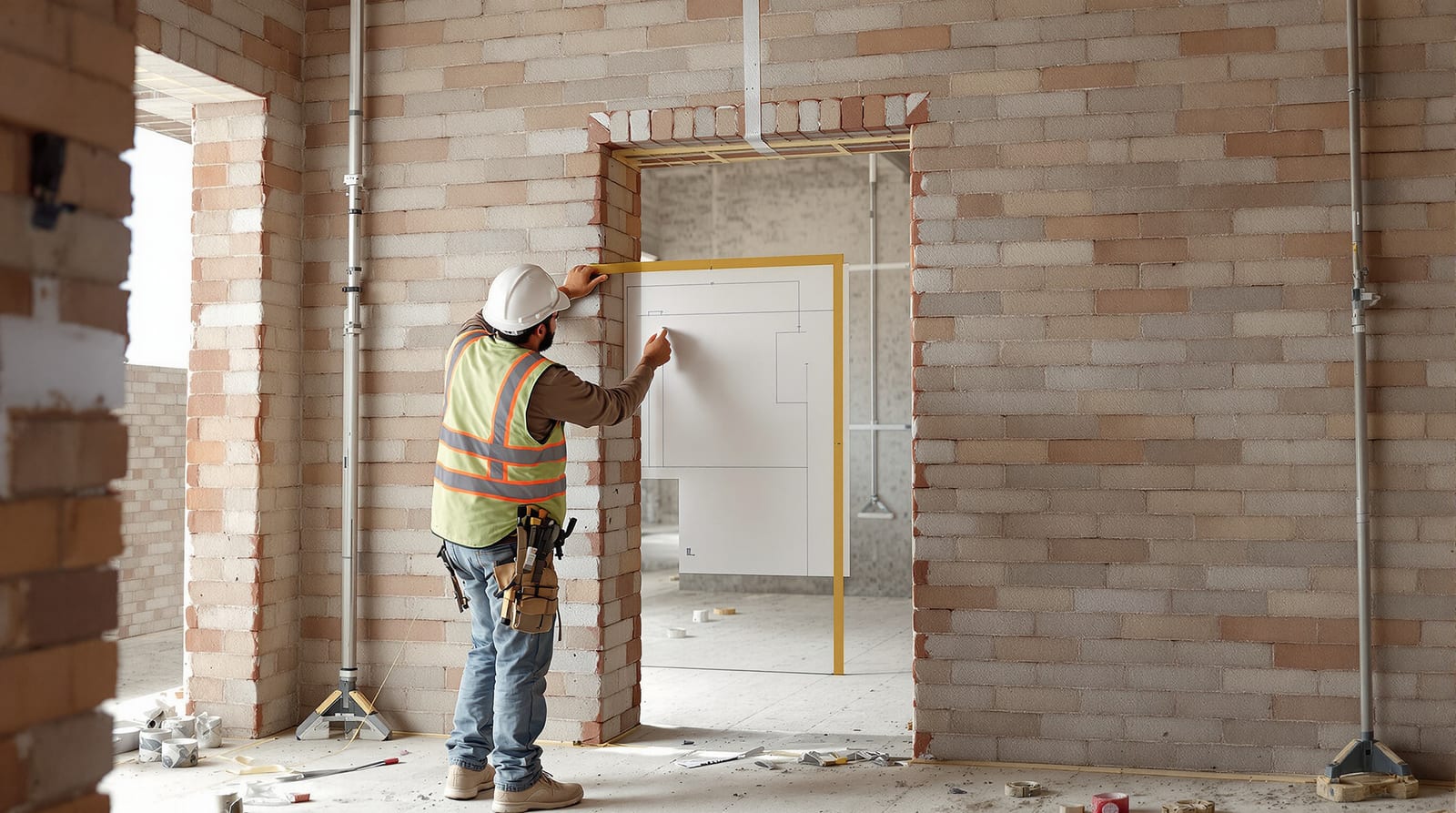
Door Setting Out Guide: Drawings to Wall (India 2026)
Translate the door schedule to the wall — datum and FFL lines, opening positions and sizes, handing, and consistent set-out across an Indian project.
Most door faults on an Indian site trace back to one moment: when someone turned a line on a drawing into a mark on the wall. Door setting out is that translation — turning the architect's plan, the structural opening sizes and the door schedule into accurate, repeatable marks for the position, width and height of every opening, against a single FFL datum. Get it right and the frames drop in plumb, the leaves swing the correct way and the hardware lines up corridor after corridor. Get it wrong on door one and you inherit the error on every door after it. This guide is the site-control craft: establishing datum, marking openings from gridlines, sizing the opening for the door-set, confirming handing, and coordinating the schedule so a whole project comes out consistent.
This sits one level above the leaf-by-leaf work. Where marking out door hardware fixes hinge and lever heights on a leaf, door setting out fixes where the opening itself lands and how big it is — the decisions that must be right before block-work or studwork closes around the frame.
What door setting out actually controls
Setting out answers four questions for every opening, in order:
1. Where does the opening sit — its position along the wall, measured from a fixed reference (a gridline, a corner, a finished surface)?
2. How big is the structural opening — wide and tall enough to take the door-set (frame plus leaf plus packing and tolerance), neither tight nor sloppy?
3. Which way does it open — the handing and swing, so the frame rebate and stops face correctly?
4. At what level — the FFL the door is hung to, so under-cut clearance and threshold are right?
Miss any one and the consequences are physical: a frame that fouls a switchboard, a leaf that swings into a wall, a 2,100mm door in a 2,040mm opening, or a 30mm gap under the leaf because the FFL was guessed. On a mixed-skill Indian site the cure is discipline — fix the references once, mark from them every time, and check before the wall closes.
Three principles run through everything below. One datum — every vertical dimension comes off a single finished-floor-level line, never the slab or leaf bottom. One reference per axis — horizontal positions come off gridlines or a fixed face, not a drifting tape from the last opening. One handing check — confirm the door's hand against the plan before you commit. Verify handing against door handing and swing.
Establish the datum and FFL line first
Nothing about a door is set out from the slab. The slab is rough and out of level; doors are hung to finished floor level (FFL) — the top of the eventual tile, stone or timber, including bed and adhesive. Before any door is marked, the site must carry a datum line: a continuous level reference, conventionally one metre above FFL (the "+1000" or metre line), struck around every room with a water level, laser or dumpy and marked in permanent ink.
From that single metre line you derive everything: FFL is 1,000mm below it; the door head, viewer, lock and lever heights all measure from it. Because the line is continuous and level, every opening references the same zero — which is why handles line up down a corridor and thresholds sit flush. Where floor build-ups change (tile to stone, dry area to wet), note the FFL offset on the schedule so the door under-cut is adjusted, not the datum.
| Reference | What it is | How it is established | Used to set |
|---|---|---|---|
| FFL | Top of finished floor | From the metre datum, 1000mm down | Door bottom clearance, threshold, head height |
| Datum line (+1000) | Level line 1m above FFL | Laser / water level, inked round each room | All vertical door dimensions |
| Gridline / structural axis | Column or wall grid from the plan | Surveyed and chalked on slab | Horizontal opening position |
| Finished wall face | The plastered / cladding face | From structural face + finish thickness | Frame reveal, opening clear width |
A practical rule of thumb: if you cannot point to the metre line in the room, you are not ready to set out a door. Re-establishing it costs an hour; chasing a drifted FFL through ten hung doors costs a week.
Mark opening positions from gridlines, not from each other
Horizontal position is where cumulative error creeps in. The disciplined method is to dimension every opening from a fixed structural reference — a gridline, a column face or a room corner shown on the plan — and never "tape from the last door," because each tape pull carries 2-3mm of slop that compounds across a wall.
Work from the architectural plan: read the dimension from the gridline to the opening edge (or centre), pull it on the slab from the chalked grid, and mark the two jamb positions plus the opening centre. Square the marks up the wall with a long level or plumb laser so the opening is vertical, not leaning. Where the drawing dimensions to a finished face, add the plaster/cladding thickness so the rough opening lands right once finishes go on.
Coordinate before you mark
Doors share walls with services. Before committing an opening, cross-check the position against electrical (switchboards beside the lock stile, not the hinge stile), plumbing (no opening over a buried line), and the swing zone (a leaf must not foul a window, another door, a wardrobe or a circulation route). This is exactly the clash-hunting that door trades coordination covers — settle it on paper and on the wall, before block-work closes around the frame.
Size the structural opening for the door-set
The opening must be cut to take the whole door-set, not just the leaf. For a typical timber frame the structural (rough) opening is sized to the frame outside dimension plus a packing/tolerance allowance all round so the frame can be plumbed and shimmed. As a rule of thumb, allow roughly 10-15mm packing each side and at the head over the frame size; too tight and the frame cannot be squared, too loose and you are bridging large gaps with packers and foam.
Work the numbers from the leaf outward: leaf size → add frame section both jambs and head → add packing tolerance → that is the structural opening. Confirm leaf and frame dimensions against measuring for a door and the manufacturer's data; common Indian leaf widths run 600/700/750/800/900mm at ~2,100mm height, but never assume — read the schedule.
| Door type (leaf) | Typical leaf size | Frame + packing allowance | Indicative structural opening |
|---|---|---|---|
| Internal flush, single | 750 × 2100mm | +~50mm jambs, +~40mm head, +pack | ~810-840 × 2150-2170mm |
| Main / entrance | 900 × 2100mm | +heavier section, +pack | ~970-1000 × 2160-2180mm |
| Bathroom | 600-700 × 2100mm | +~50mm jambs, +pack | ~660-760 × 2150mm |
| Fire door (FD30/60) set | per certified set | per tested frame, no oversize | exactly per certificate |
Fire doors are an exception you cannot improvise. A certified fire-door set is tested as a unit; the structural opening must suit the tested frame and you must not pack with foam or oversize the gaps — gaps around the leaf stay ≤3mm (4mm max) and the assembly carries continuous intumescent and smoke seals. Set these out to the certificate, and follow fire-door installation compliance at install time. Life-safety openings — fire escape, free egress — also govern swing direction: escape doors open in the direction of travel.
Confirm handing and swing before you commit
The opening can be perfectly placed and still be wrong if the door swings the incorrect way. Read the handing off the plan — the swing arc and the leaf's open position — and translate it to the wall: which jamb takes the hinges, which the lock, and which face the door opens toward. Mark the hinge jamb on the opening so the frame is fixed the right way round. Escape and accessible routes constrain this: free-egress doors open in the direction of escape, and accessible doors need clear manoeuvring space the swing must not steal. Set handing from the schedule and door handing and swing; a wrong-handed frame is a rip-out, not an adjustment.
Drive set-out from the door schedule
Setting out one opening is craft; setting out two hundred consistently is site control, and its governing document is the door schedule — the table that names every door by reference and lists its location, size, leaf type, material, fire rating, handing, frame and ironmongery. Every mark on the wall should trace to a schedule row, not to a fitter's memory. Build and read it with door schedule guide, and key each opening to a tag on the drawing and the wall via door numbering and tagging so the right frame and leaf reach the right hole.
| Control step | Practice | Why it matters |
|---|---|---|
| Issue the schedule | Door + ironmongery schedule to site | Single source of truth for every opening |
| Tag every opening | Mark door ref on the wall | Right set drops in the right hole |
| Fix references | Datum metre line + chalked grid | Position and level from one zero |
| Set out a sample | Mark, frame and hang one door | Catch set-out error before the batch |
| Spot-check | Tape openings against schedule sizes | ±5mm position, packing within tolerance |
| Record as-built | Note deviations on the schedule | Feeds snagging and handover |
A practical rule of thumb: set out and frame a sample opening, hang the leaf, and sign it off before the gang marks the rest. Once approved, that method — datum, grid dimension, opening size, handing — becomes law for the batch. Consistent set-out makes door snagging faster: fewer position and gap mismatches at handover, and openings that meet acceptance tolerances of even 2-4mm margins with frames plumb within ±1.5-2mm.
Keep this aligned with the whole install order in the complete door guide, and before you cut any opening, run the dimensions through the door clearance checker and the leaf/frame numbers through the door hardware height calculator so the schedule, the opening and the hardware all agree.
Frequently asked questions
What does setting out a door mean on site?
Door setting out is translating the drawing into accurate marks on the wall: where the opening sits (from a gridline or fixed reference), how big the structural opening must be to take the door-set, which way the door swings, and the FFL the door is hung to. It is done before block-work or studwork closes around the frame, so the frame drops in plumb and consistent.
Should I measure door heights from the slab or FFL?
Always from finished floor level (FFL), not the slab. The slab is rough and out of level; doors are hung to the top of the finished floor including tile, bed and adhesive. Establish a level +1000mm metre datum line round each room, derive FFL 1,000mm below it, and take every vertical door dimension off that single line.
How much bigger than the door should the structural opening be?
Size the opening to the whole door-set — frame plus leaf plus packing — not just the leaf. As a rule of thumb allow roughly 10-15mm packing each side and at the head over the frame size so it can be plumbed and shimmed: tight enough to fix solidly, loose enough to square. Fire-door sets are the exception — set out exactly to the certified frame, no oversize.
Why mark openings from a gridline instead of from the last door?
Because taping from one opening to the next compounds error — each pull carries 2-3mm of slop that accumulates across a wall, so the tenth door drifts. Dimensioning every opening from a fixed structural reference (gridline, column face or corner) keeps positions accurate and consistent, matching the architectural plan.
How do I keep every door consistent across a large project?
Drive all set-out from the door schedule, tag every opening to its reference, and fix two references — a level metre datum line and a chalked structural grid. Set out and approve a sample opening first, then make that method law for the batch. Spot-check positions and sizes against the schedule, and record any deviation as-built for snagging and handover.
Where does handing fit into setting out?
Confirm handing before you commit the opening. Read the swing and leaf-open position from the plan, mark the hinge jamb on the wall, and check the swing does not foul services, furniture or a circulation route. Escape doors open in the direction of travel and accessible doors need clear manoeuvring space — a wrong-handed frame is a rip-out, so settle it at set-out, not after framing.
Export this guide
Related Guides — Deep-dive reading
Measuring for a Door: Opening Sizes & Checks (India 2026)
How to measure a door opening in India — three width and height points, diagonals, plumb and level — so the carpenter cuts it right the first time.
Home Doors & EntrancesDoor Schedule Guide: Reading & Preparing One (India 2026)
What a door schedule is, every column explained, and how this single table controls door procurement, fitting and snagging across an Indian project.
Home Doors & EntrancesHow to Measure a Door India: Opening, Leaf, Frame and Hand the Right Way
A homeowner's measuring guide for India — measure the structural opening, work out leaf versus frame size, find the door hand and swing, allow for floor finish, and order without the classic too-tight or wrong-hand mistakes.
Home Doors & EntrancesRelated Tools — Try Free
Window Hardware Cost Calculator
Estimate window hardware cost — hinges, handles, locks, rollers and multipoint gears.
Window CalculatorAccessible Door Checker
Check a door against wheelchair-accessibility guidance — clear width, threshold, handle and closer force per RPwD 2021.
Compliance ToolMaterial Schedule Generator
Generate a room-wise finish schedule — walls, floors, ceilings, trim, and joinery by location.
Material Schedule