
Door Fitting Standards & IS Codes Explained (India 2026)
The IS codes, NBC 2016, CPWD specifications and accessibility rules that define good door workmanship, and how they bind a contract on an Indian site.
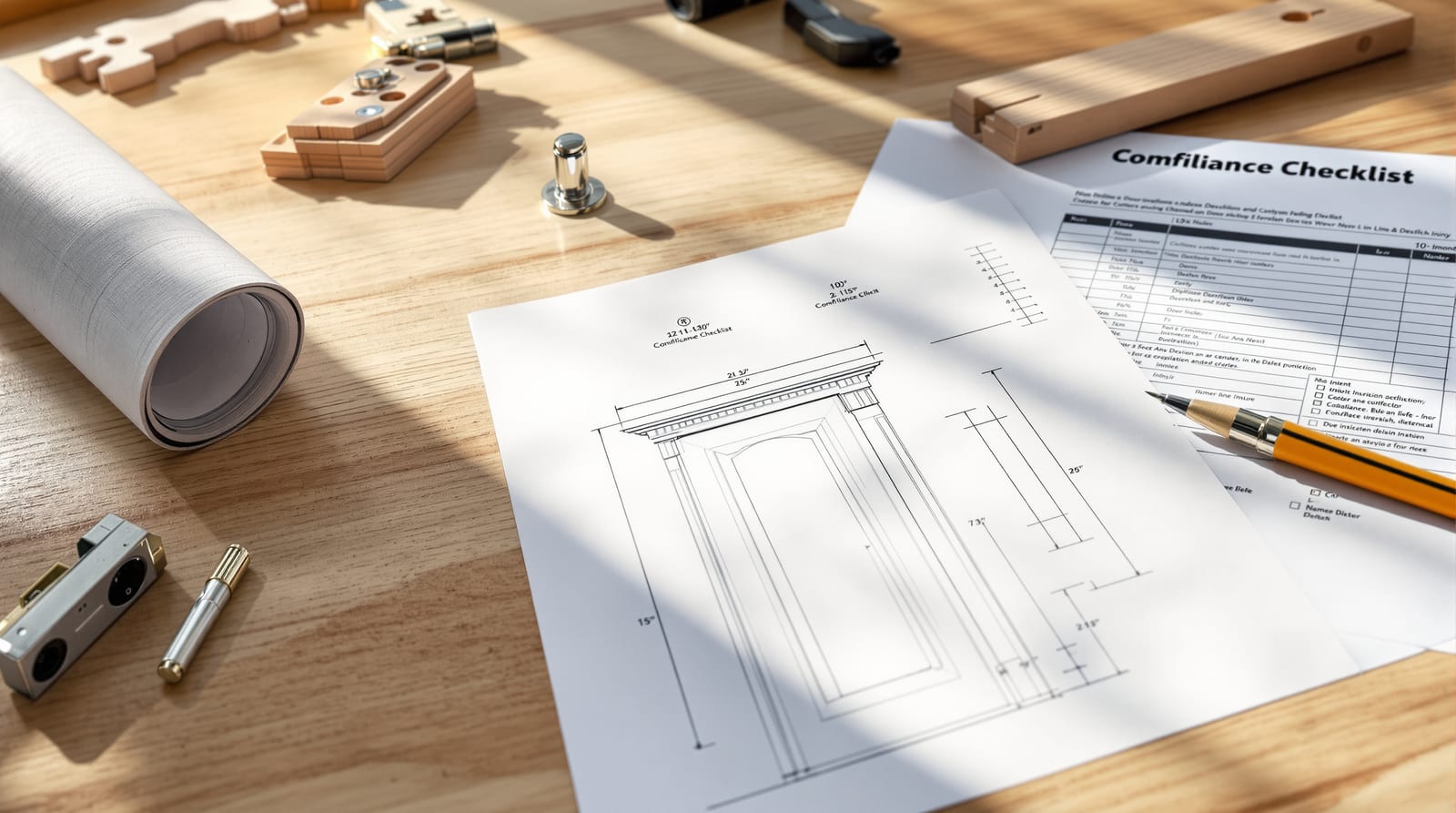
Good door work is not a matter of opinion on an Indian site — it is written down. Door fitting standards are the published IS codes, the NBC 2016 life-safety provisions, the CPWD specifications and the accessibility guidelines that together define what a correctly made and correctly fitted door must be, and how a contract measures and accepts it. When a carpenter argues that a 6mm gap is "fine" or a supplier ships a fire leaf without a tested frame, the answer lies not in argument but in the relevant clause. This guide maps the standards that govern door fitting in India — which code covers frames, which covers shutters and flush doors, which covers fire doors, how NBC fixes widths and egress, and how IS 1200 and CPWD turn all of it into a measurable, payable contract. It is the reference layer behind the complete door guide.
Why standards govern door fitting
A door is a life-safety and accessibility component, not just joinery. It must open under panic, hold back fire and smoke for a stated number of minutes, take the lever at a height a wheelchair user can reach, and survive years of slamming without binding. Left to taste, none of that is guaranteed. Standards convert those duties into testable, measurable requirements: a frame section to IS 4021, a shutter to IS 1003, a flush door to IS 2202, a fire check door to IS 3614, widths and egress to NBC 2016, accessible levers to the Harmonised Guidelines under the RPwD Act, and measurement and workmanship to IS 1200 and CPWD specifications.
On site this matters for three reasons. First, safety — a fire door fitted with 6mm gaps and no intumescent seal is not a fire door, whatever the certificate says, and NBC free-egress rules are not negotiable. Second, acceptance — you cannot snag a door against "looks alright"; you snag it against tolerances drawn from these codes, the discipline set out in door acceptance criteria. Third, payment — on any formal contract the door package is measured and valued to IS 1200 and built to CPWD workmanship clauses, so the standard is literally the basis of the bill. As a rule of thumb, if a clause cannot be pointed to, the requirement is not enforceable; if it can, it is not optional.
The code reference table
The table below is the working map of which Indian standard governs which part of the door. Keep it beside the door schedule — each schedule column ultimately answers to one of these.
| Standard | Governs | What it fixes (indicative) |
|---|---|---|
| IS 4021 | Timber door, window & ventilator frames | Frame sections, sizes, rebate, fixing and timber |
| IS 1003 (Part 1/2) | Timber panelled & glazed shutters | Shutter construction, panel/stile sizes, tolerances |
| IS 2202 (Part 1/2) | Wooden flush door shutters | Core, lipping, face panels, flatness, adhesion |
| IS 3614 (Part 1/2) | Metal & fire-check door shutters/frames | Fire-resistance, integrity, hardware for rated sets |
| IS 1341 / IS 207 | Steel butt hinges & door fittings | Hinge gauge, size and finish for ironmongery |
| NBC 2016 (Part 4) | Fire & life safety | Egress widths, swing direction, fire-door ratings |
| NBC 2016 (Part 3) | Development & building controls | Minimum door widths and clear openings |
| IS 1200 (Part 21) | Mode of measurement — woodwork & joinery | How doors are measured for payment |
| CPWD Specifications | Workmanship & materials on govt contracts | Quality of fitting, finish and accepted practice |
| RPwD Act + Harmonised Guidelines | Accessibility | Lever handles, operable force, reach heights |
A practical caution: an IS or BS certificate on a leaf is necessary but not sufficient. A fire leaf to IS 3614 is only a fire door when fitted as the tested set — leaf, frame, hinges and seals as certified — with gaps and signage correct, exactly the install-time discipline in fire-door installation compliance. Reference BS EN standards only as an international comparison; they are not Indian law.
What good workmanship means
Standards describe the product; workmanship is how it is fitted. CPWD specifications and IS 1200 both carry the idea that a door must be hung true, gapped evenly, operate freely and finish cleanly — and they let an engineer reject work that does not. The acceptance tolerances below are the rule-of-thumb numbers a competent inspector applies; they distil the codes into figures you can check with a feeler gauge and a level.
| Acceptance check | Rule-of-thumb standard | How it is verified |
|---|---|---|
| Margin / gap around leaf | Even 2–4mm; hinge side may be tighter | Feeler gauge / 3mm steel rule |
| Fire-door leaf gaps | ≤3mm (4mm max) head and sides | Feeler gauge at multiple points |
| Threshold / undercut | ≤8–10mm (sealed where rated) | Gauge or coin under leaf |
| Frame plumb / level | ±1.5–2mm over height | 1200mm spirit level both planes |
| Leaf flatness | No visible bow or wind | Straightedge / sight along stile |
| Operation | Latches first time, one-hand, no bind | Open / close ten cycles |
| Self-closing (if closer) | Closes and latches fully from any angle | Release at 10°, 45°, 90° |
| Lever height (accessible) | 800–1100mm, lever not knob | Tape from finished floor |
| Finish | No runs, sanding marks, scratches | Raking-light inspection |
Dimensional and operational quality
Good workmanship shows in even reveals and a leaf that swings without catching. Margins should read a consistent 2–4mm; the frame should be plumb and level within about ±1.5–2mm over its height; the leaf should be flat with no visible bow. The door must latch first time and operate with one hand. These are the figures behind door operation testing and the defect catalogue in common door defects, and they tie directly to the gap discipline in door gap inspection.
Fire, egress and accessibility musts
Three requirements are non-negotiable because they are life-safety law, not finish quality. Fire integrity — a rated door (FD30/FD60, minutes, to IS 3614 and NBC 2016) must be the tested set with continuous intumescent and smoke seals, gaps ≤3mm, fire-rated hinges, a self-closer and "Fire door — keep shut" signage. Free egress — NBC fixes minimum widths and requires escape doors to swing in the direction of travel and open without a key. Accessible operation — the RPwD Act and Harmonised Guidelines require lever handles, not knobs, easy one-hand operation and a lever in the 800–1100mm band, the detail in accessible doors. No finish standard overrides these.
How standards are referenced in contracts and QA
Standards only bite when a contract names them. A well-written door specification says, in effect, "shutters to IS 2202 Part 1, frames to IS 4021, fire door-sets to IS 3614 and NBC 2016, accessible doors to the Harmonised Guidelines, measured to IS 1200 and built to CPWD specifications." That single sentence makes every clause enforceable: the engineer can reject a bowed flush leaf because IS 2202 fixes flatness, refuse a 6mm fire gap because IS 3614 and NBC demand ≤3mm, and withhold payment on doors measured against IS 1200 that do not match the as-built door schedule.
On the QA side, standards are the backbone of every inspection. The door inspection checklist and door installation QA check each door against the tolerance table above; the door snagging punch-list records every departure from it; and at handover the defect liability period — commonly 6–12 months in India — holds the fitter to rectify defects that breach the standard. Specify the codes up front, inspect against them through the job, and the door package arrives at handover already compliant. To check your fits against the figures quickly, the door acceptance tolerance checker and fire-door compliance checker turn these clauses into a pass/fail screen on site.
A closing honesty: most Indian sites run on mixed-skill labour, and codes are only as good as the supervision that enforces them. Reference the standards in the contract, brief the carpenter on the few life-safety musts — fire integrity, free egress, accessible levers — and bring in a specialist joiner or fire consultant when a tested set or a difficult opening is beyond the gang's skill. Standards do not fit doors; supervised tradespeople fit doors to the standard.
Frequently asked questions
Which IS codes apply to door fitting in India?
The core set is IS 4021 for timber frames, IS 1003 for panelled and glazed timber shutters, IS 2202 for wooden flush door shutters, and IS 3614 for metal and fire-check doors. Hinges and fittings follow IS 1341 / IS 207, measurement follows IS 1200, and life-safety widths and egress follow NBC 2016. Accessible operation follows the RPwD Act and Harmonised Guidelines.
What is the difference between IS 1003 and IS 2202?
IS 1003 governs panelled and glazed timber shutters — the stile-and-rail doors with infill panels or glass. IS 2202 governs flush door shutters — the solid-faced doors with a core and ply or veneer faces. They cover different constructions, so a flush door is checked for core, lipping and face flatness under IS 2202, while a panel door is checked for stile, rail and panel sizes under IS 1003.
Does NBC 2016 fix door widths?
Yes. NBC 2016 sets minimum clear door widths and clear openings (Part 3 controls) and the fire and life-safety requirements (Part 4) — egress door widths, the requirement that escape doors swing in the direction of travel and open without a key, and the fire-door ratings in minutes. These widths and egress rules are mandatory, not advisory.
What is IS 1200 used for in door work?
IS 1200 (Part 21) is the mode of measurement for woodwork and joinery. On a contract it defines exactly how doors are measured — by area or number, what is included, how openings are deducted — so the door package can be priced, valued and paid. Combined with CPWD specifications for workmanship, it is the basis on which doors are measured and accepted for payment.
Are accessibility standards mandatory for residential doors?
The RPwD Act and the Harmonised Guidelines apply most strictly to public and commercial buildings, where accessible doors — lever handles not knobs, easy one-hand operation, levers in the 800–1100mm band and adequate clear width — are required. In homes they are best practice and increasingly expected for ageing-in-place. Where a door is flagged accessible on the schedule, treat the lever height and operable force as a hard requirement, per accessible doors.
Does an IS certificate on a fire door make it compliant?
No. A fire leaf certified to IS 3614 is only a compliant fire door when installed as the tested set — leaf, frame, hinges and intumescent plus smoke seals as certified — with gaps ≤3mm, a working self-closer and correct signage, to NBC 2016. The certificate covers the product; compliance is earned at fitting. See fire-door installation compliance.
Export this guide
Related Guides — Deep-dive reading
Door Acceptance Criteria: Tolerances & Tests India 2026
What 'acceptable' means for a fitted door: even gaps, frame plumb, flat leaf, one-hand operation, latches first time, clean finish — and the accept/snag/reject thresholds.
Home Doors & EntrancesDoor Standards India: IS Codes, NBC 2016, Fire & Accessibility Rules for Residential Doors
The consolidated map of every standard that governs a residential door in India — IS material/construction codes, NBC 2016 widths and egress, fire-door ratings, and RPwD accessibility — and which one applies where.
Home Doors & EntrancesFire-Door Installation Compliance: India 2026 Fitting Guide
Getting a fire door right at fitting — certified set, gaps under 3mm, continuous seals, fire-rated hinges, self-closing and signage to NBC 2016 and IS 3614.
Home Doors & EntrancesRelated Tools — Try Free
Accessible Door Checker
Check a door against wheelchair-accessibility guidance — clear width, threshold, handle and closer force per RPwD 2021.
Compliance ToolFire Door Rating Checker
See the likely fire-door rating (30/60/90/120 min) and components a location needs per IS 3614 / NBC — guidance, confirm with your architect.
Compliance ToolWindow Material Comparison Tool
Compare uPVC, aluminium, wood, steel and composite windows on cost, life, upkeep and insulation.
Compare