
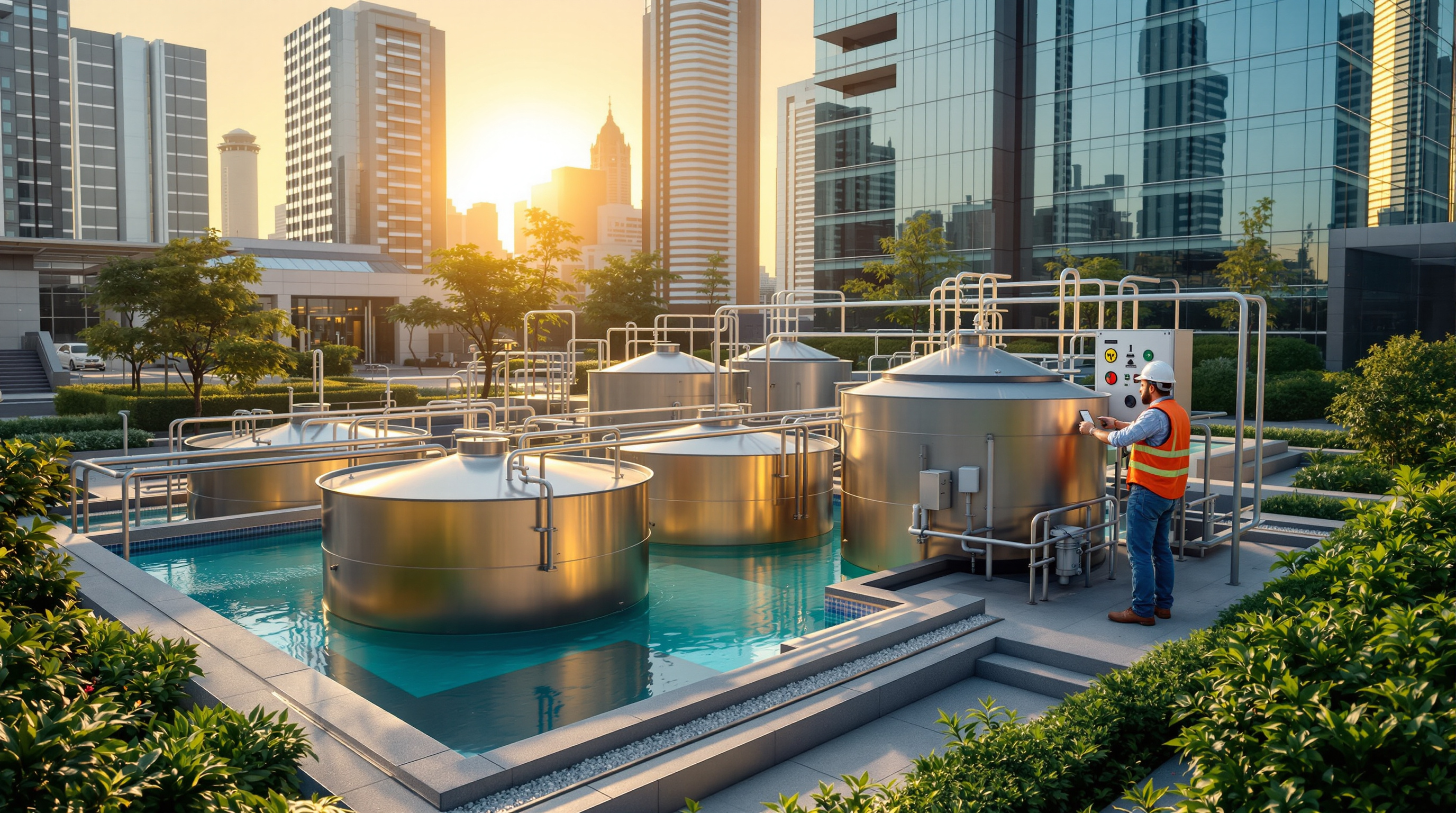
Commercial STP Cost Guide: Pricing for Hotels, Malls & Offices in India (2026)
What a commercial sewage treatment plant really costs to build and run — capacity bands, why higher reuse and tertiary polishing push the price up, and how cooling-tower and flushing reuse pays it back. Honest ranges, not false precision.
A hotel, a shopping mall and an office park all share a problem a home does not: they generate a large, uneven flow of sewage, they are watched closely by pollution-control boards, and they usually want the treated water back — for cooling towers, for flushing hundreds of WCs, for landscaping acres of podium garden. That combination is exactly what makes commercial STP cost behave differently from residential. You are buying more capacity, to a higher standard, with more reuse plumbing bolted on. This guide lays out what that actually costs in India in 2026 — in honest ranges, because a single figure quoted for "a commercial STP" is almost always wrong.
Two commercial STPs of the same 100 KLD size can differ by 2–3x in price. The number that moves is not the size — it is the treated-water standard you demand and the reuse system you build around it. Decide the reuse first; the cost follows from it.
Before anything else, a caution that runs through this whole guide: costs vary widely by capacity, city, technology, site conditions and vendor. The ranges below are for orientation and budgeting. For a number you can put in a board note or a project budget, get a written quote against your specific site and reuse plan, and sanity-check it with the STP Cost Estimator.
What makes a commercial STP different
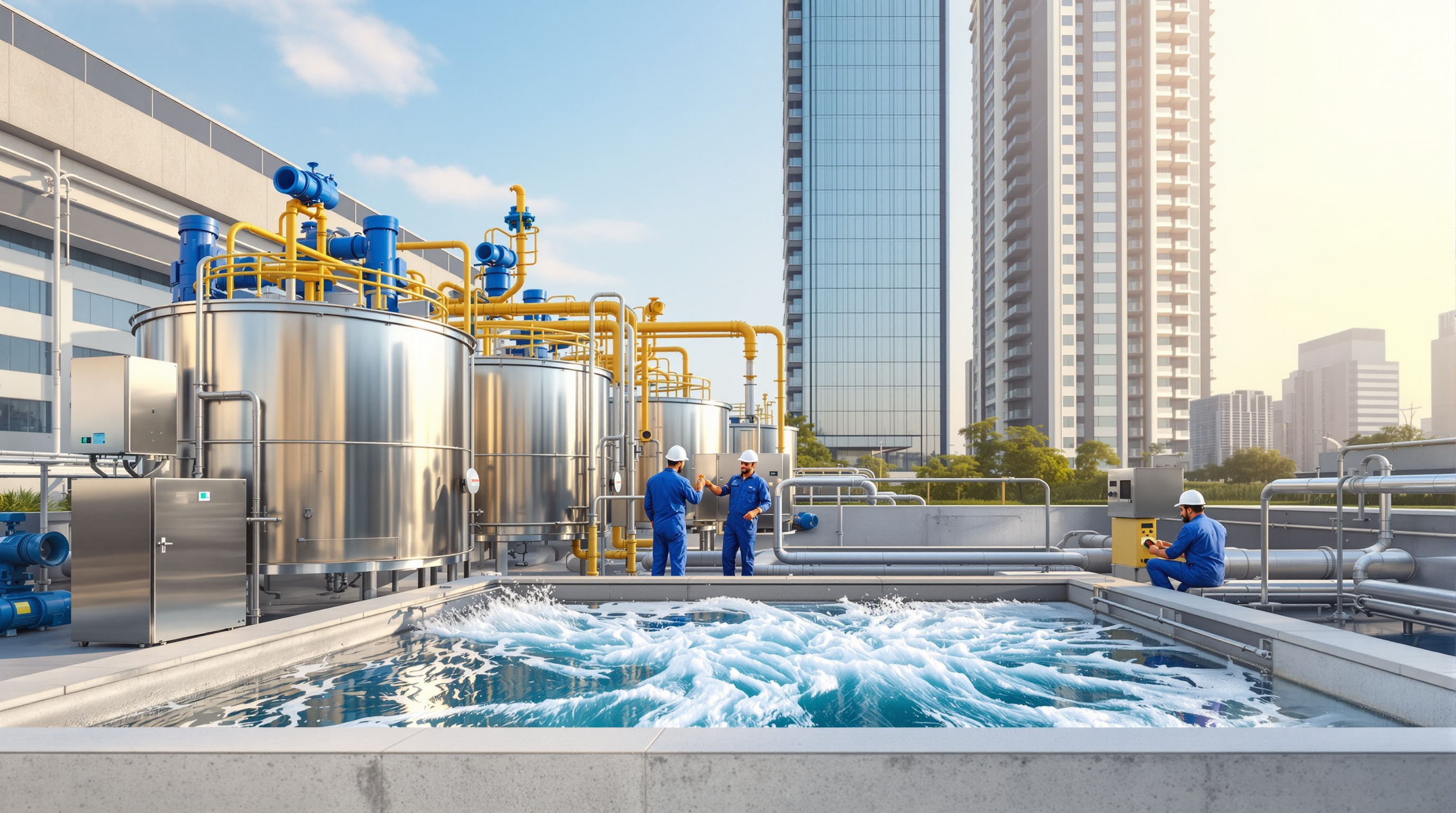
For a plain-language grounding on what an STP is and how it works, start with What is a Sewage Treatment Plant. The commercial context adds four cost pressures:
- Bigger, spikier flows. Hotels peak at check-out and dinner service; malls peak on weekend evenings; offices load heavily 10am–6pm on weekdays then go quiet. The plant must be sized for peak and buffered for the swing, which favours technologies like SBR and MBBR that tolerate shock loads.
- Higher reuse expectations. A commercial building's economics only work if it reuses most of its treated water. That pushes many owners past basic secondary treatment into tertiary polishing — and tertiary is where cost climbs.
- Cooling-tower reuse. Any large air-conditioned building — mall, hotel, IT park — has cooling towers that drink water. Feeding them treated sewage is the single biggest reuse prize, but cooling towers demand consistently clean, low-fouling water, which usually means MBR or ultrafiltration.
- Compliance visibility. Commercial plants are more likely to carry mandatory online monitoring (OCEMS) panels, and to be inspected. That is real, recurring cost.
Capital cost: what you pay to build
Commercial STPs are usually quoted per KLD (kilolitre per day of treatment capacity), and the headline truth is that cost per KLD falls as capacity rises. A small 10 KLD boutique-hotel plant can cost ₹70,000–1,00,000 per KLD, while a 200 KLD IT-park plant can fall to ₹35,000–45,000 per KLD through economies of scale.
Technology is the other big lever. The table below blends 2026 vendor benchmarks for turnkey installed cost (civil, mechanical, electrical, piping and commissioning — before GST and land):
| Technology | Typical installed cost per KLD | Treated-water quality | Best-fit commercial use |
|---|---|---|---|
| Extended Aeration / ASP | ₹18,000–30,000 | Basic secondary (BOD ~20–30) | Discharge-focused, low reuse |
| MBBR | ₹30,000–55,000 | Good secondary | Hotels, offices, general reuse |
| SBR | ₹35,000–60,000 | Good, handles flow swings | Malls, mixed-use, spiky loads |
| MBR | ₹65,000–1,10,000 | Very high, near-reuse ready | Cooling-tower reuse, tight space |
| MBBR/SBR + tertiary (UF/RO) | +₹8,000–20,000 add-on | Reuse / process grade | High-reuse malls & IT parks |
Reading the table by segment, current 2026 vendor pricing lands roughly at:
- Hotel (50–100 rooms), ~10–30 KLD: roughly ₹10–25 lakh, usually packaged MBBR.
- Office / IT complex, ~50–200 KLD: roughly ₹30–90 lakh, MBBR or SBR depending on flow profile.
- Mall / mixed-use, ~50–150 KLD: roughly ₹30–75 lakh, often SBR or MBBR with tertiary for cooling towers.
Then add the site-specific extras that commercial projects almost always trigger: dual (twin) piping to carry treated water back for flushing, mandatory online monitoring panels, and any civil complications. Basement installation, high groundwater or rocky soil can add ₹5,000–15,000 per KLD to civil cost alone — one reason many owners weigh underground versus above-ground layouts early. Budget 10–20% on top of the base equipment figure for these.
To turn your building's occupancy into a capacity in KLD — the number every quote starts from — run the STP Capacity Calculator, and read How to Size an STP alongside it.
Why higher reuse raises the cost
This is the crux of commercial STP economics. Secondary treatment (MBBR, SBR, extended aeration) gets you water that is legal to discharge and fine for gardening. But cooling towers, high-end flushing and process use demand better — consistently low turbidity, low fouling, disinfected. Getting there means bolting on tertiary stages: ultrafiltration or an MBR membrane, activated carbon, and reliable UV or chlorination.
That tertiary train typically adds ₹8,000–20,000 per KLD to equipment cost, and it also raises operating cost — more energy for membranes, more consumables, more skilled operation. It is genuinely more expensive. The reason owners still pay it is that in a commercial building the reused water is worth far more per litre than in a home, because there is so much more of it and freshwater is so much dearer. That trade-off is what the next two sections weigh.
Operating cost: what you pay to run
Capital is only half the story; a commercial STP runs every day for 15–20 years. Operating cost is dominated by electricity (aeration and pumping), then AMC, operator labour, chemicals, sludge disposal and compliance testing. Indicative 2026 monthly ranges:
| Capacity | Electricity / month | AMC + labour + consumables / month | Total OPEX / month |
|---|---|---|---|
| 10 KLD | ₹3,000–6,000 | ₹5,000–10,000 | ₹8,000–16,000 |
| 50 KLD | ₹10,000–18,000 | ₹15,000–25,000 | ₹25,000–43,000 |
| 100 KLD | ₹20,000–35,000 | ₹20,000–35,000 | ₹40,000–70,000 |
| 200 KLD | ₹35,000–55,000 | ₹30,000–45,000 | ₹65,000–1,00,000+ |
A few rules of thumb behind those figures: an STP draws roughly 0.5–1.5 kWh per KLD treated, with MBR at the higher end (membranes cost 20–30% more energy) and simpler aeration systems lower — see Reducing STP Electricity Consumption. AMC for commercial plants typically runs ₹1.5–3 lakh a year at 100–200 KLD. On top sit sludge disposal (₹2,000–8,000/month), lab testing and compliance (₹3,000–6,000/month), and chemical dosing (₹1,500–4,000/month). Model your own numbers with the Annual Operating Cost Calculator and the Electricity Consumption Calculator.
Crucially, judge any plant on lifecycle cost, not sticker price. A cheaper extended-aeration plant that guzzles power and needs constant chemical correction can cost more over 15 years than a pricier MBR. The Lifecycle Cost Comparison Tool and the lifecycle cost guide exist for exactly this comparison.
The reuse payback: where commercial STPs earn their keep
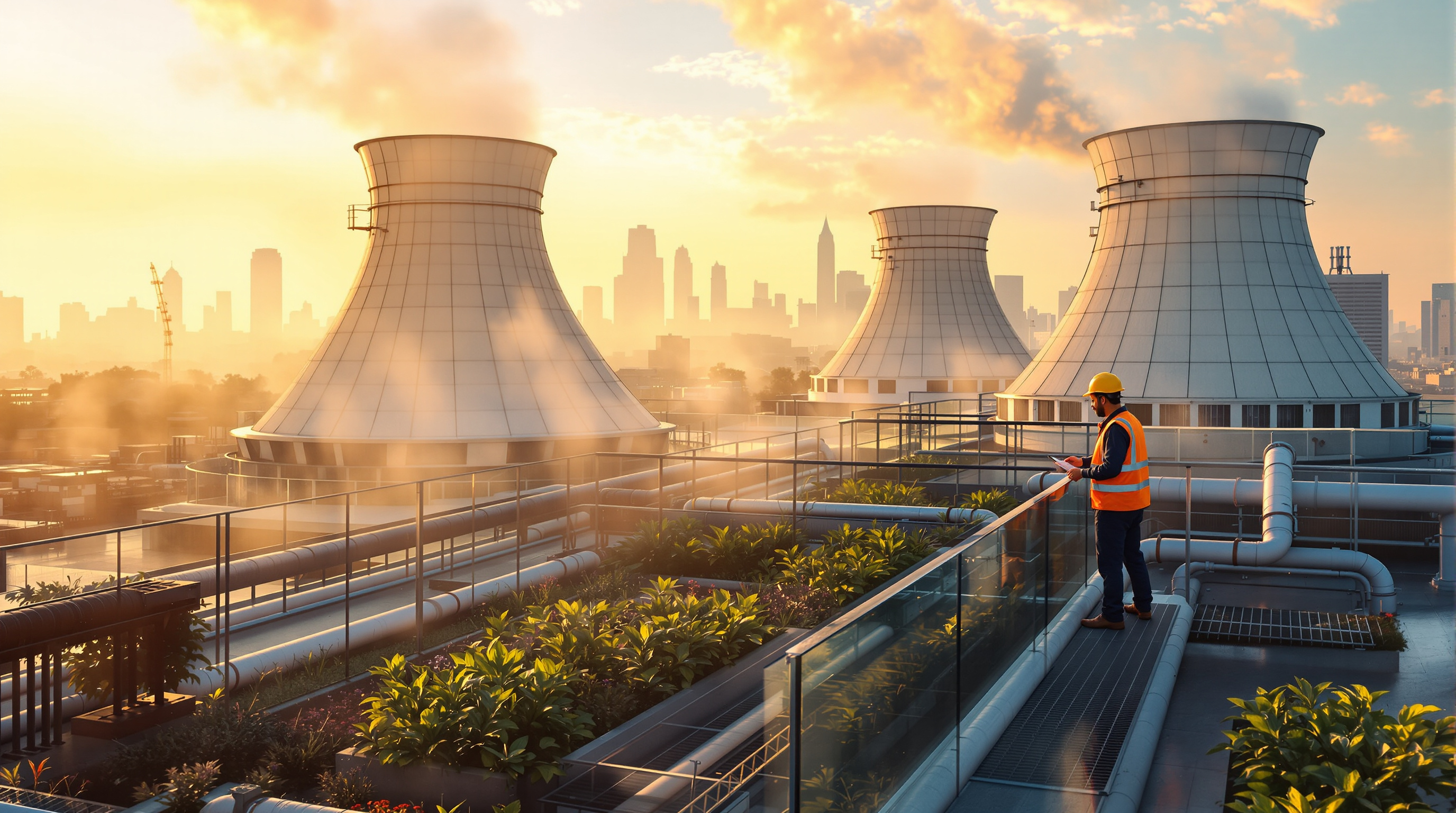
Here is the argument that turns a commercial STP from a grudging compliance cost into an investment. A commercial building typically recovers 80–85% of its water consumption as treated water. In a large air-conditioned property that is a great deal of water, offset against a freshwater price that is high and rising — ₹30–40 per KL from the utility, and ₹50–80+ per KL when you are buying tankers in a water-stressed city.
The two big reuse sinks are cooling towers and toilet flushing, and both are large and continuous in commercial buildings. Reported outcomes: societies and mid-size commercial properties in the 50–100 KLD range save on the order of ₹4–5 lakh a year, and larger water-stressed sites report ₹50,000–1.5 lakh a month, with payback commonly in 3–5 years — faster where tanker dependence is heavy. Switching cooling-tower make-up from freshwater to treated water alone can cut that water bill by 10–30% (SKF Elixer, Netsol Water).
This is why the tertiary premium is worth paying: the extra ₹8,000–20,000 per KLD that unlocks cooling-tower-grade water is repaid by years of avoided freshwater purchase. Put your own tariff and reuse split into the Water Reuse Savings Calculator and the STP ROI Calculator to see the payback for your building, and read ROI of Water Recycling for the fuller argument.
The bottom line
For a commercial STP in India in 2026, budget broadly ₹30,000–60,000 per KLD installed for a good MBBR or SBR plant, rising toward ₹65,000–1,10,000 per KLD for MBR or heavy tertiary reuse — with small plants dearer per KLD and large ones cheaper. Expect monthly operating cost of roughly ₹40,000–70,000 at 100 KLD. And expect the reuse — especially cooling-tower and flushing water — to pay much of it back within 3–5 years.
The single most important discipline is to decide your reuse standard first, then price the plant that meets it, then judge competing quotes on cost per KLD and lifecycle cost rather than headline price. Start with the STP Cost Estimator and AMC Cost Calculator for a personalised estimate, browse the full Sewage Treatment Plants guide library, and dig into the cost per KLD benchmark guide for the underlying numbers.
Sources: SUSBIO STP cost per KLD 2026, Hydromo 100 KLD STP cost, Trity Enviro STP price 2026, SKF Elixer reuse savings, Netsol Water cooling-tower reuse. Figures are indicative 2026 ranges; verify against a site-specific quote.
Export this guide
Related Guides — Deep-dive reading
ROI of Water Recycling: Does an STP Actually Pay for Itself?
A numerate, honest look at the payback case for on-site sewage treatment in India — what a recycled kilolitre is really worth, what the plant costs to build and run, and how many years it takes to break even.
Sewage Treatment PlantsResidential STP Cost Guide for Villas & Small Homes (2026 India Prices)
What a small 1–10 KLD packaged sewage treatment plant really costs to buy, install and run in India — honest capex ranges by technology, monthly running costs, and AMC rates, written for owners, developers and RWAs who want numbers they can plan around.
Sewage Treatment PlantsSTP Cost per KLD in India (2026): Realistic Price Ranges
What a sewage treatment plant actually costs per KLD in India — capital cost by capacity band and technology (MBBR, SBR, MBR, extended aeration), why the per-litre price falls as plants get bigger, and every factor that swings a quote up or down.
Sewage Treatment PlantsRelated Tools — Try Free
Water Reuse Savings Calculator
Estimate the money you save by reusing STP-treated water instead of buying fresh supply, with daily, monthly and annual savings.
STP CalculatorSTP Cost Estimator
Estimate the capital cost of a sewage treatment plant by capacity in KLD and technology, with an underground option and instant cost per KLD.
STP CalculatorSTP Lifecycle Cost Comparison Tool
Compare MBBR, SBR and MBR sewage treatment plants on total lifecycle cost — capex plus lifetime energy — at your capacity, lifespan and power tariff, and see the lowest-cost technology.
STP Calculator