
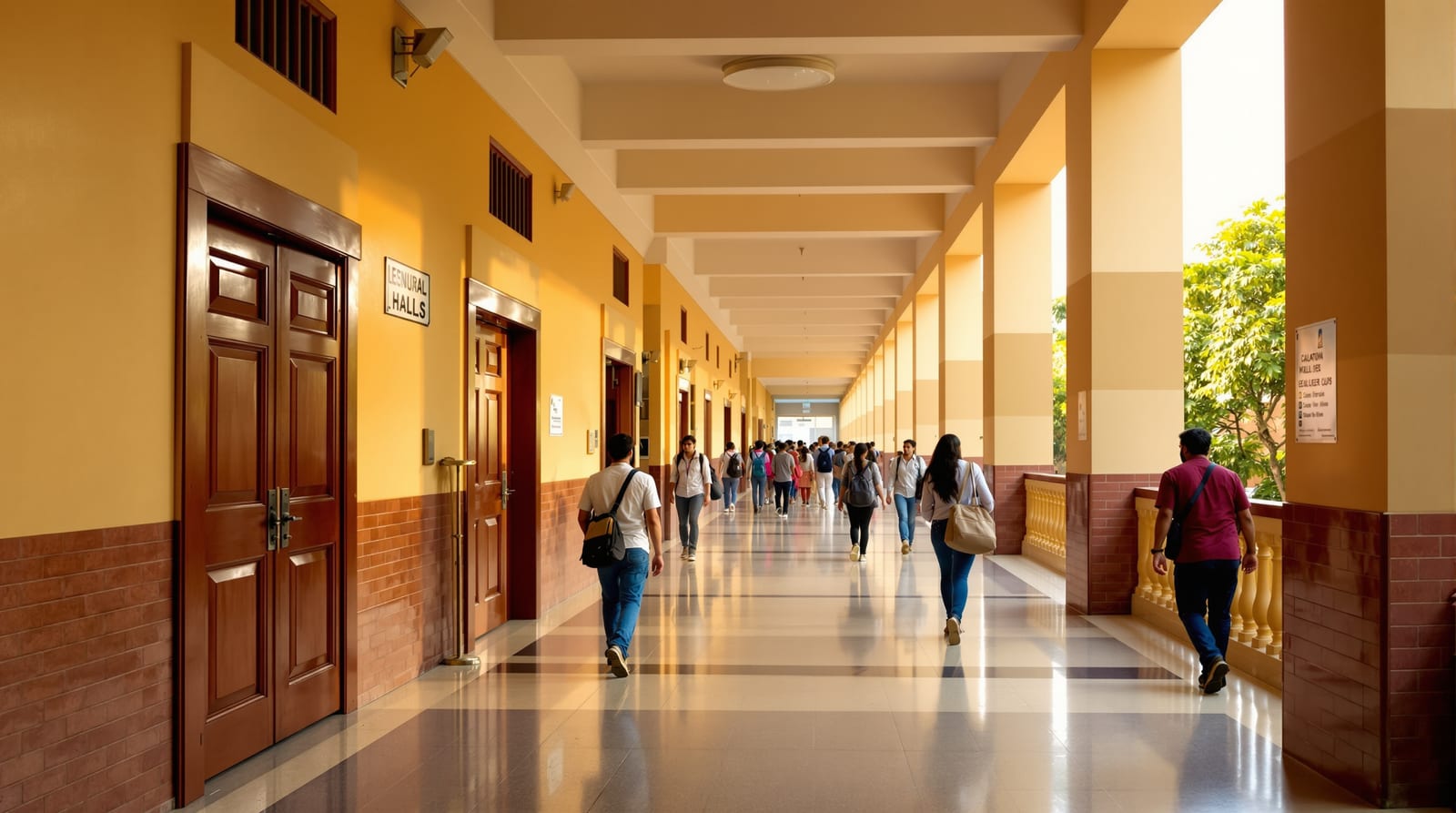
College Doors in India: The Right Door for Every Campus Facility (2026)
A facility-by-facility guide to specifying doors across an Indian college or university campus - lecture halls, discipline-specific labs, library, auditorium, hostels, admin, sports and fire exits - ranked for heavy footfall durability, fire and egress at scale, access control and institutional image, with indicative per-door costs.
A college campus is not one building with one door specification - it is a small town. Within a single university you will find a 300-seat lecture theatre, a chemistry lab where acid fumes eat ordinary timber, a server room that must lock down on a card, a library that must stay silent, an auditorium that must empty 800 people in two minutes, and hostel blocks that take a decade of student abuse and keep working. Each of these facilities asks a completely different question of its door, and the most common - and most expensive - mistake is to hand the whole campus to one contractor with one flush-door rate. The result is acid-rotted lab doors within a year, lecture halls you cannot hear in, fire exits that fail inspection, and hostel doors hanging off their hinges by the second semester. This guide walks the campus facility by facility and tells you which door belongs at each threshold, the driver that decides it, the Indian codes that govern it, and what each costs in 2026. For the wider logic of matching a door to its space, start with the master overview on choosing a door by space; a college is its broadest test, and a school campus is its closest cousin.
The six forces that shape every college door
Before the facilities, the drivers. Every door on a campus is decided by where it sits on these six demands, and the weighting flips completely from a hostel corridor to an operation-grade chemistry lab:
- Durability under heavy footfall. A campus door is opened hundreds of times a day by people who do not own it. Solid cores, steel or FRP leaves, heavy-duty hinges, kick plates and vandal-resistant hardware are not luxuries - they are the difference between a five-year door and a five-month one.
- Discipline-specific lab needs. A chemistry lab needs chemical-resistant, non-corroding leaves; a physics or fuels lab needs fire rating; an electronics or server lab needs ESD-safe surfaces and card access; a microbiology lab needs wipeable hygiene. One lab door spec does not fit the campus.
- Fire, egress and scale. A college is a high-occupancy assembly and institutional building. Stairwells, lecture blocks, the auditorium and hostels all carry serious egress loads - fire-rated compartment doors, panic hardware and outward-swinging exits sized to occupancy are mandatory, not optional.
- Access control and security. Labs, server rooms, exam-paper stores, admin offices and hostel entrances all need controlled, auditable access - card, biometric or keyed - while public circulation stays open.
- Institutional image. The main entrance, admin block and library are the face the institution shows to parents, accreditation panels and recruiters. Glass, aluminium and quality timber carry the brand; a tired flush door undermines it.
- Low maintenance. A campus estate team is small and the budget is annual. Doors that resist water, termites, warping and casual abuse - WPC, FRP, aluminium, steel - keep the maintenance register short and the replacement cycle long.
No single door answers all six. The skill is reading each facility and specifying for its dominant force.
Campus facilities and the door each one needs
Read the campus as zones of traffic, sensitivity and image. The teaching zone (lecture halls, labs) is high-traffic and discipline-driven. The quiet zone (library, reading rooms) trades acoustics and security against footfall. The assembly zone (auditorium, seminar halls) is governed by egress and panic hardware. The residential zone (hostels) demands cheap, durable, privacy-locked doors at huge quantities. The administrative and public zone (admin, main entrance) carries the institutional image. The table below maps the recommended door to each facility.
| Facility | Recommended door | Primary driver | Indicative ₹ (per door, 2026) |
|---|---|---|---|
| Lecture hall / theatre | Wide double-leaf flush, acoustic core, vision panel, soft closer | Footfall + acoustics + egress | 14,000 - 45,000 |
| Chemistry / wet lab | FRP or epoxy-faced leaf, chemical-resistant, vision panel | Chemical resistance + hygiene | 8,000 - 22,000 |
| Physics / fuels / combustion lab | Fire-rated steel or treated timber, self-closing | Fire compartmentation | 14,000 - 45,000 |
| Electronics / server lab | ESD-safe flush + card access, fire-rated where racks sit | ESD safety + access control | 18,000 - 80,000 |
| Library | Acoustic glazed door + access-control gate, frameless entrance | Quiet + security + image | 18,000 - 55,000 |
| Auditorium | Acoustic double-leaf + panic bars, outward swing | Acoustics + mass egress | 20,000 - 60,000 |
| Hostel room | Durable flush (WPC/laminated), privacy lock, fire stair doors | Durability + privacy + cost | 4,000 - 12,000 |
| Admin office / cabin | Glass partition or flush + access control, lever handle | Image + access | 8,000 - 35,000 |
| Sports / gym / changing | WPC or FRP, moisture-proof, durable | Wet/abuse resistance | 4,000 - 16,000 |
| Canteen / mess kitchen | Double-swing impact, self-closing, hygienic FRP face | Traffic + hygiene | 12,000 - 35,000 |
| Stairwell / fire exit | IS 3614 fire-rated, panic push bar, self-closer | Egress + compartmentation | 14,000 - 45,000 |
Lecture halls and seminar rooms - wide, quiet and quick to clear
A lecture hall door has three jobs: pass a wave of students between classes, keep corridor noise out of a lecture, and clear the room fast in an emergency. For halls of any size, specify a wide double-leaf door - a primary leaf for everyday use and a second leaf that opens at class change or evacuation. Use an acoustic-cored flush door with a perimeter seal and drop-seal threshold so a lecturer is heard over the corridor; for theatres screening audio-visual content, step up to a properly rated soundproof door. A vision panel lets staff see in without disrupting a class, and a soft-action door closer stops the slam that punctuates every lecture in an under-specified building. Doors must open in the direction of escape and meet NBC egress widths for the seat count - a large hall needs more than one exit, sized to its occupancy load.
Laboratories - one door per discipline, never one for all
Labs are where the single-spec mistake costs the most, because each discipline attacks its door differently. A chemistry or wet lab needs a chemical-resistant leaf: an FRP door or epoxy-faced flush leaf shrugs off acid splash and fume corrosion that would rot timber within a session, and its seamless face wipes clean. A physics, fuels or combustion lab with ignition risk takes a fire-rated door - steel or treated timber with intumescent seals and a self-closer - to compartment the hazard. An electronics, instrumentation or server-grade lab needs an ESD-safe surface plus card access to protect equipment, with access control logging who enters; where the room hardens into a true data facility, follow the server room door guide. A microbiology or food lab prioritises wipeable hygiene and a vision panel. The single dedicated treatment for the type lives in the laboratory door guide; read it before you finalise any lab schedule.
Library, auditorium and assembly spaces - silence and safe exits
The library balances three forces: it must stay quiet, control who enters with the collection, and present a scholarly face. The answer is a glazed acoustic entrance - frameless or framed toughened glass for the image and daylight - paired with an access-control turnstile or card gate so the door itself is not policing entry. Reading rooms take acoustic flush leaves with soft closers; the dedicated spec is in the library door guide.
The auditorium is governed by mass egress. It needs acoustic double-leaf doors to seal sound during performances and lectures, but those same doors carry panic push bars, swing outward in the direction of escape, and are sized to the seat count under NBC. The full treatment - airlock lobbies, acoustic ratings and panic detailing - is in the auditorium door guide. All assembly exits, plus stairwells across the campus, must meet the emergency exit door standards for outward swing, panic hardware and unobstructed escape width.
Hostels, admin, sports and canteens - the volume and the face
Hostels are a volume play: hundreds of identical room doors that take years of student abuse. Specify a durable, moisture- and termite-proof leaf - a laminated flush or WPC door - with a robust privacy lock (often combined with a master-keying or access system for warden access), heavy hinges and a kick plate. The stair and corridor doors in every hostel block must be fire-rated and self-closing, because a residential block at night is the campus's highest life-safety risk; size exits to the bed count.
Admin offices carry the institutional image and house sensitive records - exam papers, finances, student data. Use glass partition cabins or quality flush doors for the public-facing rooms, with access control on the registrar, accounts and records rooms. Reception and the principal's office set the tone, so they earn better timber or framed glass.
Sports facilities, changing rooms and gyms are wet and rough - WPC or FRP doors resist moisture and abuse where timber fails. Canteen and mess kitchens need double-swing impact doors with a hygienic FRP face and self-closing action, separating the noisy, greasy kitchen from the dining hall while staff push trolleys through hands-full. For the broader public-facing entrance and accessibility, ensure every primary route meets wheelchair-accessible door requirements.
Standards, codes and accessibility
College doors answer to a stack of Indian norms applied at institutional scale. NBC 2016 classifies colleges as educational and assembly occupancies and sets egress widths by occupancy load, requires escape doors to open in the direction of travel, and mandates fire compartmentation - critical for lecture blocks, auditoria and hostels. IS 3614 governs fire-rated door assemblies (30/60/90/120-minute ratings) for stairwells, compartment lines, server and high-hazard lab doors; IS 4351 covers steel frames and IS 1003 timber leaves. RPwD 2021 accessibility applies across the campus - every facility a student uses needs a clear width of at least 900 mm, lever handles rather than knobs, and thresholds no higher than 12 mm, with ramps and accessible routes to upper floors. Lecture and assembly doors should carry vision panels and anti-finger-trap protection where heavy traffic meets young crowds. Treat these as one combined checklist: a lab door can pass the chemical-resistance test and still fail the fire code, and an auditorium can look magnificent and still fail an egress inspection.
Do and don't
- Do schedule the campus facility by facility before pricing - a door schedule that names every facility, its door type, fire rating and access method is the single document that prevents the one-rate disaster.
- Do match the lab door to the discipline - FRP or epoxy for chemistry, fire-rated for physics and fuels, ESD plus access for electronics and servers.
- Do size every assembly and hostel exit to its actual occupancy load and fit panic hardware that opens outward under a crowd.
- Don't buy one flush-door rate for the whole campus - the chemistry lab and the principal's office cannot share a door.
- Don't under-spec hostel doors to save money up front; a cheap leaf replaced twice a year costs more than a durable one bought once.
- Don't let security locking on labs, records or hostels ever compromise fire egress - escape must always win.
Frequently asked questions
What is the best door for a college chemistry lab in India?
An FRP door or an epoxy-faced flush leaf is the standard choice, because both resist acid splash and corrosive fumes that rot ordinary timber within a single term, and their seamless faces wipe clean. Add a vision panel for safety and, for labs with ignition or fuel risk, step up to a fire-rated assembly. See the laboratory door guide for the full discipline-by-discipline specification.
How many exits and what door width does a college auditorium need?
It is driven by occupancy load under NBC 2016, not by a fixed number. The seat count sets the total egress width and the number of exits; a large auditorium will need multiple outward-swinging doors fitted with panic push bars, sized so the hall clears within the code's time limit. Acoustic double-leaf doors satisfy both sound sealing and egress. The auditorium door guide and the fire-exit door standards cover the detailing.
How do I control access to labs, server rooms and exam-paper stores?
Use electronic door access control - card or biometric readers that lock the door by default and log every entry - on labs, server rooms, records and exam stores, while leaving general circulation open. For a room that has hardened into a true data facility, follow the dedicated server room door guide. Always pair access control with fire-egress override so locks release on a fire alarm.
What door should hostel rooms use, and what does it cost?
A durable, moisture- and termite-proof leaf - a laminated flush or WPC door - with a robust privacy lock, heavy hinges and a kick plate, typically 4,000 to 12,000 per door before 18% GST. The economy comes from buying one tough specification in bulk; a cheap leaf that warps and is replaced twice a year always costs more. Stair and corridor doors in the block must be fire-rated and self-closing.
How much does a full campus door package cost in India?
It varies enormously by facility. Hostel and sports doors run roughly 4,000 to 16,000 each; lecture-hall, auditorium and fire doors 14,000 to 60,000; lab doors 8,000 to 80,000 depending on discipline and access; and glazed library and admin entrances 18,000 to 55,000, all before 18% GST. Size, fire rating, access control and acoustics drive the spread. Use the commercial door cost calculator to build a facility-by-facility budget, and the fire door requirement checker to flag where ratings are mandatory.
Export this guide
Related Guides — Deep-dive reading
Library Door in India: Quiet, Access-Controlled and Anti-Theft Reading-Room Entrances (2026)
Doors for public, college and corporate libraries in India - acoustic silence, RFID security gates, controlled single entry and a calm scholarly look, with zone-by-zone choices and costs.
Home Doors & EntrancesAuditorium Door in India: Acoustic Sound-Locks, Panic Exits and NBC Egress (2026)
Specifying doors for auditoriums, theatres and banquet halls - heavy STC 45-55 acoustic doors and sound-lock vestibules, outward-swing panic exits sized for huge crowds under NBC public-assembly rules, light-tight seals and divisible-hall operable partitions.
Home Doors & EntrancesSchool Doors in India: Child-Safe, Durable and Fire-Compliant Doors by Area (2026)
A safety-led, area-by-area guide to specifying doors for an Indian school - classrooms with anti-finger-trap guards and vision panels, durable corridors, fire-resistant labs, hygienic toilets, panic-barred assembly halls and code-compliant fire exits - with indicative per-door costs.
Home Doors & EntrancesRelated Tools — Try Free
Acoustic Privacy (STC) Visualizer
Indian healthcare acoustic visualizer — compare wall assemblies and noise sources, see received SPL after STC attenuation, and check FGI 2018 / IS 1950 / NABH speech-privacy compliance with live dual-canvas waveform.
Acoustic ToolAccessible Door Checker
Check a door against wheelchair-accessibility guidance — clear width, threshold, handle and closer force per RPwD 2021.
Compliance ToolFire Door Requirement Checker
See where fire doors are required and what rating and egress hardware your building needs, per NBC 2016 and IS 3614.
Door Tool