
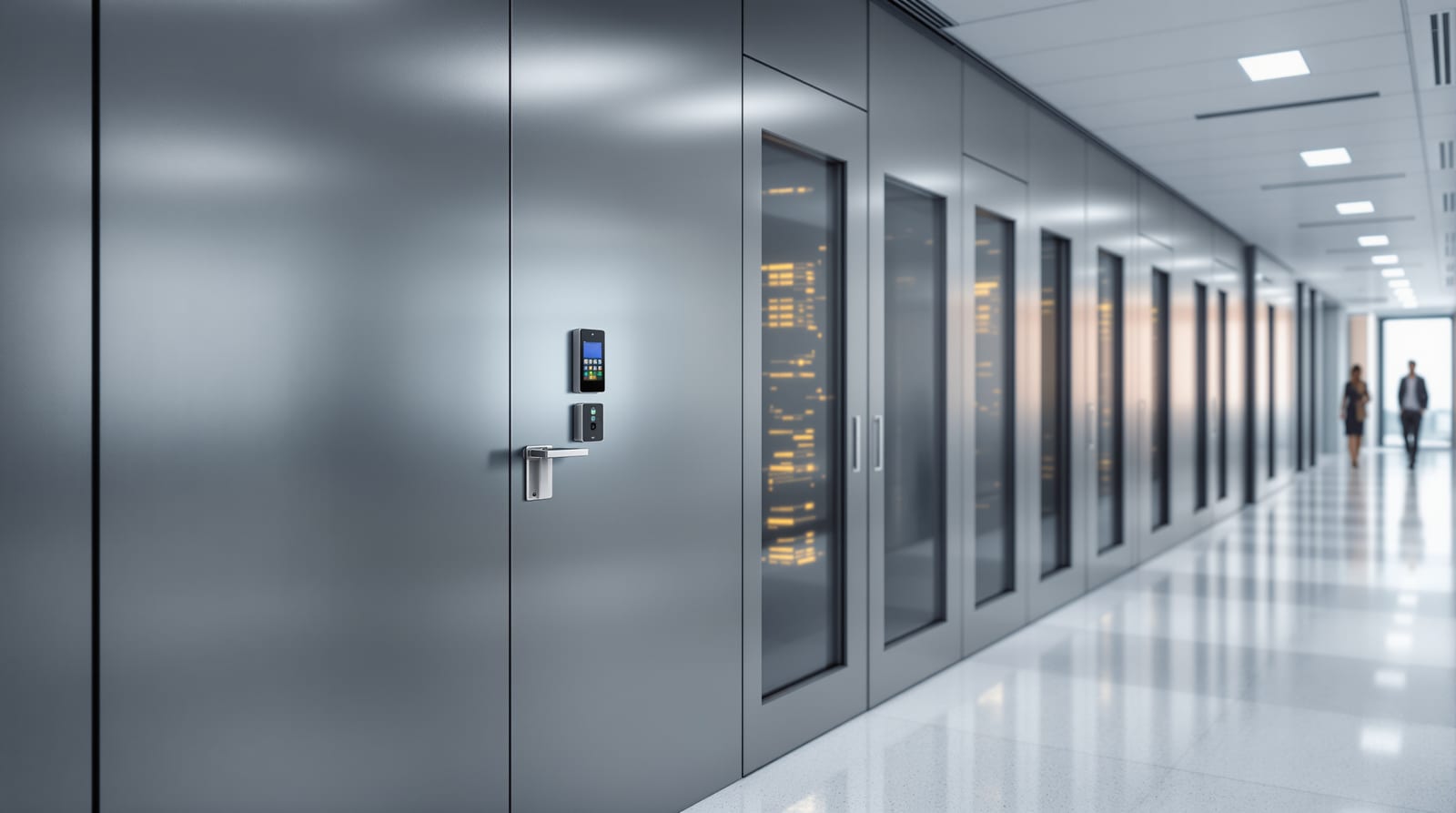
Server Room Door in India: Fire-Rated, Sealed and Access-Controlled (2026)
How to specify the door for a server, UPS or electrical room in India - fire-rated steel, gas-tight sealing for clean-agent suppression, access control and equipment clearances - with indicative rupee costs.
A server room is the most expensive few square metres in most Indian buildings. Behind that one door sit racks, switches, UPS banks and the company's entire digital memory. The door is not joinery here - it is a fire compartment boundary, a security perimeter and the gasket that lets a clean-agent suppression system actually work. Get it wrong and a corridor fire reaches the racks in minutes, or the FM-200 you paid lakhs for leaks out before it can extinguish anything. This guide tells you exactly how to specify a server, UPS or electrical-room door in India - the rating, the seal, the access control and the clearances - with indicative rupee costs.
What a server room door actually has to do
Treat the door as four overlapping requirements, ranked by what kills the room fastest:
1. Contain fire (both directions). The room sits inside a fire compartment. Electrical and battery fires start inside; corridor and adjacent-space fires must be kept out. NBC 2016 and IS 3614 treat such a door as a fire/smoke barrier - it must hold its rating, self-close and stay shut.
2. Stay gas-tight for clean-agent suppression. If the room is protected by FM-200, Novec 1230, NOVEC or inert-gas (IG-541) flooding, the agent must hold a design concentration for around 10 minutes. A leaky door drops the concentration below the extinguishing level and the fire reignites. The door, frame and threshold become part of the room's enclosure-integrity (door-fan test) result.
3. Control access. Only named, authorised people enter. This means card, PIN or biometric reader, electric strike or maglock, request-to-exit and an audit trail - tied to building access control and, ideally, the BMS.
4. Pass equipment and people safely. Racks, UPS modules and CRAC units are bulky. You frequently need a wider or double-leaf opening, plus a code-compliant egress path for staff inside.
Looks come last. There is no client-facing vision panel requirement, no decorative finish, no Vastu consideration here - this is pure performance.
The recommended specification
For almost every Indian server, UPS or main electrical room, the right answer is a fire-rated single-skin steel door with a continuous seal system and integrated access control. Here is what to write into the door schedule.
Leaf and frame. Galvanised/powder-coated steel leaf (usually honeycomb or mineral/rockwool core) in a pressed-steel frame grouted into masonry - see the wider treatment in steel doors in India. Steel is preferred over treated timber for electrical/battery rooms because it does not add fuel and survives years of trolley knocks.
Fire rating. Minimum 60 minutes for a typical IT/server room; 90-120 minutes where the room sits on an escape route, is a large UPS/battery room, or the company's risk policy demands it. The assembly (leaf + frame + hardware) must carry a tested IS 3614 rating - the rating belongs to the whole assembly, not just the leaf. The full logic is in fire-rated doors in India, and you can sanity-check a requirement with the fire-door rating checker tool.
Self-closing + latching. A fire-rated overhead door closer is mandatory so the door is never propped open. Pair it with a fire-rated mortise lock or latch that positively engages. Pick the closer from door closers in India.
Seal system (the part most people miss). For clean-agent integrity you need: intumescent + smoke seals in the frame rebate, a drop-down (automatic) threshold seal at the bottom, and gasketing around the full perimeter. This makes the closed door substantially air-tight - essential to pass the door-fan integrity test and keep the suppression agent in the room.
No vision panel / no glazing. Skip vision panels. Any glazing is a thermal and air-leakage weak point and a security exposure; a server room does not need passers-by looking in. If a small inspection light is wanted, use a sealed fire-rated mini-light, not an open pane - and accept the rating/seal penalty.
Access control. Card or biometric reader outside, electric strike or maglock fail-secure on the lock side, request-to-exit (REX) and a door-position sensor inside, all wired back to the access-control head end. Specify it via door access control in India and, for the reader type, biometric door locks in India. Crucial life-safety rule: on a fire alarm, the door must fail safe for egress - people inside always get out - while still resisting entry from outside.
Width / leaf count. A single 900-1000 mm leaf suits a small comms room. For rooms taking full racks, large UPS modules or CRAC units, specify a 1.5-leaf or double-leaf door (active + inactive leaf with flush bolts) so the inactive leaf opens for equipment moves. Keep the everyday active leaf self-closing and access-controlled.
Inline plan: a sealed, access-controlled fire door
Cost: what a server room door runs in India
Indicative, per door, 2026, including frame, fire-rated hardware and seals; add about 18% GST. Access-control electronics are usually a separate line item by the security contractor. Costs vary by size, rating and city.
| Door / scope | Rating | Indicative cost (₹ per door) | Why this price |
|---|---|---|---|
| Single steel fire door, small comms room | 60 min | 14,000 - 26,000 | Tested leaf + frame + closer + basic seals |
| Single steel fire door, full seal system | 60-90 min | 22,000 - 38,000 | Adds drop threshold + perimeter gasketing for gas integrity |
| Single steel fire door, high rating | 120 min | 30,000 - 50,000+ | Heavier core, certified 2-hour assembly |
| Double-leaf steel fire door (equipment access) | 60-120 min | 45,000 - 90,000+ | Two leaves, flush bolts, coordinator, twin seals |
| Access-control package (per door, add-on) | n/a | 18,000 - 70,000+ | Reader, controller, maglock/strike, REX, door sensor, wiring |
| Door-fan enclosure-integrity test (per room) | n/a | 12,000 - 40,000 | Commissioning of the gas-tight envelope |
For a like-for-like steel-leaf baseline, see steel doors in India; for the fire-door premium logic, fire-rated doors in India.
How it compares to ordinary doors
| Requirement | Ordinary office/internal door | Server / electrical room door |
|---|---|---|
| Fire rating | Often none | 60-120 min IS 3614 mandatory |
| Self-closing | Optional | Mandatory closer + positive latch |
| Air/gas sealing | None | Full perimeter + drop threshold (gas-tight) |
| Vision panel | Common | Avoided - security + leakage |
| Access | Mechanical lock | Card/biometric + audit trail, fail-safe on alarm |
| Leaf count | Single | Often 1.5 / double for equipment |
| Material | Timber/laminate | Steel preferred (non-combustible, durable) |
If you are also specifying the wider IT facility - cleanroom-grade hermetic and interlocked doors - see data centre door in India, which goes deeper on multi-door mantraps and ESD.
Standards to quote in your schedule
- IS 3614 - fire-resistant door assemblies; cite the required rating (60/90/120 min) for the leaf-plus-frame assembly.
- IS 4351 - steel door frames.
- NBC 2016 - fire compartmentation and means of egress; the server room is a compartment boundary and staff inside need a compliant exit.
- RPwD 2021 / accessibility - if staff regularly work inside, keep clear width >=900 mm and a lever-operable exit; threshold seals must still drop below 12-13 mm in the up-stand sense at the walking line.
- Clean-agent enclosure integrity - the room (door included) must pass a door-fan integrity test so the suppression agent holds concentration; design the door seals to this from day one.
Do and don't
Do specify the seal system at the same time as the rating - a 120-minute door that leaks gas is a failed server-room door. Do make access control fail-safe for egress on alarm. Do size for the biggest piece of equipment that will ever pass through. Do keep the closer maintained so the door is never propped.
Don't add a vision panel "to keep an eye on things" - use a camera and BMS instead. Don't use a hollow timber or flush internal door re-purposed as a server door - it has no rating and no seal. Don't let the active leaf be wedged open; that defeats fire and gas containment at once. Don't forget the threshold - the floor line is the commonest gas-leak path.
For the bigger office picture this door sits inside, see office doors in India, and for the building-wide which-door-where logic, doors by space in India.
Frequently asked questions
Does a server room door legally need a fire rating in India?
For any room that is a designated fire compartment - which server, large UPS and main electrical rooms almost always are under NBC 2016 - yes, the boundary door must be a tested fire-rated assembly (IS 3614). The common minimum is 60 minutes, rising to 90-120 minutes on escape routes or for big battery/UPS loads. Confirm with your fire consultant and the local fire NOC requirements.
Why does the door have to be gas-tight?
If the room is protected by a clean-agent system (FM-200, Novec 1230, inert gas), the agent must hold its extinguishing concentration for several minutes. A leaky door lets the gas escape and the fire can reignite. Perimeter seals plus an automatic drop-down threshold seal are what let the room pass its door-fan enclosure-integrity test.
Should I use a steel door or a treated timber fire door?
Steel is the usual choice for server, UPS and electrical rooms. It is non-combustible, adds no fuel load, takes years of trolley impacts, and accepts heavy access-control hardware and seals cleanly. Treated-timber fire doors are fine for office areas but are less robust for an equipment room. See steel doors in India.
How does access control stay safe in a fire?
Configure the lock to fail-safe for exit: people inside can always leave (request-to-exit releases the lock), while the door still resists entry from outside. On a verified fire-alarm signal the access system should release per the egress plan. Specify this explicitly via door access control in India so life safety and security are not in conflict.
Do I need a double-leaf door?
Only if equipment demands it. A small comms room is fine with a single 900-1000 mm leaf. Rooms taking full racks, large UPS modules or CRAC units benefit from a 1.5-leaf or double-leaf door so the inactive leaf opens for installs and swap-outs, while the everyday active leaf stays self-closing and access-controlled.
Export this guide
Related Guides — Deep-dive reading
Fail-Safe vs Fail-Secure Locks: The Guide (India 2026)
Why fail-safe vs fail-secure is the single most important access-control decision, and how to get it right for every door.
Home Doors & EntrancesFire Rated Doors in India: IS 3614 Ratings, Cost & Where They're Required (2026)
What a fire-check door is, how the 30/60/90/120-minute ratings work to IS 3614, where the NBC makes them mandatory, and why the whole assembly must be certified.
Home Doors & EntrancesDouble Doors in India (2026): Two-Leaf Entrances, Proportions, Hardware & Cost
When a double-leaf door makes sense for Indian main entrances, pooja rooms and master suites, plus active/inactive leaf hardware, the Vastu note on even panels, security at the meeting stile and the rupee premium over a single door.
Home Doors & EntrancesRelated Tools — Try Free
Electrical Safety & Load Audit
Home electrical audit — 10 categories, 65+ checkpoints across earthing, RCCB, MCB, wiring, switchboards, appliance circuits, DG/inverter backup.
Safety AuditEmergency-Egress Checker
A life-safety self-check that access-controlled doors on escape routes still let people out in an emergency.
Egress CheckFire Door Rating Checker
See the likely fire-door rating (30/60/90/120 min) and components a location needs per IS 3614 / NBC — guidance, confirm with your architect.
Compliance Tool