
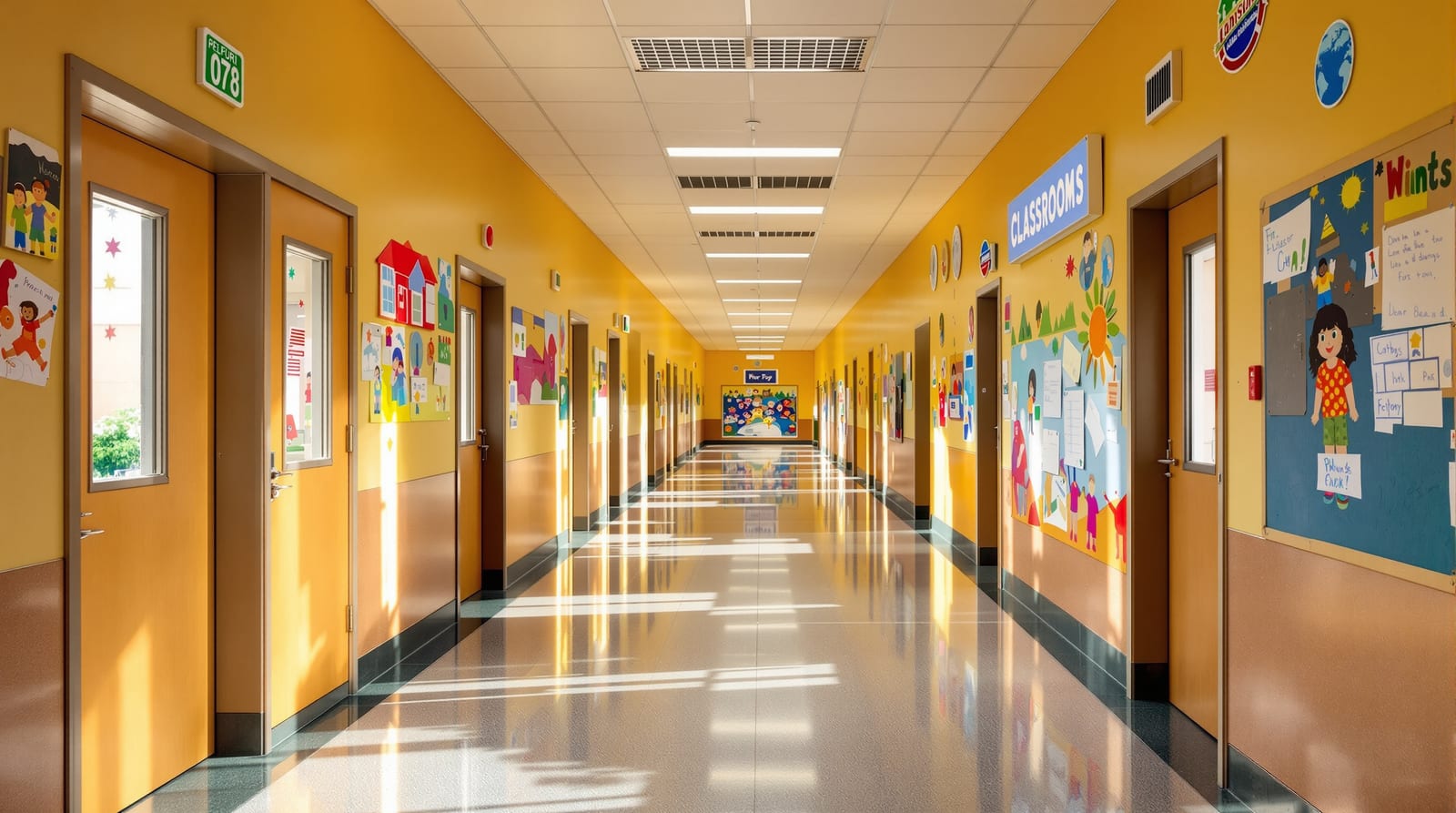
School Doors in India: Child-Safe, Durable and Fire-Compliant Doors by Area (2026)
A safety-led, area-by-area guide to specifying doors for an Indian school - classrooms with anti-finger-trap guards and vision panels, durable corridors, fire-resistant labs, hygienic toilets, panic-barred assembly halls and code-compliant fire exits - with indicative per-door costs.
A school door has a harder job than almost any door in a home or office, because the people using it are children - hundreds of them, many small, many in a hurry, many testing what a door can take. The door has to protect their fingers, survive a decade of slamming and kicking, let a teacher supervise without opening it, swing the right way when a corridor full of pupils has to empty in minutes, and do all of that across dozens of identical openings on a tight institutional budget. Get one detail wrong - a self-closing door with no finger guard, a fire exit that opens inward, a toilet door that traps a child - and you have an injury or a tragedy, not a snag. This guide tells you how to specify school doors in India area by area, what safety or code driver decides each one, and what each should cost per door so a whole building can be scheduled sensibly.
What a school door actually has to do
Treat every school door against six demands, and rank them so the children come first. The order matters: a beautiful door that traps fingers has failed.
1. Protect small fingers. The single most common door injury to children is a crushed or amputated fingertip in the hinge gap or the closing edge of a door. Every door a child can reach - classrooms, corridors, toilets, libraries - needs anti-finger-trap protection on both the hinge side and, ideally, the leading edge, plus controlled closing so the door cannot slam. This is the one demand that is non-negotiable in a school.
2. Survive abuse. School doors are slammed, kicked, leaned on, jammed open with bags and hit by trolleys all day. They need impact-resistant faces, robust frames, heavy-duty hinges and replaceable kick plates so a single damaged door does not mean a new leaf.
3. Let staff supervise. A vision panel lets a teacher or a passing staff member see into a classroom or out into a corridor without opening the door - vital for child protection, for managing a class and for spotting trouble. Many school safeguarding policies effectively require it.
4. Evacuate fast and to code. Schools are high-occupancy assembly-type buildings under NBC 2016. Exit and corridor doors must open in the direction of escape, be wide enough for the occupant load, and final exits and stair doors must carry panic hardware so a crowd of children can push through without a handle.
5. Stay hygienic and low-maintenance. Toilets and labs need wipeable, water- and chemical-resistant surfaces; every door needs to be cheap and quick to maintain because there are so many of them.
6. Reach children. Lever handles (never knobs) at a height a child can use, contrasting colour for visibility, and an accessible route for pupils with disabilities under RPwD 2021 - clear width at least 900 mm, lever handles and a near-flush threshold under 12 mm.
The big one: anti-finger-trap protection
Because finger-crush injuries are the defining risk in a school, deal with them before anything else. There are two parts to it - the hinge side and the closing edge - and a school door should address both.
The hinge gap. As a normal door opens, a wedge-shaped gap opens up on the hinge side between the leaf and the frame. A child holding the frame there can have a finger drawn into the gap and crushed when the door swings shut. The fix is a finger-protection device: a hinge-side guard - a flexible rubber or hinged-plastic shield that covers the gap through the full swing - fitted on the back (hinge) face, and often on the front face too. These are sold as finger guards or door-edge guards and are retrofittable as well as specifiable for new doors.
The leading (latch) edge. The closing edge can pinch a finger against the frame. A controlled closer that prevents slamming, a soft buffer on the edge and a child-aware closing speed all reduce this.
Controlled, non-slamming closing. Where a door is self-closing - and fire doors must be - use a closer with adjustable, gentle final speed and a backcheck so wind or an excited child cannot fling it. Combine the closer with the hinge guard; a self-closing door without a finger guard is the worst combination in a school. Choose the closer from the family in door closers in India and the hinge logic in the door hinges guide for India.
Write anti-finger-trap protection into the school door schedule as a default line item on every child-accessible door, not as an upgrade.
Door by door: the recommended school door for each area
Different areas pull on different demands. Here is the recommended door for each, with the driver that decides it.
Classroom door. A flush door with a laminate face on a solid or solid-core blockboard core - durable, light enough for a child, easy to clean and economical across many rooms. Fit a vision panel (wired or laminated safety glass) for supervision, a hinge-side finger guard, a lever handle at child height, a kick plate, and a controlled closer. Size it for evacuation and have it swing outward into the corridor where the corridor width allows, so a panicking class is not pulling a door inward against itself. See the type in flush doors in India.
Corridor / circulation door. Wide, very durable, with vision panels in both leaves and protection on both faces because traffic comes from both sides. Often a double-leaf flush or impact door so a stream of children, trolleys and teachers passes through. Heavy-duty hinges, kick plates and closers are essential here - this is the most abused door in the school.
Laboratory door. A fire-resistant, chemical- and water-resistant door - a fire-rated leaf for chemistry/physics labs near gas or burners, with a vision panel so staff can see a hazard before entering. Surfaces must shrug off spills. Specify the rating from fire-rated doors in India.
Toilet / washroom door. A waterproof, antibacterial, easy-clean leaf - PVC or WPC - with privacy hardware that an adult can release from outside in an emergency, and a gap at the bottom for ventilation. Lever or indicator-bolt hardware sized for children.
Assembly hall / multipurpose / auditorium door. Large doors handling a whole-school crowd: wide leaves, outward swing, and panic / push-bar exit hardware so children push the bar and the door opens with no handle and no thought. This is an assembly occupancy and needs the highest egress discipline.
Fire exit and stair doors. Fire-rated, self-closing doors fitted with panic bars, opening in the direction of escape, never lockable against egress. These are life-safety doors governed by emergency exit door standards in India and detailed in fire exit doors in India.
Library / staff / admin doors. Quieter areas: flush doors with vision panels and finger guards, with a little more acoustic comfort for the library. Standard durable institutional joinery.
Recommendation and cost table
Indicative 2026 supply-and-fit cost per door (standard 3x7 ft unless noted), before 18 percent GST, varying by size, finish and city. Multiply across a real door schedule - a single school block can have 40 to 100 doors, so per-door discipline matters.
| School area | Recommended door | Why (driver) | Indicative cost per door |
|---|---|---|---|
| Classroom | Laminate flush, solid-core, vision panel + finger guard, closer, outward swing | Durability, supervision, finger safety, fast evacuation | 5,000 - 12,000 |
| Corridor / circulation | Wide double-leaf flush or impact, vision panels, kick plates | Heavy two-way traffic, abuse, throughput | 12,000 - 30,000 (pair) |
| Laboratory | Fire-rated leaf, chemical/water-resistant face, vision panel | Fire/chemical hazard, supervision | 14,000 - 40,000 |
| Toilet / washroom | PVC or WPC, antibacterial, indicator/emergency-release bolt | Hygiene, moisture, child privacy with adult override | 2,000 - 6,000 |
| Assembly / multipurpose hall | Large outward-swing leaves with panic / push bars | High occupancy crowd egress | 18,000 - 45,000+ |
| Fire exit / staircase | Fire-rated, self-closing, panic bar, opens to escape | NBC egress, life safety | 16,000 - 45,000 |
| Library / admin | Laminate flush, vision panel, finger guard, acoustic option | Durability, quiet, supervision | 6,000 - 14,000 |
Costs draw on the same per-door benchmarks used across the cluster; size and city move them. Hardware - guards, panic bars, closers, vision-panel glazing - can add meaningfully and is itemised below.
Inline plan: a child-safe classroom door
The drawing shows the three details that make a classroom door safe - the hinge-side finger guard, the vision panel for supervision, and the outward swing into the corridor for evacuation.
Hardware checklist for school doors
Specify the safety and durability hardware deliberately, because most school door failures are hardware failures.
- Anti-finger-trap guards on the hinge side (and front face) of every child-accessible door.
- Door closers with gentle, adjustable closing and backcheck so doors do not slam; mandatory on fire doors. See door closers in India.
- Vision panels in safety (wired or laminated) glass for classrooms, corridors, labs and admin.
- Kick plates at the base of high-traffic doors to absorb kicks and trolley knocks.
- Lever handles at child-reachable height; never knobs (a child or an adult with full hands cannot turn a knob).
- Panic / push bars on assembly, hall and fire-exit doors.
- Robust, correctly-rated hinges for the leaf weight and cycle count - choose from the door hinges guide for India.
- Indicator/emergency-release bolts on toilet doors so a stuck child can be reached.
Standards to write into the school door schedule
- NBC 2016 classifies schools as an institutional/assembly occupancy: exit and corridor doors open in the direction of escape, are sized for the occupant load, and stair/final-exit doors carry panic hardware.
- IS 3614 governs fire-check / fire-resisting doors used on labs, stairs and escape routes; specify the rating (in minutes) per the fire strategy.
- IS 4351 for steel frames and IS 1003 for timber door shutters set the joinery quality.
- RPwD 2021 accessibility: at least one accessible route with clear door width 900 mm or more, lever handles and threshold under 12 mm.
- A fire and life-safety plan for the whole building drives where fire doors, panic bars and outward swings are mandatory - confirm with the AHJ / fire NOC.
Do and don't for school doors
Do fit a finger guard on every child-accessible door; combine closers with guards; use vision panels for supervision; swing classroom and exit doors outward where the corridor allows; use lever handles at child height; specify durable laminate/PVC/WPC faces; standardise sizes and hardware across the school for cheap maintenance.
Don't use self-closing doors without finger guards; don't use door knobs; don't let any fire-exit or stair door open inward or be lockable against egress; don't fit fragile glass at child-impact height; don't ignore the toilet-door emergency-release detail; don't put sharp edges or projecting hardware at child height.
Where this sits in the cluster
A school is one of the most demanding spaces in the wider application set in doors by space - a guide for India, and its safety and egress logic overlaps directly with the next-stage version in college and institutional doors in India. For the door types themselves, build the schedule from flush doors in India, the fire leaves from fire-rated doors in India, and the egress doors from fire exit doors in India.
Frequently asked questions
What is the single most important safety feature on a school door?
Anti-finger-trap protection. Crushed and amputated fingertips in a door's hinge gap or closing edge are the most common serious door injury to children. Fit a hinge-side finger guard, a non-slamming closer and a buffered closing edge on every door a child can reach - treat it as standard, not as an optional upgrade.
Should classroom doors open into the room or out to the corridor?
Wherever the corridor is wide enough, classroom doors in a school should swing outward into the corridor so a class can evacuate by pushing, not pulling, and so a fallen or panicking child does not block an inward-opening leaf. Fire-exit and assembly doors must open in the direction of escape under NBC. Confirm corridor widths so an open leaf does not obstruct the escape route.
Do school halls and fire exits really need panic bars?
Yes. Schools are high-occupancy assembly buildings, and assembly halls, multipurpose rooms and final fire exits should carry panic / push-bar hardware so a crowd of children opens the door by pushing against it with no handle to find and no thought required. This is required egress hardware for the occupancy under NBC 2016 and the building fire strategy.
What should a classroom door cost in India?
A durable laminate flush classroom door with a vision panel, hinge finger guard, kick plate and a controlled closer typically runs about 5,000 to 12,000 rupees supplied and fitted, before GST, varying by size, finish and city. Fire-rated lab and exit doors cost more. Across a whole school block of 40 to 100 doors, standardising sizes and hardware keeps both the build and long-term maintenance affordable.
Are vision panels in classroom doors mandatory?
There is no single all-India rule, but vision panels are strongly recommended and are effectively required by most school safeguarding and child-protection policies because they let staff supervise a classroom or corridor without opening the door. Use wired or laminated safety glass set at a height that allows supervision while protecting privacy where needed.
Export this guide
Related Guides — Deep-dive reading
Kids Room Door in India: Safe, Non-Toxic and Cheerful Door Picks (2026)
How to choose a children's bedroom door for an Indian home - finger-pinch-guard hinges and soft-close first, then non-toxic low-VOC finishes, easy lever handles, fun colours and abuse-proof durability - with picks ranked and indicative rupee costs.
Home Doors & EntrancesFire Exit Doors in India: NBC 2016 Egress, Panic Bars & Costs (2026)
How fire exit and emergency egress doors must be sized, swung, hardware-fitted and signed to NBC 2016 Part 4 in Indian buildings, and what they cost.
Home Doors & EntrancesCollege Doors in India: The Right Door for Every Campus Facility (2026)
A facility-by-facility guide to specifying doors across an Indian college or university campus - lecture halls, discipline-specific labs, library, auditorium, hostels, admin, sports and fire exits - ranked for heavy footfall durability, fire and egress at scale, access control and institutional image, with indicative per-door costs.
Home Doors & EntrancesRelated Tools — Try Free
Accessible Door Checker
Check a door against wheelchair-accessibility guidance — clear width, threshold, handle and closer force per RPwD 2021.
Compliance ToolEmergency-Egress Checker
A life-safety self-check that access-controlled doors on escape routes still let people out in an emergency.
Egress CheckFire Door Rating Checker
See the likely fire-door rating (30/60/90/120 min) and components a location needs per IS 3614 / NBC — guidance, confirm with your architect.
Compliance Tool