
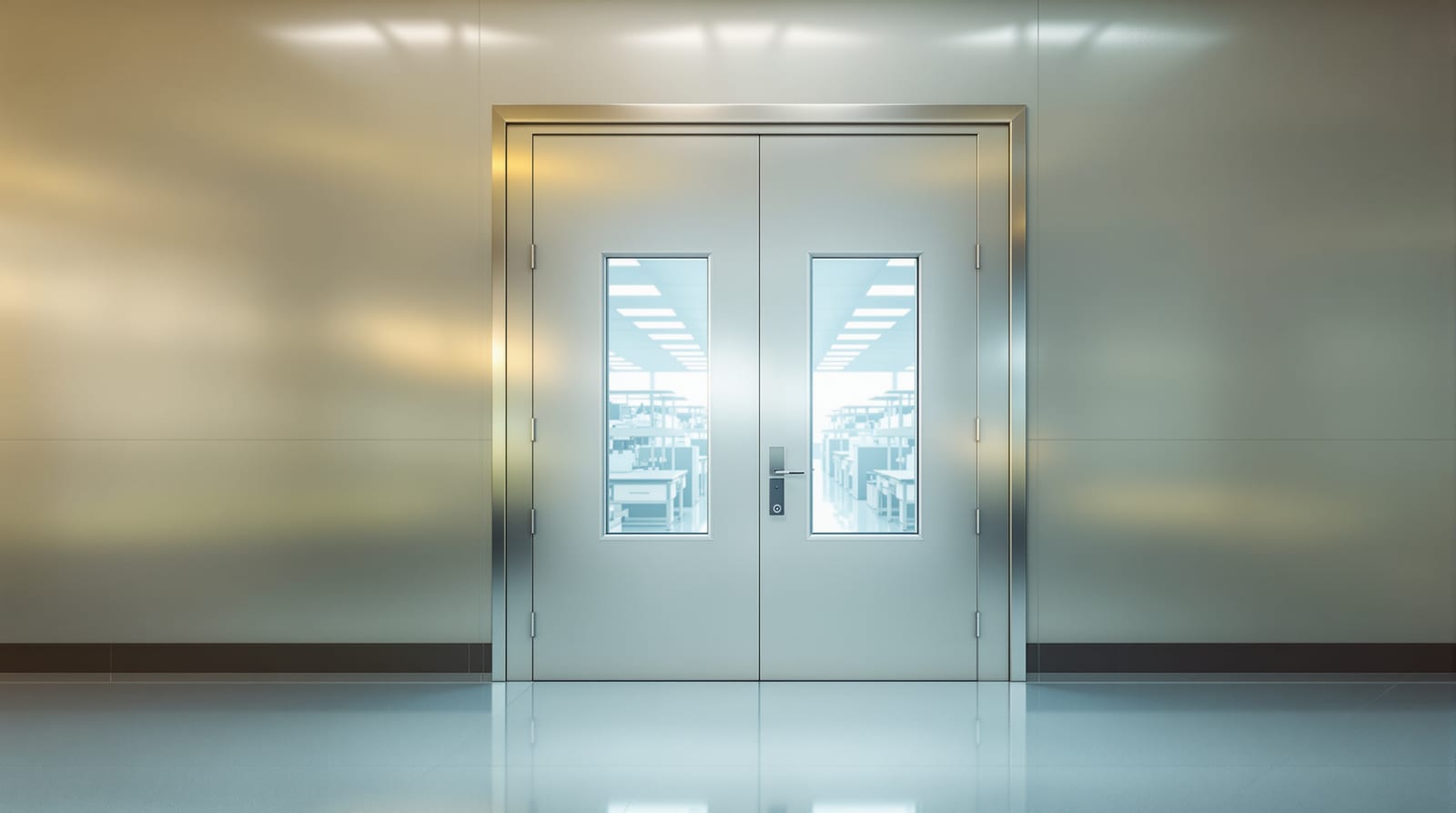
Laboratory Door in India: Chemical-Resistant, Fire-Rated, Sealed and Access-Controlled (2026)
How to specify the right laboratory door in India - matched to the hazard: chemical-resistant FRP, SS or epoxy-laminate for acids and solvents, fire-rated for flammable-solvent labs, ESD and access control for electronics, hermetic-sealed for biosafety and cleanrooms, and lead-lined for radioisotope work - with indicative rupee costs and code references.
There is no such thing as a generic "lab door". A chemistry lab spilling acids and solvents, a pharma cleanroom under positive pressure, a microbiology BSL suite that must contain pathogens, a semiconductor bay that must not see a single static spark, and a radioisotope room that must stop X-rays - each one demands a completely different door. Specify the wrong one and you get corroded leaves in a year, a failed GMP audit, a cleanroom that will not hold pressure, an ESD event that ruins a wafer lot, or radiation leaking under the threshold. This guide tells you how to match the laboratory door to the hazard - across research, pharma, chemical, pathology, electronics and education labs in India - with indicative rupee costs and the codes to quote.
What a laboratory door actually has to do
A lab door is a hazard-control device first and joinery last. Before picking a leaf, write down which of these your space demands, ranked by what does the most damage:
1. Chemical resistance. Acids, alkalis, solvents and reagents attack ordinary timber and laminate fast. Wet-chemistry, pathology and pharma QC labs need leaves that shrug off splashes and fumes - FRP, stainless steel or chemical-grade compact (epoxy/phenolic) laminate.
2. Fire and flammable-solvent safety. Solvent stores, organic-chemistry and some physics labs carry a real fire load. The door may be a fire compartment boundary needing an IS 3614 rating, self-closing and a tested assembly.
3. Sealing and decontamination. Cleanrooms, biosafety (BSL) suites and sterile pharma areas need flush, gasketed, hose-down doors that hold a pressure differential and can be wiped or fumigated - often hermetic sliding leaves.
4. Access control and interlocks. Restricted labs (BSL, controlled-substance, semiconductor, radioisotope) need card or biometric entry, audit trails, and airlock interlocks so two doors are never open together.
5. Vision and safety. Wired or laminated vision panels for collision avoidance and emergency observation; anti-finger-trap and lever hardware for teaching labs.
6. Egress. Labs with hazardous materials must let people out fast - outward swing on the escape side, panic hardware where occupancy demands, no door that traps you with a spill or fire.
Looks come last. Match the door to the dominant hazard and the rest of the schedule follows.
Match the door to the lab type
| Lab type | Dominant hazard | Recommended door | Why |
|---|---|---|---|
| Chemistry / wet-chemistry / reagent store | Acids, alkalis, solvents, fire | FRP or chemical-grade compact-laminate leaf; fire-rated steel for solvent store | Corrosion-proof, non-reactive; rated assembly contains solvent fire |
| Pharma QC / formulation (GMP) | Hygiene, cleanability, pressure | Flush SS or HPL hermetic-edge door, coved, gasketed | Wipe-down, no dust ledges, holds room classification |
| Pathology / clinical / blood bank | Biohazard, splashes, hygiene | Antibacterial HPL or SS leaf, vision panel, self-closing, hands-free | Easy decon, observation, low-touch |
| Microbiology / BSL-2 / BSL-3 | Pathogen containment | Sealed, gasketed, self-closing, interlocked airlock door; BSL-3 sealable for fumigation | Contains aerosols, supports decontamination, directional airflow |
| Cleanroom / sterile / aseptic | Particle and pressure control | Hermetic sliding or flush swing with full gaskets and interlock | Maintains ISO class and pressure cascade |
| Electronics / PCB / assembly | ESD (static) | ESD/anti-static conductive leaf, grounded hardware, access control | Drains static, protects components |
| Semiconductor / fab bay | ESD + particles + security | ESD hermetic interlocked door, access-controlled | Combines static, contamination and entry control |
| Radioisotope / nuclear medicine hot lab | Ionising radiation | Lead-lined steel door, lead vision glass, interlock | Stops X/gamma leakage, controlled entry |
| Physics / instrumentation / laser | Fire, light/laser, equipment | Fire-rated steel; light-tight + interlock for laser rooms | Contains fire; blocks stray light, locks during exposure |
| Teaching / college / school lab | Durability, child/student safety, fire | Durable FRP or laminate flush, vision panel, anti-finger-trap, lever, fire where needed | Survives heavy use, safe for students, observable |
For the underlying material logic on these leaves, see FRP doors in India; for the rating premium, fire-rated doors in India; and for the sealed/pressure family, cleanroom door in India.
The recommended specifications, hazard by hazard
Chemical labs. Specify an FRP (fibre-reinforced plastic) or stainless-steel leaf, or a chemical-grade compact-laminate (phenolic/epoxy) flush door, in a non-reactive frame - powder-coated steel, SS or FRP, never bare timber at the splash zone. Add a hose-down coved threshold, a laminated vision panel, a self-closer and lever handles. Where the room holds bulk solvents, the door becomes a fire-rated assembly as well (see below). The full material case is in FRP doors in India.
Flammable-solvent, organic-chemistry and physics labs. Where the lab is a designated fire compartment or a solvent store, specify a tested fire-rated door (IS 3614) - typically 60 minutes, rising to 90-120 minutes for large solvent stores or doors on escape routes - with intumescent and smoke seals, a fire-rated closer and a positive latch. The rating belongs to the whole leaf-plus-frame-plus-hardware assembly. See fire-rated doors in India and, where the lab is an exit point, emergency exit door standards in India.
Cleanroom, sterile pharma and biosafety labs. Specify a flush, gasketed, fully sealed door - hermetic sliding for high classes and gowning airlocks, or a flush swing with perimeter gaskets and a drop seal for lower classes. Coved, ledge-free, wipe-down surfaces; a vision panel; and an interlock so the airlock's two doors never open together (maintaining the pressure cascade and containment). BSL-3 doors must be sealable for gaseous fumigation. This whole family is detailed in cleanroom door in India.
Electronics and semiconductor labs. Specify an ESD/anti-static leaf (conductive surface, grounded hinges and hardware) to drain static safely, with access control so only trained, grounded staff enter. Fab bays combine ESD with cleanroom sealing and interlocks. Wire entry through door access control in India.
Radioisotope and nuclear-medicine hot labs. Specify a lead-lined steel door (lead sheet sandwiched in the leaf to the radiation physicist's calculated thickness), a lead-glass vision panel, and an interlock that prevents entry during exposure or scanning. These are heavy doors - the frame, hinges and closer must be sized for the load, and the lead lining must continue across the frame and threshold so there is no radiation gap.
Access, interlocks and egress (almost all labs). Restricted labs need card or biometric readers and an audit trail; airlocks need electrical interlocks; and every lab with a hazard must fail safe for egress on alarm - people inside always get out. For the reader and lock side, see door access control in India.
Inline plan: a chemical-resistant lab door with vision panel and airlock interlock
Cost: what a laboratory door runs in India
Indicative, per door, 2026, including frame and basic fitting where typical; add about 18% GST. Access-control electronics, interlocks and door-fan or radiation testing are usually separate line items. Costs vary by size, finish, rating and city.
| Lab door / scope | Typical lab use | Indicative cost (₹ per door) | Why this price |
|---|---|---|---|
| FRP chemical-resistant flush leaf | Chemistry, pathology, teaching | 6,000 - 16,000 | Corrosion-proof leaf, frame, vision panel, lever |
| Stainless-steel hygienic leaf | Pharma QC, microbiology, sterile | 18,000 - 45,000 | SS skins, coved, wipe-down, gasket-ready |
| Chemical-grade compact-laminate flush | Wet-chemistry, instrument labs | 8,000 - 20,000 | Phenolic/epoxy core, splash-proof, durable |
| Fire-rated steel door (60-120 min, IS 3614) | Solvent store, organic chemistry, escape route | 14,000 - 50,000+ | Tested assembly, intumescent seals, closer |
| Hermetic / sealed cleanroom door | BSL, sterile pharma, fab | 35,000 - 1,20,000+ | Gaskets, flush surfaces, pressure-holding, interlock-ready |
| ESD / anti-static leaf | Electronics, semiconductor | 12,000 - 35,000 | Conductive surface, grounded hardware |
| Lead-lined steel door (per mm Pb) | Radioisotope, nuclear-medicine hot lab | 60,000 - 2,50,000+ | Lead sheet to spec, lead glass, heavy frame/hinges |
| Access control / interlock package (add-on, per door) | Restricted labs, airlocks | 18,000 - 70,000+ | Reader, controller, maglock/strike, REX, interlock logic |
For a like-for-like FRP baseline see FRP doors in India; for the sealed-door family pricing logic, cleanroom door in India.
Hardware the lab door needs
- Self-closer on fire, biosafety and cleanroom doors so the door is never left open - pick from door closers in India.
- Lever handles, not knobs, for accessibility and gloved hands; hands-free / foot-pull or auto-open where staff carry samples or must avoid contamination.
- Laminated or wired vision panel for collision avoidance and emergency observation; lead glass for radioisotope rooms.
- Anti-finger-trap and durable edges for teaching labs - the same logic used in school doors in India.
- Access control + interlock for restricted labs and airlocks via door access control in India; always fail-safe for egress on alarm.
Standards to quote in your schedule
- IS 3614 - fire-resistant door assemblies; cite the rating (60/90/120 min) for solvent-store and compartment-boundary lab doors.
- IS 4351 - steel door frames; IS 1003 - timber leaves/frames where used in low-hazard teaching labs.
- NBC 2016 - means of egress and fire compartmentation; hazardous labs open in the direction of escape, with panic hardware where occupancy load demands.
- RPwD 2021 / accessibility - clear width >=900 mm, lever handles, threshold <=12 mm for staff and student access.
- GLP / GMP (CDSCO, WHO-GMP, Schedule M) - for pharma and QC labs, surfaces must be smooth, cleanable, non-shedding and coved; doors must support the room's classification and cleaning regime.
- AERB requirements - lead-lining thickness for radioisotope rooms is set by the radiation physicist to the AERB-approved shielding calculation.
- Containment / cleanroom integrity - BSL and cleanroom doors must hold the pressure differential and (for BSL-3) seal for fumigation.
Do and don't
Do identify the dominant hazard before anything else and let it drive the leaf, frame and threshold together. Do specify FRP or SS at the splash zone for any wet-chemistry or clinical lab. Do interlock airlock doors and make access fail-safe for egress on alarm. Do size lead-lined and hermetic doors' frames, hinges and closers for their real weight.
Don't re-purpose a hollow flush internal door as a chemistry-lab door - it corrodes and offers no rating. Don't add an ordinary glazed vision panel to a fire or sealed door without checking the rating and seal penalty. Don't forget the threshold - it is the commonest leak path for gas, pressure and radiation alike. Don't prop a self-closing biosafety or fire door open; it defeats containment instantly.
For neighbouring institutional and clinical spaces, see college and institutional doors in India and hospital doors in India; and for the building-wide which-door-where logic, doors by space in India.
Frequently asked questions
What is the best door material for a chemistry lab in India?
FRP (fibre-reinforced plastic), stainless steel, or a chemical-grade compact (phenolic/epoxy) laminate flush leaf - all in a non-reactive frame. They resist acids, alkalis, solvents and fumes that destroy ordinary timber and laminate, and they wipe down for spills. For a solvent store, add a fire rating on top. See FRP doors in India.
Does a laboratory door need a fire rating?
Only where the lab is a designated fire compartment or holds a real fire load - solvent stores, organic-chemistry labs and doors on escape routes typically need a tested IS 3614 assembly (commonly 60 minutes, up to 120 for large stores). Low-hazard teaching or instrument labs may not. Confirm with your fire consultant. See fire-rated doors in India.
How do biosafety (BSL) and cleanroom lab doors differ from ordinary doors?
They are flush, fully gasketed, self-closing and interlocked so an airlock never has two doors open at once - this holds the pressure cascade and contains aerosols or particles. BSL-3 doors must also seal for gaseous fumigation. The whole sealed-door family is covered in cleanroom door in India.
Why do electronics and semiconductor labs need a special door?
To control static (ESD) that can destroy components, and often particles and access too. Specify a conductive anti-static leaf with grounded hardware, plus access control so only trained, grounded staff enter; fab bays add cleanroom sealing and interlocks via door access control in India.
What makes a radioisotope hot-lab door so expensive?
It is a lead-lined steel door - lead sheet sandwiched in the leaf to the radiation physicist's AERB-approved thickness, with lead-glass vision panel and an interlock. The lead is heavy and must continue across the frame and threshold so there is no leak gap, which drives both the material cost and the heavy frame, hinge and closer hardware.
Export this guide
Related Guides — Deep-dive reading
Library Door in India: Quiet, Access-Controlled and Anti-Theft Reading-Room Entrances (2026)
Doors for public, college and corporate libraries in India - acoustic silence, RFID security gates, controlled single entry and a calm scholarly look, with zone-by-zone choices and costs.
Home Doors & EntrancesSchool Doors in India: Child-Safe, Durable and Fire-Compliant Doors by Area (2026)
A safety-led, area-by-area guide to specifying doors for an Indian school - classrooms with anti-finger-trap guards and vision panels, durable corridors, fire-resistant labs, hygienic toilets, panic-barred assembly halls and code-compliant fire exits - with indicative per-door costs.
Home Doors & EntrancesAccess Control Maintenance in India (2026): Readers, Locks and Fail-Safe Egress
How to keep a card, keypad, fingerprint or face access-control system reading reliably and locking securely — and, above everything, how to test that its doors still release on a fire alarm and on power loss, so an access-controlled door never becomes a life-safety trap.
SecurityRelated Tools — Try Free
Emergency-Egress Checker
A life-safety self-check that access-controlled doors on escape routes still let people out in an emergency.
Egress CheckFire Door Rating Checker
See the likely fire-door rating (30/60/90/120 min) and components a location needs per IS 3614 / NBC — guidance, confirm with your architect.
Compliance ToolWindow Hardware Cost Calculator
Estimate window hardware cost — hinges, handles, locks, rollers and multipoint gears.
Window Calculator