
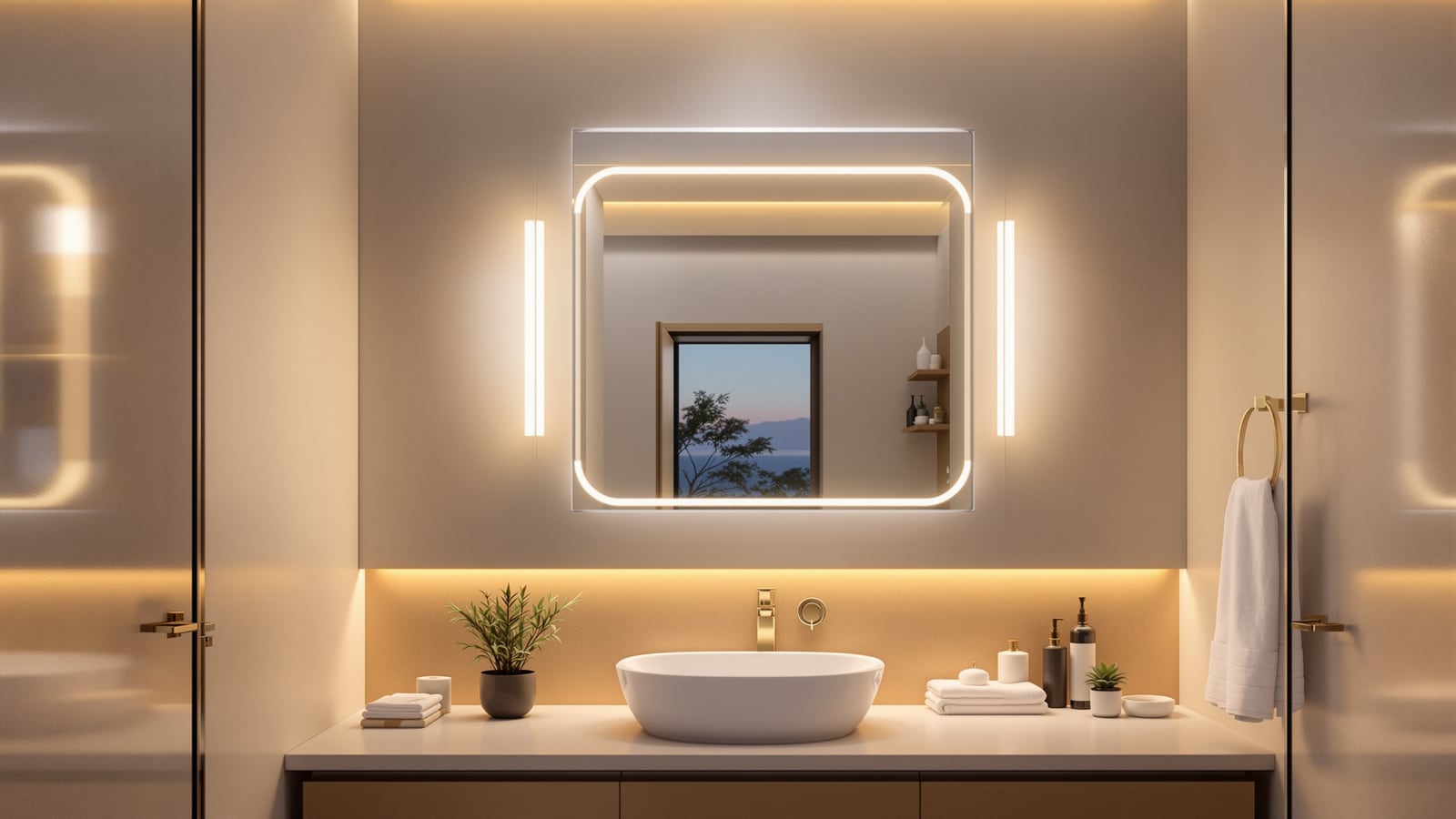
Bathroom Lighting India: The Complete Guide to Layers, Lux, Colour Temperature & IP Safety Zones (2026)
How to light an Indian bathroom properly — the three layers of ambient, task and accent light, the right lux levels and a neutral ~4000K colour temperature for grooming, the IP safety zones near water that decide which fitting goes where, waterproof fixtures, dimming and scenes, mirror lighting done right, motion sensors and energy.
Most Indian bathrooms are lit by a single fitting — one tube light or one downlight in the middle of the ceiling — and that one choice quietly wrecks the room. A central light throws your own shadow straight onto your face at the mirror, so shaving and make-up are done half-blind. It is often the wrong colour, tinting skin and towels. And in far too many homes it is an ordinary indoor fitting sitting a hand's width from a running shower, which is not just ugly but genuinely dangerous. Good bathroom lighting is not about buying a prettier fixture; it is about layering light for the tasks you do, choosing the right colour and brightness, and — above all — respecting the safety zones around water.
This is the overview pillar for bathroom lighting. It sets out the three layers every bathroom needs, the lux and colour-temperature numbers that actually matter, and the IP zone system that governs which fitting is legal and safe in each part of the room. Read it alongside the bathroom design guide for India, and go deeper through the linked sibling guides as each topic comes up.
Light in layers, not from one bulb. A bathroom needs a soft general wash you can dim, bright shadow-free light beside the mirror, and — near water — only fittings rated for the wet zone they sit in.
The three layers of bathroom light
Professional lighting design builds every room from three layers. A bathroom needs all three, and the mistake almost everyone makes is stopping at the first.
- Ambient (general) lighting is the overall wash that lets you move safely and see the whole room. In a bathroom this is usually recessed LED downlights or a ceiling light, ideally on a dimmer so it can drop low for a night visit or a soak.
- Task lighting is bright, shadow-free light exactly where you groom — at the mirror. This is the single most important layer and the one a central ceiling light can never provide, because any light behind you casts your face into shadow. The fix is light on both sides of, or all around, the mirror. This is the whole subject of the bathroom mirror lighting guide.
- Accent lighting is the decorative layer — a strip washing a stone feature wall, LED tape under a floating vanity, a lit niche in the shower. It adds depth and a hotel feel, and doubles as a gentle night light.
Get the layers separately switched (or scened) and one room can be a bright grooming space in the morning and a calm, dim retreat at night.
Lux and colour temperature — the numbers that matter
Two settings decide whether light works: how much of it there is (lux) and what colour it is (Kelvin, K).
Brightness (lux). Lux is light landing on a surface. A bathroom needs a comfortable general level and a much brighter pool at the mirror. Indian illumination guidance (IS 3646) and international practice line up closely:
| Area / task | Target level (lux) | Notes |
|---|---|---|
| General ambient (whole room) | 150–300 lux | Higher end for a windowless bath |
| Mirror / vanity (face-level, vertical) | 300–500 lux | Measured on the face, not the floor |
| Shower interior | 150–200 lux | Needs a wet-rated recessed fitting |
| WC / toilet area | 100–150 lux | Comfort, not surgery |
| Accent / night setting | 20–50 lux | Dimmed, for orientation at night |
Colour temperature (Kelvin). This is the single most misunderstood choice. Warm light (2700–3000K) is cosy but yellows skin and makes accurate grooming and make-up hard. Cool daylight (5000–6500K) is clinical and unflattering. For a bathroom the sweet spot is neutral white, around 4000K — bright and true enough to shave, match make-up and read skin tone honestly, without the harsh blue cast of a hospital tube. A good approach: 4000K neutral at the mirror for grooming, and a slightly warmer 3000–3500K for the ambient layer if you want the room to feel relaxing. Whatever you pick, keep it consistent within a layer and buy fittings with a high CRI (Colour Rendering Index) of 90 or above, so colours — of skin, towels and tile — look real.
IP zones — the safety rule that decides every fitting
This is the part that is not negotiable. Water and mains electricity are a lethal combination, so wiring rules divide a bathroom into zones by how likely a fitting is to meet water, and each zone demands a minimum IP (Ingress Protection) rating. The IP number has two digits: the first is protection against solids/dust, the second against water — and near a shower the second digit is what keeps you alive.
| Zone | Where it is | Minimum IP rating | Typical fittings allowed |
|---|---|---|---|
| Zone 0 | Inside the bath or shower tray itself | IP67 + 12V SELV | Only special low-voltage, fully submersible fittings |
| Zone 1 | Above bath/shower to ~2.25 m, where water sprays directly | IP65 (IP44 min) | Sealed shower downlights, wet-rated fittings |
| Zone 2 | 0.6 m beyond Zone 1, around basin | IP44 minimum | Splash-proof wall lights, mirror lights |
| Zone 3 / outside | Beyond 0.6 m from any water source | Ordinary IP20 acceptable | Standard downlights, decorative fittings |
The practical takeaways: put IP65 fittings in and directly over the shower, IP44 around the basin and mirror, and keep ordinary fittings well away from water. Every bathroom circuit in India should be protected by a 30 mA RCD/RCCB (ELCB) as required by wiring practice under IS 732, and all metal must be earthed and bonded. Never place a switch or socket inside a wet zone; keep switches outside the door or use a pull-cord switch. When in doubt, go one IP grade higher — it costs a little more and removes the risk entirely. The waterproof bathroom lights guide covers rated fittings in detail.
Waterproof fittings — reading the label
"Waterproof" on a box means nothing without the number. For a bathroom you want:
- IP65 or IP66 for shower and any fitting that can be sprayed — sealed against jets of water.
- IP44 for basin, mirror and general wet-area fittings — protected against splashes from any direction.
- Corrosion-resistant housings matter in India's humid, monsoon-heavy air — anodised aluminium, powder-coated steel or good polycarbonate outlast bare mild steel, which rusts and streaks the ceiling. This pairs with a properly ventilated moisture-resistant ceiling so heat and steam do not cook the driver.
A note on LED drivers: the LED module may be sealed, but its driver (transformer) often is not. Mount drivers in a dry, accessible zone — inside the false ceiling away from the shower, or outside the room — so a failed driver can be swapped without opening a wet fitting.
Dimming, scenes and switching
Layers only pay off if you can control them separately. At minimum, put the ambient layer on its own dimmable switch so it can drop to a low glow at night and rise to full for cleaning. From there:
- Separate switches for ambient, mirror and accent give three moods from one room.
- Scenes — via a smart switch or app — recall a whole combination at one tap: "Morning" (mirror full, ambient bright, 4000K), "Relax" (ambient 15%, accent on), "Night" (accent only). This is the domain of the smart bathroom lighting guide.
- Use trailing-edge dimmers rated for LED; old rotary dimmers made for filament bulbs cause LED flicker and buzz. Confirm the driver is marked dimmable before you buy.
Motion sensors and energy
Bathroom lights get left on constantly, and a light nobody switched off wastes power every day. A PIR (passive infrared) or microwave occupancy sensor turns the light on as you enter and off a set time after you leave — brilliant for children, guest baths, common toilets and midnight visits, where fumbling for a switch with wet hands is exactly what you want to avoid. See the motion-sensor bathroom lighting guide for placement and timeout tuning.
On energy: modern bathroom lighting should be 100% LED. A bathroom fully lit in layers might total 40–60 W of LED, drawing a fraction of the old 2 x 40 W tube-plus-incandescent setup, and LEDs shrug off the frequent on-off cycling that killed CFLs. Choose fittings with a BEE star rating where available, keep the mirror and accent layers on separate switches so you only run what you need, and let occupancy sensors clean up the rest.
| Choice | Do | Avoid |
|---|---|---|
| Fixtures | LED, IP-rated for the zone, CRI 90+ | Bare tube in the ceiling centre |
| Colour | 4000K at mirror, 3000–3500K ambient | 6500K cool white everywhere |
| Mirror | Light both sides / around the mirror | Single downlight above the head |
| Safety | 30 mA RCD, IP65 in shower, earthing | Switch or socket inside a wet zone |
| Control | Dimmable ambient, separate layers | One switch for the whole room |
References
- IS 3646 (Parts 1–3): Code of practice for interior illumination — recommended lux levels and glare limits for interiors including bathrooms.
- IS 732: Code of practice for electrical wiring installations — earthing, bonding and RCD/RCCB (30 mA) protection for wet areas.
- National Building Code of India (NBC) 2016, Part 8: Building Services — Section 2, Electrical and Allied Installations, and Section 1, Lighting and Ventilation.
- IS/IEC 60529: Degrees of protection provided by enclosures — the IP (Ingress Protection) rating system.
- IS 10322 / IS 16101: Luminaires — general and safety requirements for light fittings.
- Bureau of Energy Efficiency (BEE) star-rating programme for LED lighting; IGBC / GRIHA credits for energy-efficient interior lighting.
Export this guide
Related Guides — Deep-dive reading
Smart Bathroom Lighting India: App & Voice Control, Tunable White, Scenes & Safe Wiring
A practical India-first guide to smart bathroom lighting — app and voice control, tunable-white grooming and relax-bath scenes, occupancy and time automation, dimming, and how to layer mirror, cove and spot lighting safely in a wet, humid, load-shedding home.
BathroomsBathroom Mirror Lighting India: Shadow-Free Vanity Light, Colour Temp, CRI & Cost (2026)
Why a single ceiling downlight throws ugly shadows on your face, how vertical sconces either side of the mirror beat a light bar above, when a backlit mirror is glow not task light, plus the colour temperature, CRI, mounting height, IP rating and 2026 rupee costs that actually get make-up and shaving right.
BathroomsLighting Safety & IP Ratings: Choose the Right Fixture for the Spot (2026)
The homeowner's safety-literacy guide to lighting — how to read the two-digit IP rating, pick the correctly-rated fixture for bathrooms, gardens and wet zones, and know exactly where selecting a light ends and a licensed electrician's wiring begins.
LightingRelated Tools — Try Free
Cross-Ventilation Analyzer
Estimate airflow and air changes per hour (ACH) from room size, window areas, layout, and local wind — with NBC 2016 Part 8 compliance check.
Ventilation CalculatorCircadian Light Meter
Patient-centric circadian lighting visualizer for Indian healthcare design — time-of-day × intensity → CCT, melanopic lux (EML / mEDI), melatonin suppression, and an alertness curve. Calibrated against WELL v2 L03 Circadian Lighting Design, CIE S 026:2018, Brainard 2001, and Lucas et al. 2014.
Circadian ToolElectrical Safety & Load Audit
Home electrical audit — 10 categories, 65+ checkpoints across earthing, RCCB, MCB, wiring, switchboards, appliance circuits, DG/inverter backup.
Safety Audit