
LED Bathroom Mirror India: Backlit vs Front-Lit, Colour Temperature, Cost & The Point Behind the Glass
A practical India-first guide to LED and backlit bathroom mirrors — integrated shadow-free face lighting, 2700K-6500K colour temperature and tunable white, halo backlight versus sandblasted front strips, plus the concealed electrical point, IP rating, demister and driver access you must plan behind the mirror before you tile.
A bathroom mirror does one job the whole house judges you by: it shows your face. And the light that reaches your face at the mirror decides whether you shave cleanly, apply make-up that looks right in daylight, and start the day feeling awake or washed-out. A ceiling downlight behind you cannot do this — it throws your own shadow onto the very face you are trying to see. An LED mirror fixes that at source by putting the light in the mirror, around your face, where it belongs.
For Indian bathrooms the LED mirror has quietly become the default upgrade over a plain sheet of silvered glass. It looks premium, it lights the face without shadows, many models add a demister and a touch switch, and the better ones let you dial the colour of the light from warm to daylight. The catch — and it is the same catch as every powered bathroom fixture — is that an LED mirror is an electrical appliance on a wet wall. Buy one without planning a concealed, IP-rated point and driver access behind the glass, and you either cannot mount it cleanly or you leave a service problem buried behind a tiled wall.
This component guide sits inside the Studio Matrx bathroom hub. For choosing the mirror itself — size, shape, framing and placement — start with the bathroom mirror guide for India. For the wider question of how to light the vanity as a whole, read bathroom mirror lighting for India; and if you want touch controls, defog, clock and connectivity built in, the smart bathroom mirror guide is the next step up from this page.
An LED mirror is a light fitting and a mirror at once. Decide backlit or front-lit and the colour temperature you want first, then rough in a concealed IP-rated point with a maintainable driver behind the glass — before tiling. Retrofitting the point later is the expensive, wall-breaking part, not the mirror.
Backlit vs front-lit — the two families
Almost every LED mirror sold in India is one of two types, and they light your face in genuinely different ways. Choosing between them is the first real decision.
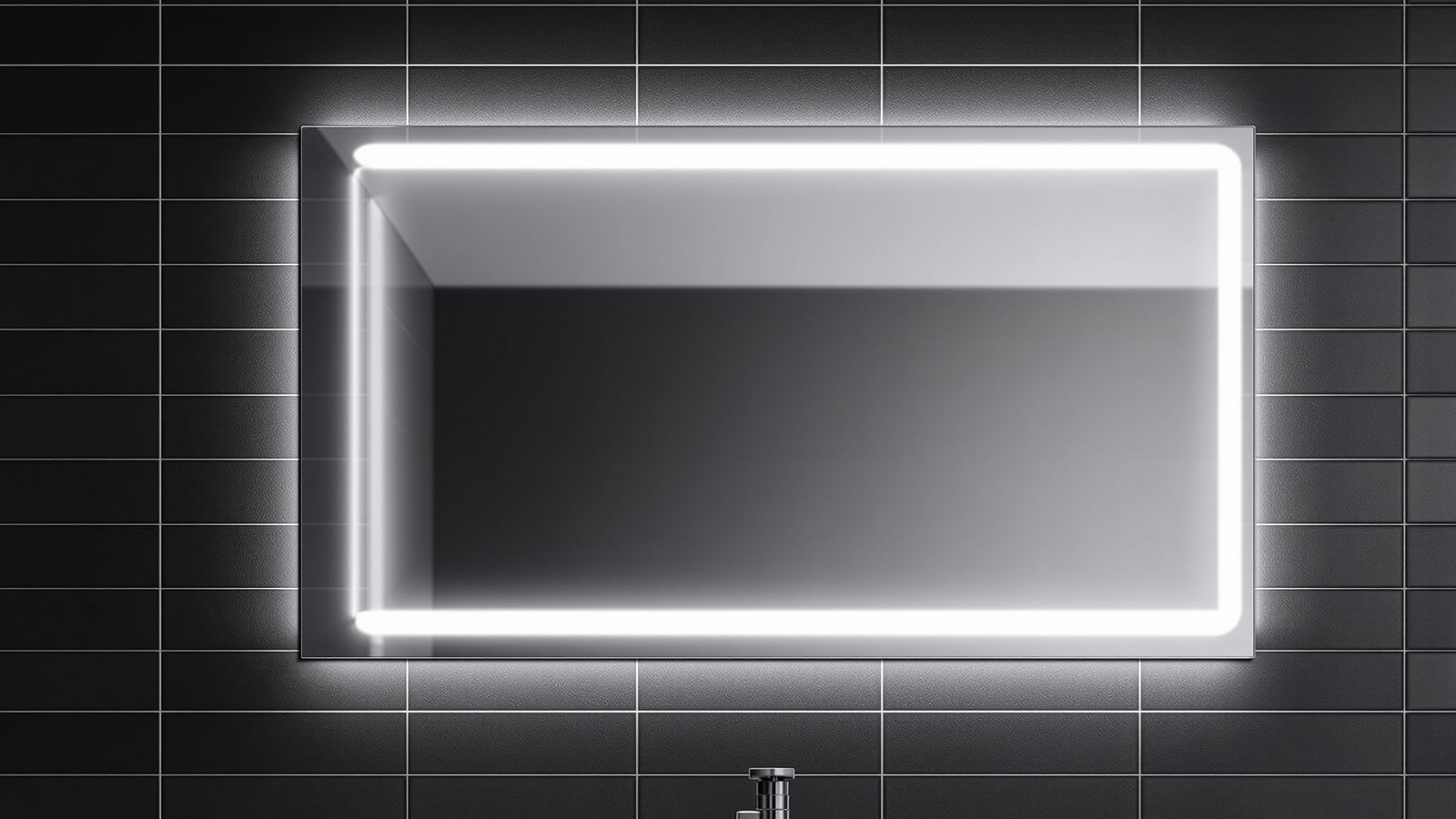
Backlit mirrors hide an LED strip around the back edge of the glass. The light escapes around the perimeter and washes the wall behind, giving the mirror a floating "halo" glow. The effect is soft, ambient and very premium — it is the look most people picture when they think of a designer bathroom. The trade-offs: backlight is gentler than front-light, so it is more mood than task, and it needs a pale, clean wall behind to bounce well. A backlit mirror against a dark stone wall loses much of its glow.
Front-lit mirrors carry the LEDs on the face of the glass, behind sandblasted (frosted) strips or a printed border, so the light shines straight out at you. This is the brighter, more even, more shadow-free option and the honest choice for close-up tasks — shaving, brows, contact lenses, make-up that must survive daylight. The trade-off is that you see the lit strips as bright lines, which reads a touch more clinical and less "spa".
Many mirrors now combine both: front-lit strips for face light plus a thin backlit halo for ambience. That hybrid is often the best answer at a family vanity.
Colour temperature — warm, daylight, or tunable
The colour of the light matters as much as its brightness, and this is where cheap and good mirrors part ways. Colour temperature is measured in kelvin (K): low numbers are warm and yellow, high numbers are cool and blue-white.
| Setting | Kelvin | Feels like | Best for |
|---|---|---|---|
| Warm white | 2700K-3000K | Cosy, flattering, incandescent | Relaxing, evening, softer skin tone |
| Neutral white | 3500K-4000K | Clean, natural, balanced | Everyday grooming; the safe default |
| Cool / daylight | 5000K-6500K | Crisp, bright, midday sun | Make-up matched to daylight, detail tasks |
- A single fixed colour is fine if you pick well: 4000K neutral is the most forgiving all-rounder for an Indian bathroom, clean without being harsh. Avoid a fixed 6500K "cool white" unless it is a dedicated make-up mirror — it can look cold and drain skin tone.
- Tunable white is the feature worth paying for. The mirror lets you slide between warm and daylight (typically 2700K to 6500K) at a touch, so the same glass gives you soft warm light for a relaxed evening and crisp daylight when you need to check make-up that will be seen outdoors. For a shared master bathroom this ends the warm-vs-cool argument for good.
- Look at the CRI, not just the kelvin. Colour Rendering Index describes how truthfully a light shows colour; you want CRI 90 or above at a mirror so skin, hair and make-up look real. A high-kelvin low-CRI panel is exactly the light that makes foundation look wrong outdoors.
For how mirror colour temperature should sit alongside the rest of the room's lighting layers, read bathroom mirror lighting for India — the mirror is the task light, not the only light.
The point behind the glass — what you must rough in
This is the part almost every Indian buyer discovers too late. An LED mirror needs power brought to the wall behind the mirror, and it is far cheaper and cleaner to place before tiling than to chase in afterwards.
| Item | Requirement | Notes for India |
|---|---|---|
| Concealed point | IP-rated flex outlet / junction box behind mirror | Centre it roughly 1200-1400 mm above floor level, behind where the glass will sit |
| Circuit protection | 30 mA RCCB / earth-leakage per IS 732 | Non-negotiable for mains power on a wet wall |
| Driver access | Reach the LED driver without breaking tiles | Behind a maintainable panel, cabinet, or the mirror itself |
| IP rating | IP44 or better for the fitting near the vanity | The vanity splash zone is a wet area under NBC 2016 |
| Switch route | Wiring for wall switch, or none if touch-controlled | Touch/sensor units only need the concealed feed |
- The concealed feed is the single most-missed item. Plan a small IP-rated junction or flex outlet on the wall exactly where the mirror will hang, on a dedicated circuit with 30 mA RCCB / earth-leakage protection per IS 732 and NBC 2016. Mark it on the tiling drawing so the tiler leaves it clean and centred, not off to one side where the cable then shows.
- Leave the driver reachable. Every LED mirror has a low-voltage driver (the small transformer that powers the strips). Drivers are the part most likely to fail in five to eight years. If it is sealed permanently behind glued tiles you will break the wall to replace a ₹800 part — so keep it behind the mirror body, a service flap, or inside the adjacent vanity cabinet.
- Decide the switch early. Many LED mirrors use a touch or infrared sensor switch on the glass — wave or tap to turn on, often to cycle colour and dim. That is elegant and needs no wall switch, only the concealed feed. If you prefer a conventional wall switch (better for elderly users who expect a familiar control), route that wiring now.
Bring all of this to the wall while you plan the wet and dry zones of the bathroom, and the mirror becomes a clean fix-and-connect job rather than a demolition.
The demister — worth it in a humid Indian bathroom
A demister (anti-fog pad) is a thin heating film stuck to the back of the mirror that gently warms the glass so steam does not condense on it. In a hot-shower, monsoon-humid Indian bathroom this is the difference between a usable mirror and wiping it with your hand every morning.
- It draws only a few watts and is usually wired to come on with the mirror light, or on its own switch.
- It genuinely earns its place in a bathroom with a hot shower or geyser and poor ventilation — exactly the Indian norm. If your bathroom has strong exhaust and good cross-ventilation you may not need it.
- A demister is a heating element on a wet wall, so it belongs on the same RCCB-protected, IP-rated feed as the rest of the mirror.
What it costs in India
Prices span a wide range because "LED mirror" covers everything from a basic round front-lit disc to a large tunable, demisting, sensor-controlled panel. Brands such as Jaquar, Hindware, Cera, Kohler and many specialist makers offer options at each tier — treat these as examples, not endorsements.
| Option | Typical ₹ range | Feature level |
|---|---|---|
| Basic front-lit LED mirror (small, fixed colour) | ₹3,000-8,000 | One colour, on/off touch, no defog |
| Mid backlit or front-lit mirror | ₹8,000-18,000 | Dimming, larger sizes, better build |
| Tunable-white mirror with demister | ₹15,000-35,000 | 2700K-6500K, anti-fog, sensor switch |
| Large / hybrid designer mirror | ₹30,000-70,000 | Backlit + front-lit, high CRI, defog |
| Smart mirror (clock, Bluetooth, display) | ₹40,000-1,50,000+ | See the smart mirror guide |
| Add-on: concealed point + RCCB rough-in | ₹1,500-5,000 | Do it at build; cheap now, costly later |
For most Indian homes the sweet spot is a mid tunable-white mirror with a demister and a touch switch, mounted over a properly roughed-in concealed point. That gives you shadow-free face light, warm-to-daylight control and a fog-free surface for a fraction of a full smart mirror — with an easy upgrade path if you later want connectivity.
If you are choosing the mirror's size, shape and placement rather than its lighting, do that in the bathroom mirror guide for India first; then come back here to specify how it lights. And if a touchscreen, clock, defog automation and voice control genuinely appeal, step up to the smart bathroom mirror guide — but plan the same concealed, protected point either way.
References
- NBC 2016 (National Building Code of India), Part 8 — building services and electrical installations, including wet-area zoning around the vanity.
- IS 732 — Code of practice for electrical wiring installations; earthing and 30 mA RCCB / earth-leakage protection in bathrooms.
- IS 3646 — Code of practice for interior illumination; guidance on lighting levels and colour appearance for task areas.
- IS/IEC 60529 — Degrees of protection provided by enclosures (IP rating), for selecting IP44+ fittings near the vanity.
- BIS product certification — check for IS-marked electrical safety and a stated IP rating on any imported LED mirror or driver.
Export this guide
Related Guides — Deep-dive reading
Bathroom Mirror Lighting India: Shadow-Free Vanity Light, Colour Temp, CRI & Cost (2026)
Why a single ceiling downlight throws ugly shadows on your face, how vertical sconces either side of the mirror beat a light bar above, when a backlit mirror is glow not task light, plus the colour temperature, CRI, mounting height, IP rating and 2026 rupee costs that actually get make-up and shaving right.
BathroomsVoice Controlled Bathroom India: Waterproof Smart Speaker, Hands-Free Lights, Shower & Geyser, Privacy & Cost
A practical India-first guide to voice control in the bathroom — a splash-rated smart speaker or voice-enabled mirror that turns lights, music, exhaust fan, geyser and even the shower on and off hands-free — plus the microphone and privacy questions, the humidity and IP durability the device must survive, whether your Wi-Fi even reaches the wet corner of the house, which tasks genuinely benefit, the real accessibility win for elderly and disabled users, and what it all costs.
BathroomsSmart Bathroom Mirror India: Touch Display, Voice, Defogger, Cost & Is It Worth It
A practical India-first guide to smart bathroom mirrors — the embedded touch display showing time, weather and news, the Bluetooth speaker, voice assistant, mood-lighting scenes and defogger — plus the power and optional data point behind the glass, the IP and electrical safety it demands, how hard water and monsoon humidity decide whether it lasts, and whether it is really worth the money over a good LED mirror.
BathroomsRelated Tools — Try Free
Circadian Light Meter
Patient-centric circadian lighting visualizer for Indian healthcare design — time-of-day × intensity → CCT, melanopic lux (EML / mEDI), melatonin suppression, and an alertness curve. Calibrated against WELL v2 L03 Circadian Lighting Design, CIE S 026:2018, Brainard 2001, and Lucas et al. 2014.
Circadian ToolElectrical Safety & Load Audit
Home electrical audit — 10 categories, 65+ checkpoints across earthing, RCCB, MCB, wiring, switchboards, appliance circuits, DG/inverter backup.
Safety AuditCross-Ventilation Analyzer
Estimate airflow and air changes per hour (ACH) from room size, window areas, layout, and local wind — with NBC 2016 Part 8 compliance check.
Ventilation Calculator