
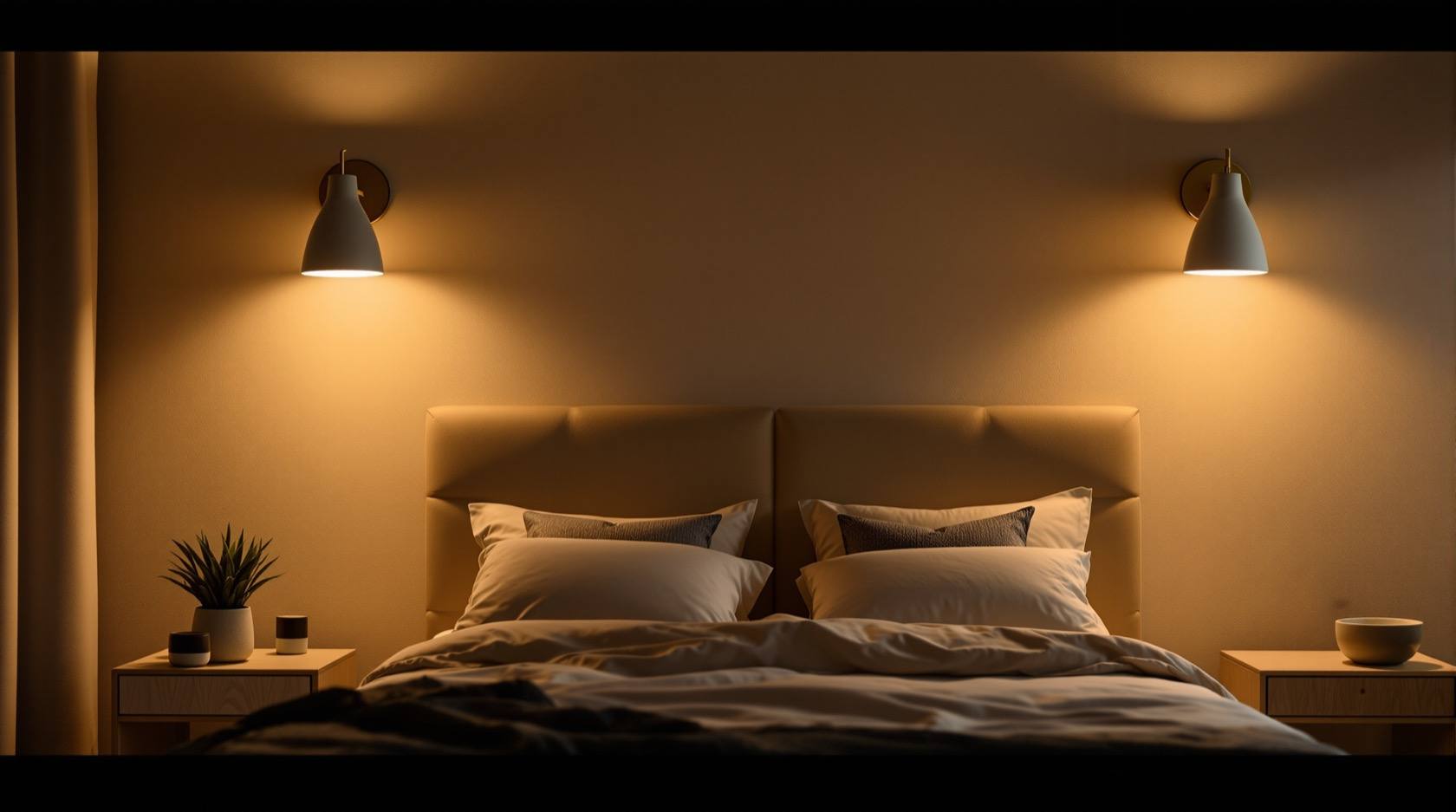
Wall Lights & Sconces: Placement, Height & Style (2026)
The design guide to the mid-height lighting layer for Indian homes — what wall lights and sconces actually do, the types worth knowing, the mounting heights that matter, and how pairs of well-placed sconces add warmth and depth a ceiling never can.
Look up in most Indian homes and you find the whole lighting budget spent on the ceiling — a central fan-light, a ring of recessed downlights, maybe a cove. Then look at the walls: flat, unlit, dead. That vertical surface is more than half of what your eye actually sees when you walk into a room, and a ceiling light barely touches it. Wall lights are the layer that fills that gap. Mounted a little above eye level, a good sconce softens a room, throws light onto the surface the ceiling misses, and does it at the height where warmth is felt rather than glared down from overhead.
This is the design guide to that mid-height layer. It sits in the Lighting hub between the complete guide to lighting pillar and the room-by-room schemes, and it is the natural partner to layered lighting: where the ceiling gives you ambient wash and downlights give task pools, wall lights give you the middle — the decorative, human-scale glow that makes a room feel finished instead of merely lit.
Scope & how to read this. This is a design and specification guide — how to choose wall lights, where to place them and at what height, how pairs read in a room. It is design-led, not a wiring manual. Every wall light needs a power point behind it, and running that point, choosing the circuit, fitting the dimmer and earthing the fixture is safety-critical electrical work for a licensed electrician — never DIY a live wall point. Heights and dimensions here are typical, indicative planning aids; confirm lux levels against IS 3646, luminaire and IP safety against IS 10322 / IEC 60598 and IS/IEC 60529, and get local quotes — cost bands are relative, not firm prices.
What wall lights actually do
A wall light — a "sconce" is simply the classic word for one — is any luminaire fixed to a vertical surface rather than the ceiling. That single change of plane changes everything about how the light behaves and what it is good for.
- It fills the wall the ceiling misses. Ceiling light falls downward and skims the wall at a steep, unflattering angle. A wall light lives on the wall, so it grazes the plaster, reveals texture, and turns a flat surface into something with depth. This is why a room with only ceiling light can feel bright yet somehow empty.
- It brings light down to human height. Table lamps and floor lamps do this too, but a sconce does it without eating a surface or a corner — useful in the tight bedrooms and passages of Indian flats. Light at 1.5 metres feels warmer and calmer than the same lumens dropped from the ceiling.
- It does three jobs at once, depending on type. A sconce can be decorative (a lit object that dresses the wall), task (a swing-arm you read by), or accent (a picture light or a wash that highlights art or a niche). Many do two of these together. See functional vs ambient vs accent lighting for how the three roles combine.
- It adds a layer you can dim independently. Switch the ceiling off, leave two sconces glowing, and a bedroom becomes a different room. That flexibility — more scenes from the same space — is the whole point of layered lighting.
The mistake to avoid is treating a wall light as the main light of a room. With rare exceptions it is not bright enough and not placed for that. It is the finishing layer — the one that adds mood, depth and warmth on top of a working ambient and task scheme.
The types worth knowing
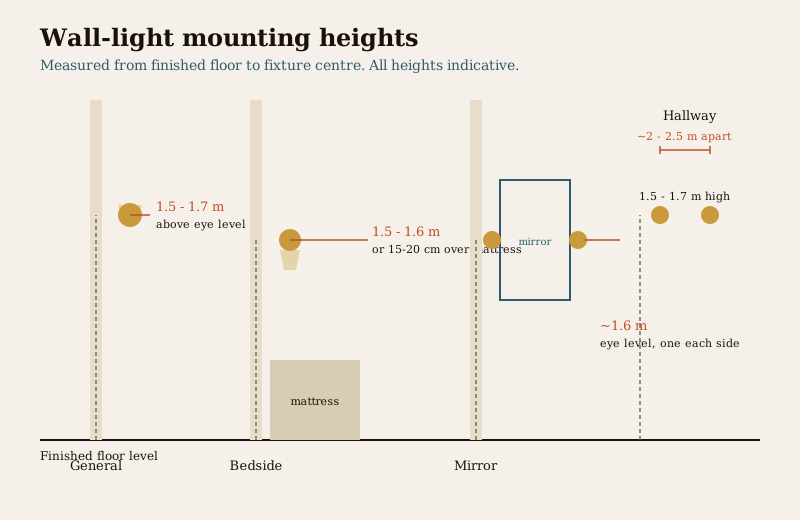
Wall lights are a big family, and the type decides the effect far more than the finish does. Choose by what you want the light to do, then choose the look.
| Type | What it does | Best for |
|---|---|---|
| Up-light | Throws light up the wall to the ceiling; soft, indirect glow | Living-room ambience, making low ceilings feel taller |
| Down-light | Casts a pool of light down the wall to the floor | Passages, marking a path, grazing textured stone |
| Up/down (dual) | Two beams, one up one down; a bright vertical stripe | Feature walls, entrances, a strong architectural line |
| Swing-arm / reading | Adjustable arm delivering a focused task beam | Bedside reading, an armchair reading nook |
| Picture light | Slim fitting arching over a frame to graze art evenly | Paintings, a gallery wall, a framed pooja print |
| Half-moon / wall wash | Frosted shade washing a broad, even patch of wall | General wall glow, softening a large blank surface |
| Decorative wall lamp | A lit object — lantern, sculptural arm — as much ornament as light | Entryways, feature corners, period or ethnic interiors |
| Mirror / vanity side-lights | Pair flanking a mirror at face height for even, shadow-free light | Bathrooms, dressing tables, wardrobes with mirrors |
| Outdoor wall lantern | Weather-sealed fitting for gate, porch, balcony | Entries and facades — must be IP-rated for the location |
A few honest notes. Up-lights are the safest choice for pure ambience because they hide the lamp and bounce everything — no glare. Down-lights are dramatic but need care: a bare down-facing lamp at eye level is a glare bomb, so shield it. Swing-arm sconces are the single best upgrade for a bedside, and mirror side-lights solve the most common grooming-light failure in Indian bathrooms (more on both below). For decorative and statement pieces, decorative lighting goes deeper; for outdoor lanterns and facade fittings, hand off to outdoor and landscape lighting.
The numbers that matter — mounting height
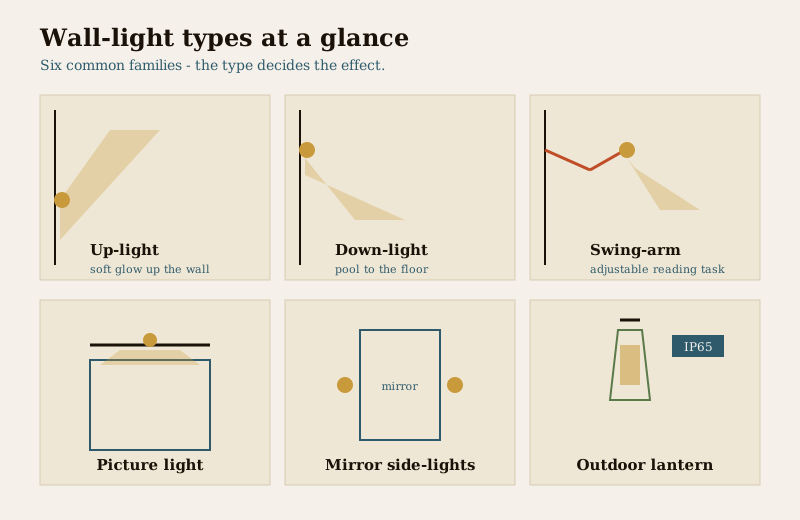
More wall lights are ruined by the wrong height than by the wrong fixture. Too high and they light the ceiling and nobody; too low and they glare into eyes and cast hard shadows. These are the working heights, measured from the finished floor to the centre of the fixture unless noted — all typical and adjustable to your ceiling and the height of the people who live there.
| Location | Typical mounting height | Why |
|---|---|---|
| General living / passage sconce | 1.5 – 1.7 m (a little above eye level) | Above sightline so the lamp is not glary, still low enough to feel warm |
| Bedside wall lamp (flanking a bed) | 1.5 – 1.6 m, or ~15–20 cm above the mattress if reading-focused | Puts light onto the book, keeps the glare cone above the sleeper's eyes |
| Bathroom / dressing mirror sconce | ~1.6 m, at eye level, one either side of the mirror | Lights the face evenly from the sides — no under-eye or overhead shadow |
| Hallway / corridor run | 1.5 – 1.7 m, evenly spaced ~2 – 2.5 m apart | Rhythm of even pools guides the eye and the feet down the passage |
| Stair sconce | 1.5 – 1.7 m above the step nosing it serves | Lights the tread, not the riser above; avoids a dark step |
| Outdoor entry lantern | ~1.6 – 1.8 m beside the door | Lights faces at the door and the lock without glare into arriving eyes |
Two rules cut through all of it. First: keep the bright part above the eye line for anyone standing near it — roughly 1.7 metres — unless the fixture is fully shielded or frosted, so people are not staring into a bare lamp. Second: for a pair flanking something symmetrical — a bed, a mirror, a doorway — match the height and the spacing on both sides exactly; the eye is unforgiving about a sconce that sits even a couple of centimetres off its twin. For task-critical spacing across a run of fixtures, the lighting spacing calculator turns a wall length into even centres, and the fixture quantity calculator tells you how many you need.
Placement — think in pairs
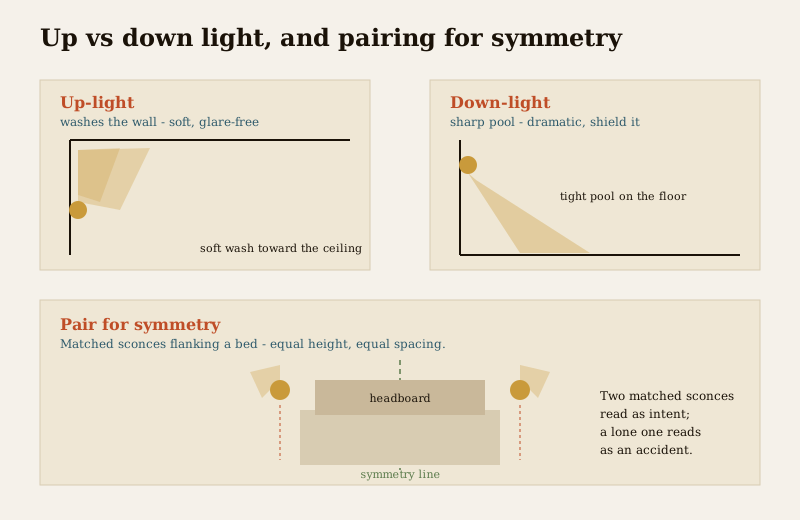
Wall lights almost always look best in pairs. A lone sconce reads as an accident; two matched sconces read as intent, and the symmetry does most of the design work for you. The classic pairings:
| Where | The pairing | The effect |
|---|---|---|
| Bedroom | One sconce either side of the bed, matched to the headboard width | Frees both bedside tables, kills overhead reading glare, balances the wall |
| Bathroom / vanity | One either side of the mirror at face height | Shadow-free face lighting for shaving, make-up, grooming |
| Entry / foyer | A pair flanking the front door or a console + mirror | A welcoming, symmetrical first impression |
| Sofa / living wall | A pair above or beside a sofa or a large artwork | Frames the seating, adds a warm reading-height glow |
| Artwork | A single picture light centred, or a symmetrical pair | Grazes the frame evenly and makes the art the hero |
| Corridor | An evenly spaced run, all identical | Rhythm and wayfinding down a long passage |
The one deliberate exception is the single accent — one picture light over a special painting, one lantern beside a doorway. There, the asymmetry is the statement, and it works precisely because everything around it is calm.
Up vs down — the effect you are actually choosing
The direction a wall light throws its beam is the biggest single design decision, bigger than shape or finish.
- Up-light washes the wall and ceiling. It is soft, indirect and glare-free because the lamp itself is hidden below the light. It makes a room feel calmer and a low ceiling feel taller — the go-to for living-room ambience.
- Down-light pools light on the floor and grazes the lower wall. It is more dramatic and directional, good for marking a path or lighting a textured surface, but the lamp is exposed, so it must be shielded or it glares.
- Up/down does both — a bright vertical band on the wall. It is architectural and bold, ideal for an entrance or a feature wall, but it is a strong effect, not a background one.
Pick up-light when you want mood and softness, down-light when you want drama and direction, up/down when the wall itself is the feature. For the fuller theory of throwing light at surfaces, lighting design principles covers grazing, washing and beam control.
Glare and shielding — the thing that separates good from cheap
A wall light lives at eye level, which makes glare its number-one failure. A bare, bright lamp staring out of a sconce at 1.5 metres is uncomfortable no matter how pretty the fitting is. Control it:
- Shield the source. Frosted glass, a solid shade, a baffle or a design where the lamp faces the wall (not the room) all hide the hot spot. If you can see the bare LED from across the room, it will glare.
- Aim the beam at a surface, not eyes. Up onto the ceiling, down onto the floor, sideways across plaster — light doing a job on a surface is comfortable; light fired straight into the room is not.
- Mind reflective walls. Glossy paint, tiles and mirrors bounce a sconce's hot spot straight back — a real issue in Indian homes with polished granite or high-gloss enamel. Matte and textured finishes absorb and soften instead.
Warm light and dimming
Wall lights are a mood layer, so their colour and dimness matter more than their raw brightness. Two settings do most of the work:
- Warm colour temperature. For living rooms, bedrooms and entries, choose a warm white around 2700–3000 K — the same warmth as the evening light Indian homes are built around. Cool white on a bedroom sconce feels clinical. Bathrooms and dressing mirrors can go slightly cooler (a neutral 3500–4000 K) for accurate grooming, but never harsh blue. The colour temperature and CRI guide explains the kelvin scale and why a high CRI makes skin and fabric look right.
- Dimming. A wall light that dims is worth two that do not — the same sconce can be a bright task light for reading and a low glow for winding down. But dimming needs the right dimmer matched to the LED driver, wired by an electrician; the wrong pairing flickers or buzzes. Decide dimming early so the electrician runs the correct wiring and switch.
Where wall lights truly excel
A few situations where a sconce is not just an option but the right answer:
- Bedside. A pair of swing-arm or fixed sconces frees both bedside tables of lamps, gives each person their own switchable reading light, and removes the overhead glare of a ceiling light in a room you lie down in. In the compact bedrooms of Indian flats — where the bedside table is often barely wider than a phone — this alone justifies wall lights. Pair the idea with the room schemes in design ideas for bedrooms.
- Bathroom vanity. The single most common grooming-light failure is a lone light above the mirror, which throws every feature into downward shadow — dark eye sockets, a shadowed chin. Two sconces beside the mirror at face height light the face evenly from both sides, the way any make-up artist or barber would want. This is worth insisting on when you plan a bathroom.
- Stairs and corridors. A rhythm of evenly spaced sconces lights the treads and walls of a stair or the length of a passage without a glary overhead run, and adds warmth to what are usually the dullest parts of a home.
- Outdoor entry. A weather-sealed wall lantern at the front door lights faces and the lock, welcomes guests, and adds security — but it must carry the right IP rating for an exposed, splashed or wet position (a covered porch is gentler than an open gate wall). Match the fixture to the exposure and hand the full scheme to outdoor and landscape lighting.
- The pooja niche. A small, warm, shielded wash light set into or beside a pooja niche or mandir gives the space a soft, reverent glow far better than a bare bulb — a quietly important detail in many Indian homes.
The electrician hand-off — decide the wall point early
Here is the one thing that trips up more wall-light plans than any other: a wall light needs a power point inside the wall, exactly where the fixture will sit, and that point has to be decided before the wall is wired and plastered.
You cannot easily add a sconce after the plaster is on without ugly surface conduit or chasing a fresh groove into a finished wall. So the sconce positions — height, spacing, which side of the bed, how far from the mirror — are a "decide early" item on the electrical plan, settled at the same moment as switch and socket positions, long before the paint. Walk the site with your electrician and mark every wall-light point on the wall with a pencil cross at the real mounting height, standing where the bed or mirror or sofa will actually go.
And to be clear about the boundary: you design the scheme; the electrician does the electrical work. Running the point, sizing and choosing the circuit, fitting a compatible dimmer, earthing the metal fixture and certifying the installation is licensed, safety-critical work — a live wall point at head height is not a DIY job. The technical side — load, circuits, driver compatibility — lives in the Electrical hub and its home lighting design guide; this guide stops at where the light goes and what it should do.
How it connects
- Start at the complete guide to lighting pillar and see how the wall layer fits the whole scheme in layered lighting and the residential lighting design guide.
- Compare wall lights with the other fixture families: chandeliers for the statement ceiling piece, and track and spotlight lighting for aimable accent light that does a similar highlighting job from above.
- For the decorative and statement end, browse decorative lighting; for the theory of throwing light at surfaces, lighting design principles.
- Hand outdoor lanterns and facade fittings to outdoor and landscape lighting, and defer wiring, circuits and dimmer install to the Electrical hub.
- Size and space the fixtures with the fixture quantity calculator, and picture the mood in design ideas for bedrooms.
Key takeaways
- Wall lights are the mid-height finishing layer — they fill the wall the ceiling misses, add warmth and depth, and give you a dimmable mood scene. They are rarely a room's main light.
- Type decides the effect: up-light for soft ambience, down-light for drama, up/down for a feature wall, swing-arm for reading, picture light for art, side-lights for mirrors, IP-rated lanterns for outdoors.
- Height is where most sconces fail — general ~1.5–1.7 m above the floor, bedside ~1.5–1.6 m, mirror sconces at eye level ~1.6 m either side, hallway runs evenly spaced. Keep the bright part above the standing eye line unless shielded.
- Think in pairs — matched sconces flanking a bed, mirror, door or sofa read as intent and do the design work; keep a single accent only where the asymmetry is deliberate.
- Wall lights excel at the bedside (freeing tiny bedside tables, no overhead glare) and the vanity (shadow-free face lighting from the sides), on stairs and corridors, at the entry, and washing a pooja niche.
- Choose warm 2700–3000 K and make them dimmable; control glare by shielding the source and aiming the beam at a surface, not eyes.
- Decide the wall point early — it must be marked before wiring and plaster — and leave the wiring, circuit, dimmer and earthing to a licensed electrician. All figures here are indicative; confirm against IS codes and get local quotes.
References
- National Building Code of India, NBC (SP 7:2026), Bureau of Indian Standards — general illumination and lighting provisions (named generally).
- IS 3646 — code of practice for interior illumination and recommended lux levels for rooms and tasks (named generally).
- IS 10322 / IEC 60598 — luminaire safety and construction requirements for wall-mounted fittings (named generally).
- IS 16107 — performance requirements for LED luminaires (named generally).
- IS/IEC 60529 — degrees of protection (IP ratings) for luminaires in damp, splashed and outdoor positions (named generally).
- BEE star rating and ECBC lighting power density (LPD) — energy efficiency guidance for residential lighting (named generally).
- Licensed electrician and the Electrical hub — wiring, circuit, dimmer compatibility and earthing of wall points (safety-critical installation).
All mounting heights, spacings, colour-temperature and cost notes here are indicative design and planning aids only; confirm the governing values against IS 3646, NBC (SP 7:2026) and the relevant luminaire and IP-rating standards, get local quotes for cost, and have a licensed electrician design, wire, dim and certify every wall-light point — a live fixture at head height is not a DIY job.
Export this guide
Related Guides — Deep-dive reading
Bathroom Mirror Lighting India: Shadow-Free Vanity Light, Colour Temp, CRI & Cost (2026)
Why a single ceiling downlight throws ugly shadows on your face, how vertical sconces either side of the mirror beat a light bar above, when a backlit mirror is glow not task light, plus the colour temperature, CRI, mounting height, IP rating and 2026 rupee costs that actually get make-up and shaving right.
BathroomsCompound Wall Lighting in India: Wall Lights, Bollards and Solar (2026)
A plain, India-grounded planning guide to lighting your compound wall and gate — entrance and pillar-top lights so guests find the door, wall-wash and grazing to show off texture, path and bollard lights, step lighting, and no-wiring solar fixtures — with warm-vs-cool colour, glare courtesy to neighbours, IP ratings for rain, and honest hand-offs to a licensed electrician and the Security hub.
Compound WallsThe Complete Guide to Home Lighting Design in India (2026)
The start-here master guide to designing light for an Indian home — what good lighting really does, the layered-design mindset that replaces the single ceiling tubelight, the decision sequence from tasks to budget, and where the design work hands off to a licensed electrician.
LightingRelated Tools — Try Free
Circadian Light Meter
Patient-centric circadian lighting visualizer for Indian healthcare design — time-of-day × intensity → CCT, melanopic lux (EML / mEDI), melatonin suppression, and an alertness curve. Calibrated against WELL v2 L03 Circadian Lighting Design, CIE S 026:2018, Brainard 2001, and Lucas et al. 2014.
Circadian ToolBathroom Lighting Calculator
A lux-based bathroom lighting plan — total lumens, number of LED downlights, mirror task lighting and indicative wattage.
Bathroom CalculatorCross-Ventilation Analyzer
Estimate airflow and air changes per hour (ACH) from room size, window areas, layout, and local wind — with NBC 2016 Part 8 compliance check.
Ventilation Calculator