
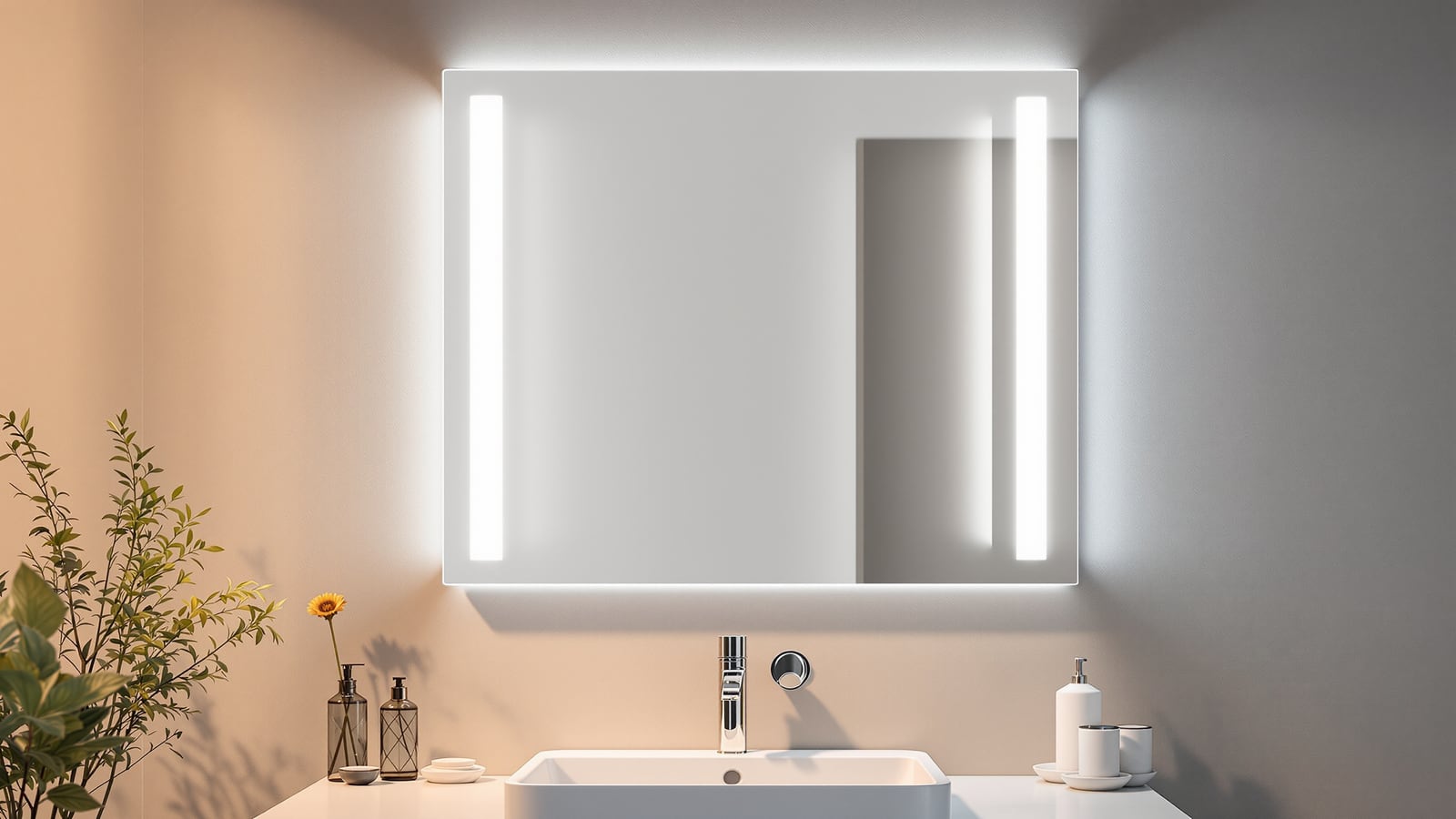
Bathroom Mirror Lighting India: Shadow-Free Vanity Light, Colour Temp, CRI & Cost (2026)
Why a single ceiling downlight throws ugly shadows on your face, how vertical sconces either side of the mirror beat a light bar above, when a backlit mirror is glow not task light, plus the colour temperature, CRI, mounting height, IP rating and 2026 rupee costs that actually get make-up and shaving right.
Ask any bathroom what its single most important lighting job is and the honest answer is not the shower, not the WC, not a mood glow behind the vanity — it is putting even, shadow-free light on your face at the mirror. This is where you shave, apply make-up, check skin, floss and read a thermometer. Every other light in the room is optional; this one is the room's whole reason for having a mirror. And it is the light Indian bathrooms get wrong most often, because the default is a single ceiling downlight — the one fitting almost guaranteed to fail the job.
This guide sits under the bathroom lighting guide for India, which plans the whole room in layers; here we go deep on just the mirror. It pairs with our guides to the LED bathroom mirror for India and the broader bathroom mirror guide for India, and it assumes Indian realities: humid monsoon air on the glass, hard-water film, load-shedding, and an electrician who will happily drop one downlight over the basin and call it done.
Light the face, not the mirror. A mirror can only reflect what falls on you — so the fixtures must aim light at the person standing there, from the sides and at eye level, never straight down from the ceiling.
Why a single overhead downlight casts bad shadows
A ceiling downlight sits directly above your head. Its light travels almost vertically downward, so it lands on the top of your head, the tip of your nose and your brow — and leaves everything beneath a projection in shadow. The result is the "raccoon look": dark hollows under the eyes, a shadow under the nose and chin, and unlit jaw and neck. You cannot shave a shadowed jaw evenly or blend make-up you cannot see.
The physics is simple. Faces are full of horizontal ledges — brow, nose, upper lip, chin — and light from directly above turns each into a shadow-caster. The fix is to bring the light source down to roughly eye level and out to the sides, so it fills those hollows instead of deepening them. That is exactly what a stage make-up mirror, a theatre dressing room and a good barber's chair all do, and it is what a bathroom mirror should copy.
- Overhead only — steep top-down light, deep under-feature shadows, poor for any face task.
- Sides at eye level — light rakes across the face horizontally, fills hollows, near shadow-free.
- A bar above the mirror — a compromise: better than a downlight, still slightly top-lit.
The three ways to light a mirror
1. Vertical sconces either side — the gold standard
Two vertical fixtures, one on each side of the mirror at eye level, throw light across the face from left and right. Because the two beams come from opposite sides they cancel each other's shadows, giving the flattest, most even, most true-to-life light of any option. This is the technique professional make-up artists insist on, and it is the single best thing you can do for a vanity.
- Mount them at eye level, centred around 1,600–1,700 mm from finished floor.
- Space them 900–1,100 mm apart (wider than the face, framing the mirror).
- Choose fixtures with a frosted/opal diffuser so the source is a soft line, not a glare point.
2. A horizontal light bar above the mirror
A single linear fixture spanning the top of the mirror is the common builder upgrade. It is a genuine improvement on a ceiling downlight because it sits close to the wall and washes down the face rather than the scalp — but it still lights from above, so it leaves faint under-eye and under-chin shadows. Make it as wide as the mirror (ideally the full width), keep it low and use a diffused source. It is the right answer when side sconces are impossible — for example a mirror that runs wall-to-wall.
3. A backlit mirror — glow, not task light
The LED-backlit mirror (a perimeter or edge glow behind the glass) is beautiful and increasingly standard. But understand what it is: the light points at the wall behind, then wraps softly around the mirror's edge. That is a lovely ambient halo and it prevents the mirror looking like a black hole — but it puts very little light on your face. Treat a backlit mirror as ambient/decorative, and add real task light (side sconces, or a front-lit LED mirror with light emitting through the front face) for shaving and make-up.
Colour temperature and CRI — where skin tone is won or lost
Two numbers decide whether the mirror shows your real skin, or a version of it you will regret when you step outside.
Colour temperature (Kelvin) is how warm or cool the white looks. CRI (Colour Rendering Index) is how faithfully the light shows colours compared to daylight, on a 0–100 scale.
- 2700K–3000K (warm white): flattering and relaxing, but it pushes skin ruddy and hides how much blush or foundation you have applied — make-up done here often looks overdone in daylight.
- 3500K–4000K (neutral / soft white): the sweet spot for a vanity. Close enough to daylight to judge make-up and skin honestly, still comfortable for the eye. This is the recommended vanity target for most Indian homes.
- 5000K+ (cool / daylight): clinical and unflattering; fine for a pure utility mirror, harsh for a home.
- CRI 90 or higher (Ra90+): essential at the mirror. Cheap CRI-70/80 LEDs mangle reds and skin tones; foundation that looks matched under CRI-80 can look grey or orange outdoors.
Best of all is a tunable / dimmable mirror light: neutral 4000K at CRI 90+ for the make-up and shaving task, dialled down to a warm dim glow for a late-night trip to the loo.
| Setting | Kelvin | Best for | Watch-out |
|---|---|---|---|
| Warm white | 2700–3000K | Ambient, relaxing evening light | Hides real make-up density; skin reads ruddy |
| Neutral / soft white | 3500–4000K | Vanity task — make-up, shaving, skin | The all-rounder; pick this if choosing one |
| Cool / daylight | 5000–6500K | Utility grooming, detailed tasks | Clinical, unflattering for a home bathroom |
| CRI | Ra90+ target | True skin & colour rendering | Below Ra80 skin tones are unreliable |
Height, spacing, brightness and IP — the install numbers
Getting the geometry right matters as much as the fixture. A vanity mirror is in Zone 2 of a bathroom under IS 732 electrical practice — the region around the basin that gets splashes but not direct spray — so fittings there should be rated IP44 minimum (protected against splashing water). Anything at real risk of a jet from a health faucet should climb to IP45. All wiring must land on an earthed, RCD-protected circuit.
| Parameter | Recommendation | Notes |
|---|---|---|
| Side sconce mount height | 1,600–1,700 mm to centre | Roughly eye level for adults |
| Side sconce spacing | 900–1,100 mm apart | Wider than the face, framing the mirror |
| Light bar above mirror | 75–100 mm above mirror top | Full mirror width if possible |
| Brightness at vanity | 300–400 lux on the face | Roughly 700–900 lm of task light total |
| Colour temperature | 3500–4000K | Neutral; tunable is ideal |
| CRI | Ra90+ | Non-negotiable for skin tone |
| IP rating (Zone 2) | IP44 minimum | Splash-protected; IP45 if jet-exposed |
| Diffuser | Frosted / opal | Kills glare and hot-spots |
Cost in 2026 rupees
Prices are indicative all-India for the fixture only; add wiring, an electrician and any wall chasing.
| Option | Typical 2026 cost (₹) | Notes |
|---|---|---|
| Pair of basic LED vanity sconces | 1,500–4,000 | Entry level; check CRI and IP |
| Quality IP44 tunable side sconces (pair) | 5,000–12,000 | CRI90+, dimmable — best value for the job |
| LED light bar above mirror | 2,000–6,000 | Full-width, diffused |
| Front-lit LED mirror (light through face) | 8,000–20,000 | True task light built in; demister a plus |
| Backlit / edge-glow LED mirror | 6,000–18,000 | Ambient glow — add task light separately |
| Anti-fog demister pad add-on | 1,500–4,000 | Worth it for monsoon humidity |
For most Indian homes the smartest spend is a pair of IP44, CRI90+, 4000K dimmable side sconces — or a good front-lit LED mirror — rather than pouring the budget into a backlit mirror that looks stunning but leaves your face in the dark. Plan this alongside the room's wider layers in the bathroom lighting guide for India, and coordinate the mirror itself using the LED bathroom mirror and bathroom mirror guides. If you are wiring from scratch, our bathroom planning for new homes guide shows where to drop the conduits before the tiling goes on.
References
- National Building Code of India (NBC) 2016, Part 8 (Building Services) — lighting and electrical installations for residential wet areas.
- IS 732 — Code of Practice for Electrical Wiring Installations; bathroom zones, earthing and RCD protection.
- IS/IEC 60529 — Degrees of protection provided by enclosures (the IP rating system) used for Zone 2 IP44 fittings.
- BIS / IS on luminaires (IS 10322 series) — general and specific requirements for LED luminaires and safety.
- Bureau of Energy Efficiency (BEE) — star-rating guidance for LED lighting and energy performance.
Export this guide
Related Guides — Deep-dive reading
LED Bathroom Mirror India: Backlit vs Front-Lit, Colour Temperature, Cost & The Point Behind the Glass
A practical India-first guide to LED and backlit bathroom mirrors — integrated shadow-free face lighting, 2700K-6500K colour temperature and tunable white, halo backlight versus sandblasted front strips, plus the concealed electrical point, IP rating, demister and driver access you must plan behind the mirror before you tile.
BathroomsBathroom Lighting India: The Complete Guide to Layers, Lux, Colour Temperature & IP Safety Zones (2026)
How to light an Indian bathroom properly — the three layers of ambient, task and accent light, the right lux levels and a neutral ~4000K colour temperature for grooming, the IP safety zones near water that decide which fitting goes where, waterproof fixtures, dimming and scenes, mirror lighting done right, motion sensors and energy.
BathroomsColour Temperature & CRI: Choosing the Right White for Every Room
The two numbers that decide how light feels and how true colours look — colour temperature in kelvin (warm to cool) and the colour rendering index (CRI). What warm, neutral and cool light suit, why CRI matters for skin, food and fabric, and the room-by-room choices for an Indian home.
Electrical & WiringRelated Tools — Try Free
Circadian Light Meter
Patient-centric circadian lighting visualizer for Indian healthcare design — time-of-day × intensity → CCT, melanopic lux (EML / mEDI), melatonin suppression, and an alertness curve. Calibrated against WELL v2 L03 Circadian Lighting Design, CIE S 026:2018, Brainard 2001, and Lucas et al. 2014.
Circadian ToolElectrical Safety & Load Audit
Home electrical audit — 10 categories, 65+ checkpoints across earthing, RCCB, MCB, wiring, switchboards, appliance circuits, DG/inverter backup.
Safety AuditBathroom Mirror Size Calculator
Recommended mirror width, height and mount height above the vanity, plus vanity-light sizing — by basin width and mirror type.
Bathroom Planner