
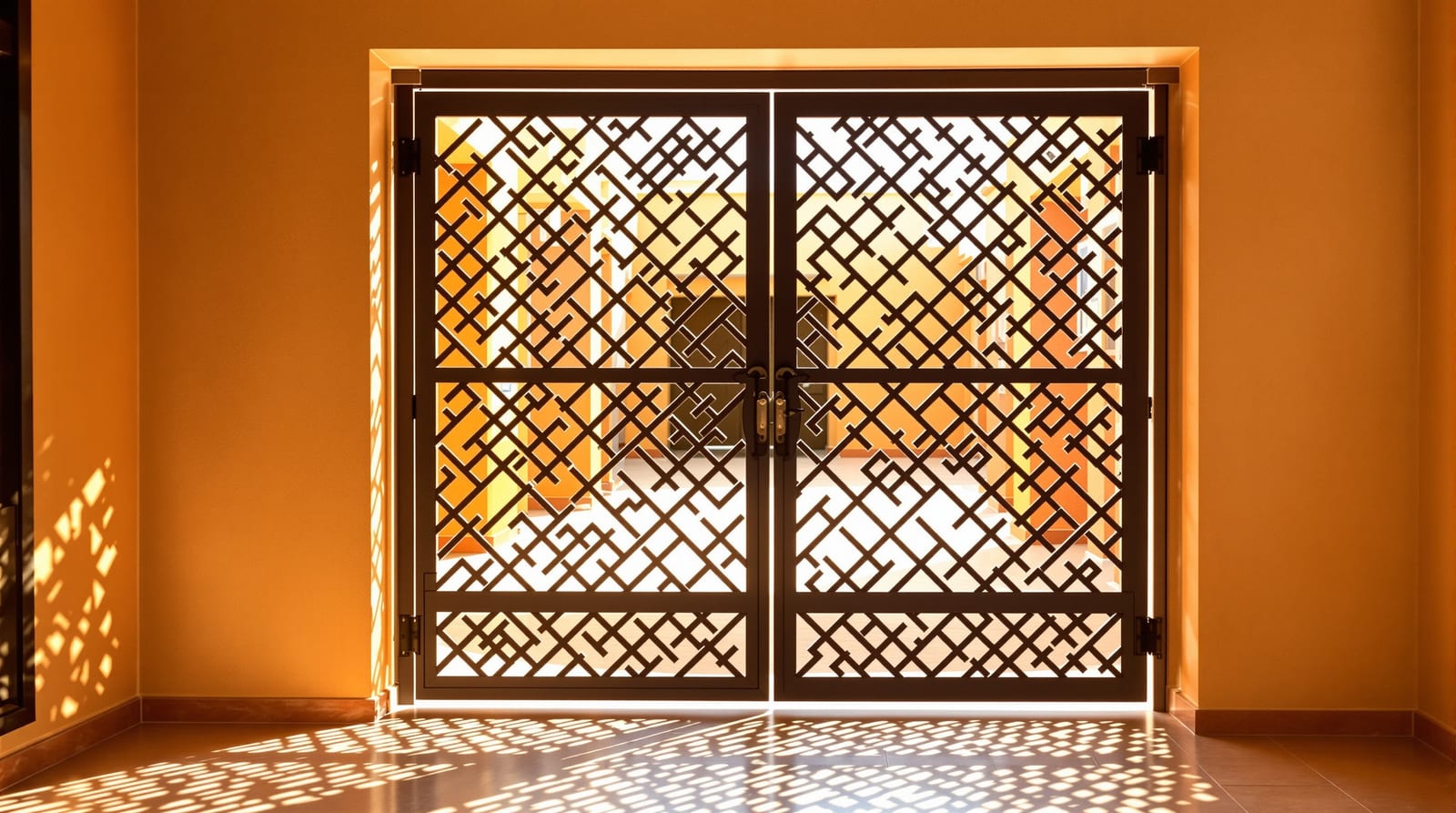
Collapsible Gate Doors in India: Channel Gates, Cost & Security (2026)
How folding iron and steel lattice gates work for Indian entrances, balconies, parking and shop-cum-houses — security, cost per sq ft, floor-track issues and maintenance.
Few doors are as quietly Indian as the collapsible gate. That concertina of criss-crossing iron channels — the one that screeches open every morning across a shop-cum-house, a stilt-parking bay, or an apartment lobby — is a second skin of security layered behind the real door. It costs a fraction of a steel security door, breathes in our heat, and folds away to almost nothing. But it is also the door most often fitted badly: a sagging floor track, a rusted channel, or a finger-pinching lattice within reach of a toddler. This guide explains how collapsible gates actually work, what they cost per square foot in 2026, and where they beat — and lose to — a safety grill door or a rolling shutter. For the wider picture, start with the complete home doors guide and the door-type comparison hub.
What a collapsible gate is — and how it folds
A collapsible gate is a security barrier built from a lattice of pivoting metal members that expand and contract like a concertina. Two designs dominate Indian homes:
- Channel (folding) gate — flat MS or SS channels (typically 19-25 mm wide) riveted in an X-cross or pantograph pattern. When you push it shut, the channels scissor outward to span the opening; when you fold it, they nest together into a slim stack at one side. This is the classic "shop gate" look.
- Pantograph / accordion gate — a finer diamond lattice of round or square rods, often used for lighter balcony and lift-lobby duty. Lighter to slide, slightly less brute-force resistant.
The whole assembly rides on a bottom floor track (a channel set into or onto the floor) and is guided by a top track screwed to the lintel. Rollers or sliding shoes at the base let it glide; a vertical end-pillar (the leading stile) carries the lock. Because the lattice itself does the spanning, a collapsible gate needs no fixed frame across the opening — that is its whole advantage over a grill door.
Single vs double (bi-parting)
For openings up to ~1200-1500 mm (a standard main door or a single balcony), a single gate folding to one side is normal. For wider openings — a double-door entrance, a 2.4-3.0 m parking bay, or a shopfront — a double / bi-parting gate folds from both sides to the centre and locks where the two leading stiles meet. Double gates fold into a smaller stack at each end but cost more in channel and have two pivot points to maintain.
Materials: MS, stainless steel and aluminium
| Material | Look & feel | Strength | Rust behaviour | Indicative cost (gate, ex-fitting) | Best for |
|---|---|---|---|---|---|
| MS (mild steel) channel, painted | Industrial, heavy | Highest | Rusts if paint chips; needs repaint every 2-4 yrs | ₹150-450 / sq ft | Parking, shop, ground-floor entrance |
| Galvanised / powder-coated MS | Cleaner finish | High | Far better; powder coat lasts 5-8 yrs | ₹250-500 / sq ft | Coastal/humid towns, exposed bays |
| Stainless steel (SS 304) | Bright, modern | Medium-high | Near rust-free; only tea-staining inland | ₹450-900 / sq ft | Balconies, lift lobbies, premium entrances |
| Aluminium section | Light, no rust | Lowest | Does not rust; can pit near sea | ₹450-800 / sq ft | High-floor balconies, low-threat decorative use |
Costs are indicative and vary by city, vendor, channel gauge and finish; add ~18% GST and fitting. The trade-off is blunt: MS is the cheapest and strongest but fights rust forever; SS and aluminium pay a premium to stop corroding. In coastal Mumbai, Chennai, Kochi or Goa, an unprotected MS gate on an open balcony can bleed rust within a monsoon. There, SS 304 or galvanised-then-powder-coated MS earns its cost — the same logic as choosing a climate-appropriate door material.
Manual vs motorised (automatic)
Most home collapsible gates are manual — you slide and bolt them by hand. Motorised collapsible gates use a chain or rack drive with a remote, useful for:
- Wide parking bays where you want to open from the car.
- Shop-cum-houses opening a heavy bi-parting shopfront daily.
- Elderly or mobility-limited users.
Motorisation adds roughly ₹25,000-60,000+ over the gate, plus a power point and a manual-release for power cuts. For a single residential entrance it is rarely worth it — the gate is light enough to hand-slide, and a motor is one more thing to service. Where you genuinely want hands-free closing, a rolling shutter is often the better automated choice.
How secure is it, really?
A collapsible gate's job is deterrence and delay, not an impregnable wall. Security depends on three things: channel gauge (thicker = harder to spread), the lock, and how well the top and bottom tracks are anchored. The classic attack is spreading — levering two channels apart to slip a hand or body through — so closely-spaced, heavy channels and a good multi-point or padlock-and-hasp arrangement matter more than the lattice pattern.
| Collapsible gate | Safety grill door | Rolling shutter | |
|---|---|---|---|
| Security level | Medium-high (deterrent + delay) | High (rigid welded frame) | High (full barrier, no see-through) |
| Airflow / ventilation | Excellent (open lattice) | Excellent (open grill) | None when closed |
| Visibility out | Good | Good | None |
| Space when open | Folds to a slim stack at one side | Swings on hinges (needs swing clearance) | Coils overhead (zero floor footprint) |
| Floor track needed | Yes (trip/clean issue) | No | No (overhead box) |
| Typical cost | ₹150-900 / sq ft | ₹150-450 / sq ft (MS) | ₹350-1,200 / sq ft |
| Best for | Entrances, balconies, parking, shops | Behind main door, windows | Shopfronts, garages |
In short: a safety grill door is more rigid and resists spreading better, but it swings and needs hinge clearance — read the dedicated safety grill doors guide to compare. A rolling shutter is the strongest full barrier but kills airflow and visibility. A collapsible gate is the airflow-and-space champion: it lets the breeze and your sightline through, then folds to nearly nothing. For the layered approach most Indian homes use — a solid main door plus a security layer — see door security strategy.
The mechanism (inline diagram)
The floor-track problem (and how to avoid it)
The single biggest complaint about collapsible gates is the bottom track. A surface-mounted channel becomes a trip hazard and a dirt trap — leaves, grit and water collect in the groove, the rollers jam, and the gate starts to drag and screech. Three fixes:
1. Recess the track flush into the floor screed at construction stage so the groove sits level with the finished floor — sweep-friendly and trip-safe.
2. Specify a self-draining or weep-holed track for balconies and parking where water enters.
3. For a clean threshold (or accessibility), consider a top-hung collapsible gate where the weight hangs from the lintel track and the bottom only guides — though this costs more and is less common in homes.
A flush, drainable track is also kinder to the ≤12 mm threshold accessibility target. If you are still planning the opening, our door size standards guide covers the clear widths to leave.
Rust and maintenance
A collapsible gate is mostly metal in motion, so it needs a little discipline:
- Lubricate the rollers, pivots and lock with a light machine oil or silicone spray every 3-6 months — this stops the screech and the jam.
- Sweep the bottom track weekly; flush it after dust storms or monsoon.
- Touch up paint on MS gates the moment you see a chip — rust spreads from a pinhole. Wire-brush, red-oxide prime, then enamel. Budget a full repaint every 2-4 years inland, sooner near the coast.
- SS gates need only a wipe; do not let iron tools or steel wool leave embedded particles that "rust-stain" the surface.
Choosing galvanised or powder-coated MS up front roughly doubles the repaint interval and is almost always worth the small premium in humid or coastal India.
Safety caveat: the pinch risk for children
The folding lattice creates dozens of moving scissor points. A toddler's finger caught between two closing channels can be badly pinched or worse. If you have small children:
- Treat the gate as a two-handed adult operation and never let a child slide it.
- Prefer a finer pantograph pattern with smaller gaps over a wide-channel gate within reach.
- For a child-gate at the top of stairs or a kitchen, a collapsible gate is the wrong tool — use a purpose-made safety gate.
This pinch geometry is the main reason many families fit a safety grill door (which swings as one rigid leaf, no scissor points) at the main entrance and reserve collapsible gates for balconies and parking.
Where collapsible gates fit best in an Indian home
- Main entrance (ground floor / independent house): as the airy outer security layer behind a solid main door, letting you keep the wooden door open for breeze while staying locked.
- Balcony / terrace: a light SS or aluminium gate keeps the balcony or terrace door area secure and child-deterred without blocking the view.
- Stilt / open parking: an MS bi-parting gate across the bay — cheap, strong, foldable.
- Shop-cum-house: the workhorse use — a heavy double channel gate, often paired with a rolling shutter for the night.
Vastu tradition favours the main door as the largest and most auspicious opening (best N/NE/E) and prefers it to open inward; a see-through collapsible outer gate does not block that energy the way a solid shutter might — see Vastu for the main door. Frame this as belief plus the practical bonus of light and air.
For a like-for-like material and cost comparison against every other door type, the door materials hub and the master door cost benchmark are the next stops; you can also size a quote with the door cost calculator.
Frequently asked questions
Is a collapsible gate as secure as a steel security door?
No — a solid pressed-steel door is a full barrier, while a collapsible gate is a see-through deterrent that buys time. Its value is layering: a thief faces the gate's lock and spread-resistance before reaching your main door, while you keep airflow and a sightline. For high-threat ground-floor entrances, pair it with a strong lock and a solid inner door, or step up to a grill door or steel door.
What does a collapsible gate cost in 2026?
Indicatively, painted MS runs about ₹150-450 / sq ft, powder-coated/galvanised MS ₹250-500, and stainless steel or aluminium ₹450-900 / sq ft — gate only, before fitting, the lock set and ~18% GST. A standard ~3.5 ft × 7 ft entrance gate therefore lands roughly ₹4,000-12,000 in MS and ₹12,000-22,000 in SS. Prices vary by city, channel gauge and finish.
MS, stainless steel or aluminium — which should I pick?
Pick MS (galvanised/powder-coated) for the strongest, cheapest gate at parking and ground entrances; pick SS 304 or aluminium for balconies, high floors and coastal homes where rust is the real enemy. Inland with a tight budget, well-maintained painted MS is fine — just commit to repainting.
Can the floor track be made flush so it does not trip people?
Yes. Ask the fabricator to recess the bottom channel into the floor screed at construction stage so its groove sits level with the finished floor, ideally with weep holes to drain water. A flush track is trip-safe, sweep-friendly and closer to the accessibility threshold limit than a surface-mounted one.
Are collapsible gates safe with small children?
The folding lattice has many scissor points that can pinch fingers, so keep it a two-handed adult operation, choose a finer pantograph pattern within a child's reach, and never use it as a stair or kitchen child-gate. Many families fit a rigid swinging grill door at the entrance and reserve collapsible gates for balconies and parking.
Export this guide
Related Guides — Deep-dive reading
The Complete Home Door Guide for Indian Homes (2026): Types, Materials, Cost, Security & Vastu
Everything an Indian homeowner needs to specify the right door for every opening — from main entrance to bathroom — with real 2026 prices, IS/NBC standards and Vastu sense.
Home Doors & EntrancesSafety Grill Doors in India: MS & SS Security Gates, Types, Designs and Cost (2026)
The secondary security door behind your main door — grill door types, materials, designs, sizes, ₹/sq ft cost and rust-proof maintenance for Indian homes.
Home Doors & EntrancesGate Materials in India: MS, Wrought Iron, Steel, Aluminium and Wood (2026)
A plain, India-grounded guide to choosing what your compound gate is made of — mild steel, wrought iron, stainless steel, aluminium and wood or WPC compared on cost band, strength and security, weight, corrosion resistance, look and maintenance, so you pick the material that fits your budget, your coast and your fabricator.
Compound WallsRelated Tools — Try Free
Cross-Ventilation Analyzer
Estimate airflow and air changes per hour (ACH) from room size, window areas, layout, and local wind — with NBC 2016 Part 8 compliance check.
Ventilation CalculatorGrill Door Cost Calculator
Estimate a safety grill door or collapsible gate cost by size, material, design and mesh add-on, with GST and fitting.
Door CalculatorDoor Cost Calculator
Estimate the all-in cost of a door — leaf, frame, hardware, fitting and GST — by type, material and size.
Door Calculator