
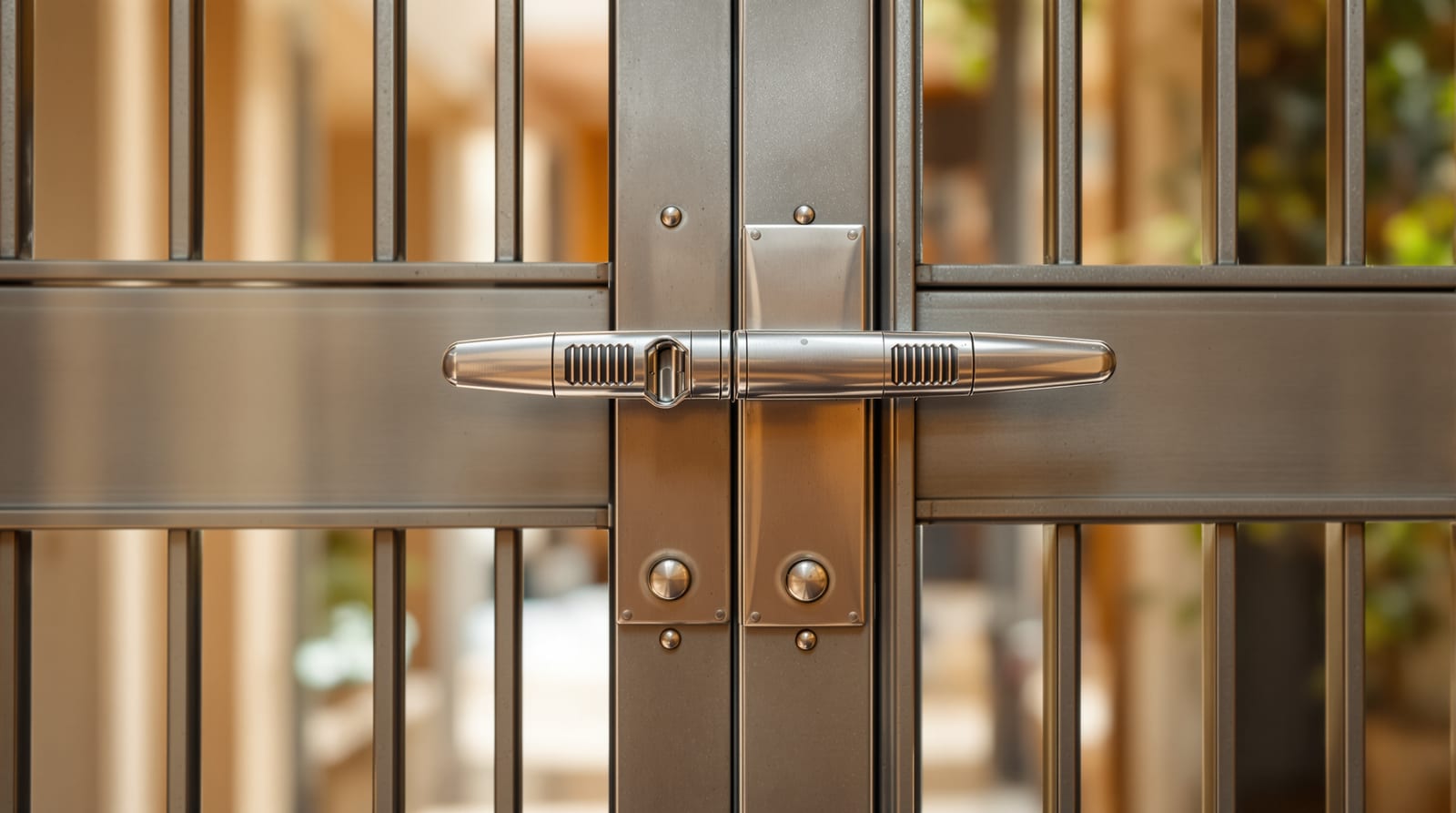
Burglar-Proof Doors in India: What Actually Stops a Break-In (2026)
A burglar-resistant main door is a system — solid leaf, anchored frame, multipoint lock, anti-saw bolts and visibility — not just an expensive lock. Here is how each layer works and what it costs to upgrade.
There is no such thing as a "burglar-proof" product you can buy off a shelf and bolt on. Security is a chain, and a burglar attacks the weakest link, not the strongest. You can fit a ₹20,000 lock and still lose everything because the intruder simply kicked the thin frame off the wall, levered out a hollow leaf, or unscrewed the hinges from outside. A genuinely burglar-resistant main door is a system: a solid leaf, a frame anchored into masonry, a quality lock, anti-saw and hinge bolts, a deep strike plate, and the visibility to make a thief think twice. Get the system right and an opportunist burglar moves on to an easier house — which, statistically, is the whole game.
This guide goes layer by layer through what actually makes a door hard to break, where most Indian doors fail, and what each upgrade costs. It complements the broader door security overview and the standards-led residential door standards; here we focus narrowly on resisting a forced entry at the main door. To score your own door against these layers, the door security rating tool turns this into a checklist.
How burglars actually get through a door
Forced residential entry is fast, crude and opportunistic. Burglars rarely "pick" locks like in films; that is slow and skilled. Instead they attack the cheapest point of failure with brute force or simple tools:
- Kicking or shouldering a door so the frame splits or the latch tears through a shallow strike plate — the single most common method.
- Levering a crowbar or screwdriver between leaf and frame to spring a single deadbolt or snap a thin leaf.
- Sawing or snapping an exposed bolt or a cheap cylinder (cylinder snapping is the classic attack on euro-profile locks).
- Unscrewing or punching out hinges when the hinge knuckles and screws are accessible from outside.
- Cutting through a hollow leaf — a thin plywood flush door can be breached with a hand tool in under a minute.
Every layer below exists to defeat one of these. The honest framing: you are not building a bank vault, you are buying time and noise. Most break-ins are abandoned if entry takes more than a few minutes or makes a racket.
Layer 1 — the leaf: solid beats everything
The single biggest weakness in Indian homes is a hollow-core flush door used as a main door. It is light, cheap, and a determined intruder can punch or cut straight through the skin. A burglar-resistant leaf must be solid:
- Solid hardwood (teak, sal): heavy, dense, and very hard to cut or kick through. The traditional gold standard — see teak wood doors and solid vs hollow core doors.
- Steel security door: a steel-skinned leaf over a reinforced internal frame, often with built-in multipoint locking. The most cost-effective high-security option at ₹8,000-25,000 — covered in depth in steel doors.
- Solid-core engineered / WPC: denser than hollow flush, but still not in the same league as steel or hardwood for impact resistance.
If your existing main door is a hollow flush door, no lock upgrade fully compensates. Either replace the leaf or, as an interim, fit a safety grill door as a second outer barrier — two doors to defeat instead of one.
Layer 2 — the frame: anchored into masonry
A famous failure mode: an expensive solid door with a great lock, hung on a flimsy frame nailed loosely to the wall. One hard kick and the whole frame leaves the masonry. The lock never gets a chance. A secure frame needs:
- A strong frame material — seasoned hardwood (IS 4021) or a steel frame (IS 4351) — properly sized, not a slim cosmetic chowkhat.
- Deep anchoring into the masonry / RCC, with proper holdfasts or expansion bolts at multiple points each side, set in cement — not a few wall plugs into plaster.
- A snug, even reveal between leaf and frame so a crowbar has nowhere to bite. Big gaps invite levering.
When a new door is being installed, this is the moment to get the frame right — there is no retrofitting a badly anchored frame without re-doing it. Our door installation guide and door frame cost cover anchoring detail and budgets.
Layer 3 — the lock: multipoint or quality deadbolt
The lock is what most people obsess over, but it only performs if Layers 1 and 2 hold. The hierarchy:
- Single mortise deadbolt — fine for a strong leaf and frame, but it secures only one point; the door can flex around it.
- Multipoint locking — one key throw drives bolts into the frame at three or more points (top, middle, bottom), spreading the load and defeating levering. This is the biggest single upgrade for a main door; see multipoint locking doors.
- Anti-snap, anti-drill, anti-bump cylinder — if the lock uses a euro cylinder, insist on a tested anti-snap cylinder; cylinder snapping is a known fast attack.
Add a separate night latch / rim lock as a second independent locking mechanism, so an intruder has two different locks to defeat, not one. A solid mortise lock + handle set runs ₹600-6,000 (Godrej, Yale, Dorset, Europa); a multipoint mechanism adds meaningfully on top.
Layer 4 — bolts, hinges and the strike plate
These small, cheap components are where most doors quietly fail — and where the best value upgrades hide.
- Reinforced/deep strike plate: the metal plate the bolt shoots into. Stock plates are thin and held by two short screws into the frame face — they tear out on a kick. A heavy strike plate fixed with long (65-75 mm) screws driven into the masonry behind the frame is one of the cheapest, most effective upgrades you can make.
- Hinge bolts (dog bolts): fixed steel studs on the hinge edge of the leaf that engage holes in the frame when shut, so the door stays anchored on the hinge side even if the hinges are attacked or removed.
- Non-removable / security hinges: for outward-opening doors especially, hinges with set screws or interlocking knuckles so the pin cannot be punched out from outside.
- Heavy tower bolts / flush bolts top and bottom (IS 7196) for an inactive leaf on a double door — secure the double door passive leaf or it becomes the weak point.
- Anti-saw bolts: rotating hardened inserts inside the deadbolt so a hacksaw blade spins instead of cutting.
Layer 5 — visibility and deterrence
The cheapest layer is making the burglar choose someone else's door. A wide-angle door viewer / peephole (₹80-600, see door viewers and peepholes) or a video door phone (₹4,000-25,000) lets you vet callers without opening — defeating the pretext entry that bypasses every bolt. Good lighting over the entrance, a visible camera or VDP, and a door that obviously looks reinforced all push an opportunist along. Deterrence is not a substitute for hardware, but combined with it, it is what makes the rest unnecessary.
A reinforced main door, layer by layer
The diagram below shows where each defence sits on a typical inward-opening main door.
Weak point, vulnerability and upgrade — with ₹
Use this as your audit. Indicative costs; add 18% GST and fitting labour, and treat as a range that varies by city, brand and vendor.
| Door element | How a burglar exploits it | The upgrade | Indicative ₹ |
|---|---|---|---|
| Hollow-core flush leaf | Punched or cut through in under a minute | Replace with steel or solid-hardwood leaf | Steel door ₹8,000-25,000; teak leaf ₹10,000-1,50,000+ |
| Slim, loosely fixed frame | Whole frame kicked out of the wall | Hardwood (IS 4021) or steel (IS 4351) frame, anchored into masonry | Frame + anchoring ₹3,000-15,000+ |
| Single deadbolt only | Leaf flexes / levered around one point | Multipoint locking mechanism (3+ bolts) | Mortise lock set ₹600-6,000 + multipoint mechanism premium |
| Cheap euro cylinder | Snapped or drilled in seconds | Tested anti-snap, anti-drill cylinder | ₹800-3,500 |
| Thin stock strike plate | Tears out of frame on a kick | Heavy strike plate, long screws into masonry | ₹150-1,200 (the best-value upgrade) |
| Exposed / removable hinges | Pins punched out, leaf lifted off | Security hinges + hinge bolts (dog bolts) | ₹150-1,500 per set |
| Exposed bolt to a hacksaw | Bolt sawn through | Anti-saw rotating bolt inserts | Built into better mortise locks |
| Inactive leaf of a double door | Passive leaf forced open | Heavy flush/tower bolts top and bottom (IS 7196) | ₹80-500 each |
| No way to vet callers | Pretext entry — talked through the door | Wide-angle viewer or video door phone | Viewer ₹80-600; VDP ₹4,000-25,000 |
| No deterrence | Door looks soft, poorly lit | Entrance lighting + visible VDP/camera | Lighting ₹500-3,000 |
Where to spend first (a sensible order)
You do not have to do everything at once. For most Indian homes, in priority order:
1. Fix the strike plate and hinges — a few hundred rupees, and it defeats the most common kick-in attack. Do this first.
2. Add a quality lock / multipoint mechanism with an anti-snap cylinder.
3. Add a viewer or VDP so you never open to a stranger.
4. If the leaf is hollow, plan to replace it with steel or solid hardwood — or fit an outer grill door as an interim second barrier.
5. Get the frame and anchoring right whenever the door is next replaced, because it cannot be retrofitted cleanly.
For a deeper, component-by-component treatment, see door reinforcement. To pressure-test your own door against every layer above, run it through the door security rating tool.
Frequently asked questions
What is the single most cost-effective upgrade to make a door burglar-proof?
A heavy reinforced strike plate fixed with long screws driven into the masonry behind the frame, plus security hinges or hinge bolts. Together they cost a few hundred to a couple of thousand rupees and defeat the most common attack — kicking the door so the latch tears through a shallow strike plate. No expensive lock helps if the strike plate pulls out.
Is a steel door really more burglar-resistant than a solid teak door?
Both are strong; they fail differently. A steel security door resists cutting and impact and usually comes with built-in multipoint locking, at a lower price (₹8,000-25,000) than a comparable solid teak leaf. Solid teak is extremely hard to cut through and ages beautifully but costs far more. For pure value security, steel wins; for a heritage look on a strong frame, teak with the right lock is excellent. See steel doors and teak wood doors.
Will a multipoint lock alone make my door secure?
No. A multipoint lock is one of the best upgrades because it bolts the leaf to the frame at several points, but it only performs if the leaf is solid, the frame is anchored into masonry, and the strike points are reinforced. A great lock on a hollow door or a flimsy frame is defeated by cutting through the leaf or kicking the frame out of the wall. Security is the whole chain — see multipoint locking doors.
Should I add a grill door in front of my main door?
For many Indian homes, yes — a steel safety-grill door gives you a second independent barrier, lets you keep the main door open for ventilation while staying secure, and roughly doubles the time and noise a burglar needs. It is one of the most practical retrofits, especially if your existing leaf is hollow. See safety grill doors.
How do I check whether my current door is secure?
Audit it layer by layer: is the leaf solid (knock — a hollow ring means weak), is the frame firmly anchored, does the lock bolt into a deep strike plate with long screws, are the hinges non-removable from outside, and can you see who is at the door before opening? The door security rating tool and the door security overview walk you through scoring each of these.
Export this guide
Related Guides — Deep-dive reading
Anti-Theft Door Guide India: Affordable Ways to Burglar-Proof Your Entry (2026)
A practical, layered checklist of low-cost upgrades — deadbolts, strike-plate reinforcement, hinge bolts, viewers, grill doors and smart alerts — to make any Indian home door far harder to force.
Home Doors & EntrancesReinforced Wooden Doors in India (2026): Making the Timber Main Door Actually Secure
A homeowner's decision guide to choosing or upgrading the wooden main or flat door most Indian homes actually have, so it genuinely resists a break-in, without pretending a hollow flush door is secure.
SecurityDoor Frame Security in India (2026): Anchoring the Chowkhat Break-Ins Actually Exploit
A homeowner's guide to the real weak point behind most forced entries: the frame, not the leaf or the lock, and how to anchor, pack and reinforce a chowkhat so a strong door genuinely stays in the wall.
SecurityRelated Tools — Try Free
Door Security Rating Calculator
Score your main door out of 100 across leaf, frame, lock and hardware — and see the top upgrades.
Security ToolDoor Cost Calculator
Estimate the all-in cost of a door — leaf, frame, hardware, fitting and GST — by type, material and size.
Door CalculatorDoor Material Comparison Tool
Compare 2–4 door materials on cost, durability, maintenance, security and moisture resistance.
Comparison Tool