
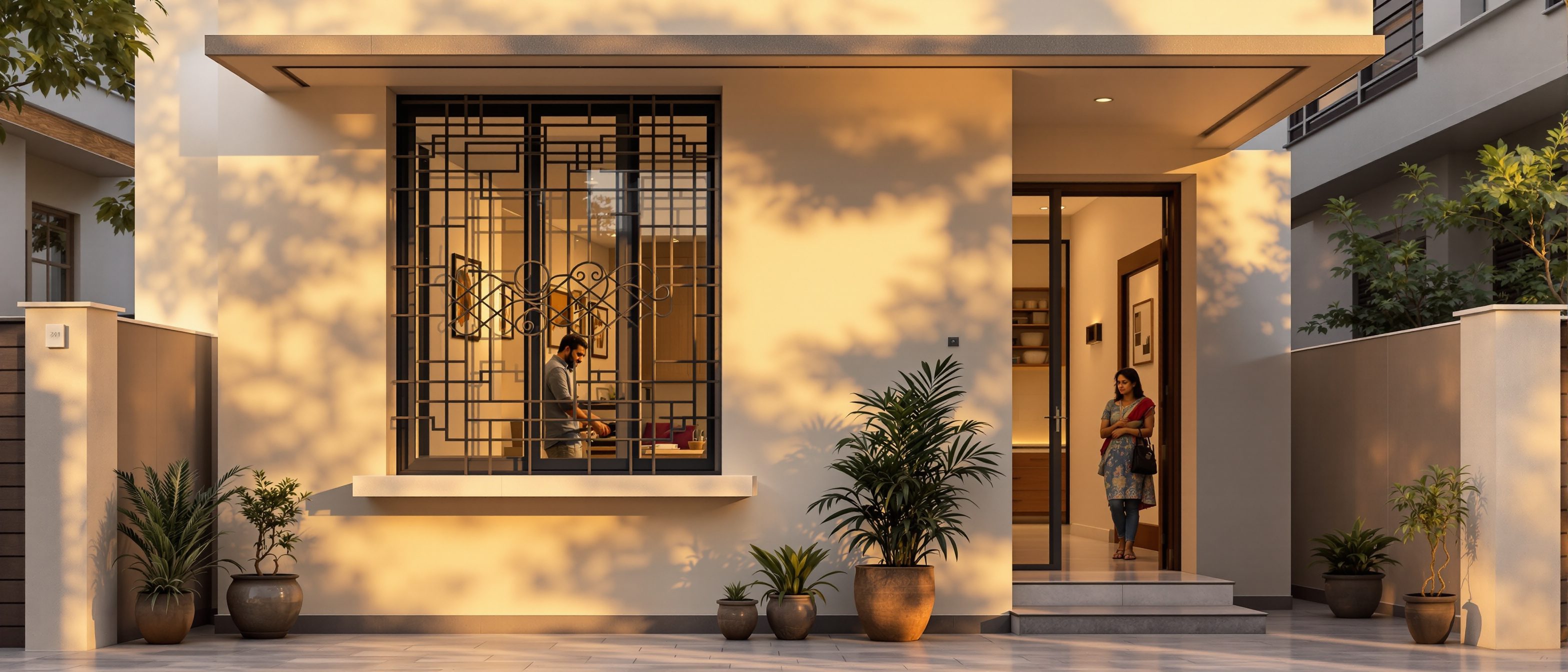
Window Security Guide
The layered-defence model for Indian homes — frame, glass, locks, grille and sensors working together
Windows, not doors, are where most home break-ins begin. A glazed opening is the softest point in the wall: it can be levered, lifted, smashed or simply found unlatched. Yet the honest truth runs the other way too — no window is burglar-proof. A determined intruder with time and tools will get through anything. Good security does not aim for impossibility; it aims for delay, deterrence and detection. Make a window slow and noisy to attack, obviously hard from the street, and wired to raise an alert, and most opportunists move on to an easier house.
This pillar lays out the whole system. The six spokes below each go deep on one layer; here we show how the layers stack, which windows are weakest, and how to decide what your home actually needs.
Security is a chain of small delays, not a single magic product. The grille, the glass, the lock and the alarm each buy seconds — together they buy the minutes an intruder will not spend.
The layered-defence model
Think of a window as five defensive layers, working outside-in. Each layer does a different job, and removing any one weakens the rest.
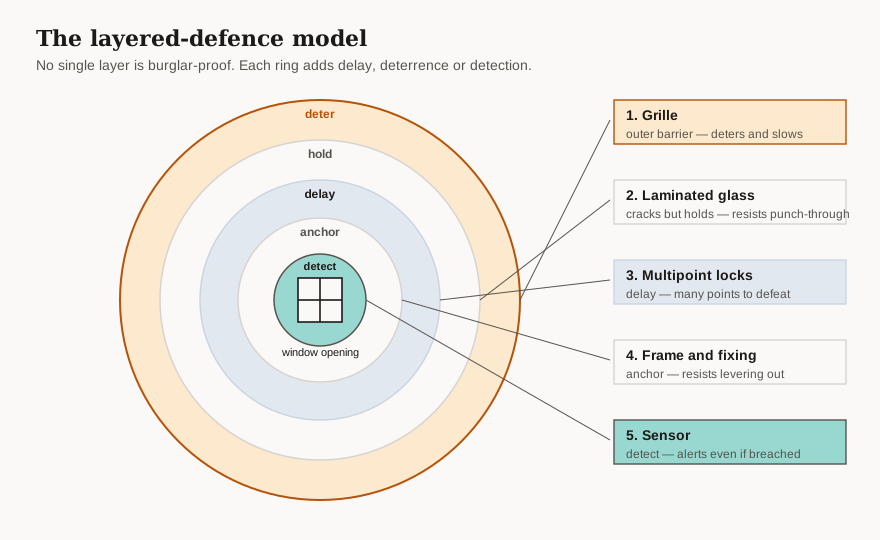
- Frame and fixing — a strong frame (aluminium, uPVC or seasoned hardwood) properly anchored to the masonry. A great lock on a flimsy or badly fixed frame is theatre; pry the whole frame and the lock is irrelevant.
- Glass — laminated security glass holds together when struck, denying the quick "smash and reach" entry. Toughened glass is for human safety, not security (it crumbles away cleanly).
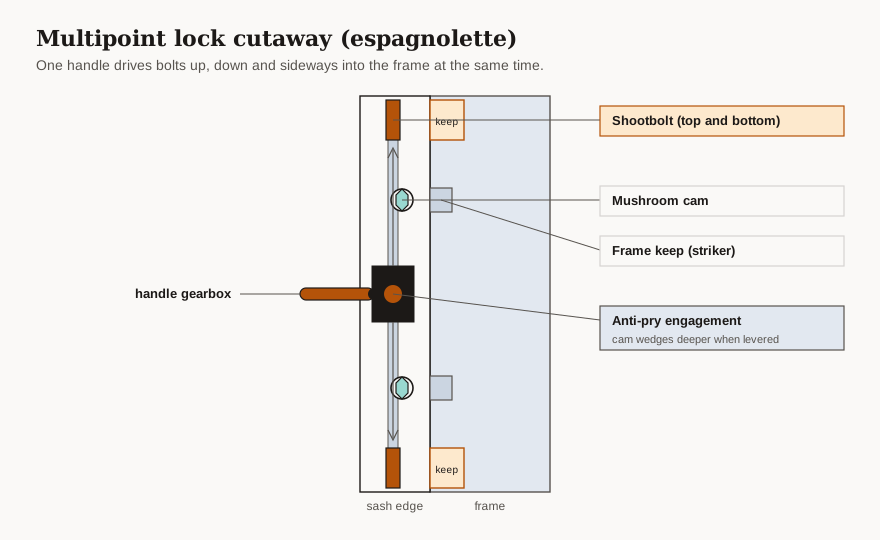
- Locks and hardware — multipoint locking, anti-pry cams and lockable handles turn the opening into the slowest part of the wall.
- Grille / shutter — the visible deterrent and the physical barrier most Indian homes already rely on. Grilles are one layer of the system, not the whole of it.
- Sensors and habits — open-close sensors, glass-break detectors and the simple discipline of locking up convert a silent break-in into a loud, monitored one.
The grille is so central to the Indian home that it has its own dedicated guide — see Window Grills Design Guide for patterns, materials and the all-important fire-egress rule. That guide is about designing the grille; this guide is about how the grille fits the larger layered system. A beautiful grille on an unlatched sliding window is still a weak window.
Risk by window type
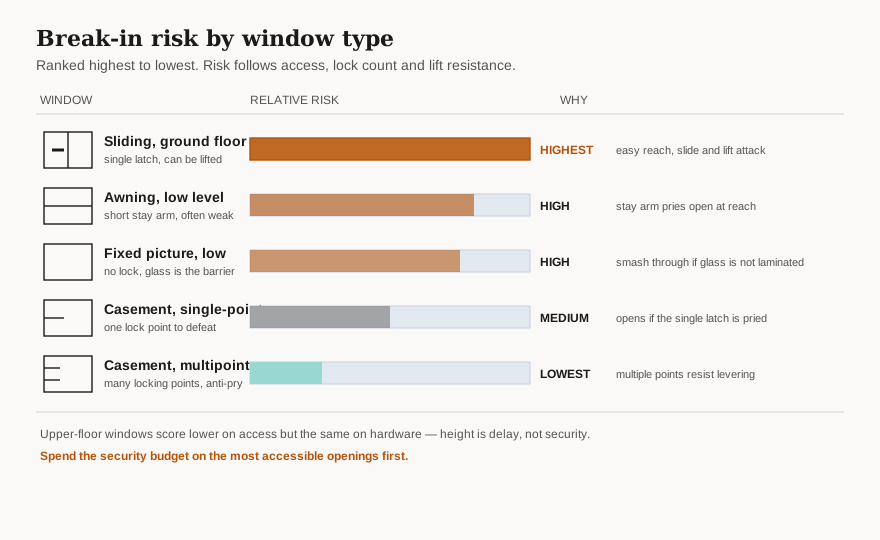
Not all windows carry the same risk. The most vulnerable combination in Indian homes is the ground-floor sliding window — it can be lifted off its track and its single thin latch is easily shimmed. The safest is an inward or outward casement window with multipoint locking, which bolts into the frame at several points.
| Window type | Risk level | Why | First fix |
|---|---|---|---|
| Sliding (ground floor) | Highest | Lift-out off track, thin latch shimmed | Anti-lift blocks plus auxiliary sliding lock |
| Awning / top-hung (low) | High | Single stay, leverage point | Lockable stay, restrictor |
| Fixed picture (low level) | High | Smash-and-reach if not laminated | Laminated glass plus grille |
| Casement, single point | Medium | Pry at the unlocked edge | Upgrade to multipoint, hinge-side bolts |
| Casement, multipoint | Lowest | Bolts at several points, anti-pry cams | Add sensor and laminated glass |
Height matters as much as type. Ground and first-floor windows, and any window reachable from a parapet, drainpipe, boundary wall or car porch roof, are the real targets. Spend your budget there first; a second-floor bathroom window rarely justifies an RC-rated frame.
For the full taxonomy of casement, sliding, awning and other window styles, see Types of Home Windows in India.
How strong is "strong enough"?
European standard EN 1627 rates whole windows for forced-entry resistance from RC1 to RC6. For Indian homes the useful band is small:
| Class | Resists | Time | Where it fits |
|---|---|---|---|
| RC1 | Bodily force, opportunist | Seconds | Token only — avoid relying on it |
| RC2 | Simple hand tools (screwdriver, pliers) | ~3 min | Residential baseline; pair with at least P4A laminated glass |
| RC3 | Crowbar and second tool | ~5 min | High-value or exposed ground-floor openings |
| RC4 to RC6 | Power tools | 10 min plus | Vaults, commercial — overkill for homes |
The glass class is rated separately under EN 356 (P4A to P8B for laminated security glass). A genuine RC2 window pairs the frame, the multipoint hardware and the glass — fitting RC2 hardware behind ordinary float glass defeats the rating. The full engineering of these ratings, and how to specify them with Indian fabricators, lives in Burglar-Resistant Windows. The matching lock and hardware deep-dive — espagnolette multipoint, sash jammers, anti-lift blocks, restrictors — is in Window Locks and Hardware.
The locks do the most work
Most "security upgrades" worth the money are hardware, not heroics. A short ladder of priorities, cheapest first:
- Lock everything you have. An unlatched window beats any tool. Half of opportunist entries are simply through openings left open.
- Add anti-lift blocks and an auxiliary lock to every sliding window — the single highest-value fix in an Indian home.
- Upgrade single-point casements to multipoint with mushroom cams that grip when levered.
- Fit key-locking or lockable handles on accessible windows so the glass cannot be broken and the handle simply turned.
Glass: safety first, security second
Two jobs get confused. Safety glass stops people being injured by breaking glass; security glass slows an intruder. Laminated glass does both because its PVB interlayer keeps the pane bonded when struck. Toughened glass is a safety glass only — it shatters into blunt crumbs and offers no break-in resistance.
Indian code makes safety glass mandatory in defined risky locations under IS 2553 (Part 1):2018, and the ISI mark is compulsory under the Safety Glass Quality Control Order.
| Location | Safety glass required |
|---|---|
| Glazed doors and their side panels | Yes |
| Low-level windows (sill below 600 mm) | Yes |
| Within 900 mm of stairs and landings | Yes |
| Shower and bath enclosures | Yes |
| Balustrades below 1.5 m | Yes |
| Overhead glazing and skylights | Yes — must be laminated |
The where-required-by-code human-safety story is covered fully in Safety Glass for Homes. For a child-fall-safety angle — restrictors limiting opening to 100 mm or less, guard-bar spacing 100 mm or less, locks out of reach and cordless blinds to remove strangulation risk — see Child-Safe Window Design.
Detection and storms
Two more layers complete the picture. Open-close sensors, glass-break detectors and shock sensors turn a break-in into an alert — the detection layer covered in Smart Security Windows. And on India's cyclone coasts, IS 875 (Part 3) wind loads (coastal basic wind speed around 50 to 55 m/s) and flying-debris impact demand laminated glass in reinforced, well-anchored frames — see Storm-Resistant Windows.
A room-by-room decision framework
Walk the house and rate each window by access (can a person reach it?) and value (what is on the other side?). High access plus high value gets the full stack.
| Room | Typical risk | Sensible layered spec |
|---|---|---|
| Ground-floor living / bedroom | High | Grille plus laminated glass plus multipoint plus sensor |
| Kitchen / utility (rear, hidden) | High | Grille plus auxiliary lock; sensor if isolated |
| Children's room | Medium | Restrictor 100 mm, cordless blinds, low-level safety glass |
| Bathrooms (ground) | Medium | Obscured laminated glass plus lockable stay |
| Upper-floor, exposed by porch roof | High | Treat as ground floor |
| Upper-floor, unreachable | Low | Standard lock plus habit of closing |
One rule overrides every grille and lock: each room must keep at least one window or grille that opens from the inside for fire escape. Security must never trap the family it protects.
Do and avoid
| Do | Avoid |
|---|---|
| Fix frames into masonry, not plaster | Relying on a single thin sliding latch |
| Pair RC-rated hardware with laminated glass | Toughened glass for break-in resistance |
| Keep one fire-egress opening per room | Welding every grille shut |
| Layer deterrence, delay and detection | Trusting one "unbreakable" product |
| Light and trim around accessible windows | Leaving ladders, bins, drainpipes as climbing aids |
Start with the cheapest, highest-impact moves — lock what you have, secure every sliding window, light the approaches — then add laminated glass, multipoint locks and sensors where access and value are both high. That is the whole of window security: not one fortress wall, but several honest seconds of delay, stacked.
References
- Bureau of Indian Standards — IS 2553 (Part 1):2018, Safety Glass: https://www.bis.gov.in
- Bureau of Indian Standards — IS 875 (Part 3), Wind Loads: https://www.bis.gov.in
- National Building Code of India 2016 (BIS): https://www.bis.gov.in
- EN 1627 burglar-resistance classes (overview): https://en.wikipedia.org/wiki/EN_1627
Export this guide
Related Guides — Deep-dive reading
Door and Window Security Assessment for Indian Homes
Go opening by opening and rate the hardware itself — leaf and frame, hinges and locks, strike plates, grilles, glazing and latches — so you can grade each door and window's real resistance while never trapping anyone behind it.
SecurityThe Complete Guide to Door and Window Security in India (2026)
The pillar reference for every opening in your home — how to think about doors, windows and glazing as a system, why the weakest opening decides your safety, and where each part of the library takes the detail further.
SecurityChild-Safe Window Design in India
Fall prevention, cordless blinds and safe glass for homes with young children
Windows & GlazingRelated Tools — Try Free
Full-Room BOQ — Living, Bedroom, Kitchen, Bath
Room-wise BOQ across living, bedrooms, kitchen, utility, and bathrooms with line-item pricing.
Full-Room BOQWindow Cost Calculator
Estimate window price plus installation by type, frame material, size, glass and quantity.
Window CalculatorWindow Grill Design Selector
Pick a window grille style and material by priority — security, looks, budget, view — and estimate cost.
Window Tool