
Louis Kahn
The master of brick, concrete and light who made buildings feel eternal
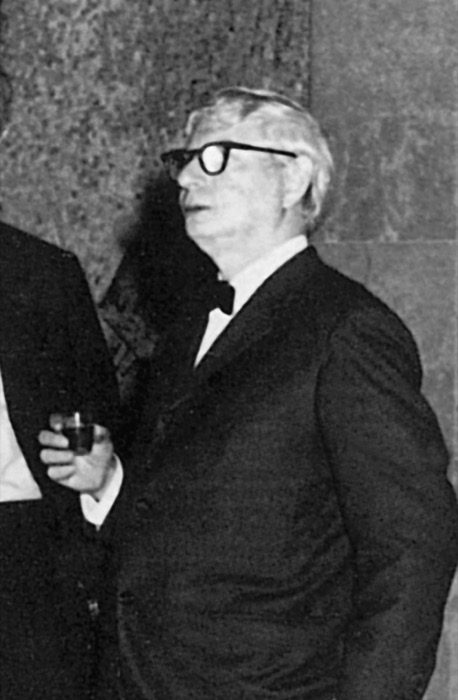
Photo: Gerhard Richter, CC BY-SA 3.0, via Wikimedia Commons
Movements
Signature works
- Salk Institute, La Jolla
- Kimbell Art Museum, Fort Worth
- Indian Institute of Management Ahmedabad
- National Assembly Building, Dhaka
- Phillips Exeter Academy Library
Stand in the central court of the Salk Institute at La Jolla, with your back to the laboratories, and the building does something almost no other building does: it gets out of the way. A single channel of water runs down the spine of a vast travertine plaza, dead straight, toward a horizon where the stone simply ends and the Pacific begins. There is no garden, no ornament, no soft edge — only proportion, light, and silence. Louis Kahn called this space, famously, a facade to the sky. To walk it is to understand that a building can be made to feel like a question put to the universe and left, deliberately, unanswered.
Louis Isadore Kahn (1901–1974) was an Estonian-born American architect who, more than any figure of the late twentieth century, returned modern architecture to weight, permanence and something close to the sacred. He came late to greatness — almost everything for which he is revered was built after he turned fifty — and he died with two of his largest works rising on the soil of South Asia.
Kahn's contribution was to insist that a building is not a service to be optimised but a presence to be made — that brick, concrete, light and shadow carry meaning, and that the architect's first job is to listen: to the material, to the nature of a room, to what a thing "wants to be." He turned plumbing into poetry, hierarchy into clarity, and daylight into the true structure of a space. (For a close reading of how this shaped his building skins — the brick arch, fair-faced concrete and the "wrapping ruins" shading screen — see our Louis Kahn facade signature guide.)
The idea
Most of modern architecture before Kahn had been arguing about efficiency: lighter structures, thinner walls, more glass, less mass, the building dissolving into a machine for living. Kahn quietly turned the argument around. He asked not how little a building could be, but what a building, fundamentally, is.
His answer rested on a small number of convictions that he repeated, in his elliptical and almost mystical way, for the last twenty years of his life. The first was the distinction between what he called served and servant spaces. In an ordinary building, ducts, pipes, stairs and shafts are buried inside walls and ceilings, hidden so the "real" rooms can be pure. Kahn refused the deception. He pulled the servant elements — the machinery that serves human use — out into their own honest forms: the brick stair-and-exhaust towers of the Richards Medical Laboratories, the great hollow columns of Dhaka. The served room is then free to be itself, and the building reads its own logic on its face.
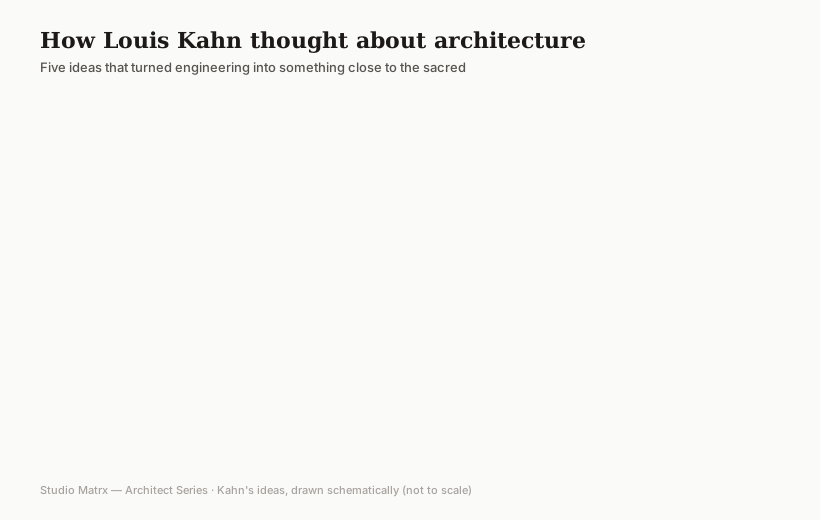
The second conviction was that no room is truly a room without natural light. For Kahn, light was not a finish applied at the end but the very thing that makes structure visible and a space alive; the way a slot of daylight crosses a concrete vault tells you the hour, the season, the orientation. He went so far as to say that the sun never knew how great it was until it struck the side of a building — a line that captures how, for him, light only becomes meaningful when matter is there to receive it. The third was the truth of construction — the joint, the seam, the tie-hole left by the concrete formwork are not flaws to be plastered over but the building's honest account of how it was made. And underneath all of it ran a longing for monumentality: not bigness for its own sake, but the sense that a building has always existed and always will, that it belongs to silence as much as to use.
These ideas were not a style he could switch on. They came wrapped in a private, almost biblical vocabulary that baffled some listeners and electrified others. Kahn would speak of the "form" of an institution — the unchanging, essential nature of a school or a library or a house, prior to any particular "design" — and insist that the architect's first duty was to discover that form before drawing a single wall. A school, he liked to say, began with a man under a tree who did not know he was a teacher, talking with others who did not know they were students. Find that origin, he taught, and the building almost designs itself.
Life and path
Kahn was born in 1901 on the island of Saaremaa, off the Baltic coast of what was then the Russian Empire (today Estonia). As a small boy he carried scars on his face from a childhood burn — he had been transfixed by the light of coals. Around 1906 the family emigrated to the United States and settled in Philadelphia, the city that would be his home and base for the rest of his life. He was poor, gifted at drawing and music, and made his way through the public schools and then the University of Pennsylvania, where he trained in the rigorous Beaux-Arts tradition under the French-born architect Paul Cret, graduating with a degree in architecture in 1924.
Then came a long, slow middle passage. Through the Depression and the war years Kahn worked on housing studies and modest commissions, absorbing the lessons of European modernism without ever fully belonging to it. He travelled, and a stay at the American Academy in Rome at the start of the 1950s seems to have changed him: the massive ruins of antiquity, the way Roman brick and stone hold light and shadow, gave him a vocabulary the International Style could not. He was past fifty and still without a defining building.
The breakthrough came with the Richards Medical Research Laboratories at the University of Pennsylvania (designed in the late 1950s). Its clustered brick towers, with the servant shafts expressed as separate masses, announced an architect who had found his own language. From that moment, in roughly fifteen extraordinary years, Kahn produced the works that made him immortal — and was simultaneously a beloved, demanding teacher at Penn, shaping a generation of architects through studio and through his famously gnomic lectures.
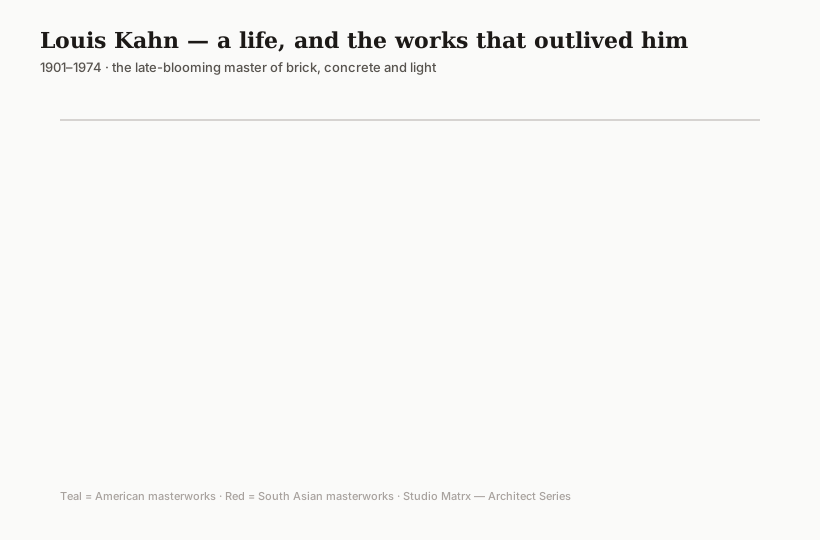
He died in 1974 of a heart attack in a men's room at Penn Station in New York, returning from a trip to India, carrying drawings, his passport address crossed out. His office was deep in debt. And yet his greatest commission, the National Assembly at Dhaka, was still under construction and would be completed years later, exactly to his design — a building that has outlived every account of his frailty.
The signature works
| Work | Place & years | Why it matters |
|---|---|---|
| Richards Medical Labs | Philadelphia, late 1950s | The breakthrough: served labs and servant brick towers split into honest, separate masses. |
| Salk Institute | La Jolla, California, 1959–1965 | Twin laboratory blocks flank a travertine court open to the Pacific — silence, symmetry, the "facade to the sky." |
| First Unitarian Church | Rochester, New York | A meeting hall lit from four corner light-hoods; the sanctuary as a vessel for daylight. |
| Kimbell Art Museum | Fort Worth, Texas, 1966–1972 | Cycloid concrete vaults with a slot at the crown wash the galleries in a soft, silver, ever-changing light. |
| Phillips Exeter Library | Exeter, New Hampshire | A brick cube wrapping a soaring concrete atrium; giant circular openings reveal the stacks. |
| IIM Ahmedabad | Gujarat, India, 1962–1974 | Monumental exposed brick pierced by circular and arched openings — geometry as climate control. |
| National Assembly Building | Dhaka, Bangladesh, 1962–1983 | His magnum opus: concrete and marble citadel of pure geometry, lit from above; completed after his death. |
The Kimbell is, for many, the most perfect art museum ever built. Its repeated concrete vaults are not true barrel arches but cycloid curves, each split by a narrow skylight at the top; a perforated aluminium reflector spreads the Texas sun across the underside of the vault so that the gallery glows with a silver light that shifts all day and never dazzles a painting. It is the purest demonstration of Kahn's belief that the structure and the light are the same act.
The Salk Institute is its emotional opposite — outdoor, austere, oceanic. The scientist Jonas Salk asked for a place he could comfortably invite Picasso; Kahn gave him laboratories of unmatched flexibility and, between them, that single empty plaza whose late insertion of the water channel is one of the great editing decisions in architecture. The laboratory floors are served by full-height interstitial levels — entire mechanical storeys tucked between the working floors so that the pipework of science can be rerouted without ever disturbing the researchers above. It is the served-and-servant principle taken to its most generous extreme, and it is why the Salk still works as a cutting-edge research building decades after it was finished.
The First Unitarian Church at Rochester shows the same mind at a smaller, more intimate scale. Kahn wrapped the central worship hall in a ring of classrooms and lit the sanctuary not from windows in the walls but from four great hooded light-monitors at the corners of the roof, so daylight arrives indirectly, bounced and softened, falling on the rough concrete as a kind of presence rather than a view. The result is a room that feels lit by something larger than itself — exactly the effect Kahn meant when he spoke of silence and light meeting at what he called the threshold of inspiration.
The philosophy
Kahn is often filed under Brutalism, and the label is not wrong so much as too small. He shared Brutalism's central honesties — raw concrete left as-cast, structure and services exposed, mass and shadow over surface and decoration — and his work sits at the heart of any account of that movement, which our guide to what Brutalism is sets out in full. The Richards towers and the Dhaka assembly are textbook lessons in beton brut and in the moral seriousness Brutalism prized.
You say to a brick, "What do you want, brick?" And brick says to you, "I like an arch." And you say to brick, "Arches are expensive, I can use a concrete lintel." And then you say, "What do you think of that, brick?" Brick says, "I like an arch."
But where much of Brutalism was about toughness and the city, Kahn was about silence, light and a near-religious sense of beginnings. He spoke of architecture as the thoughtful making of spaces, and of every great building as a meeting of silence — the will to be, the not-yet-made — and light — the giver of all presence. That metaphysical streak is why critics resist confining him to any one "ism." He was, more truly, a one-man tradition: an architect who used the materials of Brutalism to chase the permanence of a Roman ruin and the quiet of a temple.
India
Kahn's relationship with South Asia is not a footnote to his career; it is the stage for two of his three or four greatest buildings. In 1962, on the recommendation of his friend and former colleague the Indian architect Balkrishna Doshi, Kahn was invited to design the new campus of the Indian Institute of Management Ahmedabad (IIM-A). Doshi, who had worked with Le Corbusier in Ahmedabad, became Kahn's associate architect on the ground, and the collaboration shaped a generation of Indian practice.
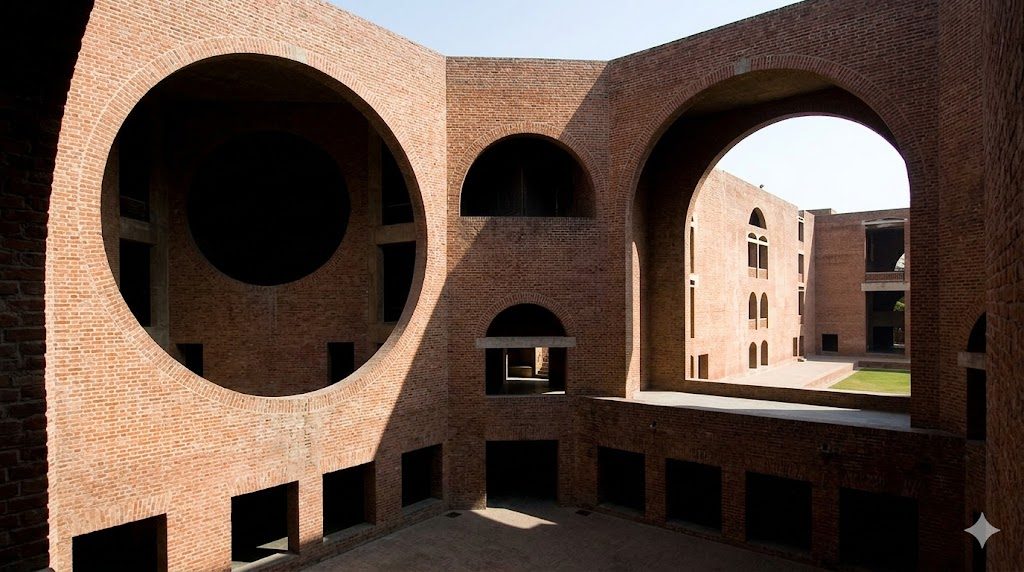
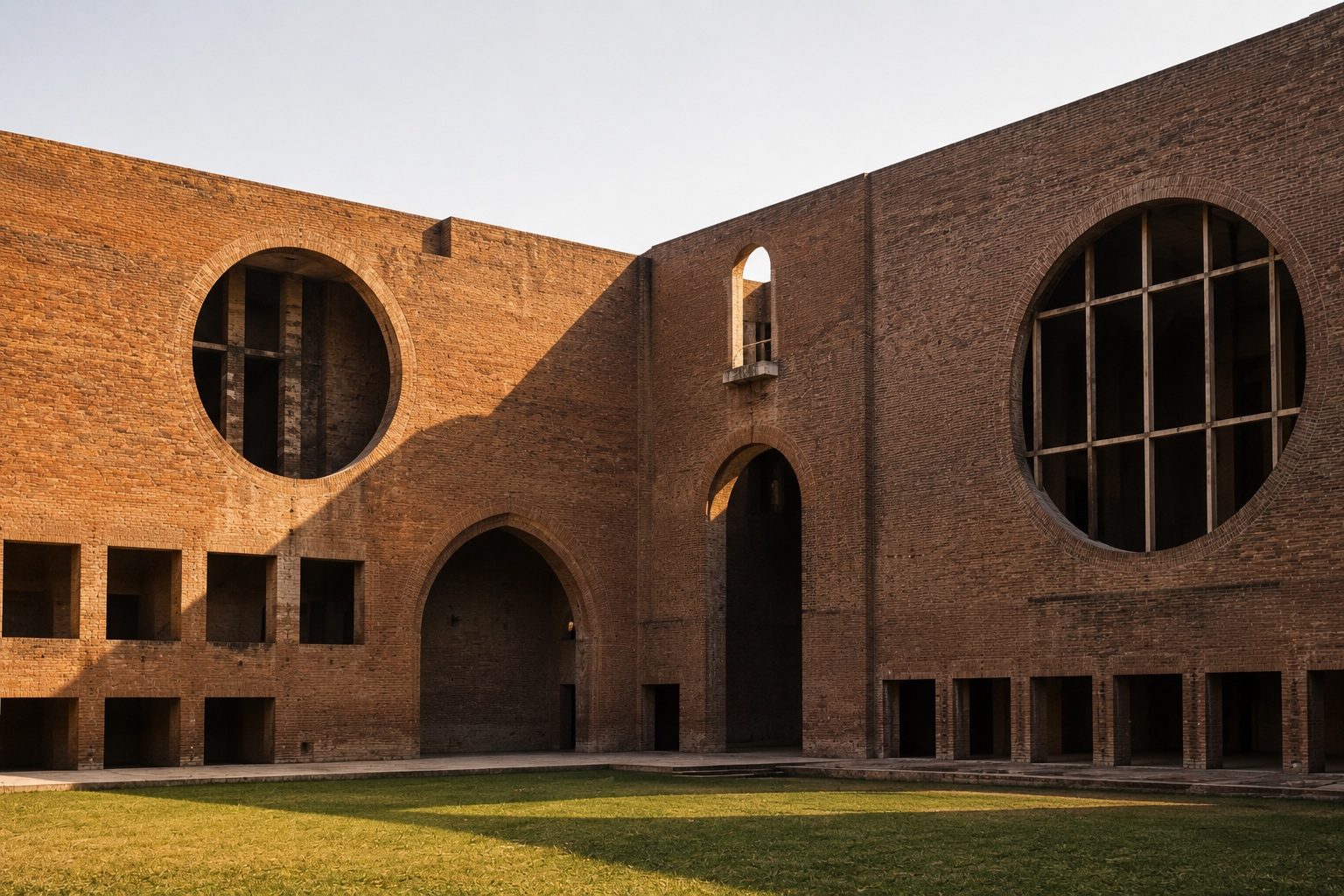
At IIM-A, Kahn did something remarkable: he took the humblest and most Indian of materials — load-bearing brick, laid by local masons — and built monumentality from it. The campus is a composition of brick walls pierced by enormous circular and arched openings, with flat concrete lintels riding above the brick arches in a kind of structural duet. Those openings are not merely beautiful; they are climate machines, framing shade and breeze and cutting the harsh Gujarat sun into deep, cool shadow, so the buildings breathe without glass or air-conditioning — a passive intelligence that today's designers study closely, as our guide to passive design across India's climate zones explores. The way Kahn read the sun here is exactly the discipline a modern architect can rehearse with our sun-path analyzer.
His other South Asian work is his magnum opus: the National Assembly Building (Jatiya Sangsad Bhaban) at Sher-e-Bangla Nagar, Dhaka, designed from 1962 and completed in 1983, nine years after his death, for what became Bangladesh. A vast citadel of concrete inlaid with bands of white marble, ringed by water, its assembly chamber crowned with light pouring through immense geometric cut-outs, it is widely regarded as one of the most important buildings of the twentieth century — and an astonishing gift from an itinerant Philadelphian to a newly born nation.
The Dhaka complex is, in a sense, Kahn's entire philosophy built at the scale of a state. The outer ring of the parliament is wrapped in offices, prayer hall, dining and circulation — servant spaces, each given a pure geometric figure, circle and triangle and rectangle, punched as colossal openings in the concrete shell. These hollow outer rooms shade and buffer the great central chamber, the served space, from the fierce Bengal heat and glare, so that the deliberations of a nation take place inside a building that cools itself by its own geometry. That a structure begun in poverty, interrupted by war, and finished long after its architect's death should stand today as a serene and unifying national symbol is one of the most moving stories in modern architecture.
Through Doshi, and through the discipline of IIM-A, Kahn's influence runs deep in the institutional architecture of independent India. The taste for honest brick and concrete, monumental geometry and climate-wise openness that defines so much of the subcontinent's best modern building owes him an enormous debt — a lineage our guide to what defines contemporary Indian architecture traces.
Legacy and what we can learn
Kahn's direct influence is everywhere a building is asked to feel weighty and true rather than merely efficient — in Tadao Ando's silent concrete, in the institutional work of his many students, in Doshi's own evolution. But the deeper lesson is a way of working. Kahn began every problem not with a plan but with a question about essence: what does this institution want to be, what does this material want to do, where does the light come from. He let those answers, not fashion, generate the form.
For anyone designing today — a home, a school, a single room — Kahn offers a discipline that needs no budget: respect the material you have, let daylight do the work, separate the spaces that serve from the spaces that are served, and leave the honest evidence of construction visible rather than hiding it under a smooth lie. A modest house built on those principles will age better than a lavish one built on none.
His principles still shape how thoughtful spaces get made — and how DesignAI helps you think about light, material and room before you think about decoration.
References
- Robert McCarter, Louis I. Kahn (Phaidon, 2005).
- Carter Wiseman, Louis I. Kahn: Beyond Time and Style (W. W. Norton, 2007).
- David B. Brownlee & David G. De Long, Louis I. Kahn: In the Realm of Architecture (Rizzoli / MoCA, 1991).
- Nathaniel Kahn (dir.), My Architect: A Son's Journey (2003), documentary.
- Kenneth Frampton, Modern Architecture: A Critical History (Thames & Hudson).
- William J. R. Curtis, Modern Architecture Since 1900 (Phaidon, 3rd ed., 1996).
- Louis I. Kahn, Essential Texts, ed. Robert Twombly (W. W. Norton, 2003).
To follow this thread, read about Kahn's collaborator Balkrishna Doshi and his great contemporary Le Corbusier, and the movement Kahn's raw mass and honesty helped define in our guide to what Brutalism is.
Philosophies they championed