
Le Corbusier
The prophet of the machine age who named Brutalism — and gave India the city of Chandigarh
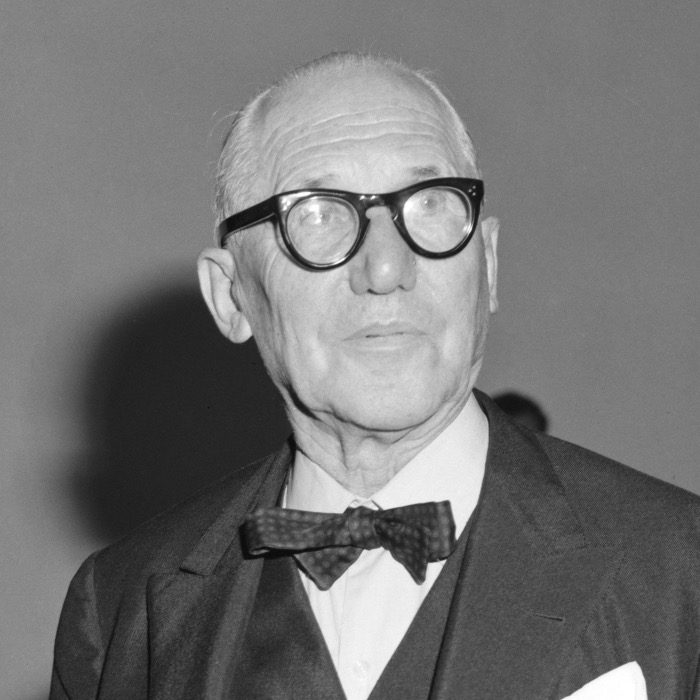
Photo: Joop van Bilsen / Anefo, CC0 1.0, via Wikimedia Commons
Movements
Signature works
- Villa Savoye, Poissy (1928–31)
- Unite d'Habitation, Marseille (1947–52)
- Notre-Dame du Haut, Ronchamp (1955)
- Capitol Complex, Chandigarh (from 1951)
- Mill Owners' Association Building & villas, Ahmedabad (1950s)
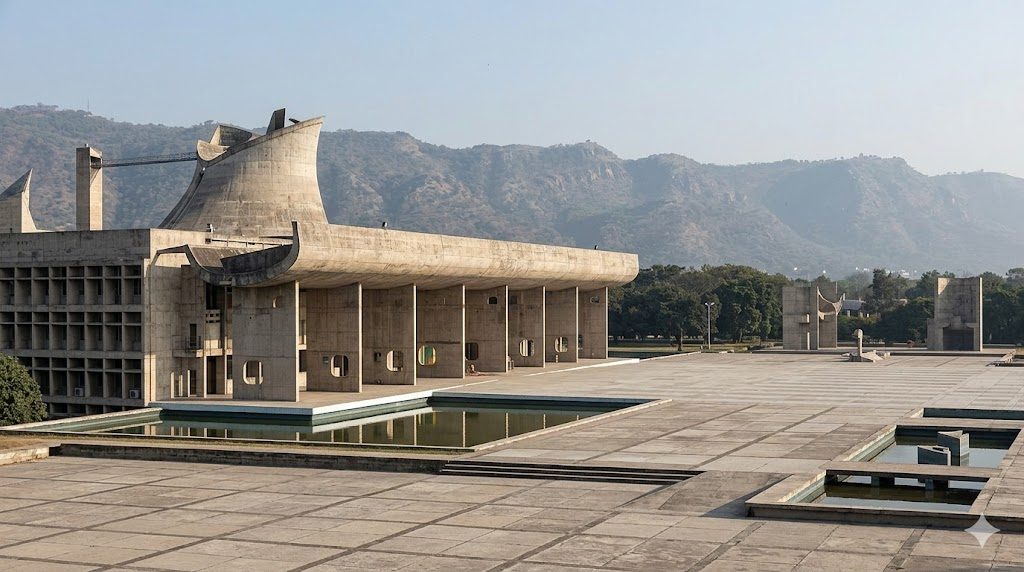
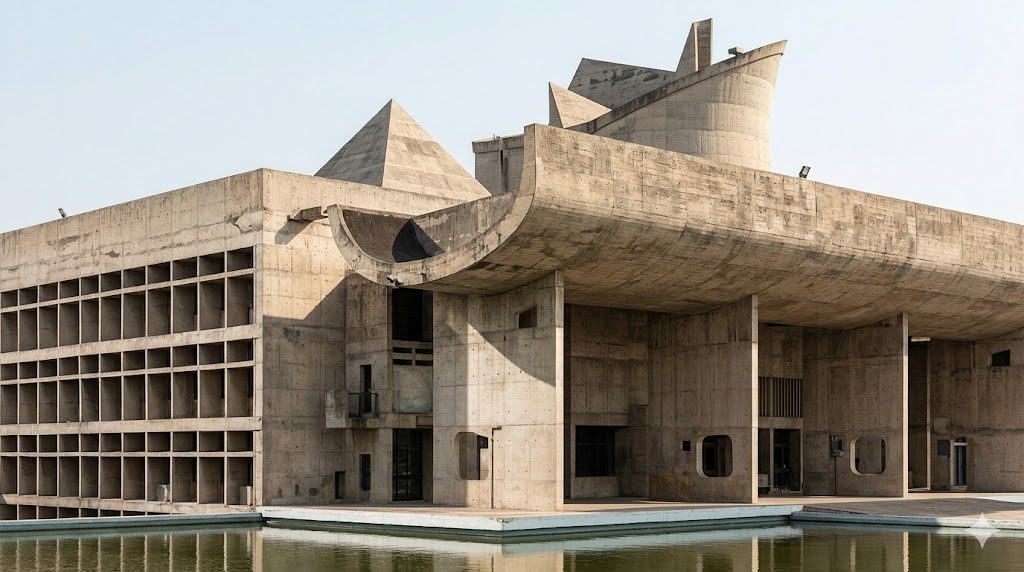
Stand on the great paved esplanade of the Capitol Complex in Chandigarh, India's first planned modern city, and the buildings come at you like geology. To one side, the Secretariat runs for a quarter of a kilometre, its long concrete face broken into a deep honeycomb of sun-shades. Ahead, the Palace of Assembly carries a vast portico and a hyperbolic cooling-tower form punched through its roof. Off to the right, the High Court shelters under an enormous parasol roof that floats above the courtrooms. And on its plinth, turning slowly in the wind, the sculpted Open Hand reaches up — "open to give, open to receive." It is raw, sun-baked, monumental concrete, and it was conceived by a Swiss-French architect who never lived in India but gave it one of its boldest civic landscapes.
That architect was Le Corbusier — born Charles-Edouard Jeanneret in 1887, dead in 1965, and, by almost any reckoning, one of the most influential architects of the entire twentieth century.
His core contribution was twofold. First, he wrote the grammar of modern architecture — the idea that a building should be liberated by new technology into open, light-filled space, that "a house is a machine for living in." Then, decades later, he taught that same architecture to speak in raw, board-marked concrete — beton brut — and in doing so gave the world the material language we now call Brutalism.
The idea: from the machine for living to the honest material
Le Corbusier's career splits cleanly into two great acts, and understanding the bio means understanding both.
In the first act, in the 1920s, he was the prophet of the machine age. Reinforced concrete — a frame of columns and slabs — meant a wall no longer had to hold a building up. If the wall is freed of its structural job, then everything follows: the plan can flow, the facade can become a thin taut skin, windows can stretch in long horizontal ribbons, the whole house can be lifted off the wet ground on slender columns and the lost garden returned on the roof. He codified this into his famous Five Points of a New Architecture, and demonstrated it in a series of crisp white villas that still look startlingly modern a century on. (For a close reading of how these ideas shaped the building skin — the brise-soleil, beton brut, pilotis and the free facade — see our Le Corbusier facade signature guide.)
In the second act, after the Second World War, the white plaster fell away. Le Corbusier began to leave concrete exactly as it came out of its wooden moulds — rough, ridged with the grain of the timber, frankly imperfect. He called it beton brut, "raw concrete." Out of this came heavy, sculptural, deeply shadowed buildings: a workers' housing block in Marseille, a pilgrimage chapel that looks like nothing else on earth, a hill-top monastery, and the civic monuments of Chandigarh. When British critics looked for a name for the new heaviness, they took it from his own French — and Brutalism was born.
A house is a machine for living in.
It is the most quoted line in modern architecture, and it is genuinely his — from his 1923 manifesto, "Vers une architecture" ("Toward an Architecture"). It has been misread for a century as cold functionalism. He meant something closer to the opposite: a house should be as efficiently, beautifully and rationally made as a fine ship or aircraft, so that the people inside are free to live well.
Life and path
Charles-Edouard Jeanneret was born in 1887 in La Chaux-de-Fonds, a watchmaking town in the Swiss Jura. He trained first not as an architect but as an engraver of watch cases, and that early discipline of precise, repeated pattern never quite left him.
He had no conventional architecture degree. Instead, he learned by travelling and by working in the offices of the era's masters. He spent time with Auguste Perret in Paris, the great pioneer of reinforced concrete, and with Peter Behrens in Germany, in whose office the young Mies van der Rohe and Walter Gropius also passed — an extraordinary crucible of the coming modern movement. He travelled through the Mediterranean and the East, filling sketchbooks with the white geometry of Greek islands and the mass of ancient ruins.
Around 1920, settled in Paris, he reinvented himself. He took the pseudonym "Le Corbusier" — loosely adapted from an ancestral name — partly to separate his architecture from his painting. With the painter Amedee Ozenfant he had founded Purism, a movement seeking clarity and order after the chaos of the First World War, and he ran an influential little magazine, "L'Esprit Nouveau," in which the essays that became "Vers une architecture" first appeared.
Through the 1920s and 1930s he built the white villas and theorised relentlessly — about cities, about mass housing, about a tower-in-the-park urbanism that would later prove deeply controversial. The war stopped almost all building. When it ended, he was nearly sixty, and his architecture had changed utterly. The last twenty years brought the beton brut masterpieces and, in 1951, the unexpected commission of a lifetime: a whole new capital city in northern India.
He drowned while swimming in the Mediterranean at Cap Martin in 1965, near the tiny holiday cabin he had built for himself. France gave him a state funeral in the courtyard of the Louvre.
The signature works
A handful of buildings carry the whole arc of his thinking — from the weightless white machine to the heavy hand-cast monument.
| Building | Place & dates | Why it matters |
|---|---|---|
| Villa Savoye | Poissy, France, 1928–31 | The purest demonstration of the Five Points — a white box floating on pilotis with ribbon windows and a roof garden. The textbook image of early modernism. |
| Unite d'Habitation | Marseille, France, 1947–52 | A "vertical village" of 337 apartments raised on massive pilotis, with internal shopping street and rooftop running track. The first great work in raw beton brut — and the seed of Brutalism. |
| Notre-Dame du Haut | Ronchamp, France, 1955 | A pilgrimage chapel of curving white walls and a swooping concrete roof, pierced by deep, irregular light-wells. Proof that the modernist could also be a sculptor and a mystic. |
| Sainte-Marie de La Tourette | near Lyon, France, late 1950s | A Dominican monastery in rough concrete, all rhythm, silence and controlled light — a quiet companion to Ronchamp's drama. |
| Capitol Complex | Chandigarh, India, from 1951 | His largest realised work: the Assembly, High Court and Secretariat of a new Indian state capital, in monumental shaded concrete. A UNESCO World Heritage Site. |
| Mill Owners' Association & villas | Ahmedabad, India, 1950s | The ATMA House and the Sarabhai and Shodhan villas — where his concrete vocabulary meets the Indian climate at a domestic scale. |
The thread running through all of them is the search for what he called the "ineffable space" — light, proportion and mass arranged so precisely that a room moves you. Even at his most industrial, he was reaching for the sublime. Walk through the Unite at Marseille and you feel it: the brutal pilotis at the base, the riot of primary colour on the loggias, the surreal sculpted chimneys and ramps on the roof, the long internal street lit from above. It is a single apartment block that contains a theory of how thousands of people might live a good urban life — wrong in some of its assumptions, unforgettable in its conviction.
He also chased a system to tie it all together: the Modulor, a proportional scale he devised from the dimensions of the human body and the golden ratio, meant to bring human measure and mathematical harmony to industrial building. You can find its proportions stamped, quite literally, into the concrete of the Unite and of Chandigarh.
The philosophy: Purism, then the raw truth of concrete
Le Corbusier championed two ideas that shaped the century.
The first was an urban and architectural Purism — the conviction that the new century needed a new, machine-clean architecture stripped of ornament, organised by logic and light. He carried this conviction into city planning through CIAM (the Congres Internationaux d'Architecture Moderne) and the resulting Athens Charter, which argued that cities should be sorted into separate zones for living, working, recreation and circulation, with housing lifted into towers set among open green space.
This is the part of his legacy that is, rightly, most debated. The tower-in-the-park model — applied around the world, often crudely and without his care — too often produced isolating, car-dominated estates that cut the fine grain of street life. His own unbuilt "Plan Voisin" proposed sweeping away much of central Paris for slab towers, an idea now read as a warning. An honest account of Le Corbusier holds both things at once: a designer of extraordinary individual buildings, and the source of an urban dogma that later planners and critics — Jane Jacobs foremost among them — spent decades undoing.
The second idea is the one that concerns this profile most directly. In the raw concrete of his late work, Le Corbusier insisted that a material should show its true nature — its texture, its weight, its making — with no cosmetic disguise. That ethic of honest, expressive, monumental concrete became the foundation of an entire movement. To understand how it grew from his Marseille block into a global language of civic buildings, libraries and universities, read our guide to what Brutalism is — a philosophy he, more than anyone, set in motion.
India: the architect of Chandigarh
No foreign architect has left a deeper mark on modern India.
In 1947, Partition severed the historic Punjab and left the Indian side without its capital, Lahore, which had gone to Pakistan. Jawaharlal Nehru's government resolved to build a wholly new capital from open farmland at the foot of the Shivalik hills — a city, in Nehru's words, "unfettered by the traditions of the past, an expression of the nation's faith in the future." After the American planner Albert Mayer's early scheme lost its architect partner in a plane crash, the commission passed, in 1951, to Le Corbusier, working with his cousin Pierre Jeanneret and the British architects Maxwell Fry and Jane Drew.
Le Corbusier laid out the master plan — a calm grid of self-contained neighbourhood "sectors," generous green belts, and a hierarchy of roads he poetically called the "7Vs." Pierre Jeanneret, Fry and Drew did much of the patient work of the houses and the everyday city. But Le Corbusier reserved for himself the head of the city: the Capitol Complex.
There he placed the three organs of the state as separate sculptural monuments on a great open esplanade — the Palace of Assembly, the High Court and the long Secretariat — together with the Open Hand monument, his emblem of peace and exchange. Crucially, this was concrete made for the Indian sun. The facades are wrapped in the deep brise-soleil, the concrete "sun-breaker," that shades the glass from the fierce Punjab heat while admitting light and air. The High Court's giant parasol roof and the Assembly's portico are, before anything else, devices for shade and the monsoon. Chandigarh is modernism rephrased for a hot climate.
In 2016, UNESCO inscribed the Capitol Complex on the World Heritage List as part of a transnational listing of seventeen Le Corbusier works across seven countries — India's contribution to a global tribute.
His Indian story did not end at Chandigarh. In Ahmedabad, in parallel, he built a tight group of works in the 1950s: the Mill Owners' Association Building (ATMA House), with its raw concrete and brise-soleil over the Sabarmati river; the Sanskar Kendra city museum; and two remarkable houses, the Villa Sarabhai and the Villa Shodhan, where his vocabulary of pilotis, deep shade and roof gardens met the heat and the wealthy patrons of Gujarat.
The deeper legacy is human. Chandigarh became a school. Working under and alongside Le Corbusier and Pierre Jeanneret, a generation of Indian architects learned the language of modern concrete first-hand — and then translated it, with growing confidence, into something genuinely Indian. The line runs straight from this project to figures like Balkrishna Doshi, who worked in Le Corbusier's Paris studio and supervised the Ahmedabad projects on the ground, and whose later work fused these lessons with Indian climate and culture. To see how that conversation between imported modernism and Indian tradition still plays out, our guide on what defines contemporary Indian architecture and the comparison of modern versus traditional Indian house architecture both pick up the thread.
Legacy and what we can learn
Le Corbusier's influence is almost impossible to overstate, and it cuts both ways.
On the one hand, nearly every architect who followed had to reckon with him. Louis Kahn, who built his own modern capitol just across the subcontinent at Dhaka, wrestled with the same problem of monumental concrete in a hot land. Balkrishna Doshi carried his master's lessons into a lifetime of humane Indian work and, in 2018, won the Pritzker Prize. Charles Correa absorbed and then argued past him, insisting that Indian modernism must answer to the local sun, the open-to-sky space and the monsoon. The entire Brutalist movement — every board-marked civic building from Boston to Bengaluru — descends from his beton brut.
On the other hand, his urban ideas became a cautionary tale, and the best thing later architects did was to learn what to keep and what to leave. Keep: the honesty of materials, the mastery of light, the seriousness about how people actually inhabit space. Leave: the impulse to plan a whole human world from a single mind on a single sheet of paper. Even Chandigarh, for all its grandeur, is criticised for being scaled to the car and the panorama rather than to the pedestrian and the bazaar — a magnificent stage that India's denser, messier street life has had to colonise over seventy years on its own terms.
That tension is the lasting lesson. A great building is a controlled thing; a great city is a living one, and the two cannot be designed the same way. The architects who came after him in India understood this and corrected for it — bringing back the courtyard, the verandah, the close-grained neighbourhood — while keeping his command of concrete and light.
For anyone designing in India today, the practical takeaway is sharp and timeless. Le Corbusier's greatest Indian buildings work not because they are concrete, but because that concrete is shaped by the sun — angled, shaded, oriented, deep. Before the form comes the climate. That is exactly the logic our sun-path analyzer puts in your hands: see where the sun falls on a site across the year, and let the shade — the brise-soleil of your own building — follow.
His principles still live in how thoughtful spaces get planned today — try DesignAI to explore light, openness and proportion in your own rooms.
References
- Le Corbusier, Vers une architecture ("Toward an Architecture"), 1923.
- Le Corbusier, The Modulor: A Harmonious Measure to the Human Scale Universally Applicable to Architecture and Mechanics, 1948.
- William J. R. Curtis, Le Corbusier: Ideas and Forms, Phaidon.
- William J. R. Curtis, Modern Architecture Since 1900, Phaidon.
- Nicholas Fox Weber, Le Corbusier: A Life, Knopf.
- Kenneth Frampton, Le Corbusier, Thames & Hudson.
- UNESCO World Heritage List, "The Architectural Work of Le Corbusier, an Outstanding Contribution to the Modern Movement" (inscribed 2016).
Explore the movement he set in motion in what is Brutalism, and trace his influence through his Indian heirs Balkrishna Doshi, Louis Kahn and Charles Correa.
Philosophies they championed