
Louis Kahn's Façade Signature: Wrapping Ruins, Brick Arches, and Monumental Light
How Louis Kahn shaded the glass behind giant geometric screen walls, asked the brick to be an arch, and built monumental façades of fair-faced concrete and light — and what that hot-climate logic teaches Indian builders today.
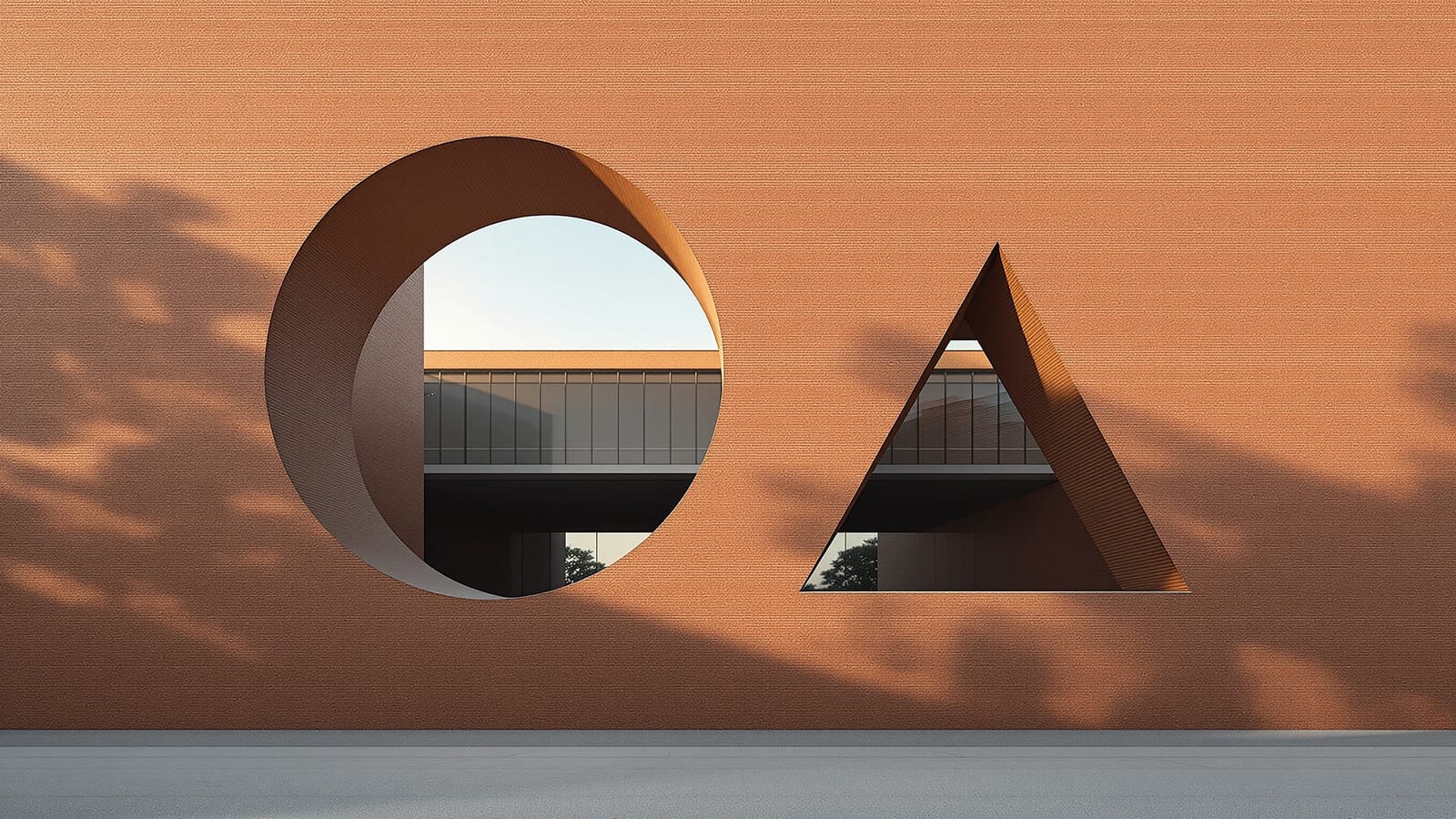
Stand in front of a Louis Kahn building and the first thing you notice is what is missing. There is no cladding, no curtain wall, no decorative skin pretending to be something it is not. Instead there is a wall — heavy, silent, monumental — and in that wall a single enormous geometric hole: a perfect circle, a triangle, a segmental arch big enough to drive a truck through. Look harder and you realise the hole opens onto nothing. Behind it sits another wall, set back in shadow, with ordinary windows. The giant opening is not a window at all. It is a screen, a free-standing ruin, built solely to stand between the sun and the glass.
That single move — wrapping a perforated outer wall around an inner glazed one — is the heart of Kahn's façade language, and it happens to be one of the most intelligent hot-climate shading ideas of the twentieth century. He arrived at it most fully in Dhaka and Ahmedabad, both punishing-sun cities, and it is precisely the kind of thinking Indian architects rediscover every time air-conditioning bills come due. Kahn was not chasing a style. He was asking, with almost religious seriousness, what a wall is for and what a material wants to be.
This is part of our Building Façades series — specifically our Masters of the Façade set, where we study how one great architect handled the elevation, not their whole life. We already have a full biography at Louis Kahn, so we will not retell the life here. Instead we stay narrowly on the façade: the brick arch, the fair-faced concrete, the deep reveal, and above all the screen wall. Read this alongside our guides to exposed brick façades and concrete façades, because Kahn worked both materials at the highest level. And note the kinship to Le Corbusier's façade signature: the two of them built Ahmedabad's twin poles of modernism a few kilometres apart — Corbusier in raw concrete, Kahn in raw brick — and between them they taught India how a modern wall could be honest.
1. Monumentality: a wall that means it
Kahn's word for what he wanted was monumentality — not size for its own sake, but a quality of permanence and spiritual weight, a building that feels like it has always been there and always will be. He chased it with mass, symmetry, and silence. His walls are thick. His openings are few, large, and pure. There is almost no ornament, because for Kahn the structure and the light were the ornament.
This matters for the façade because it sets every other decision. A monumental wall is load-bearing or looks it; it is made of one honest material; it casts deep shadow; it is composed of whole geometric figures — circle, square, triangle, arch — rather than fussy detail. When you understand that Kahn wanted the elevation to feel eternal and elemental, the brick arches and the concrete cut-outs stop looking like fashion and start looking like the only possible answer to his question.
2. Served and servant spaces, read on the elevation
One of Kahn's most influential ideas is the split between served spaces (the rooms people use — labs, reading rooms, the parliament chamber) and servant spaces (the supporting plumbing, stairs, ducts, toilets, services). At the Richards Medical Research Laboratories in Philadelphia he pulled the servant spaces out into separate brick towers, so the façade became a frank diagram of how the building works: tall service shafts standing guard around the working floors.
On the elevation this reads as a hierarchy. The big calm volumes are the served rooms; the tall narrow towers or thickened corners are the servants. Kahn refused to hide the machinery behind a flat skin. He gave it its own architecture and let the façade tell the truth about the plan. For an Indian designer this is a useful discipline: instead of disguising the staircase, the shaft, the toilet stack, let them become legible masses on the elevation and the building gains exactly the honesty Kahn was after.
3. Ask the brick what it wants to be
Kahn's most quoted line is a conversation with a brick. "You say to a brick, 'What do you want, brick?' And brick says to you, 'I like an arch.' And you say, 'Look, arches are expensive and I can use a concrete lintel.' And brick says, 'I like an arch.'" The point is moral as much as practical: brick is strong in compression and weak in tension, so the form it "wants" is the arch, where every brick pushes against its neighbours and the whole opening holds itself up without hidden steel.
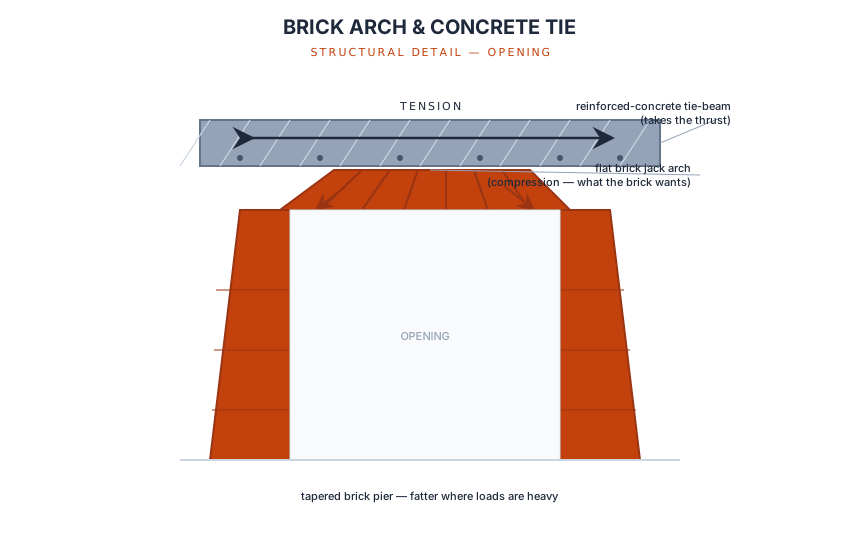
But Kahn was no purist. At the Phillips Exeter Library he topped the windows with flat jack arches — shallow, fanned brick arches that look like an arch but barely rise — and hid a slim reinforced-concrete beam directly behind each one to catch the thrust the flat arch could not resist on its own. This is the brick arch plus concrete tie: the brick does the compression honestly on the face, and a concrete tie-beam quietly takes the tension. He even tapered the brick piers — fatter at the base where loads are heavy, slimmer higher up where they are light — so the wall visibly shows its own statics. The façade becomes a true drawing of the forces inside it.
4. Fair-faced concrete: the pour as the finish
Where Kahn used concrete, he refused to plaster or clad it. He wanted fair-faced concrete (also called board-formed or off-form concrete) — the wall left exactly as it came out of the mould, with every mark of its making visible and dignified. At the Salk Institute he treated this with obsessive care. The plywood forms were filled, sanded, and sealed with polyurethane so the cast surface came out smooth as travertine. The horizontal pour lines — where one day's concrete met the next — were not hidden but chamfered into clean V-grooves, turning a construction joint into a deliberate line.
Most tellingly, the tie-holes (the small round holes left by the steel rods that hold the formwork together against the wet concrete's pressure) were not patched and forgotten. Kahn set them out on a strict grid and plugged each one with a disc of lead, so the finished wall reads as a quiet pattern of dots — the building honestly admitting how it was poured. At Salk these concrete walls are inset with teak panels for the study windows, the warm wood ageing silver against the grey concrete. Nothing is faked; the wall is its own record.
Wrapping ruins around buildings
Here is the technical heart of this guide, and the one idea worth carrying home. Kahn's phrase was "wrapping ruins around buildings." Faced with the brutal sun of Dhaka and Ahmedabad, he did not bolt on louvres or sun-shades. He built an entire second wall — a free-standing double-wall shading screen — and pierced it with vast circles, triangles, and arches. This outer screen stands a metre or more in front of the real, glazed inner wall. The sun strikes the screen, not the glass. The huge openings let light and breeze pass into the gap, but the inner windows sit in permanent shade, looking out through the giant geometric holes as if through the broken openings of an ancient ruin.
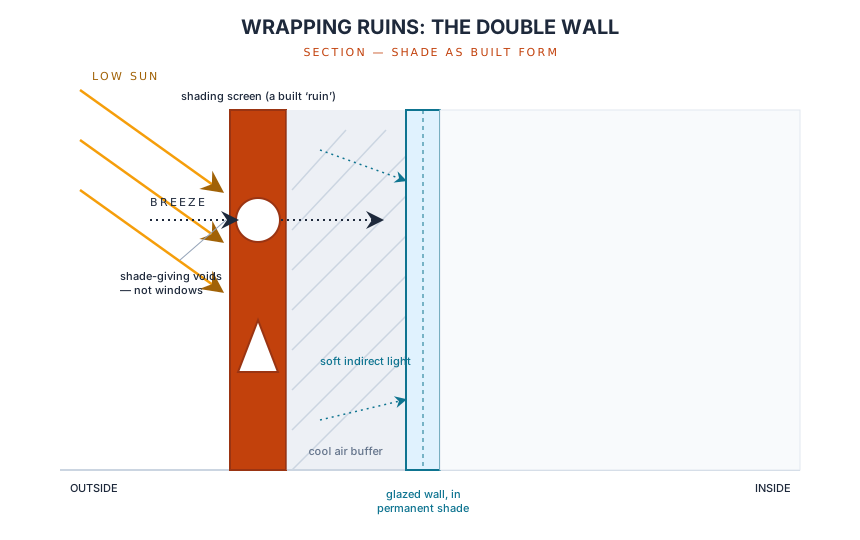
Kahn said his Dhaka design was inspired by the Baths of Caracalla in Rome — vast surviving walls with their floors and roofs long gone, pure geometry standing against the sky. The "ruin" is built deliberately. The gap between the two walls becomes a shaded buffer zone that the heat has to cross before it reaches the rooms, and the screen itself never overheats the occupied space because it is detached from it. This is, in essence, a passive cooling device dressed as monumental architecture — and it solves the exact problem every Indian façade faces: how to get daylight without solar gain. It is the most transferable lesson Kahn offers, and we will return to how to use it at the smaller, domestic scale.
5. Deep reveals, monolithic walls, and the play of light
Because Kahn's walls are genuinely thick — masonry or mass concrete, not thin panels — every opening sits inside a deep reveal: the window is set far back from the outer face, so the wall's own thickness shades it and frames a slot of light. The deeper the reveal, the longer the sun is kept off the glass and the softer the light that finally enters. On a monolithic wall a deep reveal does for a single window what the screen wall does for a whole façade: it uses mass to make shade.
This is where Kahn's famous pairing of "silence and light" lives. He believed a wall should not just keep weather out but should measure light — let it slide down a curved surface, glow at the edge of an opening, fall in a shaft into a dark room. His façades are designed for the low, raking sun precisely because that is when the deep reveals throw their longest shadows and the monolithic surface comes alive. The wall is never a flat picture; it is a relief, carved by the day.
6. Whole geometry: the composite order of circle, triangle, square
Kahn assembled his elevations from complete geometric figures rather than from windows in the conventional sense. A façade might carry one enormous circle, one triangle, one square, one segmental arch — each a pure shape cut clean through the wall. He treated these like a new composite order, the way a classical architect treated columns and pediments: a fixed vocabulary of monumental openings, repeated and combined. At Dhaka the outer shell is literally a catalogue of them — full circles, half circles, triangles, rectangles, flat arches — each sized to admit light and air while blocking sun and rain.
This is why his buildings photograph so powerfully and why they are so often imitated badly. Done right, the giant geometry is structural and climatic — it shades, it ventilates, it carries load. Done as decoration, a big circle punched in a thin wall is just a gimmick. The discipline is to make the shape do real work.
Real buildings, not renders
Five verified projects, and how each façade actually performs.
Salk Institute for Biological Studies, La Jolla (1965). Two laboratory blocks face a travertine court split by a single channel of water running to the Pacific. The façades are fair-faced concrete — smooth, warm-grey, marked with chamfered pour lines and a disciplined grid of lead-plugged tie-holes — inset with teak window panels, louvres, and shutters that have weathered to silver. The concrete and the wood are the entire palette; there is no other finish. It is the purest demonstration of Kahn's "the pour is the finish" principle.
Indian Institute of Management, Ahmedabad (1962 onwards). Kahn's great Indian work, designed with B. V. Doshi and Anant Raje. The façades are exposed load-bearing brick — local, unplastered — pierced by monumental brick arches and large circular and segmental cut-outs, with reinforced-concrete tie-beams spanning across the arch springings to catch the thrust (the brick-arch-plus-concrete-tie writ large). Deep shaded corridors and verandahs wrap the blocks, so the brick mass and the giant voids together keep the Ahmedabad sun off the working rooms. It is the canonical Indian example of honest exposed brick at monumental scale.
National Assembly Building, Dhaka, Bangladesh / Jatiya Sangsad Bhaban (completed 1982). Kahn's masterpiece. The parliament chamber sits at the centre of a vast composition of exposed cast-in-situ concrete, banded with thin lines of white marble inlaid into the formwork joints — a quiet echo of Mughal marble inlay. The outer shell is the full wrapping-ruins idea realised: enormous circles, triangles, and squares cut through a free-standing screen that shades the offices behind and frames the sky. It is the most complete statement of the double-wall shading screen anywhere in the world, and it is in our climate, on the subcontinent.
Phillips Exeter Academy Library, New Hampshire (1972). A near-cube of load-bearing brick on the outside, concrete within. The brick piers taper as they rise, slimmer where loads are lighter, and the windows are crowned with flat brick jack arches backed by hidden concrete beams. Inside, the famous central atrium is a concrete drum pierced by four giant circles that reveal the book stacks behind — the same whole-geometry move, turned inward. The façade is a textbook of honest masonry statics.
Kimbell Art Museum, Fort Worth (1972). A row of long cycloid concrete vaults (a cycloid is the gentle curve traced by a point on a rolling wheel), each split along its crest by a narrow skylight. Daylight enters the slot, bounces off a perforated aluminium reflector, and washes the underside of the vault in a soft, silvery glow. The "façade" here is really the roof, but the lesson is the same: concrete shaped to measure light rather than merely keep out weather.
Signature façade devices at a glance
| Device | What it is | Why Kahn used it | Where to see it | India relevance |
|---|---|---|---|---|
| Wrapping-ruins screen wall | Free-standing outer wall with giant geometric openings, set in front of the glazed wall | Shade the glass and create a cool buffer; monumental form | Dhaka Assembly; IIM corridors | The single best passive-shading idea for hot Indian façades |
| Brick arch + concrete tie | Brick arch (or flat jack arch) carries compression; a concrete tie-beam takes the thrust | Honest use of brick's strength, steel's tension capacity | IIM Ahmedabad; Exeter | Direct lineage of Indian exposed-brick building |
| Fair-faced concrete | Off-form concrete left raw, with chamfered pour lines | The making is the finish; no cladding to fail | Salk; Dhaka; Kimbell | Hard to execute well in India — see cautions below |
| Lead-plugged tie-holes | Form-tie holes set on a grid, plugged with lead discs | Turn a construction necessity into honest pattern | Salk Institute | A detail to specify, not improvise |
| Deep reveal | Window set far back into a thick wall | Wall thickness shades the glass; frames soft light | Salk; Exeter; IIM | Cheap, effective shading using mass alone |
| Whole-geometry opening | One pure circle, triangle, square or arch cut clean | A monumental "composite order"; structural + climatic | Dhaka; Exeter atrium | Powerful — but the shape must do real work |
| Marble inlay strips | Thin white marble set into the concrete pour joints | Mark the lifts; echo Mughal inlay | Dhaka Assembly | A regionally rooted, low-cost ennobling detail |
What it means for India
The honest news first. The wrapping-ruins double wall is a gift to Indian architecture. It is not a foreign idea grafted on — it is the same logic as a jaali screen, a verandah, a chajja, scaled up and made monumental. A perforated outer skin standing off a glazed inner wall, with a shaded air gap between, directly attacks the central problem of our façades: daylight without solar gain. Kahn proved it works on the subcontinent, in Dhaka's heat, at the largest scale. And his exposed brick plus concrete tie at IIM Ahmedabad is a genuine Indian lineage — local brick, unplastered, honestly arched, a tradition that B. V. Doshi and a generation of Indian architects carried forward.
But be honest about the costs. Kahn's work is monumental and institutional — parliaments, laboratories, libraries — and its scale does not transfer wholesale to a house. The giant circle that ennobles a parliament can look absurd on a 30×40 plot. More seriously, exposed brick and fair-faced concrete are genuinely hard to build and maintain. At IIM Ahmedabad the brick dormitories deteriorated badly over decades — water seepage and the 2001 earthquake among the causes — and the institute moved to demolish them, triggering a global preservation outcry (Pritzker laureates, the Council of Architecture, MoMA, the World Monuments Fund) before a partial restoration-versus-reconstruction compromise. Restoration work on the library's east-façade flat arches had to rebuild them with stainless-steel reinforcement. This is the warning: monumental exposed masonry is unforgiving of poor detailing and deferred maintenance. Fair-faced concrete is harder still — one bad pour is permanent, as our concrete façades guide explains in detail. Borrow Kahn's principles; respect the discipline they demand.
What this means for you
You will probably never build a parliament, and you should not try to. But three of Kahn's ideas scale straight down to an Indian home or studio.
Build a shading screen, not a sunshade. Instead of bolting louvres onto the glass, set a perforated screen wall — brick jaali, fins, a punched RCC or stone panel — a foot or two in front of your most sun-hit glazing, with an air gap between. That gap is the whole point: it is the cool buffer the heat must cross. This is Kahn's wrapping-ruins idea at domestic scale, and it is the single most valuable thing in this guide.
Be honest with one material. Pick brick or concrete and let it show — no plaster, no cladding pretending to be something else. If you use a brick arch, let it be a real arch and put an honest concrete tie behind it. A deep reveal costs almost nothing and shades the glass with the wall's own thickness.
Design the wall to catch light. Orient your big openings to the low morning and evening sun, give them depth, and watch how the raking light carves the surface. That is Kahn's "silence and light" — and it needs no budget at all.
What you should not borrow is the monumentality for its own sake, or the maintenance burden of unprotected exposed concrete. Take the screen, the honesty, and the light. Leave the parliament behind.
For the materials underneath these ideas, read our companion guides on exposed brick façades and concrete façades, see the Le Corbusier façade signature for Ahmedabad's other pole, and start the whole series at why building façades matter in India.
Sources
- Louis Kahn, "You say to a brick…" — the brick-arch quote, widely transcribed (National Endowment for the Humanities, "You Say to Brick").
- Salk Institute for Biological Studies — official architecture guide (salk.edu); Witold Rybczynski on the form-tie detail; restoration documentation of the teak window walls (fair-faced concrete, chamfered pour lines, lead-plugged tie-holes, teak panels).
- Indian Institute of Management Ahmedabad — coverage of the dormitory demolition/restoration controversy (Dezeen, ArchDaily, Wallpaper*, The Print, Deccan Herald); design with B. V. Doshi and Anant Raje.
- National Assembly Building, Dhaka / Jatiya Sangsad Bhaban — Banglapedia; ArchEyes; WikiArquitectura; coverage of the wrapping-ruins double wall and the Baths of Caracalla inspiration (exposed concrete, white marble inlay strips, circular/triangular/square openings).
- Richards Medical Research Laboratories — MoMA collection notes and Encyclopaedia Britannica (served vs servant spaces).
- Phillips Exeter Academy Library — Docomomo-US; ArchEyes; "The Tectonic Integration of Louis I. Kahn's Exeter Library" (brick jack arch over concrete beam, tapered load-bearing brick, central concrete circles).
- Kimbell Art Museum — official Kimbell architecture pages and ArchDaily AD Classics (cycloid concrete vaults, skylit reflected daylight).
- Studio Matrx in-house: Louis Kahn biography, exposed brick façades, concrete façades.
Export this guide
Related Guides — Deep-dive reading
Tadao Ando's Façade Signature: Silky Off-Form Concrete and the Tie-Hole Grid
How Tadao Ando turned exposed concrete into the world's most disciplined façade language — the tatami-proportioned formwork panel, the rhythmic six-hole grid, and walls that frame light, water and sky instead of opening to the street.
Building FacadesIIM Ahmedabad: How Louis Kahn Taught Brick to Build an Institution
Louis Kahn's Indian Institute of Management campus is Modernism reconciled with the Indian sun and the Indian mason — a monumental language of exposed brick arches tied by hidden concrete, of light-cut voids and diagonal geometry that turns circulation into the school itself. A study of its structure, its collaboration with B.V. Doshi and Anant Raje, and the demolition fight that made it a test case for what we owe the recent past.
The Future of ArchitectureBrick House, Wada: How iSTUDIO Bent an Ancient Craft into a Curve
A 2,500-square-foot farmhouse in rural Maharashtra bends the poorest, most ordinary building material — the fired clay brick — into free-flowing curved walls, and proves that low-cost, low-carbon, hand-built architecture can be as spatially ambitious as anything made of steel and glass. A close reading of its rat-trap-bond masonry, earthen-pot filler slabs, ferrocement roofs, and the Laurie Baker lineage it carries forward.
The Future of ArchitectureRelated Tools — Try Free
Brise-Soleil Visualizer
Interactive horizontal-louvre cut-off angle calculator — sun altitude, louvre depth, and spacing inputs with a live shadow preview. Computes θ = arctan(spacing/depth) for façade shading, ECBC envelope compliance, hospital daylight design, and tropical sun-control detailing.
Sun Shading ToolCross-Ventilation Analyzer
Estimate airflow and air changes per hour (ACH) from room size, window areas, layout, and local wind — with NBC 2016 Part 8 compliance check.
Ventilation CalculatorWindow Material Comparison Tool
Compare uPVC, aluminium, wood, steel and composite windows on cost, life, upkeep and insulation.
Compare