
Raj Rewal
The architect who rebuilt the old Indian city in modern concrete and stone
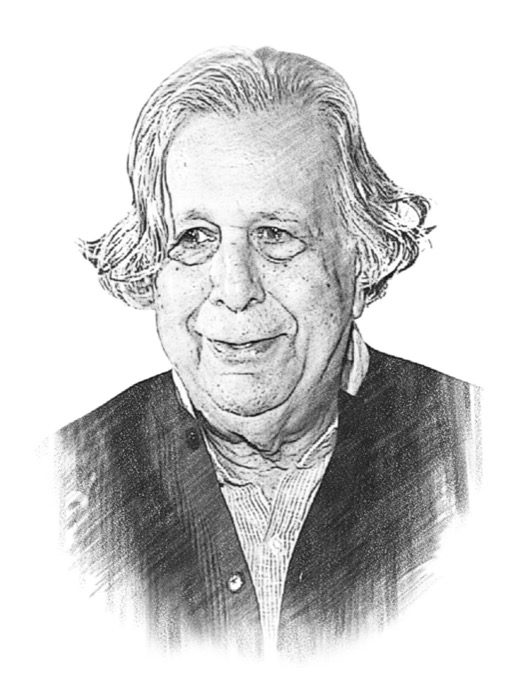
Photo: Sarbjit Bahga, CC BY-SA 4.0, via Wikimedia Commons
Movements
Signature works
- Hall of Nations, Pragati Maidan, New Delhi (1972, demolished 2017)
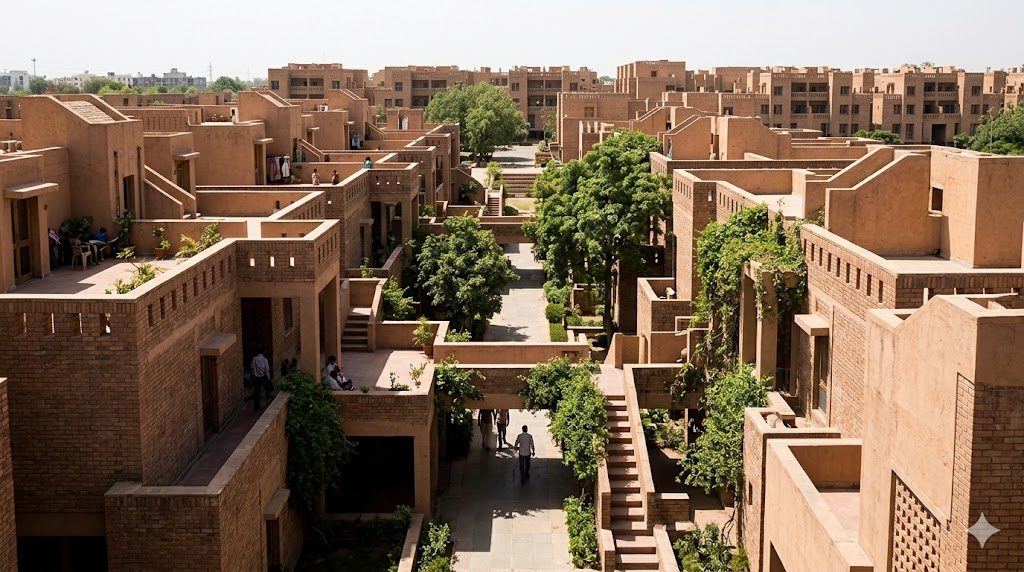
- Asian Games Village, New Delhi (1982)
- Parliament Library (Sansadiya Gyanpeeth), New Delhi (2002)
- National Institute of Immunology, New Delhi
- SCOPE office complex, New Delhi
Stand, for a moment, where you no longer can. Under the soaring concrete diagrid of the Hall of Nations at Pragati Maidan in New Delhi, light fell in shifting lattices across a column-free hall the size of a small stadium. Built for India's twenty-fifth year of independence, it was raised in board-marked concrete by hand, by labourers shaping a space-frame that engineers in richer countries were still building in steel. For forty-five years it told a young republic that it could be modern on its own terms, with its own materials and its own hands. In 2017 it was demolished overnight. What it stood for did not die with it.
Raj Rewal (1934–2024) was one of the most important architects of independent India — a designer of monumental public buildings who insisted that modern concrete and the dense, shaded, walkable fabric of the old Indian city were not opposites but the same idea, separated only by centuries.
His central conviction was that the historic Indian city — Jaisalmer, Fatehpur Sikri, the bazaar towns of Rajasthan — already held the answers to climate, density and community that modern India needed, and that an architect's job was to translate that intelligence into contemporary structure rather than to copy its surfaces. (For a close reading of his building skins — sandstone cladding, the jaali, the deep reveal and the Hall of Nations concrete space frame — see our Raj Rewal facade signature guide.)
The idea
Most modernism arrived in India as a foreign object: glass towers and freestanding slabs that baked in the sun and emptied the street. Rewal's whole career was an argument against that import. He looked instead at the cities Indians had built for themselves over a thousand years and asked a structural question, not a decorative one: how did they work?
The answer was geometry. The old desert towns packed buildings tightly so that walls shaded streets and streets shaded walls. Movement happened on foot, in shadow, through a graded sequence of spaces — gate, lane, square, court, threshold — that was at once a climate device and a social one. Mass kept interiors cool; openings were small and considered; stone and earth stored the night's coolness against the day's heat.
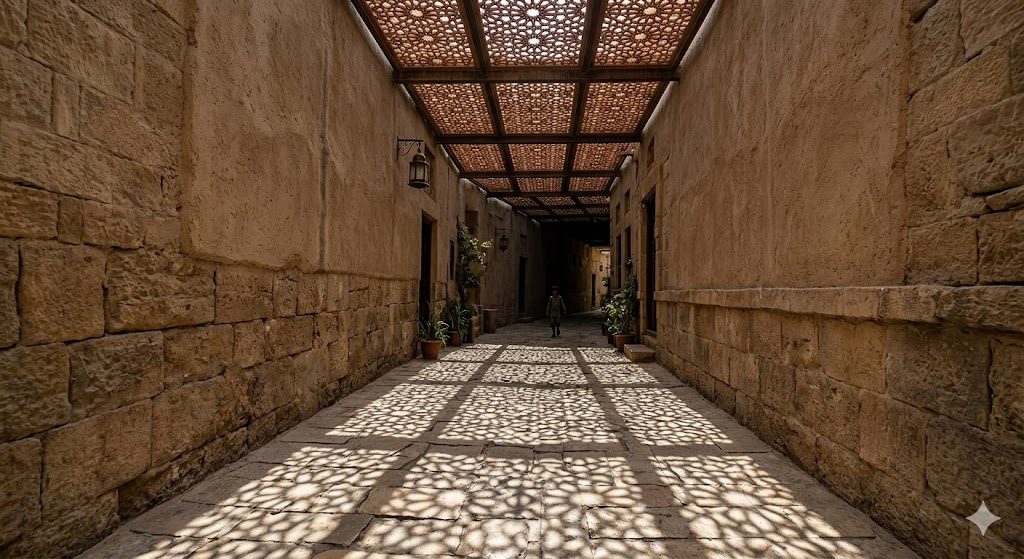
Rewal's contribution was to take that logic — not its arches and not its ornament, but its underlying organisation — and rebuild it in the materials of his own century: cast concrete, sandstone aggregate, the long-span frame. His buildings are monumental, sometimes severe, often structurally daring. Yet they are organised like a town: you walk through them rather than past them, and you almost always walk in shade.
Life and path
Raj Rewal was born in 1934 in Hoshiarpur, in Punjab. He grew up across northern India, and the cities and forts of Rajasthan — Jaisalmer above all — lodged in him early as a kind of permanent reference library: proof that a built environment could be beautiful, dense, cool and humane all at once.
He studied in Delhi and then in London at the Architectural Association, one of the most adventurous schools of its era, before further study in Brussels. In Europe in the 1950s he encountered the full force of late modernism at first hand, and worked briefly in offices in London and Paris. He could have stayed. Instead, like many of the most consequential figures of his generation, he chose to come home: he returned to India in the early 1960s and set up practice in Delhi, the city that would receive most of his major work.
The timing mattered. Independent India was building itself — institutions, housing, exhibition grounds, the apparatus of a modern state — and there was an appetite for an architecture that could carry national ambition without simply mimicking the West. Rewal arrived into that moment with both the technical confidence of an AA training and a deep, almost archaeological feeling for the Indian city. The combination defined everything that followed.
It is worth being precise about what the European years gave him, because it was not a style. The Architectural Association in the 1950s was a place of intense debate about structure, about what modern architecture owed to its own time, and about whether the rationalist project had lost touch with how people actually lived. Working briefly in London and Paris, Rewal saw that the most interesting architects of the moment were already turning from the smooth international object toward weight, texture and the honest expression of how a building stood up. He carried that conviction home, but he did not carry home the climate it was tuned to. The genius of his early Delhi years was to ask what those same structural and material ambitions would mean under a sun that could crack open a glass curtain wall — and to find that the Indian desert town had been answering the question for a thousand years.
The signature works
Rewal's buildings are public and civic almost without exception — exhibition halls, housing for events of state, institutes, libraries, office complexes. He was an architect of the collective rather than the private villa, and that scale suited his preoccupation with the city.
| Building | Place & year | Why it matters |
|---|---|---|
| Hall of Nations & Halls of Industries | Pragati Maidan, New Delhi, 1972 | Pioneering long-span concrete space-frames, built largely by hand for India's silver jubilee of independence — a feat of engineering and a symbol of self-reliant modernity. Demolished in 2017, a loss mourned far beyond India. |
| Asian Games Village (Yamuna Apartments) | New Delhi, 1982 | Low-rise, high-density housing organised as shaded pedestrian streets and courts — the old Indian town reborn as a modern neighbourhood. Among the most studied housing schemes in South Asia. |
| State Trading Corporation (STC) Building | New Delhi | A tall office building treated with a deep, sculpted, sun-conscious facade — modern commerce given civic weight and climatic intelligence. |
| National Institute of Immunology | New Delhi | A campus laid out like a small town of courts and connected pavilions, marrying research function to Rewal's hierarchy of shared outdoor space. |
| Parliament Library (Sansadiya Gyanpeeth) | New Delhi, 2002 | A monumental yet low-lying library set beside the Parliament — domed and stone-clad, it answers Lutyens's New Delhi with an architecture rooted in Indian geometry rather than imperial classicism. |
| SCOPE office complex; Ismaili Centre & mosque, Lisbon | New Delhi; Lisbon | A large stone-clad institutional complex in Delhi, and works abroad that carried his vocabulary of court, screen and crafted stone to Portugal. |
Two of these deserve a closer look, because together they hold his whole philosophy.
The Hall of Nations (1972) was a structural manifesto. India did not have the steel industry to build vast column-free exhibition space the way Europe or America would have, so Rewal — working with the structural engineer Mahendra Raj — built the space-frame in reinforced concrete instead, a pyramidal lattice cast in situ by hand. It was, at the time, among the largest such concrete structures in the world, and it announced that technical ambition need not wait on imported industry. Its 2017 demolition, despite international protest, became a rallying point in India for the protection of modern heritage.
The Asian Games Village (1982), built to house athletes for the 1982 Asian Games and then converted to apartments, is the gentler, equally radical companion. Here Rewal turned away from monument toward neighbourhood. Instead of towers in a windswept plot, he laid out low terraced housing threaded by narrow, shaded pedestrian streets that swell into small courts and shrink into intimate lanes — the exact spatial grammar of Jaisalmer, rebuilt for a contemporary city, with cars pushed to the edges and people given the interior. It remains a touchstone for anyone arguing that density and humanity are not in conflict.
The scheme answered a specific anxiety of late-twentieth-century India: that as cities densified, the only available model was the high-rise tower, with its lifts, its lobbies and its severing of the home from the ground. Rewal showed a third way. By keeping buildings low but packing them close, he reached a real urban density while preserving the thing the tower destroys — a continuous, walkable public ground where a child can be sent to a neighbour's door, where a doorway opens onto a shared court rather than a corridor, where the street itself does the social work that an old Indian mohalla always did. The terraces step and overhang so that the streets stay in shadow through the worst of the day; the colour and grain of the surfaces echo the sandstone city around them. It is housing as urbanism, and it has been studied and imitated across South Asia ever since.
The Parliament Library of 2002 shows the same mind working at the scale of state. Set beside Lutyens's imperial New Delhi, it could easily have shouted. Instead it lies low, domed and stone-clad, its geometry drawn from Indian rather than classical sources — an answer to the colonial capital that is confident enough to be quiet. Together with the National Institute of Immunology, planned as a small town of courts and pavilions, it shows how consistently Rewal carried a single idea from a housing scheme up to the most symbolic ground in the country.

The philosophy
Rewal is most precisely understood through two movements he championed.
The first is critical regionalism — the idea that good modern architecture should resist the placeless international style by drawing, critically, on the climate, materials, light and building culture of its specific place, without lapsing into nostalgic pastiche. Rewal is one of the clearest cases anywhere of this position made concrete. He never quoted an arch or a dome decoratively; he extracted the working logic of the Indian city — shade, mass, the graded sequence of public space — and re-expressed it in modern structure. That is critical regionalism in its purest form: regional intelligence, modern means.
The second is the structural lineage of brutalism — the honest, unfaced expression of concrete and of structure as the building's true character. Rewal's space-frames and board-marked surfaces are brutalist in the original, dignified sense of the word: the material is shown for what it is, and the structure is the architecture. But he pulled brutalism toward warmth, using sandstone aggregate and the colours of the Delhi plain so that his concrete reads as kin to the desert forts rather than to grey European housing estates.
The old cities of Rajasthan solved heat, density and community centuries ago; the modern architect's task is to learn their logic, not copy their ornament.
The above paraphrases the conviction that ran through his work and writing; it is not offered as a verbatim quotation.
India
For Rewal, India was not a project but the whole subject. He built almost entirely at home, and almost entirely for the public realm of the new republic — its exhibition grounds, its games, its institutes, its Parliament. More than perhaps any of his peers he treated the precolonial Indian city not as picturesque heritage but as advanced, working technology for a hot, crowded country, and he spent a career proving the point in concrete and stone.
That places him in direct conversation with his great contemporaries. Where Charles Correa worked the open-to-sky section and the climate of the tropics, and Balkrishna Doshi drew the institution as a slow, organic settlement, Rewal pursued the dense, shaded, pedestrian morphology of the desert town at civic scale. All three were shaped by the long Indian shadow of Le Corbusier at Chandigarh, and all three answered him by indigenising the modern — but Rewal's answer was the most explicitly urban, the most concerned with how a building organises a crowd.
His work is a built argument for the principles that animate contemporary Indian architecture and the renewed interest in vernacular architecture for modern Indian homes: that the answers to India's climate were here all along, in the geometry of its old cities, waiting to be read structurally rather than sentimentally. The honours came — the Robert Matthew Award, the Gold Medal of the Indian Institute of Architects, and the Padma Bhushan, conferred in 2022. He died in 2024.
Legacy and what we can learn
The bulldozing of the Hall of Nations in 2017 was, paradoxically, the clearest measure of Rewal's importance: a building did not have to be old to be irreplaceable, and a nation could lose a piece of itself in a single night. The episode galvanised India's modern-heritage movement and made Rewal, in his last years, a symbol of what is at stake when a country forgets its own twentieth century.
His influence runs through a generation of Indian practice that takes density, climate and the public realm seriously rather than reaching reflexively for the imported tower. The space-frame ambition of the Hall of Nations gave Indian engineering a confidence it had not had before; the street-and-court grammar of the Asian Games Village gave Indian housing an alternative to the corridor block; and his lifelong refusal to separate "modern" from "Indian" gave younger architects permission to stop choosing between the two.
For practising architects and for anyone designing a home in India today, the practical lesson is exact and usable. Before you reach for a glass wall, look at how the old town next to you handled the same sun. Pack buildings to shade each other. Let people move in shadow. Make a sequence of outdoor rooms — court, lane, threshold — rather than a building marooned in a parking lot. Trust mass and shade before you trust the air-conditioner. These are the same instincts behind passive design across India's climate zones, and they begin, as Rewal began, with watching where the sun goes — something you can test on any plot with the sun-path analyzer.
Rewal's deepest legacy is permission: proof that an Indian architect could be unapologetically modern and unapologetically rooted at the same time, and that the two ambitions, far from fighting, made each other stronger.
His belief — that the intelligence of a place should drive how we build in it — is exactly the principle that guides DesignAI when it helps you shape a home around your light, your climate and your way of living.
References
- William J. R. Curtis, "Modern Architecture Since 1900" (Phaidon) — situates Rewal within the global modern and its regional reinterpretations.
- Brian Brace Taylor, "Raj Rewal" (Mimar / Concept Media) — the principal monograph on his work.
- Kenneth Frampton, "Towards a Critical Regionalism" and "Modern Architecture: A Critical History" — the theoretical frame for Rewal's position.
- Rahul Mehrotra, "Architecture in India Since 1990" — Rewal's place in the longer arc of Indian modernism.
- Documentation of the Hall of Nations and Halls of Industries, Pragati Maidan, and the 2017 demolition controversy (architectural press and heritage-advocacy records).
- Citations for the Robert Matthew Award, the Indian Institute of Architects Gold Medal, and the Padma Bhushan (2022).
If Rewal speaks to you, read about his peers Charles Correa, Balkrishna Doshi and Le Corbusier, and explore the philosophies he championed — critical regionalism and brutalism.
Philosophies they championed