
What Defines Luxury Interiors Today?
Beyond price tags — the materials, craft, proportion, light and restraint that separate true luxury from expensive
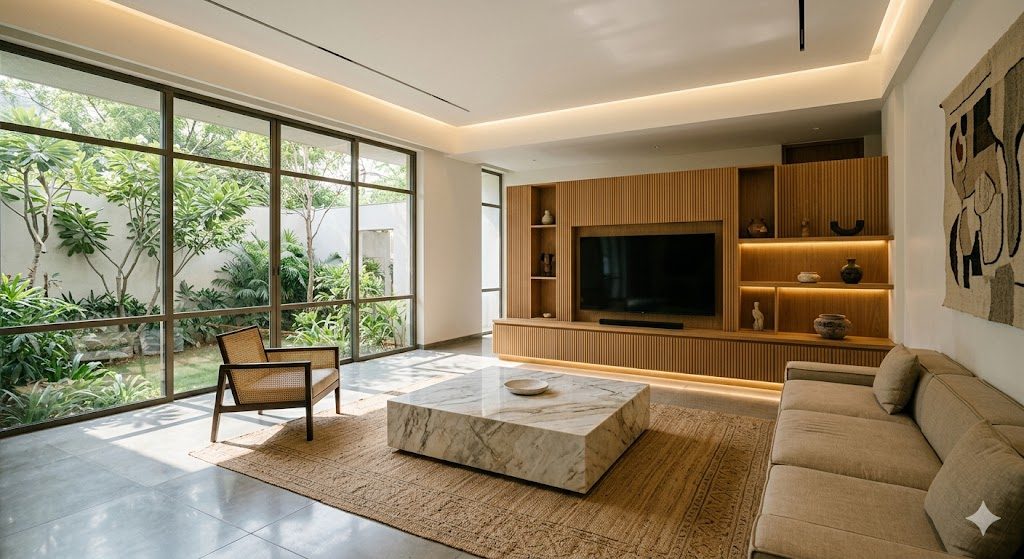
Walk into two homes in the same Mumbai tower, both with the same eight-figure interior budget. One greets you with a marble-clad lobby, a gold-rimmed console, a crystal chandelier that fills the double-height void, and a wall of veneer in three competing tones. The other is quieter — a single slab of fume-finished oak underfoot, a plaster wall that catches the afternoon light, joinery so tight you cannot find where the panels meet. Most people, asked which is more luxurious, will hesitate at the first and settle into the second. They cannot always say why. This guide is about why.
This is the pillar of our Luxury Interiors cluster. It sets out what actually separates true luxury from merely expensive in an Indian home in 2026 — the materials, the craft, the proportion, the light, and the restraint — and then sends you off into nine deep dives, one for each decision that matters. We will name real brands, real stones, real hardware, and real rupee bands you can hold a contractor to.
The core idea is simple and slightly uncomfortable: luxury is not what you spent or what you showed. It is material truth, craft you cannot photograph, proportion you cannot retrofit, light you stop noticing because it is right, and the confidence to leave things out. Money is necessary but never sufficient. Taste, supervision, and provenance are what convert a budget into a luxurious home.
How Indian luxury taste has evolved
For two decades, "luxury interior" in India meant addition. More marble. More gold. A bigger chandelier. Italian everything, announced loudly. This was aspirational luxury — the home as a declaration that the family had arrived. It made complete sense in a country newly affluent: when wealth is recent, it wants to be seen, and the surest visual shorthand for money was shine, symmetry and scale.
That phase is closing. Affluent buyers in Mumbai, Bengaluru, Delhi-NCR and Hyderabad have travelled, stayed in genuinely good hotels, and learned to tell catalogue from custom. A new register has taken hold — call it considered luxury or quiet luxury — where the flex is no longer the price tag but the discipline. The hero is one material, beautifully resolved. The lighting is felt, not seen. The detailing rewards a second, closer look. Nothing shouts.
The positioning map below captures the shift. The vertical axis is time horizon — trendy versus timeless. The horizontal axis is how a home communicates its value — shown versus felt. India's taste is migrating along the diagonal, from the top-left (loud, performed, dated in five years) toward the bottom-right (quiet, lived-in, better with age).
Neither pole is wrong in the abstract. A grand, classical, status-performing home can be exquisitely made. The problem is that loud luxury is far easier to fake — a printed tile photographs almost exactly like Calacatta — while quiet luxury is almost impossible to fake, because it lives in things a camera cannot capture. That is precisely why discerning buyers have moved toward it. We unpack this register fully in Quiet Luxury Interior Design.
The five pillars of true luxury
Strip away the styling debates and luxury rests on five load-bearing pillars. Remove any one and the home reads as expensive but not luxurious — the way a meal can be costly yet unmemorable.
1. Material truth. Luxury materials are what they appear to be. Real stone, not a marble-look vitrified tile. Solid wood or natural veneer over a BWP-plywood core, not PVC foil printed to imitate grain. Solid brass or bronze that weighs in the hand and patinas over time, not electroplated zinc that flakes in three years. Natural fibre — linen, wool, jute — and breathable lime or Venetian plaster, not synthetic velvet and vinyl "texture" wallpaper. The body reads authenticity through weight, temperature, depth and the way a true material ages. We go deep on this in Italian Marble vs Quartz.
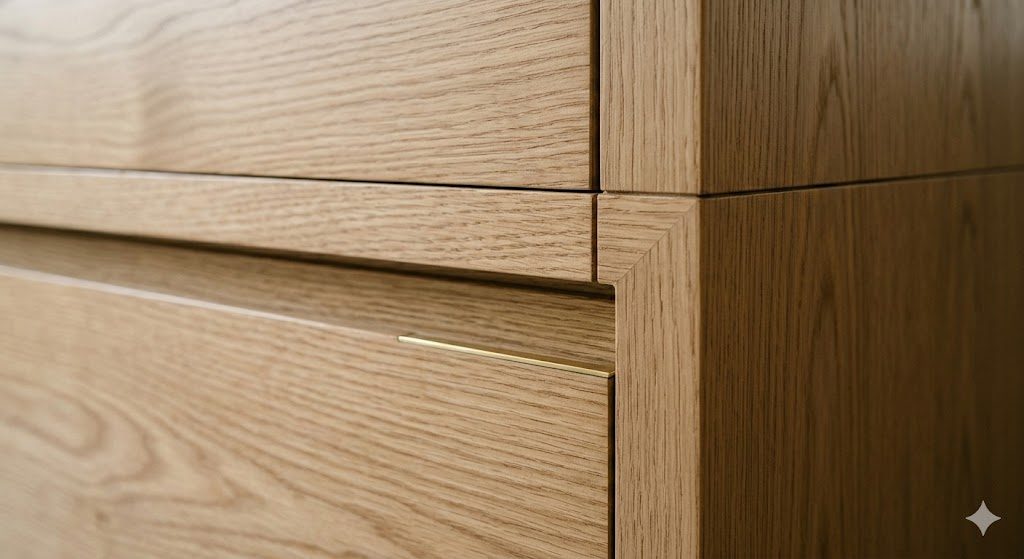
2. Craft and joinery. This is where money disappears unseen — and where most "luxury" projects quietly fail. Tight, consistent shadow gaps. Grain that runs continuously across adjacent panels (book-matching). Mitred edges with no filler. Skirting that returns cleanly, switch plates that align, doors that swing on concealed hinges and shut with a single soft sound. None of this can be photographed; it can only be supervised. Craft is the difference between furniture that is bought and furniture that is made — covered in Bespoke Furniture, Explained.
3. Proportion and volume. A 3.0-metre-plus ceiling, generous circulation, calm room ratios and considered sightlines do more for the feeling of luxury than any single finish. Proportion is the highest-leverage pillar and the one you cannot retrofit — it is decided at the plan stage, before a single tile is bought. A modest material palette in a beautifully proportioned room beats lavish finishes in a cramped one, every time.
4. Light. Daylight first — orientation, window size, modulation through jaali or overhang — then four artificial layers (ambient, task, accent, feature) each on its own dimmable circuit, warm in colour, with the source concealed. A single flat ceiling panel doing all the work is the surest sign of a non-luxury fit-out. Light is explored fully in Designer Lighting for Luxury Homes.
5. Restraint. The hardest pillar, because it costs taste rather than cash. Fewer, better things. Negative space treated as a luxury in its own right. The confidence to leave a wall bare, to use one accent metal instead of three, to let a single stone be the hero. What you leave out signals more than what you put in. This is the through-line of Luxury Minimalism in Indian Homes.
A quiet sixth test underwrites all five — provenance and longevity. Does the home look better at year fifteen than at year one? Authentic materials and real craft earn a patina; imitations only decay.
Material truth: real versus imitation
If you internalise one pillar, make it this one, because it is where the largest sums are won or lost and where the eye is most easily fooled in a photograph and least easily fooled in person.

| Authentic (true luxury) | Common imitation | How the body tells them apart |
|---|---|---|
| Natural stone slab — Italian marble, granite, Indian quartzite (18–20 mm) | Marble-look glazed vitrified tile (8–10 mm) | Stone is cool, veins run through the body; tile pattern repeats, has grout lines, feels flat |
| Solid wood / natural veneer on BWP ply | PVC foil or paper-print laminate on MDF | Real grain is continuous and can be re-sanded; print repeats and chips at edges |
| Solid brass / bronze fittings | Electroplated zinc or ABS | Solid alloy is heavy and patinas; plating is light and flakes in 2–3 years |
| Linen, wool, lime / Venetian plaster | Polyester velvet, vinyl "texture" wallpaper | Natural fibre breathes and catches real light; synthetics pill and read plastic up close |
This is not snobbery about imitation as a category — a well-laid large-format porcelain floor is a perfectly good, durable choice. The point is honesty. True luxury does not pretend. It does not pass off a foil shutter as walnut or a printed slab as Statuario. Where the budget cannot stretch to the real thing, the luxurious move is to choose a humbler material honestly (a beautiful Kota stone, a clean micro-cement) rather than a costly fake of an expensive one. For the systematic version of these trade-offs, use our Material Compare tool.
Craft, joinery and the things a camera cannot see
Two cabinets can use identical Italian-veneer faces and identical Blum hinges, cost a lakh apart, and look the same in a listing photo. In person, the difference is total. The expensive one has a 2-mm reveal held consistently along its entire length, grain that flows uninterrupted across four shutters, edges mitred so the veneer wraps the corner with no dark laminate line, and a carcass squared so every door shuts flush. The cheap one has wandering gaps, a band of edge-banding visible at every corner, and one shutter that proud-stands by a millimetre.
This is craft, and it is bought with three things: a skilled karigar or a good factory line, a designer who details the joinery in shop drawings, and relentless site supervision. It is the single biggest reason luxury costs what it does, and the single thing most likely to be value-engineered away when a client only watches the headline materials. Premium hardware is the enabler here — Blum, Hettich and Häfele soft-close runners and concealed hinges turn good joinery into something that also moves beautifully — but hardware alone cannot save sloppy carpentry. We cover the hardware decision in detail in our Premium Kitchen Hardware Guide.
In a luxury interior, you are mostly paying for work you will never see — the squared carcass, the concealed fixing, the third coat of polish, the day a karigar spent getting one joint to disappear. The visible material is the smaller half of the bill.
There is a practical test you can run before signing off any joinery: stand at a low, raking angle and look along the length of every reveal and every shutter line. Craft hides in plain view at eye level and exposes itself at a grazing angle, where a wavering gap, a proud panel or a filler-patched mitre cannot escape. Run the same test on skirting returns, the junction where stone meets joinery, and the line where the false ceiling meets the wall. A site team that can pass this test consistently is rare, and worth paying for.
Acoustic and thermal comfort: the luxury you feel but cannot see
There is a sixth thing the best homes get right that the brochure never mentions: how they sound and how they feel on the skin. Step into a genuinely luxurious room and it is quiet — the city drops away, footsteps soften, conversation does not echo. That comes from specification, not luck: laminated or double-glazed windows to cut traffic noise, denser partitions and resilient layers between rooms, soft finishes (rugs, curtains, upholstered surfaces, acoustic plaster) to tame reverberation, and door bottoms that actually seal. Thermal comfort is the twin — generous insulation, good shading, low-emissivity glass and a quietly capable HVAC layout so the home holds an even temperature without a roaring AC. These are invisible in every photograph and unmistakable the moment you are inside. They are also where genuine luxury most often parts ways with merely expensive, because they cannot be added at the styling stage; they are engineered into the build.
Proportion, volume and the feeling you cannot buy later
Of the five pillars, proportion is the cruellest, because it is the one money cannot fix after the fact. A 2.7-metre ceiling is a 2.7-metre ceiling; no finish will make it feel like 3.3. This is why genuinely luxurious apartments tend to come from developers who specified generous floor-to-floor heights, and why villa interiors — where you control the section — have an inherent advantage. We treat the apartment case in Premium Apartment Design and the villa case, across floors and double-heights, in Luxury Villa Interior Planning.
| Dimension | Standard build | Generous / luxury | Why it reads as luxury |
|---|---|---|---|
| Clear ceiling height | 2.7–2.9 m | 3.0–3.6 m | Volume above the eye signals abundance the body registers instantly |
| Main door height | 2.1 m | 2.4–2.7 m (or full-height) | A taller threshold reframes the whole entry sequence |
| Circulation / passage width | 0.9–1.05 m | 1.2–1.5 m | Space to move without negotiation feels effortless, unhurried |
| Window head height | 2.1 m | To ceiling / floor-to-ceiling | Daylight reaches deeper; the outside becomes part of the room |
Even when you inherit a fixed shell, proportion can be coaxed: align door and wardrobe heights, run joinery floor-to-ceiling to imply height, keep furniture low to let volume breathe, and resist the false ceiling that steals 150–200 mm for no reason. A Furniture Layout Designer helps you protect circulation and sightlines before anything is built.
Light: the choreography that separates the two homes
Return to those two Mumbai apartments. The single biggest reason the second one reads as luxurious — beyond any material — is that its light is choreographed. Luxury lighting is layered: a daylight strategy first, then four artificial layers, each independently dimmable, each warm (2700–3000 K), each rendering colour faithfully (CRI 90+), and crucially, each with its source concealed. You see the effect, never the fitting.
| Layer | Role | Typical fitting | The luxury detail |
|---|---|---|---|
| Ambient | Soft base glow, no glare | Cove / cornice LED, indirect | Source fully hidden; even wash, no scallops |
| Task | Focused light for an activity | Recessed spot, under-counter | Tight beam, no spill, dimmable to taste |
| Accent | Drama on texture, art, stone | Wall-grazer, picture light | Skims a surface to reveal its relief |
| Feature | The jewellery of the room | Decorative pendant / chandelier | A genuine design piece, not a catalogue stand-in |
The anti-luxury default is one flat ceiling panel — bright, shadowless, unflattering, doing the work of none of these layers. Specify each layer on its own circuit, add scene control, and the same room performs five different moods across the day. Use our Lighting Planner to map layers room by room, and go deeper in Designer Lighting for Luxury Homes.
What each budget band actually buys (India, 2026)
Cost is where most "luxury" conversations go wrong, because the word is attached to packages that are merely tidy. Here is an honest map of fit-out cost per square foot of carpet area in a metro, in 2026, excluding the shell and civil works. Treat these as typical bands, not quotes.

| Band (per sq ft, fit-out) | Tier | What it honestly buys |
|---|---|---|
| ₹2,500 – ₹4,000 | Entry / smart | Good laminate and pre-lam modular, economy branded hardware, vitrified tile, basic false ceiling, profile lights, catalogue loose furniture. Clean and functional — reads as nicely done, not luxury |
| ₹6,000 – ₹10,000 | Premium | Natural veneer and acrylic shutters, Blum/Hettich soft-close, engineered-wood flooring, Indian plus select Italian stone, layered dimmable lighting, some bespoke joinery, a designer in charge. The honest floor for luxury |
| ₹12,000 – ₹25,000+ | Bespoke / rare | Solid wood, statement Italian marble (Calacatta, Statuario), book-matched slabs, designer lighting (Flos, Vibia, Lasvit), architectural detailing, custom everything, acoustic and thermal engineering, provenance and longevity |
Two honest truths fall out of this table. First, most offers marketed as "luxury packages" actually sit in the entry band — clean, but not luxury. Second, the jump from premium to bespoke is mostly invisible: more craft, more provenance, more engineering, not more visible bling. If your budget sits below the premium floor, the smart strategy is not to spread it thin across a whole flat but to concentrate it — a deep dive lives at Budget Luxury Interiors, and you can model trade-offs with our Style Budget Calculator.
The designer and the bespoke premium
Notice that the premium band names a non-material input: "a designer in charge." This is not incidental. Above the entry tier, the single highest-return line item is design and supervision, because luxury lives in decisions — the proportion held, the joinery detailed, the light layered, the one material chosen over the three rejected — and in the discipline to execute them on site.
Bespoke is the natural language of luxury for the same reason. A catalogue sofa fits a notional room; a made-to-measure piece fits yours, in the exact fabric, depth and seat height your space and body need. Bespoke joinery turns an awkward niche into the room's best feature. The premium over catalogue is real — often 1.5 to 2.5 times — but it buys fit, longevity and a piece that is yours alone. The full economics are in Bespoke Furniture, Explained. The same logic extends to technology: in a luxury home, the smart layer should be invisible — concealed speakers, hidden sensors, a single elegant control — which we cover in Smart Luxury Homes.
Common "fake luxury" mistakes
These are the recurring tells that a home is expensive but not luxurious. Each is avoidable, and avoiding them costs nothing.
| Mistake | Why it fails | The luxury move instead |
|---|---|---|
| Marble (or marble-look) on every surface | Visual noise; no surface gets to be the hero | One statement stone, calm everywhere else |
| Three or four veneer / metal tones competing | Reads busy and uncertain | One hero material, one accent metal |
| Oversized chandelier as the only lighting idea | A feature layer with no ambient, task or accent to support it | Four layers, source concealed, feature last |
| Foil shutters, printed slabs, plated handles | Imitation decays and exposes itself in 2–3 years | Honest, humbler real materials over costly fakes |
| Every wall styled, every shelf filled | No negative space; nothing to rest the eye | Edit hard; let walls and space breathe |
| False ceiling everywhere for its own sake | Steals 150–200 mm of precious height | Drop ceilings only where services demand it |
| Catalogue furniture bought to fill, not to fit | Generic proportions, generic feel | Fewer, better, bespoke or properly chosen pieces |
The pattern across all seven is the same: doing more, and doing it loudly, in place of doing less, and doing it perfectly. The luxury instinct is subtractive. For a structured route through these choices, hotel-inspired residential design is a useful lens — good hotels solve restraint, durability and atmosphere for a living, and a residence can borrow their discipline.
Provenance and longevity
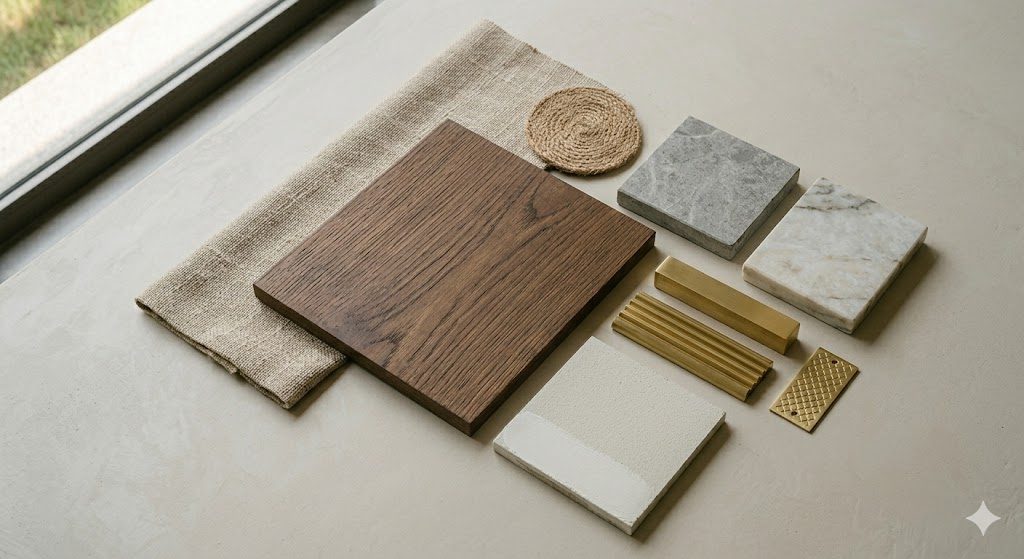
The last quiet ingredient is provenance — where a thing comes from and how it will age. A Statuario slab quarried in Carrara, a hand-knotted rug, solid teak from a known source, a lighting piece by a named designer: these carry a story and, more practically, they endure and improve. Patina is the reward of authenticity. Solid brass mellows; oak deepens; lime plaster softens; good stone earns the marks of a life lived around it. Imitation has no such future — foil peels, plating flakes, printed slabs scratch to reveal the lie underneath.
This is why longevity belongs inside the definition of luxury, not beside it. The truly luxurious home is the one that will look better in fifteen years than the day it was handed over — and that quality cannot be bought late or faked at all. To start a luxury project from your own taste rather than a trend, our Style Finder is a good first step, and the architectural foundations are laid out in Defining Luxury Residential Architecture.
The nine deep dives
This pillar is the map. Each spoke below goes deep on one decision that defines a luxurious Indian home.

1. Quiet Luxury Interior Design — restraint as the new flex: how understatement became the highest form of luxury.
2. Premium Apartment Design — achieving true luxury within the fixed shell of a high-end apartment.
3. Luxury Villa Interior Planning — choreographing interiors across floors, double-heights and indoor-outdoor thresholds.
4. Designer Lighting for Luxury Homes — the four-layer choreography of light, and the pieces worth specifying.
5. Italian Marble vs Quartz — the defining surface decision, by cost, durability and feel.
6. Bespoke Furniture, Explained — what the made-to-measure premium really buys, and when it is worth it.
7. Luxury Minimalism in Indian Homes — less, executed perfectly: the discipline behind warm, pared-back rooms.
8. Smart Luxury Homes — technology made invisible, in service of comfort rather than spectacle.
9. Hotel-Inspired Residential Design — borrowing the discipline of great hospitality for the home.
Get it right, in order
A luxurious interior is built in a sequence. Skip a step and a later one cannot recover it.
1. Lock proportion first. Protect ceiling height, door heights, circulation and sightlines at the plan stage — this is the one pillar you cannot fix later.
2. Choose one hero material. Decide the single surface the home will be remembered for, then build a calm, restrained palette around it.
3. Bring in design and supervision. Budget for a designer in charge and for site supervision — above the entry tier, this is the highest-return line item.
4. Detail the craft. Insist on shop drawings, book-matched grain, concealed hardware (Blum, Hettich, Häfele) and tight, consistent reveals.
5. Layer the light. Daylight first, then ambient, task, accent and feature — each warm, each dimmable, each with its source concealed.
6. Edit ruthlessly. Remove the third metal, the busy wall, the surplus pieces. Treat negative space as a feature you paid for.
7. Buy for longevity. Prefer honest, real, well-provenanced materials that will patina, over costly imitations that will decay.
Use our Style Budget Calculator to size each of these decisions to a realistic 2026 budget before you commit.
Luxury, in the end, is a set of decisions made with discipline and held through execution — not a sum spent. If you want to see your own taste rendered into a coherent, buildable luxury scheme before you spend a rupee, DesignAI turns a brief, a budget and a room into photoreal directions you can take to a designer or contractor — proportion, palette, light and joinery, considered together.
References
- Bureau of Indian Standards (2016) IS 1659: Block Boards and Veneered Decorative Plywood — Specification. BIS, New Delhi.
- National Building Code of India (2016) NBC 2016, Part 8: Building Services — Lighting and Ventilation. Bureau of Indian Standards.
- Illuminating Engineering Society (2021) The Lighting Handbook, 10th Edition. IES, New York.
- Pile, J. & Gura, J. (2013) A History of Interior Design. Laurence King Publishing.
- Pallasmaa, J. (2012) The Eyes of the Skin: Architecture and the Senses. Wiley.
- Indian Institute of Interior Designers (IIID) (2023) Standards of Professional Practice. IIID.
- Marble Institute / Natural Stone Institute (2016) Dimension Stone Design Manual, Version VIII. NSI.
Continue into the cluster: Quiet Luxury Interior Design, Italian Marble vs Quartz and Designer Lighting for Luxury Homes — or step back to the architecture in Defining Luxury Residential Architecture.
Export this guide
Related Guides — Deep-dive reading
The Design Decisions With the Biggest Cost Consequences
A cost-leverage map of Indian home interiors — the handful of decisions that swing your total budget the most, so you spend your attention where a single choice has an outsized rupee impact.
Cost & MoneyBudget vs Premium Interiors: What Actually Changes?
Where the extra money really goes — and where premium is just a markup
Cost & MoneyGod Is in the Details: Small Choices That Define a Home
Reveal lines, tile setting-out, alignment, hardware and hiding the ugly — the 1mm decisions that quietly make an Indian home feel considered instead of cheap.
Design PrinciplesRelated Tools — Try Free
Cross-Ventilation Analyzer
Estimate airflow and air changes per hour (ACH) from room size, window areas, layout, and local wind — with NBC 2016 Part 8 compliance check.
Ventilation CalculatorBrise-Soleil Visualizer
Interactive horizontal-louvre cut-off angle calculator — sun altitude, louvre depth, and spacing inputs with a live shadow preview. Computes θ = arctan(spacing/depth) for façade shading, ECBC envelope compliance, hospital daylight design, and tropical sun-control detailing.
Sun Shading ToolFalse Ceiling Cost Estimator
Live ₹/sqft across 8 ceiling types — POP, gypsum, designer, metal, PVC, wooden — with cove and spot lighting for 20 Indian cities.
Cost Calculator