
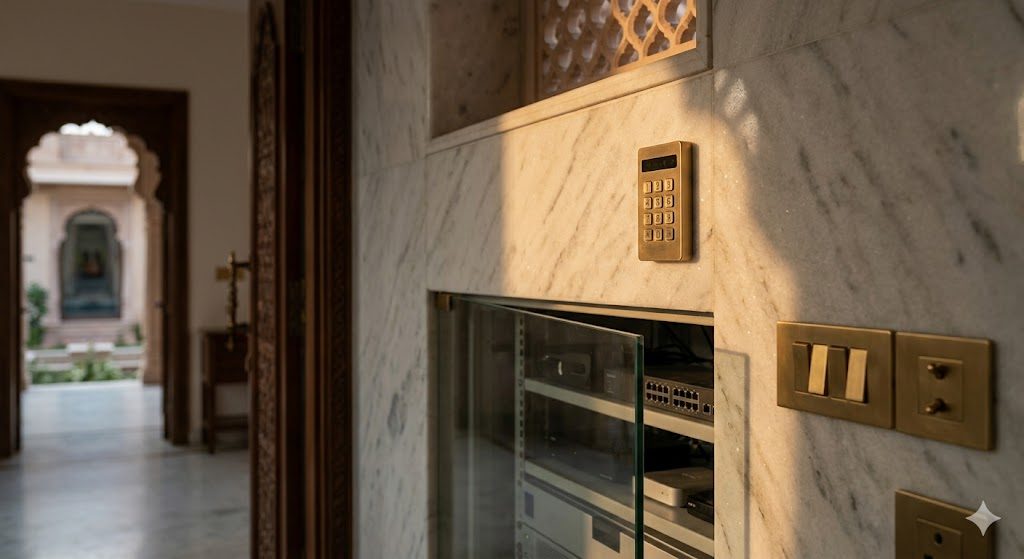
Smart Luxury Homes
Home automation done with restraint — invisible technology that elevates a luxury interior
Walk into a genuinely well-automated luxury home and you notice nothing at all. There is no wall of glowing toggles, no tablet barking for a firmware update, no guest fumbling to find a light switch. The curtains have already drawn back to the morning sun, the air is exactly 24 degrees, a low murmur of music follows you from the bedroom to the kitchen, and when you say goodnight the entire house settles in a single breath — lights off, doors locked, AC dialled back, geyser scheduled for 6am. You did not operate a smart home. You simply lived in a calm one.
This guide is about getting there: how home automation is actually planned, wired, specified and commissioned in Indian luxury residences in 2026 — the systems, the wired-versus-wireless decision, the brands across price tiers, the budget reality, and the pitfalls that turn a ₹30 lakh install into an expensive irritation. It is written for homeowners building or renovating a premium apartment or villa, and for the designers and integrators they hire.
The core idea is restraint: in a luxury home, technology should be invisible, reliable and forgettable — it should "just work" — and the surest way to achieve that is to plan the automation backbone before the first wall is plastered, not after.
The luxury automation philosophy: it just works
Mass-market "smart home" marketing sells gadgets — a voice assistant here, a Wi-Fi bulb there, a video doorbell you check on your phone. Luxury automation sells the opposite: the disappearance of effort. As we argue in our pillar guide on what defines luxury interiors in India, true luxury is not about displaying expense; it is about the absence of friction. The same principle governs technology. A guest should never sense the systems at all — only the comfort they produce.
That reframing has three practical consequences. First, reliability outranks features. A scene that works 99 percent of the time is a failure in a luxury home, because the 1 percent — the dropped command when guests are watching, the lock that will not respond in the rain — is precisely the moment that breaks the spell. Second, the interface recedes. Elegant keypads and a single phone app replace the clutter of brand-specific dongles. Third, the technology is serviced, not abandoned. A luxury install comes with an annual maintenance contract and a relationship with the integrator, the way a luxury car comes with a service plan.
A smart home shows off its technology. A luxury home hides it — the highest compliment a guest can pay is to never realise it is there.
This is the lens to apply to every decision below. If a system makes the house feel cleverer, ask instead whether it makes the house feel calmer.
The systems: what actually gets automated
A full luxury install integrates six families of systems under one controller. You do not need all of them on day one, but the backbone should be planned to carry all of them.
| System | What it controls | Why it matters in luxury | Typical India spec |
|---|---|---|---|
| Lighting & scene control | Dimming, colour temperature, scenes, circadian tint | The single biggest mood lever; ties to layered design | DALI or wired dimmers, keypads, no visible drivers |
| Motorised shades | Curtains, roller blinds, blackout, sheers | Privacy, glare, solar heat, theatre of the reveal | Somfy, Lutron, Häfele tubular motors, hidden tracks |
| Climate / HVAC | VRF/VRV AC, thermostats, humidity, fresh air | Comfort and energy; zoned so empty rooms cost nothing | Daikin/Mitsubishi VRF with BMS or KNX gateway |
| AV & multi-room audio | Streaming, home cinema, distributed speakers | Music that follows you; a true theatre room | Sonos, Denon HEOS, B&O, in-ceiling/in-wall speakers |
| Security & access | Video door, CCTV, smart locks, intrusion, gate | Safety without a guard at every door | Hikvision/CP Plus CCTV, Yale/Godrej locks, video DB |
| Energy / solar | Rooftop solar, battery, net meter, load monitoring | Visibility and control of a ₹20–40k/month bill | Inverter app + energy meter into the dashboard |
Two sub-systems deserve their own mention because they are increasingly requested in Indian villas. Smart bathrooms — sensor-flush WCs, thermostatic showers with preset temperatures, mirror demisters and mood lighting (Kohler, TOTO, Jaquar's premium ranges) — turn a bathroom into the spa experience we detail in our luxury bathroom moodboards guide. Automated wardrobes — motorised lift rails, sensor-lit interiors, and jewellery drawers with biometric locks (Häfele, Hettich) — bring the boutique into the dressing room; see our wardrobe finish ideas for the cabinetry that houses them.
Lighting is the system most worth getting right, because it carries the most emotional weight and integrates with everything else. The four-layer approach and the scene logic behind it are covered in depth in our companion guide on designer lighting for luxury homes — automation is the nervous system that makes those layers move.
Wired vs wireless: the decision that defines the install
This is the fork in the road. Get it wrong and no amount of premium hardware will rescue the experience.
A wired (structured) backbone runs dedicated low-voltage control cable — typically a KNX bus, or a proprietary Lutron, Crestron or Control4 network — alongside Cat6/Cat6A data cabling, all terminating in a central rack. Commands travel on their own wire, so they are deterministic: press a keypad and the response is sub-second, every time, regardless of how many phones are on the Wi-Fi. This is the standard for any serious luxury home, and it is non-negotiable for lighting, shades and climate.
A wireless (retrofit) backbone leans on Wi-Fi, Zigbee, Z-Wave, Thread/Matter and Bluetooth, coordinated by a hub and apps such as Apple Home, Amazon Alexa or Google Home. It is the right answer for a finished apartment or a rental where you cannot open walls — and a sensible choice for "leaf" devices like a single smart plug or a battery sensor even in a wired home.
| Dimension | Wired (KNX / Lutron / Crestron) | Wireless (Zigbee / Matter / Wi-Fi) |
|---|---|---|
| Response | Deterministic, sub-second | Variable; lag and drop-outs under load |
| Reliability | Very high; no RF congestion | Depends on Wi-Fi health and battery state |
| Service life | 15–20 years | 3–5 years before app/cloud churn |
| When to install | Before civil work (conduiting) | Any time, on a finished home |
| Vendor lock-in | Low with open KNX; higher with proprietary | Reducing as Matter matures |
| Cost band | ₹400–800+ per sq ft | ₹150–350 per sq ft |
| Best for | New villas, full renovations | Apartments, rentals, leaf devices |
The luxury default is therefore a hybrid with a clear hierarchy: a wired bus for the load-bearing systems (lighting, shades, HVAC, security) and wireless only at the edges for convenience devices. The mistake is to invert this — to run a whole villa on Wi-Fi bulbs and smart plugs and call it automation. It will work in the showroom and fail on a humid Bengaluru evening when forty devices are fighting for the same router.
Plan before the plaster: automation in the civil sequence
The most expensive automation mistake in India is timing. Owners decide on automation after the slab is poured, the walls are up and the false ceiling is closed — by which point retrofitting a wired backbone means chasing walls, breaking ceilings and a 30 percent cost penalty for half the result.
A wired luxury install has to be designed during the architectural and MEP stage, alongside electrical and plumbing. Three things must be reserved before civil work:
1. Conduiting — empty PVC conduits with pull-wires from every keypad, motor, sensor and AV point back to the rack, sized with spare capacity for future runs.
2. A control room or rack — a ventilated, ideally air-conditioned cupboard (even 3x3 feet) housing the controller, network switches, AV matrix, UPS and patch panels. Heat kills electronics; this room cannot be an afterthought in a shoe cupboard.
3. The network backbone — Cat6A home runs to every room, a managed PoE switch, and a fibre or high-throughput core so the data network never becomes the bottleneck.
This is why the integrator belongs in the room with the architect and interior designer from day one — the same coordination discipline we describe for premium apartment design, where services have to be choreographed before finishes are committed. Decisions about where a curtain track hides, how a speaker disappears into the ceiling, and where a keypad sits at the perfect height are interior decisions as much as technical ones.
| Project stage | Automation action | Consequence if skipped |
|---|---|---|
| Concept / design | Integrator briefed; scene list drafted | Backbone undersized for the brief |
| Structure / MEP | Conduits, rack location, home runs laid | Costly wall-chasing later |
| Electrical first fix | Bus cable, motor points, keypad boxes | Wireless-only fallback |
| False ceiling | Speaker, sensor and shade-track provisions | Visible surface-mounted devices |
| Finishing | Keypads, drivers, terminations | — |
| Handover | Commissioning, scene programming, AMC sign-off | Half-working "smart" home |
To pressure-test your own scope and budget before briefing an integrator, our smart home cost calculator lets you model rooms, systems and tiers against realistic 2026 bands.
Integration and scenes: one app, one breath
The point of integration is that the six systems stop being six. Lighting, shades, climate, audio and security collapse into a single layer of control — elegant keypads on the wall, one app on the phone, and a small set of scenes that do the thinking. A scene is a single command that orchestrates dozens of devices at once.
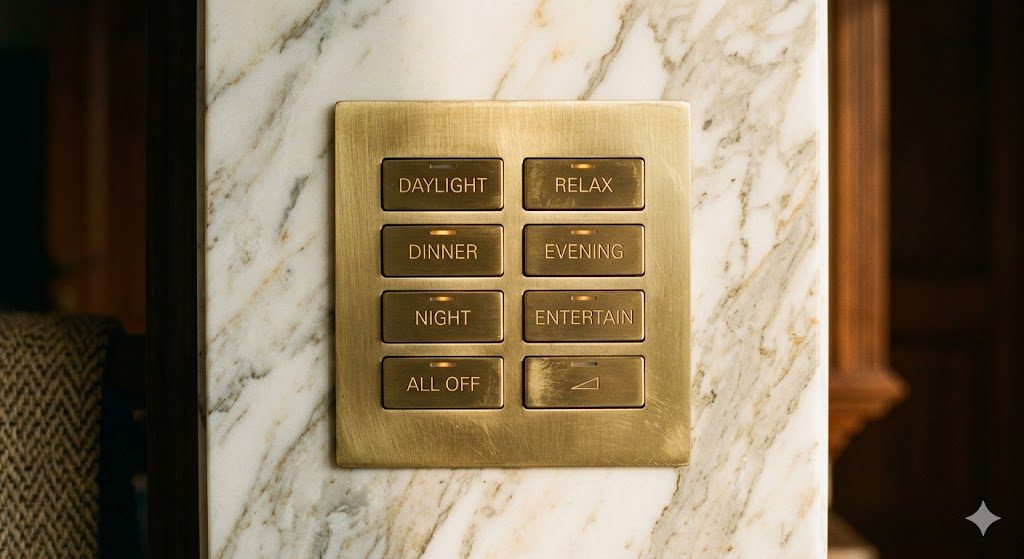
| Scene | What it does | Triggered by |
|---|---|---|
| Morning | Sheers open, warm lights rise, geyser on, soft music | Time / first motion |
| Party | Accent lighting, terrace shades open, multi-room audio synced | Keypad / app |
| Movie | Lights to 10 percent, blackout blinds down, AV powers up | Keypad / voice |
| Away | All off, AC eco, perimeter armed, occupancy simulation | Geofence / lock |
| Goodnight | Whole house off, doors locked, bedroom dimmed, alarm set | Bedside keypad |
The discipline is to keep the scene set small and memorable — five to seven scenes a family actually uses, not forty nobody remembers. Voice control (Siri, Alexa) and app control should be the convenient extras; the wall keypad, placed exactly where the hand expects it, remains the primary interface. A guest should be able to turn on a light without a tutorial.
Reliability, redundancy and dodging obsolescence
Luxury is reliability, and reliability in a connected home is engineered, not assumed. Four safeguards separate a professional install from a hobbyist one:
- A UPS on the rack so the controller, network and access systems ride through India's routine power cuts and DG changeover gaps. A villa should also keep automation on the backed-up DG/inverter circuit.
- Local control that survives the cloud. Lighting, shades and locks must keep working from the keypad even when the internet is down. Cloud-only systems that go dark during an ISP outage have no place in a luxury home.
- Graceful fallback. Every motorised shade has a manual override; every smart lock has a physical key; every automated light can be switched conventionally. Automation should add options, never remove the basic one.
- Open standards and documentation. A KNX bus or a well-documented Matter setup outlives any single vendor's app. Insist on as-built drawings, a device schedule, and exported configuration files handed over at commissioning — so a future integrator can service the home without starting from scratch.
Obsolescence is the quiet enemy. Choose the backbone (KNX, Lutron, Crestron) for permanence and treat consumer leaf devices as replaceable. The wiring should be designed to last twenty years; the gadgets plugged into it can change every five.
Brands and tiers: what to specify, and at what price
The Indian market spans a wide range, from affordable retrofit kits to integrator-only systems that never appear on a shelf. The ladder below maps the three realistic tiers.
| Tier | Per sq ft | 4,000 sq ft villa | Backbone | Representative brands |
|---|---|---|---|---|
| Entry | ₹150–300 | ₹3–8 lakh | Wireless retrofit | Wipro, Syska, Philips Hue, Schneider Wiser, Apple Home |
| Mid | ₹300–500 | ₹8–20 lakh | Hybrid, part-wired | Häfele, Legrand, Schneider, GM modular |
| Luxury | ₹500–800+ | ₹20–40 lakh+ | Fully wired bus, control room | Lutron, Crestron, KNX, Control4, Bang & Olufsen |
A few notes on what these brands actually are. Lutron is the global benchmark for lighting and shade control — its keypads and motorised shades are a luxury signature. Crestron and Control4 are full-home integration platforms sold and programmed only through certified integrators. KNX is an open, vendor-neutral wired standard (used by ABB, Schneider, Gira and others) prized because it is not locked to one company. Bang & Olufsen sits at the top of AV, as much furniture as electronics. In the mid-tier, Häfele and Legrand offer well-supported India-wide systems that an interior contractor can deliver, while Schneider Wiser bridges entry and mid. These price bands sit alongside the wider material and finish choices in our premium apartment design guide — automation is one line in a larger luxury budget, not the whole story.
If your project is an apartment rather than a villa, or you are weighing how far to take automation against the rest of the fit-out, our broader smart home design guide for India covers the apartment-scale playbook and the off-the-shelf systems that make sense without opening walls.
Privacy and cybersecurity: the unglamorous essentials
A luxury home is also a target. A connected home full of cameras, microphones and door locks is a privacy and security surface that has to be hardened — quietly, as part of the install.
- Segment the network. Put automation and IoT devices on a separate VLAN from family laptops and phones, so a compromised camera cannot reach your banking session.
- Change every default. Default passwords on CCTV NVRs and routers are the single most exploited weakness in Indian homes; the integrator must set strong, unique credentials and enable two-factor on the controller app.
- Keep firmware current. A serviced home with an AMC gets security patches; an abandoned one accumulates known vulnerabilities.
- Mind the microphones. Voice assistants and always-listening devices should be a deliberate, informed choice — and absent from bedrooms and studies where they are not wanted.
- Local storage for cameras. Prefer on-premise NVR recording over cloud-only feeds for sensitive areas, and know exactly which footage leaves the house.
None of this is glamorous, but the absence of a breach is precisely the kind of invisible reliability that defines luxury.
The pitfalls that ruin a luxury install
| Pitfall | What goes wrong | The fix |
|---|---|---|
| Over-automation | Forty scenes nobody remembers; toddlers locked in tech | Five to seven scenes; keep manual overrides |
| Poor commissioning | Hardware installed but never properly programmed | Pay for commissioning; insist on a sign-off scene test |
| No AMC | System rots; no patches, no support | Annual maintenance contract from day one |
| Wireless-only villa | Lag and drop-outs under load | Wired bus for load-bearing systems |
| Voice-control gimmicks | Demo magic that fails in daily use | Voice as extra, keypad as primary |
| No documentation | Future service starts from zero | As-builts, device schedule, config files at handover |
| Skipping the rack room | Overheating, hidden faults | Ventilated, ideally cooled control room |
The thread running through every failure is the same: treating automation as a product to buy rather than a system to design, commission and maintain.
Get it right, in order
1. Decide early. Bring the integrator into the design table alongside the architect and interior designer, before structure.
2. Choose the backbone. Wired KNX/Lutron/Crestron for a new villa; honest hybrid or quality wireless for a finished apartment.
3. Reserve the infrastructure. Conduits with spare capacity, a ventilated control room, and Cat6A home runs to every space.
4. Write the scene list. Define the five to seven scenes the family will actually live by, then specify hardware to serve them.
5. Specify to tier and brand. Match Entry / Mid / Luxury hardware to budget; keep load-bearing systems wired, leaf devices replaceable.
6. Commission properly. Pay for programming and a full scene test at handover; collect as-builts, schedules and config files.
7. Sign an AMC. Lock in maintenance, firmware patches and support so the home stays effortless for twenty years.
Planning a luxury home and want to see how automation, lighting, materials and layout come together before you commit a rupee? DesignAI lets you visualise a fully resolved interior — scenes, finishes and mood — and stress-test the choices against realistic Indian budgets, so the technology you specify disappears into a calm, coherent home rather than announcing itself.
References
- Bureau of Indian Standards (2016) IS 732: Code of Practice for Electrical Wiring Installations. BIS, New Delhi.
- Bureau of Indian Standards (2016) National Building Code of India (NBC) 2016, Part 8: Building Services. BIS, New Delhi.
- KNX Association (2024) KNX System Specifications and Handbook for Home and Building Control. KNX Association, Brussels.
- Lutron Electronics (2024) Residential Lighting and Shading Control: Design Guide. Lutron Electronics Co.
- Illuminating Engineering Society (2021) The Lighting Handbook, 10th Edition. IES, New York.
- Connectivity Standards Alliance (2024) Matter Specification, Version 1.3. CSA.
- Bureau of Indian Standards (2019) IS 16819: Information Security Controls for IoT. BIS, New Delhi.
Part of the Studio Matrx Luxury Interiors series — read the pillar on what defines luxury interiors in India, then explore designer lighting for luxury homes and the premium apartment design guide.
Export this guide
Related Guides — Deep-dive reading
Smart Home Design for Architects & Designers (India)
The smart layer is an architectural system, not an accessory bought after handover. Here is how to design it at concept and schematic stage, coordinate with your MEP consultant and integrator, and produce drawings that a contractor can actually build.
Smart HomeComplete Guide to Security System Cybersecurity in India (2026): Protecting the Systems That Protect You
The cameras, locks, alarms and door phones you install to feel safer are internet-connected computers that can themselves be attacked, and an insecure one is worse than none. This pillar maps the whole attack surface — devices, network, accounts and data, operations — and points to every guide that hardens it.
SecuritySmart Home Security Systems in India: CCTV, Sensors, Alarms & AI
How to think in layers — perimeter, entry, interior — and build a system that actually protects an Indian home: AI cameras, video door phones, door and glass-break sensors, alarms, panic buttons, gate automation, monitoring and DPDP-aware privacy, with real brands and rupee costs.
Smart HomeRelated Tools — Try Free
Smart Home Cost Calculator
13 device categories across 5 ecosystems (Apple HomeKit, Alexa, Google Home, Mi, Wipro). Live floor-plan that lights up as you add devices, per-room and per-category breakdown.
Smart Home CalculatorFalse Ceiling Cost Estimator
Live ₹/sqft across 8 ceiling types — POP, gypsum, designer, metal, PVC, wooden — with cove and spot lighting for 20 Indian cities.
Cost CalculatorSecurity Cabling & PoE Planner
Estimate cable length, drops, PoE power budget, the right switch, conduit and cost for a CCTV/security cabling plan.
Cabling Planner