
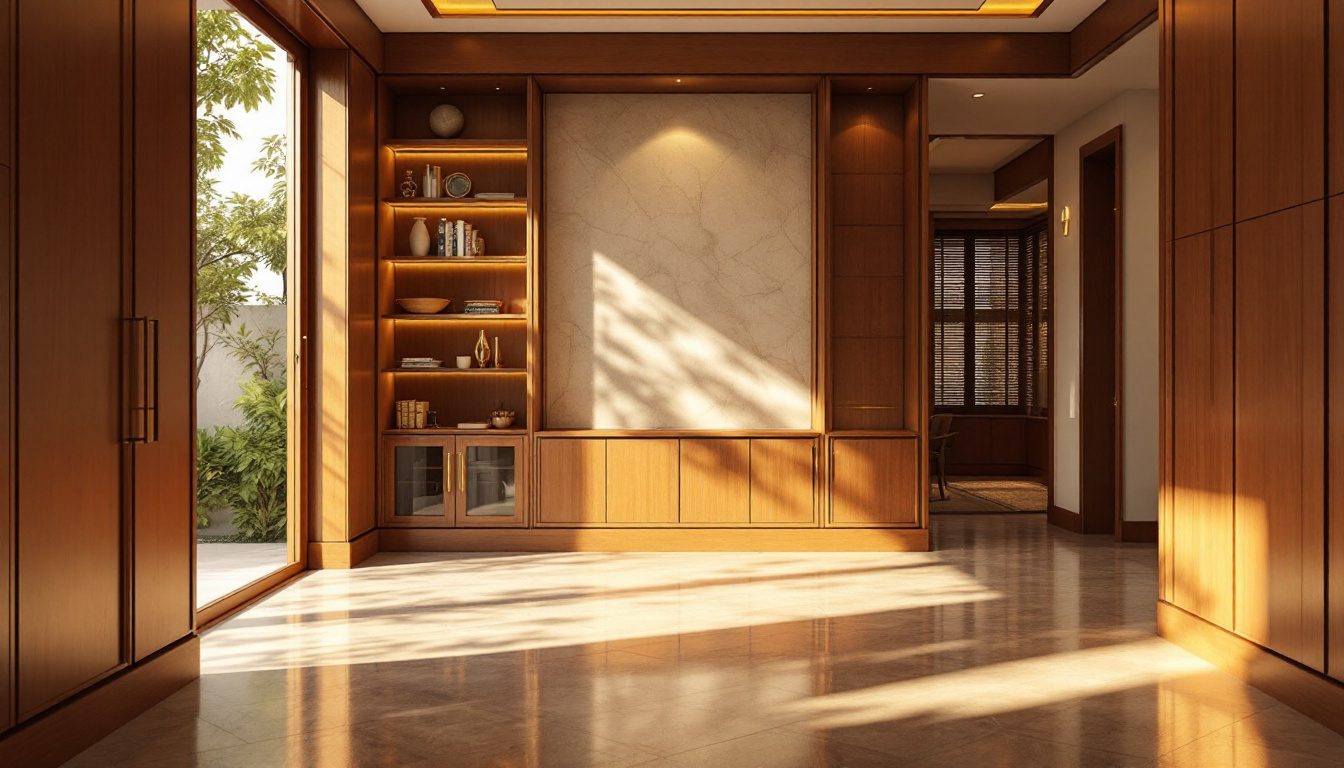
God Is in the Details: Small Choices That Define a Home
Reveal lines, tile setting-out, alignment, hardware and hiding the ugly — the 1mm decisions that quietly make an Indian home feel considered instead of cheap.
Two homes can have the same floor plan, the same marble, the same sofa and the same budget — and one feels considered while the other feels cheap. Nothing in the brochure explains the difference. It is not the big moves; it is the thousand small ones: whether the skirting meets the floor with a crisp shadow line or a smear of caulk, whether the switchboard sits at the same height as its neighbour, whether the tile at the wall is a full tile or a sad two-centimetre sliver, whether the AC pipe runs in a neat duct or dangles down the facade like a vine. You feel all of this before you can name any of it.
This guide is about those small choices — the reveal lines and shadow gaps, the way two materials meet, the alignment of door heights and switch plates, the quality of the handle you touch fifty times a day, the discipline of hiding the ugly. It is the most overlooked layer of home-making in India, partly because builders have every incentive to skip it and partly because we have been trained not to expect it. Yet it is precisely the layer that separates a home that feels designed from one that merely got built.
A home is judged not by its grand gestures but by its junctions — the 1mm decisions about how things meet, line up, and disappear are what the eye reads as quality, long before it reads anything else.
The phrase and what it really means
"God is in the details" travels under the name of Ludwig Mies van der Rohe, the architect who reduced buildings to steel, glass and obsessive precision. The line is older than him — the art historian Aby Warburg used it, Gustave Flaubert circled the same idea — and its meaning has flipped over the years between "the divine reveals itself in small things" and the rueful "the devil is in the details." Both readings are about the same thing: the quality of a whole is decided by the parts nobody photographs.
Mies meant it almost literally. His Barcelona Pavilion has no ornament to hide behind; everything is the way one polished stone slab meets another, the way a joint is honoured rather than concealed. Strip away decoration and the only thing left to get right is the junction. That matters even for a modest Indian flat, because most modern interiors are, by intention, plain — and a plain interior has nowhere to hide a bad detail.
The opposite of a detailed home is not an ugly home. It is a home full of small unresolved compromises that each seem too minor to fix: the gap filled with putty, the misaligned tile, the cable taped to the wall "for now." None of them is a disaster. Together they are the reason a space feels, in a word people use without quite knowing why, cheap. Quality is the sum of decisions that were each individually skippable.
Reveals, shadow gaps and how things meet
The single most powerful detail in modern interiors is the reveal — a deliberate small recess or shadow gap where two surfaces meet, instead of forcing them flush. A shadow gap between the skirting and the wall, between the false ceiling and the wall, between a cabinet and the floor, does three things at once. It catches a thin line of shadow that reads as a crisp, intentional edge. It hides the imperfection that is inevitable where two materials of different behaviour meet. And it lets each material move — expand, settle, get re-painted — without cracking against its neighbour.

Compare the two ways the same skirting can meet the same wall. The butt joint pushes the skirting hard against the plaster; the two never align perfectly, so a painter fills the gap with caulk, which cracks within a year, leaving a wavering grey line at ankle height across every room. The shadow-gap reveal sets the skirting back a few millimetres or leaves a recessed channel, so the meeting is a clean dark line by design — no caulk, no crack, no apology. It costs a little more in carpentry and demands a builder who measures, and it is the clearest single tell of whether a home was detailed or just assembled.
The same logic governs every place two materials meet. A flooring transition — vitrified tile to wooden flooring, marble to a carpeted bedroom — is one of the most-walked junctions in a house, and it is routinely botched with a cheap aluminium strip that lifts at the corner and trips you. A proper transition is set out so the two floors meet at a doorway threshold, at the same finished level (no toe-stub step), with a flush brass or stone profile that is fixed, not stuck. The edge profile of a marble or granite countertop tells the same story: a sharp square arris chips and cuts; a small bevel, a bullnose or a mitred drop-edge reads as deliberate and lasts.
The eye does not read materials; it reads junctions. You can buy the most expensive marble in India and a bad edge profile will make it look like a remnant — and a humble Kota stone with a clean mitred edge will look like money.
Setting out: the war against the sliver
There is a recurring small tragedy in Indian tiling, and once you have seen it you cannot unsee it: a beautiful wall of large-format tiles, and then, at the far corner, a thin two-centimetre sliver where the last tile was cut to fit. It is a failure of setting out — the planning step where a good tiler decides, before laying a single tile, where the grid will start so the cuts fall evenly and generously, not as a starved offcut at the most visible edge.

The rule is simple and almost never followed by a hurried mason: set out from the centre, or from the most-seen line, so the cut pieces are equal and at least half a tile wide. Centre the floor grid on the room or the doorway sightline; centre the wall behind the basin on the basin, not on a random corner; let the cuts die quietly at the least-seen edge. The same discipline applies to grid alignment between floor and wall tiles in a bathroom — when the floor joints run into the wall joints rather than colliding at a random offset, the whole room snaps into order.
Setting out is free. It costs only an hour of thinking before work starts, which is exactly why it gets skipped: the mason is paid by area laid, not by where he started. This is the kind of decision worth weighing deliberately, and our design trade-off helper is built for these "spend an hour now or live with it for years" calls. Setting out is the cheapest quality you will ever buy.
| Detail | The cheap default | The considered choice | What it costs |
|---|---|---|---|
| Skirting to wall | Butt joint, caulk-filled, cracks | Shadow-gap reveal or recessed channel | A little carpentry, a careful builder |
| Flooring transition | Stuck-on aluminium strip that lifts | Flush brass/stone profile at the threshold, same level | Setting-out thought + a better profile |
| Tile setting-out | Start at a corner, sliver at the wall | Centre the grid, equal cuts, none under half | One hour of planning, free |
| Stone/marble edge | Sharp square arris, chips and cuts | Bevel, bullnose or mitred drop-edge | Fabricator time, modest |
| Floor-to-wall tile joints | Random offset, joints collide | Joints aligned, floor runs into wall | Layout discipline, free |
Alignment and the silent grid
Walk into a room that feels resolved and you are, usually, looking at an invisible grid that someone enforced. Door heights line up with the top of the wardrobe and the top of the window. Switch plates sit at one consistent height and one consistent distance from the door frame across the whole home. The TV unit, the artwork above it and the console are centred on the same vertical line. None of this announces itself; you simply feel that nothing is fighting anything else.

The discipline behind this is borrowed straight from architecture: pick a few datum lines and make as many elements as possible touch them. The common one is the door-head line — set the top of the doors, windows and wardrobe shutters all to the same height (commonly 2.1 metres), and the wall above becomes a single calm band instead of a jagged skyline. Switchboards are the everyday version of the idea: agree one centre-line height for switches (around 1.2 m) and sockets, keep every plate a fixed distance from the door architrave, and never let an electrician place them by eye. The Gestalt psychologists would call this the law of continuity and alignment; you will just call it tidy.
Sightlines deserve the same care. Stand at the front door and look through: what you see lined up — or not lined up — sets the tone for the whole home. A corridor that frames a window or a piece of art at its end feels composed; one that ends in a switchboard and an awkwardly placed AC unit feels accidental. This is where small detail meets big planning, and connects to the questions of proportion and human fit in our companion guide on scale and human comfort, and to the idea of a home that simply feels coherent in why a home feels right.
The things you touch: hardware, switches, taps
Some details you only see. Others you touch every single day, and those carry a quality signal out of all proportion to their cost. The handle of your main door, the switch you press the moment you wake, the tap you turn a dozen times, the drawer that either glides shut or slams and bounces — these are the home's handshake. A flimsy switch with a hollow click, a tap that wobbles, a handle whose chrome flakes in a season: each is a small daily disappointment that tells you someone economised where you would notice most.
The economics here are kinder than people fear. Upgrading from the cheapest builder-grade modular switches to a good range across a 2BHK might cost a few thousand rupees more in total — a rounding error against years of pressing them. Soft-close hinges and drawer channels, a solid main-door lever, taps with a ceramic-disc cartridge rather than a rubber washer that drips within months: these are the highest return-on-feeling spends in the whole home. The principle is to spend on what your hand meets and your eye rests on, and economise on what is hidden — the inside of a storage loft does not need premium anything.
| Touched daily | Cheap version's tell | Worth the upgrade because |
|---|---|---|
| Light switches | Hollow click, plate yellows | Pressed thousands of times; small cost across the home |
| Main-door handle | Loose, chrome flakes | The literal first touch; sets expectation |
| Taps / mixers | Wobbles, washer drips in months | Ceramic-disc cartridge lasts years, no drip |
| Drawers / shutters | Slam and bounce, sag in a year | Soft-close glides feel premium every use |
| Wardrobe / cabinet pulls | Sharp edges, work loose | Hand contact dozens of times a day |
Hiding the ugly: India's exposed-conduit problem
No detail problem is more visibly Indian than the exposed service. The bunch of wires stapled across the wall to a new plug point. The DTH and broadband cables taped down the corridor and out through a drilled hole. The water-purifier tube snaking across the kitchen wall. The split-AC copper pipe and drain hose running down the facade, dripping onto whatever is below. And the great national emblem of the unplanned home — the inverter and its battery, parked in the passage with its tangle of cables, because nobody made it a place.
These are not poverty; expensive flats have them too. They are a failure of anticipation — of asking, before the plaster goes on, where every service will live. The fix is almost always concealment by planning, not hiding after the fact. Route wiring in chased conduits decided at the slab stage. Give the inverter, modem and meter a dedicated ventilated cabinet near where the cables already arrive. Run AC copper inside a wall chase or neat external trunking painted to match, with the drain piped to a proper outlet, not left to weep on the balcony. Carry the RO and gas lines inside the cabinetry. A home where you cannot see a single loose cable does not feel sterile — it feels, immediately and unmistakably, finished.
The deeper point is that detailing is mostly a sequencing discipline. Almost every ugly exposed service exists because a decision was made too late — after the wall was closed, after the floor was laid. The home that feels considered is the one where someone thought about the small things early, while they were still cheap to get right. There is even a memory dimension to this: the homes we remember as warm and whole, explored in our guide on why a home feels like home, are rarely the ones with the grandest finishes — they are the ones where nothing jarred.
Restraint: skirting, cornices and grout
A surprising amount of detailing is knowing when to stop. The instinct in many Indian interiors is to add — a chunky 6-inch skirting, a heavy gypsum cornice with three steps of moulding, a multi-level false ceiling that drops the room and dates it within a few years. More ornament is read as more value. Usually it is the opposite: a slim, restrained skirting, a simple cornice or none at all, a single clean ceiling plane — all read as more confident and more expensive than the busy version, because they let the proportions and materials speak.
Grout is the tiny decision that proves the rule. A grout matched closely to the tile makes the surface read as one calm plane; a contrasting white grout on a dark floor turns every joint into a grid you cannot ignore — and, worse, a light grout on a kitchen or bathroom floor goes grey and grubby in a year and looks unclean forever after. Choose grout colour as deliberately as tile colour, lean a shade darker for floors, and you have spent nothing for a result that looks maintained for a decade.
Restraint extends to the railing, another classic Indian failure point: the loose mild-steel balcony or staircase railing, under-fixed and over-decorated, that rattles when you lean on it. A railing is leaned on and trusted with safety — it should feel utterly solid and look quiet, not ornate and wobbly. The same is true of jaali and joinery: done as real craft — a stone or timber jaali with consistent openings, a door with honest joints — they carry a building; faked thin, they cheapen everything around them. Christopher Alexander, in "A Pattern Language," argued that the small patterns — the trim, the edge, the way a thing is made — are where a building gains or loses life; the big diagram is only the beginning.
| Element | The over-done version | The restrained, considered version |
|---|---|---|
| Skirting | Chunky 6-inch, busy moulding | Slim 2–3 inch, or flush shadow-gap |
| Cornice / ceiling | Multi-step gypsum, multi-level drop | Simple cornice or none; one clean plane |
| Grout | Bright contrast, light on floors | Matched to tile, a shade darker on floors |
| Railing | Ornate, under-fixed, rattles | Quiet design, solidly anchored |
| Jaali / joinery | Thin, faked, decorative-only | Real craft, consistent, structural-honest |
What this means for your home
1. Treat junctions as the project, not the leftover. Before finishes are ordered, decide how skirting meets wall, how floors transition at doorways, and what edge profile every stone gets. These decisions made early are cheap; made late they are impossible.
2. Demand setting-out before tiling. Insist your tiler dry-lay or chalk the grid so cuts are centred and at least half a tile wide, and floor joints run into wall joints. It costs an hour and is the single highest-value free decision in the build.
3. Enforce a grid. Pick datum lines — a door-head height of 2.1 m, a switch centre of about 1.2 m, a fixed distance from architraves — and make doors, windows, wardrobes and switch plates obey them. Walk the sightlines from the front door and resolve what you see.
4. Spend on what you touch. Upgrade switches, the main-door handle, taps with ceramic-disc cartridges, and soft-close drawers. Economise on the hidden. This is the best return-on-feeling money in the home.
5. Make a place for every service first. Give the inverter, modem, meter and RO a planned, ventilated home; chase wiring and AC copper into walls and trunking. A home with no visible loose cable simply reads as finished.
6. Choose restraint. A slim skirting, a single clean ceiling, grout matched to the tile and a shade darker on floors, a railing that is solid rather than ornate — confidence reads as quality.
7. Sequence early. Almost every detail you regret was decided too late. Detailing is, more than anything, the habit of thinking about small things while they are still cheap to get right.
How Studio Matrx helps
The hardest part of detailing is seeing it before it is built — imagining whether a shadow gap, a centred tile grid, or an aligned door-head line will actually feel better than the default. DesignAI lets you visualise your rooms with these choices in place — junctions, alignments, edge profiles, concealed services and restrained trim — so you can feel the difference between a home that was assembled and one that was detailed, before a single tile is cut or a single conduit is chased.
References
1. Mies van der Rohe, L. — attributed aphorism "God is in the details"; on the honouring of joints and junctions in modern architecture (see the Barcelona Pavilion, 1929). The phrase is also traced to Aby Warburg and echoes Gustave Flaubert.
2. Alexander, C., Ishikawa, S. & Silverstein, M. (1977). A Pattern Language — on small patterns, trim and edges as the source of a building's life (e.g. patterns on "Ornament" and the making of edges).
3. Ching, F. D. K. Building Construction Illustrated and Architecture: Form, Space, and Order — on junctions, reveals, datum lines and the reading of alignment.
4. Wertheimer, M., and the Gestalt school — laws of grouping, continuity and alignment that explain why aligned elements read as calm and ordered.
5. Bureau of Indian Standards. National Building Code of India 2016 — for service routing, electrical conduit and safe railing/parapet provisions.
6. Neufert, E. Architects' Data — standard heights for switches, sockets, door heads and the dimensional norms behind a consistent grid.
Part of the Studio Matrx Design Principles series. Continue with why a home feels right, scale and human comfort in Indian homes, why a home feels like home, and the cluster pillar on design principles over magazine examples.
Export this guide
Related Guides — Deep-dive reading
Minimalist Door Designs in India (2026): Flush, Frameless & Concealed-Frame Doors
The clean-line, no-architrave, hidden-hardware door language behind modern Indian apartments and designer interiors — flush-to-wall doors, concealed hinges, recessed pulls, tall leaves and what the look really costs.
Home Doors & EntrancesStorage Planning Before Interior Design
Why storage must be planned first — audited, budgeted and given its floor area — before a single layout, colour or sofa is chosen. The homeowner's plan-it-first master guide for Indian homes.
StorageThe Trade-Offs Every Homeowner Has to Make
No one gets everything — every home is a stack of compromises. This is about the sacrifices: the cost-quality-time triangle, the recurring homeowner trades, and how to make your cuts on purpose instead of having them forced by a blown budget.
Planning Your ProjectRelated Tools — Try Free
Flooring Cost Calculator
Estimate the all-in cost of a floor — material, laying, wastage, skirting and GST — by area and material.
Flooring CalculatorInterior Layout Planner — Printable Graph Grid
Printable graph grid to sketch room layouts to scale before committing to furniture placement.
Layout ToolModular Kitchen Budget Calculator
Live breakdown by running feet, countertop area, material tier and city — with wastage, design fee, GST.
Kitchen Calculator