
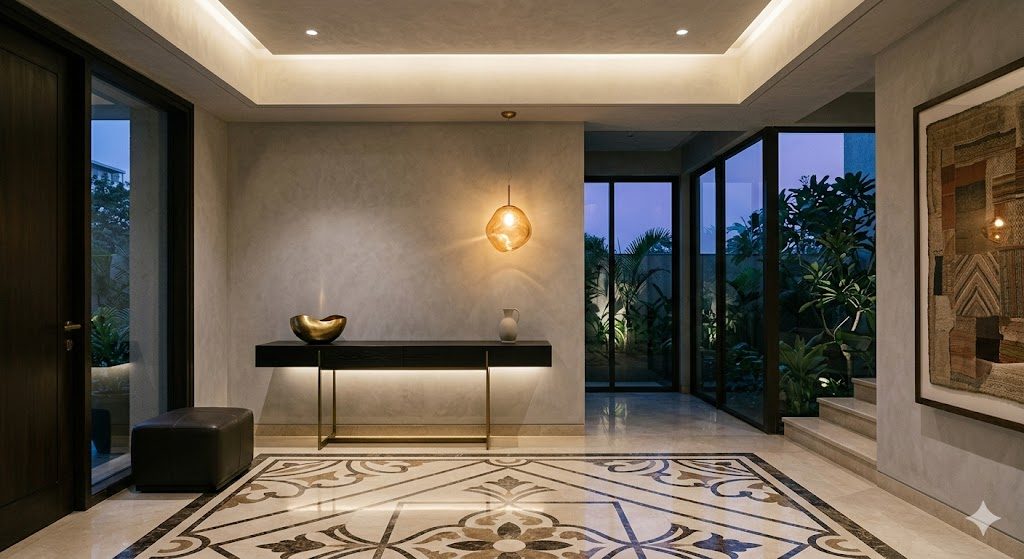
Premium Apartment Design Guide
Designing high-end interiors within the constraints of an Indian luxury apartment
Walk into a ₹9 crore apartment on the 31st floor of a Lodha tower in Lower Parel, and the building has already made most of the decisions for you. The slab is poured. The ceiling sits at 3 metres, not the 3.6 a villa would give you. The plumbing risers, the window line, the façade, the balcony railing — none of it is yours to move. And yet the best of these homes feel unmistakably luxurious the moment the door opens. That gap, between a fixed concrete shell and a home that reads as serious money, is entirely the work of interior design.
This guide is about closing that gap. It covers what actually defines a "premium apartment" in India in 2026, the specific constraints that separate apartment luxury from villa luxury, and exactly where to spend — foyer, living-dining, kitchen, master suite, the powder room as a jewel box — to land the most luxury per rupee. It walks through ceiling and false-ceiling strategy when you have no height to give away, acoustic luxury across shared walls, smart-home integration, the real ₹4,000–12,000 per square foot fit-out budget, and how to work inside society and RWA fit-out rules instead of against them.
The core idea: in an apartment you cannot buy spatial drama, so you buy everything else — material quality, light, joinery and acoustic calm — and you concentrate it ruthlessly in the five zones that carry the verdict. This is the apartment-specific application of the principles in our pillar guide on what defines luxury interiors in India; here we translate them into the language of a fixed RCC shell.
What is a "premium apartment" in India in 2026?
The phrase has inflated to the point of meaninglessness in builder brochures, so let us be specific. A premium apartment, in the sense this guide uses, is a 3 to 5 BHK unit in a genuinely top-tier tower — Lodha World Towers or The Park in Mumbai, DLF The Camellias or The Arbour in Gurugram, Prestige Golfshire or Sobha Neopolis in Bengaluru, Godrej Reserve, or My Home Apas and Phoenix Kessaku-grade addresses in Hyderabad. Carpet areas run from roughly 1,800 to 6,000 square feet. Ticket prices in 2026 sit anywhere from ₹3 crore for a smaller premium unit in a Tier-1 city to ₹25 crore and beyond for a full-floor or duplex in a marquee tower.
What these units share is a good developer shell — Italian-marble or large-format vitrified flooring as standard, VRV provision, a fire-rated door, decent ceiling heights for the category — and almost nothing in the way of finished interior character. The developer hands you a polished blank box. The premium tag is paid for in location, brand and structure; the luxury is something you add afterwards.
| Tier | Typical address | Carpet area | 2026 ticket | Developer shell |
|---|---|---|---|---|
| Entry premium | Godrej / Sobha / Prestige mid-line | 1,800–2,500 sqft | ₹3–6 cr | Vitrified floor, basic VRV provision |
| Core premium | DLF, Lodha, Prestige flagship | 2,500–4,000 sqft | ₹6–14 cr | Imported marble, branded sanitaryware |
| Ultra | Camellias, World Towers, Kessaku penthouse | 4,000–6,000+ sqft | ₹14–25 cr+ | Bare-shell or semi-fit, designer freedom |
The strategic point: at the entry and core tiers you are dressing a finished shell, so your money goes into surface, joinery and light. At the ultra tier, many units are handed over bare-shell precisely so the buyer's designer can build from the slab — a different, larger brief closer to our luxury villa interior planning playbook.
Why luxury in an apartment is a different problem
A villa designer starts with volume — double-height voids, a sculptural stair, 3.6 metre ceilings, a façade and a garden. None of that is available to you. Apartment luxury is a discipline of constraint, and naming the constraints precisely is the first design move.
Fixed structural shell. The RCC columns and beams are non-negotiable. You can demolish a few light masonry partitions with RWA approval, but you cannot move a column or relocate the kitchen across the unit. Good apartment design is design within the given plan, not a re-plan.
Limited ceiling height. Premium towers give you 2.9 to 3.1 metres slab-to-slab — generous by apartment standards, mean by villa standards. After services and a false ceiling you may be left with 2.7 to 2.8 metres of finished height. This single number governs your entire ceiling, lighting and joinery strategy.
Shared walls and acoustics. You have neighbours above, beside and below. Impact noise through the slab, airborne noise through party walls, and the hum of a shared building are the enemies of a calm, expensive feeling. Acoustic work is not optional luxury here — it is foundational.
Fixed MEP. Plumbing risers, drainage stacks, electrical shafts and AC drain lines are locked at handover. You can shift a fixture a metre or so, but the wet wall stays where the developer put it.
Balcony and MEP constraints. The balcony depth, the railing design and often the glazing are dictated by the society and cannot be enclosed or altered in most towers without breaching bye-laws.
No façade control. The elevation belongs to the building. Your luxury is entirely an interior proposition — which, counter-intuitively, is freeing. You stop thinking about the outside and pour everything inward.
In a villa you design the volume and dress it. In an apartment the volume is fixed, so you design the surface, the light and the silence — and done well, nobody misses the volume.
Where to spend: the five zones that carry the verdict
Spread your budget evenly across an apartment and it will read as competently done, never as luxurious. Concentrate it in five zones and the same money reads as a different class of home. This is the single most important strategic decision in the project.
1. The entrance foyer — the first eight seconds
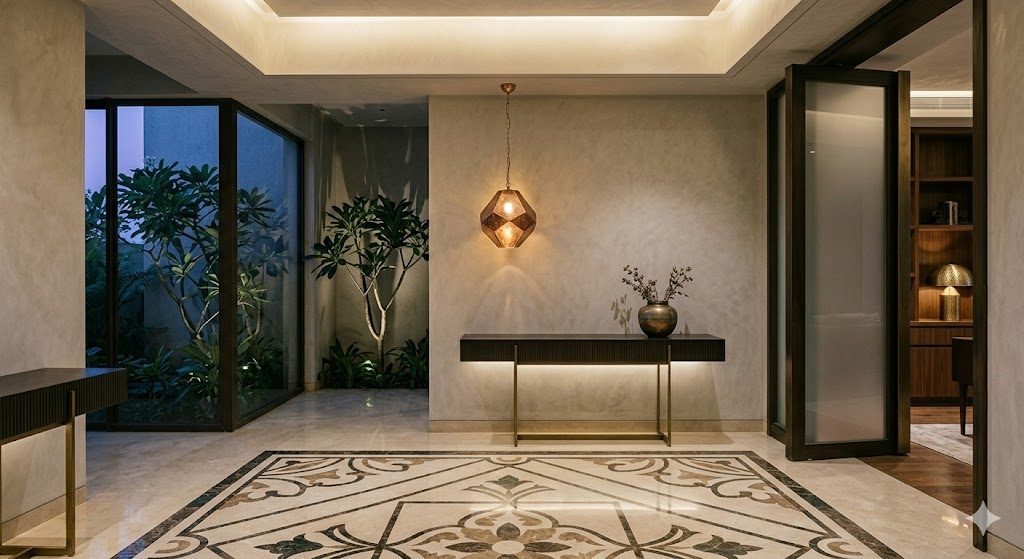
The foyer is the cheapest luxury in the home per square foot of impact. It is small, everyone passes through it, and it sets the entire reading of what follows. A stone-inlay floor (a marble or terrazzo border, an Italian-marble field, or a brass-line inlay), one slim veneer or fluted console, a framed mirror or single artwork, and exactly one statement light — a sculptural pendant from Klove Studio or a clean cluster from Sirohi. Spend ₹2–6 lakh and it does the work of a room three times its size.
2. Living-dining flow — the spine
This is where guests spend ninety per cent of their visit, so it gets the largest share. The moves that matter: continuous flooring across living and dining with no threshold breaks (engineered oak from Square Foot, or large-format Italian marble); a single anchor sofa of real quality from Stanley Levantro, Beyond Designs or a bespoke maker; layered lighting on three separate dimmable circuits; floor-to-ceiling drapery to the balcony line; and one disciplined art or media wall in veneer, fluted ply or stone. The full living-dining build typically runs ₹8–25 lakh and is the backbone of the spec.
3. The premium kitchen — the highest single line item
In a premium apartment the kitchen is increasingly open to the living area, which means it has to look as good as it cooks. A genuine premium kitchen means a stone or sintered counter (not laminate), real extraction at 1,200 m³/hr or more, European hardware (Blum, Hettich, Häfele soft-close and lift-ups), and built-in appliances. Modular houses worth the spend include Häcker, Nolte, Sleek by Asian Paints studio line and Stanley. Budget ₹5–12 lakh for a 100–140 square foot kitchen, fully equipped. A ₹15,000 chimney over a beautiful counter is a premium kitchen in name only.
4. The master suite — your private retreat
Treat the master bedroom, its wardrobe and bath as one designed retreat rather than three rooms. An upholstered or fluted-veneer headboard wall, a walk-in or full-height veneer wardrobe with internal lighting and German hardware, a hotel-grade bath, blackout drapery on a motorised track, and bedside scene control. This is the only zone that is wholly, privately yours — spend on it accordingly, typically ₹6–18 lakh across the three elements. For wardrobe finish decisions, our note on wardrobe finish ideas is the companion read.
5. The powder room — the jewel box
The guest powder room is twelve square feet, which is exactly why you go bold. It is the one room where a dramatic stone, a hand-painted wall, a sculptural basin and a jewel of a light will never feel excessive, because the scale is contained. Spend ₹1.5–4 lakh and it becomes the most-photographed room in the home.
The matrix above is the priority map: lighting, the foyer and the powder room sit top-left — high impact, low cost, do them first. Kitchen and master suite are high impact but high cost, so they get done but paced. Full home automation and false ceiling everywhere sit lower — worth phasing, never the opening move. To pressure-test your own split, run the numbers through our budget allocation tool.
Ceiling treatments when you have no height to give away
The ceiling is where apartment luxury most often goes wrong. A designer used to villas drops a deep, boxed-down false ceiling across the whole apartment, loses 150–200 mm of precious height, and ends up with a home that feels lower and cheaper than the bare shell did.
The apartment rule is the opposite: keep the central field of every ceiling as flat and high as possible, and confine the false ceiling to a slim perimeter where the services and cove lighting actually need to run. A 100–150 mm perimeter cove with a flat centre gives you architectural light and a sense of height at the same time. Where a beam has to be hidden, hide only the beam, not the room.
| Ceiling approach | Height lost | Reads as | Use where |
|---|---|---|---|
| Flat centre + slim perimeter cove | 100–150 mm at edge only | Taller, architectural | Living, dining, master — default |
| Floating / island ceiling | 75–100 mm, localised | Defines a zone in open plan | Over dining table, foyer |
| Full boxed-down ceiling | 150–250 mm everywhere | Lower, dated, heavy | Avoid in apartments |
| Acoustic plaster on slab | 0 mm | Seamless, premium quiet | Living-dining, if budget allows |
Materials matter: gypsum board on a GI frame is the workhorse, but a seamless acoustic plaster finish (BASWA-type microporous plaster) on the bare slab adds quiet without dropping the ceiling at all — the single most luxurious ceiling move available in an apartment. For costing the false-ceiling element specifically, use our false ceiling cost estimator.
Acoustic luxury: the silence you can buy
Nothing undoes a beautiful apartment faster than hearing the neighbour's television through the party wall or footsteps on the slab above. Quiet is one of the most reliable signals of a high-end home, and in an apartment it has to be engineered rather than assumed.
The toolkit, in order of cost-effectiveness:
- Flooring underlay. A 3–5 mm acoustic underlay beneath engineered wood or laminate is the cheapest impact-noise control there is, and most premium societies mandate it above the ground floor. Non-negotiable.
- Party-wall lining. On the walls you share with a neighbour, a resilient-channel and gypsum lining with 50 mm rockwool infill cuts airborne noise dramatically. Apply it behind the TV wall and the master headboard wall as a minimum.
- Solid-core, gasketed doors. Hollow flush doors leak sound. Solid-core doors with perimeter gaskets and a drop seal at the base make bedrooms feel sealed and private.
- Soft furnishing. Full drapery, large rugs and upholstered surfaces absorb reverberation so rooms sound calm rather than echoey. Acoustics and luxury are the same purchase here.
The relevant Indian benchmarks come from the National Building Code 2016 Part 8 on acoustics and IS 1950 on sound insulation of buildings; a designer who can speak to these is one who takes the quiet seriously.
Smart-home integration, phased correctly
A premium apartment buyer expects intelligence in the home, but the mistake is to attempt full automation in one go. The right approach is to phase it, leading with the systems that buy daily delight and leaving the rest as future-proofed conduit.
| Phase | System | Indian ecosystem | Indicative cost |
|---|---|---|---|
| 1 — lead | Lighting scenes + dimming | Lutron, Schneider Wiser, Legrand | ₹1.5–4 lakh |
| 2 | Motorised drapery + AV | Somfy tracks, integrated AV | ₹1.5–3 lakh |
| 3 | Climate + safety | VRV control, gas/leak sensors, cameras | ₹1–3 lakh |
| 4 — optional | Full integration | Control4, KNX backbone | ₹3–10 lakh |
The luxury is not the number of automated devices — it is that the lighting responds instantly and beautifully to a single "evening" scene, that the drapes glide silently at a touch, and that none of it announces itself with blinking boxes on the wall. Lead with light. For a full treatment, see our guides on smart luxury homes in India and smart home design in India, and cost a system with the smart-home cost calculator.
The budget reality: ₹4,000–12,000 per square foot
Premium apartment fit-outs in 2026 land in a clear band depending on how far you push material and finish. Below is the realistic per-square-foot picture on carpet area, all-in for interiors excluding loose art and the developer shell.
| Level | ₹ / sqft (carpet) | What it buys | 2,500 sqft total |
|---|---|---|---|
| Premium baseline | ₹4,000–6,000 | Good joinery, branded fittings, layered light | ₹1.0–1.5 cr |
| True luxury | ₹6,000–9,000 | Stone, veneer throughout, bespoke anchors, full smart | ₹1.5–2.25 cr |
| Ultra-bespoke | ₹9,000–12,000+ | Imported everything, custom millwork, art-led | ₹2.25 cr+ |
Within any band, the split that produces the most luxury per rupee is roughly: 25–30% to joinery and wardrobes, 15–20% to the kitchen, 12–15% to flooring and surfaces, 10–12% to lighting, 10–15% to loose furniture anchors, and the remainder to bathrooms, soft furnishing, automation and contingency. Hold 8–10% as contingency in an apartment specifically, because what the developer hid behind the shell tends to surprise you. To size storage and wardrobe runs precisely, our storage calculator does the running-foot maths.
If your number lands below this band, the disciplined path is not to thin the whole spec but to do fewer zones to a true luxury standard — our companion guides on budget luxury interiors and compact luxury apartment cover that triage in detail.
Working with society bylaws and gated-community fit-out rules
This is the part most design guides ignore and most projects stumble on. In a premium gated community, the fit-out is governed by a written manual, and the rules have teeth.
- Read the fit-out manual before design freeze. Every premium society — Lodha, DLF, Prestige, Godrej — issues one. It defines what you may and may not alter.
- No structural or wet-area change without an NOC. Demolishing even a masonry partition, or moving a bathroom drain, requires written society approval and often a structural engineer's certificate.
- Refundable fit-out deposit. Expect to lodge ₹50,000 to ₹2 lakh as a refundable deposit against damage to common areas, lifts and lobbies.
- Work windows and material hoisting. Work is typically restricted to weekday daytime hours (often 8 am to 6 pm), with the service lift bookable in slots and a ban on hammering on weekends. This stretches programmes — plan for it.
- Debris and dust protocol. Designated debris removal, lift padding and lobby protection are usually mandatory and chargeable.
Treat these rules as a design input on day one, not an obstacle discovered in week six. A programme that respects the work windows and clears the NOCs early is the difference between a calm project and a litigious one. The mapping of each apartment constraint to its luxury solution is summarised in the playbook figure above.
Get it right, in order
1. Read the society fit-out manual and clear NOCs first. Know the work windows, the deposit and what you are allowed to touch before any design is frozen.
2. Lock the five spend zones. Foyer, living-dining, kitchen, master suite and powder room get the budget; everything else gets a calm, restrained base.
3. Set the ceiling and lighting strategy together. Flat centres, slim perimeter coves, three dimmable circuits per major room. Protect every millimetre of height.
4. Engineer the quiet. Acoustic underlay everywhere, party-wall lining behind TV and headboard walls, solid-core gasketed doors.
5. Specify joinery in veneer on BWP or HDHMR with European hardware. This single decision separates premium from mid-market more than any other.
6. Phase the smart home, leading with lighting scenes. Future-proof conduit for the rest.
7. Hold 8–10% contingency. The shell will surprise you; the buffer keeps the luxury intact.
Designing luxury inside a fixed apartment shell is a problem of judgement — which zones to fight for, which to keep quiet, how to spend a fixed budget so the home reads up a class. DesignAI lets you test those decisions visually before you commit a rupee: generate photoreal options for your foyer, living-dining and master suite, compare ceiling and lighting schemes against your actual plan, and walk into the build knowing exactly where your money is going. In an apartment, where you cannot undo a poured slab, seeing it first is the cheapest insurance there is.
References
- Bureau of Indian Standards (2016) National Building Code of India 2016, Part 8: Building Services — Acoustics, Sound Insulation and Noise Control. BIS, New Delhi.
- Bureau of Indian Standards IS 1950: Code of Practice for Sound Insulation of Non-Industrial Buildings. BIS, New Delhi.
- Bureau of Indian Standards IS 3483: Code of Practice for Noise Reduction in Industrial Buildings. BIS, New Delhi.
- Ching, F. D. K. (2014) Interior Design Illustrated. 3rd edn. Wiley.
- Pile, J. and Gura, J. (2013) A History of Interior Design. 4th edn. Laurence King Publishing.
- Indian Green Building Council (2020) IGBC Green Homes Rating System. CII-IGBC, Hyderabad.
Continue the cluster: read the pillar on what defines luxury interiors in India, then the related deep dives on luxury apartment design, premium apartment interiors, compact luxury apartment and designer lighting for luxury homes.
Export this guide
Related Guides — Deep-dive reading
Luxury & Statement Lighting: Drama, Sculpture & Scale (2026)
How to design lighting that actually feels luxurious in an Indian home — layered scenes, deep shadow-and-highlight contrast, hidden sources and premium materials — and how to place one sculptural statement fixture as the jewel of a room without over-lighting the whole thing.
LightingSmart Storage Interiors — A 2026 Working Reference for Indian Homes
Inventory-driven · Floor-to-ceiling · Hardware-engineered · Zone-mapped
Room PlanningSpace-Efficient Homes — A 2026 Working Reference for Compact Indian Apartments
Five spatial multipliers · Floor plan tricks · Dual-purpose furniture
Room PlanningRelated Tools — Try Free
Acoustic Privacy (STC) Visualizer
Indian healthcare acoustic visualizer — compare wall assemblies and noise sources, see received SPL after STC attenuation, and check FGI 2018 / IS 1950 / NABH speech-privacy compliance with live dual-canvas waveform.
Acoustic ToolFalse Ceiling Cost Estimator
Live ₹/sqft across 8 ceiling types — POP, gypsum, designer, metal, PVC, wooden — with cove and spot lighting for 20 Indian cities.
Cost CalculatorApartment Interior Planning Checklist
51-item checklist across structural, ceiling, lighting, furniture, storage, electrical, kitchen, bathroom.
Checklist