
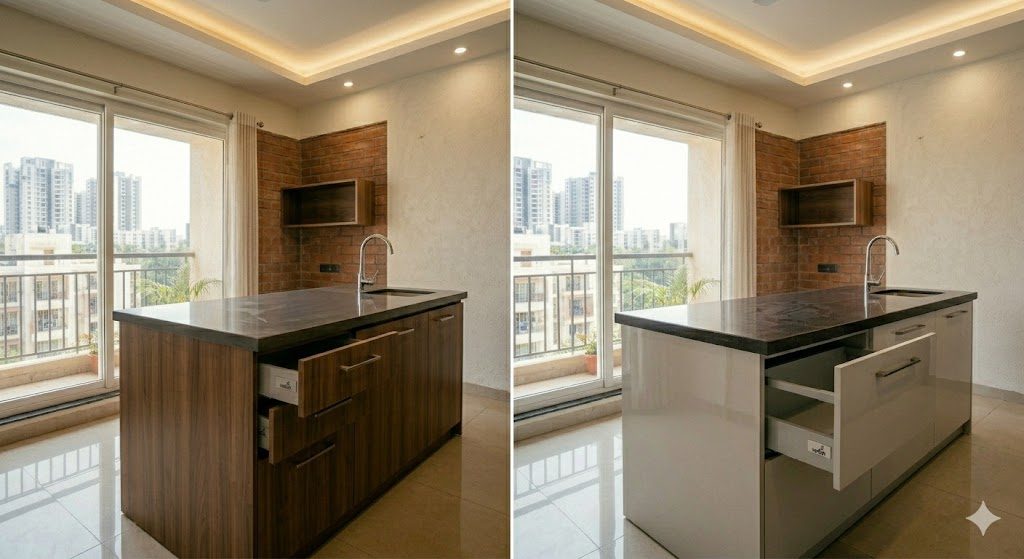
Budget vs Premium Interiors: What Actually Changes?
Where the extra money really goes — and where premium is just a markup
A Bengaluru couple finishing a 1,150 sqft 2BHK gets two quotes for what looks like the same scope of work: full modular kitchen, two wardrobes, a TV unit, false ceiling, paint, flooring, lights. One contractor quotes ₹9.8 lakh. A reputed firm quotes ₹17.5 lakh. Same drawings, same room count, same "finished look" in the render. The ₹7.7 lakh gap is the entire question this guide answers — because almost none of it is visible in a photograph, and a surprising amount of it is not worth paying for.
This guide goes category by category — substrate, finish, hardware, kitchen, wardrobes, flooring, ceiling, lighting, paint, furniture, sanitaryware — and tells you, in rupees, exactly what changes between a budget and a premium interior, and whether that change earns its price. Not "how to fake a luxury look on a budget" (that is a different guide, budget-luxury-interiors), but the honest engineering-and-money truth of where the extra lakhs physically go.
The single idea to hold onto: premium money is worth spending where it touches your hands daily, where it gets wet, and where failure is expensive to fix — and is largely a badge everywhere else. Hardware, kitchen carcase, wet-zone CP fittings and high-traffic flooring genuinely repay the upgrade. Designer downlights, branded paint over a good local emulsion, and acrylic shutters on a guest-room wardrobe mostly do not.
The ₹7.7 lakh gap, decoded
Before the category breakdown, here is where the difference between a budget and a premium fit-out of the same 2BHK actually accumulates. These are 2026 Indian-metro bands for a 1,100–1,200 sqft carpet-area flat, supply-and-install, GST extra.
| Category | Budget spec | Premium spec | Budget ₹ | Premium ₹ | Delta |
|---|---|---|---|---|---|
| Kitchen (modular) | MR/BWR ply carcase, laminate shutter, local hinges, granite counter | BWP ply/HDHMR, PU/acrylic shutter, Hettich/Blum, quartz counter | 1,80,000 | 4,50,000 | +2,70,000 |
| Wardrobes (2) | MR ply, laminate, local sliders | BWP ply, acrylic/PU, Hettich/Hafele | 1,40,000 | 3,20,000 | +1,80,000 |
| Flooring | Vitrified tile | Engineered wood / large-format vitrified | 1,10,000 | 3,40,000 | +2,30,000 |
| False ceiling | Basic peripheral gypsum | Profile + cove + designer levels | 70,000 | 1,80,000 | +1,10,000 |
| Lighting | Basic LED downlights | Layered: profile, spots, pendants, dimmers | 45,000 | 1,80,000 | +1,35,000 |
| Paint | Economy emulsion | Premium emulsion / texture / Royale | 90,000 | 1,90,000 | +1,00,000 |
| Loose + bespoke furniture | Readymade | Bespoke + designer pieces | 1,50,000 | 4,50,000 | +3,00,000 |
| Sanitaryware & CP | Mid (Jaquar Continental, Cera) | Premium (Kohler, Grohe, Duravit) | 80,000 | 2,40,000 | +1,60,000 |
| Electrical + switches | Standard (Anchor Roma) | Modular designer (GM, Legrand Arteor) | 60,000 | 1,30,000 | +70,000 |
| Total (indicative) | ~9.25 L | ~25.5 L | +16.3 L |
The point of this table is not the totals — those scale with how much premium you choose — but the shape of the gap. Some categories double in cost for a change you will feel every single day; others double for a change a guest would never notice. The rest of this guide separates the two.
Premium is not one decision. It is forty small decisions, and maybe eight of them are actually worth the money. The skill is knowing which eight.
1. Substrate — the plywood you never see
Everything modular sits on a substrate. It is invisible behind the finish, which is exactly why it is the first place a budget quote cuts and the last place you should let it.
| Spec | Budget | Premium | ₹ delta (per kitchen) |
|---|---|---|---|
| Grade | MR (moisture-resistant) or local BWR | IS:710 BWP (boiling-waterproof), branded | — |
| Brand | Local/unbranded "ISI-looking" | Century, Greenply, Greenpanel, Austin | — |
| Carcase rate | ₹85–110 /sqft | ₹140–190 /sqft | +₹55–80 /sqft |
| Kitchen carcase total | ₹55,000–70,000 | ₹95,000–1,30,000 | +₹40,000–60,000 |
MR-grade plywood is fine for a dry bedroom wardrobe. In a kitchen — under the sink, near the hob, against a wall that shares plumbing — MR ply swells, delaminates and grows the smell of a failed cabinet within three to five monsoons. BWP (IS:710) plywood is rated to survive boiling water for 72 hours; in a real kitchen it is the difference between a carcase that lasts fifteen years and one you rebuild in six.
Verdict: premium genuinely earns it — but selectively. Pay for BWP only in wet zones: the entire kitchen carcase, and the bottom 600 mm of any wardrobe near an external or bathroom-adjacent wall. Everywhere dry, a good branded BWR/MR board (not the cheapest local sheet) is honest value. The trap is paying BWP rates for a guest-bedroom wardrobe that will never see water. For a deeper failure analysis, see why-cheap-interiors-expensive-later.
2. Finish — laminate vs acrylic vs PU vs veneer
This is the most visible decision and the one with the widest price spread. The finish does two jobs: how it looks, and how it survives touch.
| Finish | What it is | Look | Durability | ₹ /sqft (finished) | Verdict |
|---|---|---|---|---|---|
| Laminate | 0.8–1 mm printed sheet | Good; matte hides marks | Excellent — scratch/heat tough | 95–280 | Best value, full stop |
| Acrylic | High-gloss/matte PMMA sheet | High mirror-gloss | Good; shows fingerprints & fine scratches | 320–550 | Looks premium, fragile gloss |
| PU paint | Sprayed polyurethane, multi-coat | Seamless, repairable | Good; patch-repairable | 400–900 | Worth it for seamless/curved |
| Veneer (+ melamine/PU) | Real wood slice | Genuine timber warmth | Needs care; ages | 450–1,200 | A look, not durability |
The honest hierarchy: laminate is the most durable finish per rupee in India and there is no shame in it. A tier-1 woodgrain laminate on BWP ply outlasts an acrylic shutter and is a fraction of PU. Acrylic buys you a deep gloss that photographs beautifully and shows every fingerprint and swirl mark in real life. PU's real advantage is not toughness — it is seamlessness (no visible edge band) and patch-repairability on curved or handle-less designs. Veneer buys you the warmth of real wood and the responsibility of maintaining it.
Verdict: laminate everywhere as default; PU only where you specifically want a handle-less, edge-band-free, monochrome look (typically the kitchen tall units or a feature wardrobe); acrylic only on a low-touch feature panel. Compare the full PU-vs-laminate economics in pu-finish-vs-laminate-cost-comparison-india, and run real numbers on /utilities/material-compare.
3. Hardware — the upgrade that quietly matters most
Hinges, drawer channels and sliders are the single most under-rated line item. They are 4–6% of the budget and 80% of how the interior feels every day.
| Component | Budget (local) | Premium (Hettich/Blum/Hafele) | ₹ delta per kitchen |
|---|---|---|---|
| Hinges (per pc) | ₹35–70 | ₹180–450 (soft-close) | — |
| Drawer system (per set) | ₹350–700 | ₹2,200–6,500 (tandembox/Legrabox) | — |
| Tall-unit pull-out | ₹3,000–6,000 | ₹14,000–35,000 | — |
| Whole-kitchen hardware | ₹18,000–30,000 | ₹70,000–1,60,000 | +₹50,000–1,30,000 |
A local hinge is rated for perhaps 20,000–30,000 open-close cycles before it sags; a Blub/Hettich soft-close hinge is rated 80,000–2,00,000 cycles and carries a warranty. At a kitchen-cabinet's real usage — twenty-plus operations a day — the cheap hinge sags within two to three years, the door stops sitting flush, and the failure cascades: misaligned doors rub the laminate, the carcase rep needs a service visit, the "expensive" kitchen suddenly looks cheap.
Verdict: this is the clearest worth-it upgrade in the whole house. Premium hardware is where a budget interior most visibly betrays itself. This is so consistently true that we wrote a whole piece on it — why-cheap-hardware-destroys-expensive-interiors. If you cut one premium decision back, never cut this one; if you splurge on one thing in a budget home, make it soft-close drawer channels in the kitchen.
4. Modular kitchen — four sub-decisions, not one
The kitchen is where budget and premium diverge most because it is four upgrades bundled into one quote: carcase, shutter, counter and appliances/hardware. A premium kitchen is rarely premium in all four.
| Element | Budget | Premium | ₹ delta |
|---|---|---|---|
| Carcase | MR/BWR ply | BWP ply / marine HDHMR | +40,000–60,000 |
| Shutter finish | Laminate | Acrylic / PU / lacquered glass | +60,000–1,50,000 |
| Counter | Granite (₹150–250/sqft) | Quartz (₹350–650/sqft) | +40,000–90,000 |
| Hardware | Local | Hettich/Blub | +50,000–1,30,000 |
| Typical total | 1,60,000–2,20,000 | 4,00,000–6,50,000 | +2.4–4.3 L |
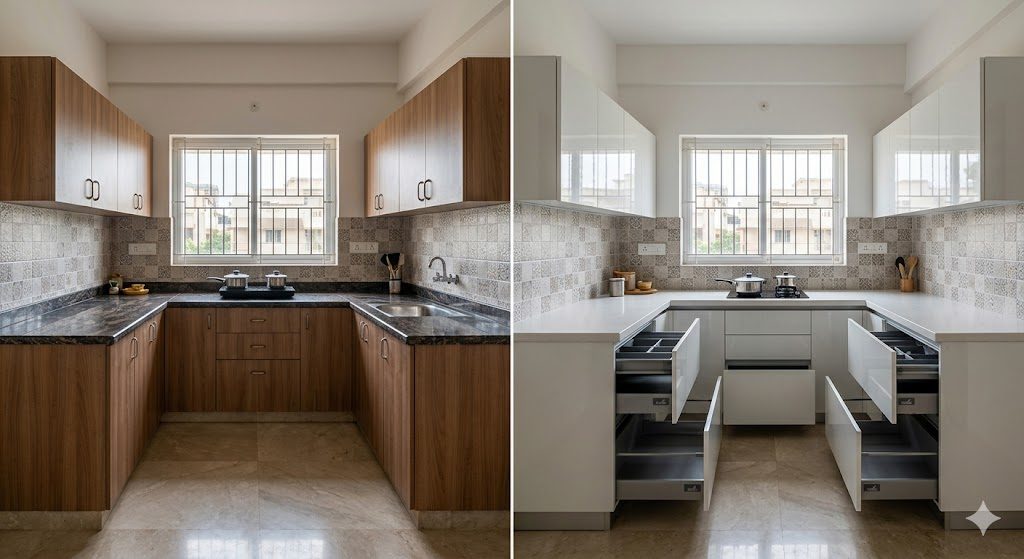
The smart-money kitchen mixes tiers: BWP carcase (worth it), laminate shutters in matte (value), quartz counter only if you cook with turmeric and acidic masalas daily (genuinely worth it for stain resistance — granite stains, quartz does not), and premium hardware (worth it). That single recipe captures ~80% of the "premium feel" at ~60% of the premium cost. For the full kitchen-budget method, see budget-modular-kitchen-planning-india and estimate on /utilities/kitchen-budget.
5. Wardrobes — where premium is most often wasted
Wardrobes follow the same logic as the kitchen minus the wet zone and minus daily abuse. A wardrobe shutter is opened a few times a day, gently, in a dry room.
| Element | Budget | Premium | ₹ delta (per 8x7 ft) |
|---|---|---|---|
| Carcase | MR ply | BWP ply | +15,000–25,000 |
| Shutter | Laminate sliding | Acrylic/PU/mirror | +30,000–70,000 |
| Internals | Open shelves, MS rod | Soft-close drawers, pull-outs, lacquered glass | +20,000–60,000 |
| Hardware | Local channel sliders | Hettich/Hafele track | +12,000–30,000 |
Verdict: mostly skip the premium finish, sometimes pay for the internals. Nobody touches a wardrobe shutter the way they touch a kitchen drawer, and nobody sees the inside but you. A laminate shutter on BWP-bottom MR-top carcase with good sliders is the value sweet spot. Where premium does pay is the internal hardware — soft-close drawers, trouser pull-outs and good sliding tracks make daily use genuinely better. So: budget shutter, premium track. Read why-wardrobes-become-inefficient and size yours with /utilities/wardrobe-storage-capacity-calculator. Full costing in wardrobe-cost-guide-india.
6. Flooring — the biggest ticket, the trickiest call
Flooring is often the single largest delta because it covers the whole carpet area and the premium options are several times the price.
| Floor | ₹ /sqft (supply+lay) | 1,100 sqft total | Durability | Verdict |
|---|---|---|---|---|
| Vitrified tile (double-charge) | 90–160 | 1.0–1.8 L | Excellent, 20+ yr | Best value, hard to beat |
| Large-format / GVT | 160–280 | 1.8–3.1 L | Excellent | Worth it for seamless look |
| Engineered wood | 280–450 | 3.1–5.0 L | Good; warm; needs care | Look-driven, not value |
| Italian marble | 350–900+ | 3.9–10+ L | Premium; staining/maintenance | Status, real upkeep cost |
Here is the uncomfortable truth: a good double-charge vitrified tile is more durable than marble or engineered wood and costs a third to a fifth as much. Marble stains, etches with acid and needs periodic polishing; engineered wood scratches and cannot get wet. You are paying premium for warmth and look, and accepting worse durability — the opposite of the kitchen-hardware case.
Verdict: premium flooring is a look purchase, not a durability one. It is worth it only in the rooms you most want to feel warm (living room, master bedroom) and only if you accept the maintenance. The savvy move is large-format vitrified in tile-look or wood-look — 90% of the aesthetic at a third of the cost. Be especially wary here because flooring is one of the choices that age poorly if the spec outruns the lifestyle.
7. False ceiling — basic vs profile-and-cove
| Spec | Budget | Premium | ₹ /sqft | Verdict |
|---|---|---|---|---|
| Peripheral gypsum band | Single-level, plain | — | 65–95 | Fine for most rooms |
| Full level + cove lighting | — | Coves, profile channels, steps | 110–180 | Worth it in living/dining only |
| Designer multi-level / POP art | — | Curves, backlit, mouldings | 180–350 | Mostly badge |
A false ceiling does two real jobs: hiding ducting/wiring and housing layered light. Beyond that, multi-level designer ceilings are decorative and date quickly. Verdict: spend premium only in the living/dining ceiling where cove lighting genuinely transforms the room; keep bedrooms to a simple peripheral band. Over-designed bedroom ceilings are a classic regret — see biggest-false-ceiling-mistakes — and cost it precisely with /utilities/false-ceiling-cost-estimator. Deep dive: false-ceiling-cost-guide-india.
8. Lighting — basic downlights vs layered design
| Layer | Budget | Premium | ₹ delta |
|---|---|---|---|
| Ambient | Flat ceiling downlights | Recessed spots + profile lights | — |
| Task | Tube/panel | Under-cabinet, focused spots | — |
| Accent | None | Cove, picture, pendant, dimmers | — |
| Whole home | 40,000–60,000 | 1,50,000–2,50,000 | +1.1–1.9 L |
Lighting is where premium is partly worth it and partly a markup. The worth-it part is the design — layering ambient, task and accent so the room can shift mood. That layering costs more in fixtures and circuits but transforms how the home feels at night, far more than any expensive fixture does. The markup part is designer fixtures: a ₹12,000 pendant rarely lights better than a ₹3,000 one. Verdict: pay for the layering and dimmer circuits; buy mid-range fixtures. Good lighting design with affordable fixtures beats expensive fixtures with flat lighting every time.
9. Paint — economy vs premium emulsion vs texture
| Tier | Product class | ₹ /sqft (2 coat, w/ putty) | 1,100 sqft | Verdict |
|---|---|---|---|---|
| Economy | Distemper / basic emulsion | 18–28 | 70,000–95,000 | Fine for rentals |
| Premium emulsion | Washable, low-VOC (Royale-class) | 32–55 | 1.2–1.9 L | Worth it for daily walls |
| Texture / accent | Lime, metallic, designer texture | 120–400 /sqft | varies | One feature wall only |
Premium emulsion is one of the genuinely worth-it upgrades that is cheap in absolute terms: a washable, stain-resistant, low-VOC paint costs maybe ₹60,000–90,000 more across the home and keeps walls cleanable for years — a real daily-life improvement. Texture finishes, by contrast, are pure feature-wall money: stunning on one wall, exhausting and dating on four. Verdict: premium emulsion everywhere is worth it; texture on exactly one wall, never more.
10. Furniture — readymade vs bespoke
| Approach | Budget | Premium | Verdict |
|---|---|---|---|
| Sofa | Readymade (₹35,000–70,000) | Bespoke/imported (₹1.5–4 L) | Pay mid; frame & foam matter, brand does not |
| Beds/storage | Readymade | Bespoke carpentry | Bespoke worth it only where space is tight |
| Dining | Readymade set | Designer | Readymade wins on value |
| Accent/loose | Local | Designer | Mix; one or two statement pieces |
Furniture is the category with the widest "badge premium." A bespoke sofa is worth it when an odd room shape wastes space with readymade — bespoke buys you fit, not quality. Otherwise, a well-made readymade sofa with good frame and foam outperforms a designer brand at a quarter of the price. Verdict: bespoke only where fit demands it; buy quality readymade everywhere else and spend the saving on one genuine statement piece.
11. Sanitaryware & CP fittings — the quiet worth-it
| Item | Mid (Jaquar/Cera) | Premium (Kohler/Grohe/Duravit) | ₹ delta per bath |
|---|---|---|---|
| WC | 8,000–15,000 | 25,000–60,000 | — |
| Basin + mixer | 6,000–12,000 | 20,000–55,000 | — |
| Shower/diverter | 5,000–12,000 | 18,000–45,000 | — |
| Whole bathroom | 40,000–70,000 | 1,20,000–2,50,000 | +0.8–1.8 L |
This is a wet zone and a daily-touch zone — both worth-it triggers. The catch: the worth-it ceiling is lower than the brands suggest. A mid Jaquar mixer with a ceramic cartridge will outlast cheap CP and feel solid; the jump from Jaquar to Grohe buys you better feel and finish longevity, but the jump from cheap-local to mid is the one that actually prevents leaks and corrosion. Verdict: never buy cheap CP (it corrodes and leaks — an expensive wet failure), but mid-premium is the sweet spot; full-premium is feel and badge. Cheap CP is one of the most-expensive-interior-mistakes precisely because the failure is wet and hidden.
The category cards — budget vs premium at a glance
Ranking the deltas — where the money actually goes
When you line up how much each premium upgrade adds, and colour-code by whether it is worth paying, the strategy becomes obvious. The biggest deltas are not the most worth-it.
Notice the inversion: flooring and bespoke furniture carry the biggest deltas but sit in the skip-or-selective zone, while hardware and CP fittings carry smaller deltas and sit firmly in worth-it. Premium money is poorly correlated with premium value — which is the whole game.
The worth-it / skip-it matrix
Plot every category on two axes — how much the upgrade costs against how much value it returns in daily life, durability and wet-zone safety — and four quadrants appear.
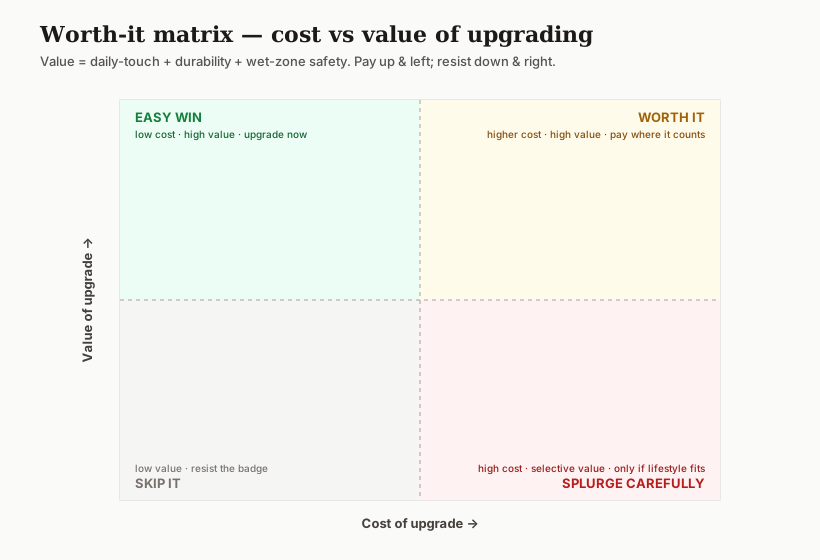
| Quadrant | Meaning | Categories |
|---|---|---|
| Easy win (low cost, high value) | Upgrade without hesitation | Premium emulsion, premium hardware, mid CP fittings |
| Worth it (higher cost, high value) | Pay where it counts | BWP kitchen carcase, quartz counter, layered lighting design |
| Splurge carefully (high cost, selective value) | Only where lifestyle justifies | Engineered wood/marble flooring, bespoke furniture, PU/acrylic finish |
| Skip it (cost without proportionate value) | Resist | Designer fixtures over good mid, multi-level bedroom ceilings, texture on multiple walls, full-premium CP everywhere |
The honest verdict table
| Category | Premium genuinely worth it? | Why |
|---|---|---|
| Substrate (kitchen/wet) | Yes | Wet-zone failure is expensive and hidden |
| Substrate (dry bedrooms) | No | Branded BWR is plenty |
| Finish — laminate | n/a (this IS the value pick) | Most durable per rupee |
| Finish — PU/acrylic | Selective | Look only, where seamless/handle-less wanted |
| Hardware | Yes — top priority | Daily-touch, lifespan, cascading failure |
| Kitchen counter (quartz) | Yes if you cook heavy | Stain resistance vs granite |
| Wardrobe shutter | No | Low-touch, unseen |
| Wardrobe internals/track | Yes | Daily use quality |
| Flooring (engineered/marble) | Look only | Worse durability than vitrified |
| False ceiling (living cove) | Yes | Transforms the room |
| False ceiling (bedroom levels) | No | Dates quickly |
| Lighting design (layering) | Yes | Biggest mood impact |
| Lighting fixtures (designer) | No | Mid lights as well |
| Paint — premium emulsion | Yes | Cheap, daily-touch, washable |
| Paint — texture | One wall only | Dates fast at scale |
| Furniture — bespoke | Only for fit | Brand is badge |
| CP — mid tier | Yes | Wet zone, prevents leaks |
| CP — full premium | No | Feel and badge |
How to budget it, in order
1. Lock the carcase and hardware first. BWP in all wet zones, premium soft-close hardware in the kitchen. These are non-negotiable worth-it spends and they protect everything else.
2. Default every finish to laminate. Promote to PU/acrylic only on a named, specific surface you genuinely want seamless — usually one kitchen run or one feature wardrobe.
3. Choose flooring by room, not by whole flat. Large-format vitrified as the base; engineered wood or marble only in one or two warmth-priority rooms you accept maintaining.
4. Buy the lighting design, not the fixtures. Pay for layering, circuits and dimmers; fit mid-range fixtures.
5. Premium emulsion throughout, texture on one wall. This is your cheapest premium-feel upgrade.
6. Never buy cheap CP; stop at mid-premium. Protect the wet zones; do not chase the badge.
7. Bespoke furniture only where the room shape wastes space. Quality readymade everywhere else; one statement piece.
8. Bank the savings as contingency. What you save by skipping the badge upgrades funds the hidden costs and the 8–10% contingency every honest renovation needs.
Run this allocation logic across your whole flat with smart-budget-allocation-indian-homes, see how the metro premium itself moves the numbers in cost-of-luxury-interiors-metro-cities-india, and sanity-check your split on /utilities/style-budget-calculator.
Let DesignAI draw the line for you
The hard part is not knowing that hardware beats fixtures — it is applying that to your plan, room by room, in rupees. DesignAI takes your floor plan and lifestyle and drafts an itemised BOQ that defaults to the worth-it tier in each category and the value tier everywhere else, so the premium money lands where it earns its keep. You get a budget and a premium column side by side and decide each line yourself, with the honest verdict already baked in.
References
1. Bureau of Indian Standards — IS:710 (Marine/BWP plywood) and IS:303 (plywood for general purposes), specification and bonding-quality tests.
2. CPWD Plinth Area Rates and Delhi Schedule of Rates (DSR) — finishing and joinery item rates, latest revision.
3. Construction Industry Development Council (CIDC) — composite labour-and-material rate indices for interior finishing trades.
4. National Building Code of India (NBC) 2016, Part 8 — Building Services, lighting and electrical-load guidance.
5. BMTPC — Compendium of building materials and performance of wood-based panel products in Indian climatic zones.
6. Manufacturer technical datasheets and cycle-life warranties — Hettich, Blum, Hafele (hinge and drawer cycle ratings); Kohler, Grohe, Jaquar CP-fitting cartridge specifications.
7. RERA carpet-area definitions (Real Estate (Regulation and Development) Act, 2016) — basis for all per-sqft figures in this guide.
Related cost guides: smart-budget-allocation-indian-homes · budget-luxury-interiors · cost-of-luxury-interiors-metro-cities-india · why-cheap-hardware-destroys-expensive-interiors · expensive-interior-choices-age-poorly
Export this guide
Related Guides — Deep-dive reading
The Design Decisions With the Biggest Cost Consequences
A cost-leverage map of Indian home interiors — the handful of decisions that swing your total budget the most, so you spend your attention where a single choice has an outsized rupee impact.
Cost & MoneyComplete Guide to Interior Hardware
The 8–12% of the interior budget that decides whether everything else works
Materials & FinishesSmart Storage Interiors — A 2026 Working Reference for Indian Homes
Inventory-driven · Floor-to-ceiling · Hardware-engineered · Zone-mapped
Room PlanningRelated Tools — Try Free
False Ceiling Cost Estimator
Live ₹/sqft across 8 ceiling types — POP, gypsum, designer, metal, PVC, wooden — with cove and spot lighting for 20 Indian cities.
Cost CalculatorHome Building & Interior Cost Calculator — 20 Cities
Construction + interior costs for 20 Indian cities across kitchen, wardrobes, flooring, painting, ceiling.
Cost CalculatorApartment Furniture Size Chart
Standard furniture dimensions for Indian apartments — sofas, beds, tables, dining, storage.
Reference Chart