
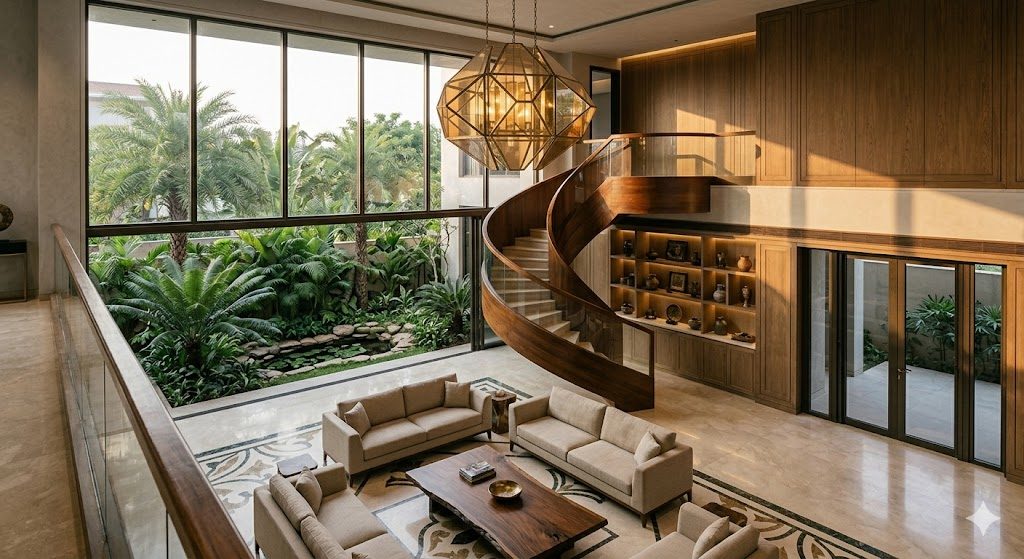
Luxury Villa Interior Planning
Orchestrating interiors across multiple floors, zones and a grand spatial canvas
Stand in the unfinished shell of a 6,000-square-foot villa in Whitefield or on a Lonavala hillside and the problem announces itself before a single sofa is chosen. You are not decorating rooms; you are conducting a building. A double-height living volume swallows light and sound differently from a flat. A staircase is no longer a fire-code afterthought but the spine of the house. There are two kitchens, three living areas, a guest wing, staff quarters, and a garden that wants to come indoors. The apartment instincts that served you well — pick a palette, lay it out, furnish — collapse under the sheer area and the number of moving parts.
This guide is about planning the interiors of a luxury villa in India in 2026: the demands that scale and verticality impose, how to sequence the spaces so the house has a narrative, how to zone for joint families and serious entertaining, how to hold a "material story" together across thousands of square feet, and how to coordinate the small army of consultants — architect, interior designer, landscape architect, AV and automation specialists — without the project fracturing. It sits inside our Luxury Interiors cluster, and it assumes you already know what luxury means at the level of finish; here we are concerned with luxury at the level of the plan.
The core idea is simple to state and hard to execute: a villa interior is won or lost in the section, not the moodboard. Get the vertical and horizontal organisation right — public below, private above, service tucked behind, a single material spine running through it all — and the finishes look after themselves. Get it wrong and no amount of imported marble rescues a house where guests trail through your bedroom corridor to reach the powder room.
What a villa demands that an apartment never does
An apartment is a single horizontal plate. A villa is a three-dimensional organism, and several conditions that simply do not exist in flats become the central design problems.
| Villa-only condition | Why it changes everything | Interior consequence |
|---|---|---|
| Double-height volumes | 5.5–7 m ceilings in living/foyer | Lighting, acoustics, AC throw and art scale all rethought |
| Grand staircase | Vertical circulation is visible, central | Becomes a sculptural object, not a utility |
| Multiple living zones | Formal, family, outdoor, media | Each needs distinct character yet shared DNA |
| Leisure programme | Theatre, bar, gym, spa, pool deck | Specialist acoustics, AV, ventilation, drainage |
| Guest + staff quarters | Two parallel circulation circuits | Plan must keep them from crossing |
| Two kitchens + pantry | Show kitchen and wet/Indian kitchen | Ducting, exhaust, plumbing run lengths |
| Landscape continuity | Garden, courtyards, verandahs | Floor levels, thresholds, indoor-outdoor materials |
The single biggest mental shift is that you stop thinking in rooms and start thinking in zones and sequences. A 3BHK is furnished; a villa is orchestrated. For the architectural envelope that wraps all of this — massing, structure, site response — pair this with luxury villa architecture in India and the villa elevation design guide; the interior plan and the elevation must be designed as one conversation, not handed over the wall.
Reading the villa in section
Before any floor plan, draw the section. The section tells you where the house breathes, where it compresses, and how the three functional zones stack.
The disciplined villa resolves into three zones that almost never overlap:
- Public (ground): foyer, formal living, dining, bar, powder room, one guest suite. This is the face the house shows visitors. It tolerates — even wants — a degree of drama and double-height generosity.
- Private (upper floors): master suite, children's and parents' rooms, family lounge, study. The retreat. Lower ceilings, warmer materials, total acoustic separation from the entertaining floor below.
- Service (rear / basement): wet kitchen, pantry, utility, staff quarters, plant room, DG and pump rooms. Invisible to guests, yet the engine of a household that runs on cooks, drivers and house staff — a reality of Indian villa life that Western plans ignore.
The double-height living volume is the section's signature move. At 6 m it transforms an ordinary drawing room into a space with grandeur, but it imposes real obligations: air-conditioning must be designed for the volume (high-wall cassettes or a concealed VRV throw of 6+ metres), acoustics need soft surfaces or the room booms, and any lighting hung in the void must be serviceable — plan a motorised chandelier hoist or a discreet access route. The void is luxurious only if it is also liveable.
The spatial sequence: arrival to retreat
A villa is experienced as a journey, and the journey should decompress you from public performance to private ease. This is the choreography that separates a designed house from a large one.
The sequence runs: arrival → foyer → formal living → family core → vertical circulation → private floor. Each stage has a job.
- Arrival is the forecourt, drop-off and threshold — a water feature, a framed view, a moment of pause before the door. The register is anticipation.
- The foyer is the pause and the reveal. This is where the double-height does its work, where art hangs, where the staircase first announces itself. Keep it generous but not a thoroughfare; you should be able to stand here.
- Formal living and dining are the hospitality engine — designed to host forty people at Diwali without feeling like a banquet hall when it is just the two of you. The bar and a deck or verandah extend it outward.
- The family core — a den, a courtyard, the breakfast nook, the pooja room — is where the house actually lives day to day. It should be reachable without passing through the formal zone, so the family is not perpetually on display.
- Vertical circulation is the threshold to the private realm. Once you are on the stair, you have left the public house behind.
The non-negotiable rule the diagram encodes: guests flow horizontally across the ground plane and never need to ascend. The family rises to the private floor and the two circuits do not collide. If a visitor has to walk past bedroom doors to find a washroom, the plan has failed regardless of finish.
In a great villa you can throw a party of fifty and put your children to bed at the same time, and neither group ever knows the other exists.
Zoning for joint families and entertaining
Indian luxury villas are rarely for nuclear couples. They house joint families — grandparents, a married son or two, children, and a household staff — while also functioning as the family's primary venue for entertaining. The plan must hold both.
| Living unit | Privacy need | Planning device |
|---|---|---|
| Grandparents / parents | Ground-floor suite, no stairs | En-suite bedroom near family core, accessible bath |
| Married son's family | Self-contained wing | Bedroom + lounge + bath as a sub-apartment |
| Children | Supervised but separate | Cluster near master, shared study |
| Entertaining | Spillover capacity | Formal + deck + garden as one continuous host zone |
| Staff | Present but invisible | Service stair, rear access, own toilet |
The elegant solution to multi-generational living is the suite-within-the-house: each family unit gets a bedroom, a small private sitting area and a bathroom, clustered so they have autonomy but share the common heart of the villa. For elders, an en-suite on the ground floor is not a courtesy but a necessity — design it from day one rather than retrofitting a stairlift later.
For entertaining, the move is to make the formal living, the dining, the bar and the outdoor deck or garden read as a single flexible host zone with sliding glass walls between them. Closed, it is four intimate rooms; opened, it is one continuous space for a large gathering. To test a layout at full scale before committing joinery and built-ins, sketch the furniture footprint in our furniture layout designer — it will quickly show you whether your circulation routes survive a crowd.
The material story across a large canvas
In an apartment you can finish a hero wall in fluted Italian marble and let it carry the whole flat. In a villa of several thousand square feet, the same gesture would be exhausting and incoherent. The large canvas needs a "material story" — a disciplined system of repeated anchors and deliberate accents.

The governing principle is in the matrix: hold the floor constant, vary the walls and ceilings. A single continuous floor material across the public zones — say, large-format Statuario or Botticino marble, or a calm engineered surface — reads as one luxurious plane and visually ties thousands of square feet together. Walls and ceilings then carry the variety, giving each room its own character within the family.
| Zone | Floor (the anchor) | Walls (the variety) | Indicative supply rate |
|---|---|---|---|
| Living + foyer | Statuario / Botticino marble | Veneer panelling, lime plaster | ₹350–1,200 / sqft (floor) |
| Dining + bar | Same marble, continuous | Fluted stone feature wall | as above |
| Kitchen | Engineered quartz / porcelain slab | Back-painted glass | ₹250–900 / sqft |
| Master suite | Engineered oak timber | Upholstered fabric panels | ₹450–1,100 / sqft |
| Outdoor / deck | Leather-finish granite, Kota | Exposed local stone | ₹120–450 / sqft |
A few rules keep the story honest. Limit yourself to two or three "hero" stones for the whole house — a white marble, a dark statement stone, and perhaps one warm timber — and repeat them. Shift to a warmer, softer register as you move from public to private: cool marble downstairs, engineered oak and fabric upstairs. And resolve the marble-versus-engineered question deliberately rather than defaulting to imported stone everywhere; our deep comparison of Italian marble versus quartz in India lays out where each earns its place, and the material-decision logic applies floor by floor.
Double-height and the staircase as signature moments
Every villa needs one or two spaces that are unapologetically about feeling rather than function. The double-height living volume and the staircase are the obvious candidates, and they deserve dedicated design attention.
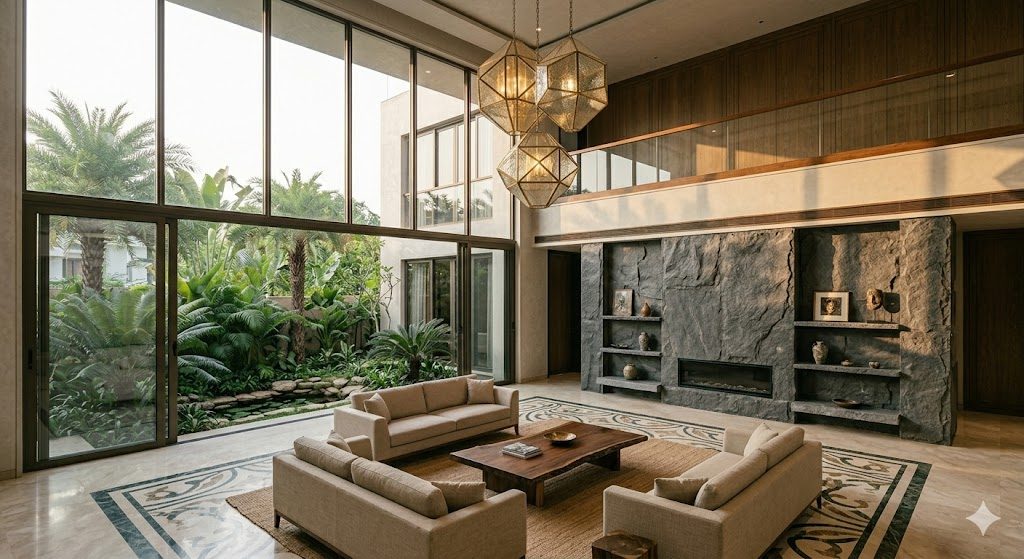
The double-height works only if it is composed. A tall, blank volume is not grand; it is a void waiting for a heating bill. Compose it with a full-height window or sliding wall to the garden (so the volume frames a view), a deliberate art or stone feature on the tall wall, a statement light that occupies the vertical space, and a mezzanine or gallery edge above so the upper floor participates rather than turning its back. Acoustically, introduce soft mass — drapery, a large rug, an upholstered wall — or the room will echo.
The staircase is the most under-used opportunity in Indian villa interiors. Treated as utility it is a stack of treads; treated as architecture it becomes the house's sculptural centre. The materials matter — cantilevered stone, folded steel with timber treads, a glass or metal-rod balustrade — but so does the light. A staircase washed by a skylight or a tall window above changes through the day and gives the foyer a living focal point. Specify the lighting of these two moments with the same care you would a jewel; our guide to designer lighting for luxury homes in India covers the layering — ambient, accent, statement — that makes a double-height volume read as intended after dark.
Indoor-outdoor flow, courtyards and verandahs
A villa, unlike a flat, owns its ground. The garden, the courtyard and the verandah are not landscape afterthoughts but rooms of the house, and the interior plan must reach out to meet them.
The mechanics matter. Get the floor levels flush — a continuous threshold with a flush drainage channel, so the indoor floor reads as one plane with the deck and there is no tripping step. Choose materials that transition gracefully: a polished marble inside can meet a leather-finish or flamed version of the same stone outside, so the eye reads continuity while the outdoor surface stays non-slip and weatherproof. And design the courtyard as a passive engine — an internal court pulls light and air into the deep heart of a large plan and cools the house through stack ventilation, the same logic that makes traditional havelis and Kerala nalukettu houses comfortable without mechanical help.
Landscape continuity is too important to leave to chance, which is why a landscape architect belongs on the team from the start, not after the building is up. The relationship between the building edge, the verandah and the planting is a single design problem — explored in depth in our villa landscape design guide. To gauge how well your scheme connects occupants to nature — views, daylight, planting, natural materials, water — run it through our biophilic score tool; in a villa, that connection is one of the most genuinely luxurious things money can buy.
Climate-responsive luxury: this is India
The most overlooked truth in Indian villa interiors is that passive comfort is luxury. A house that stays cool in a Hyderabad summer without the air-conditioning roaring, that holds warmth on a Lonavala winter night, that lets a Bengaluru breeze through — that is a more luxurious house than one that brute-forces comfort with energy.
| Climate strategy | Device | Where it earns its place |
|---|---|---|
| Cut solar gain | Deep overhangs, jaalis, pergolas | West and south façades |
| Cross-ventilation | Aligned openings, courtyard stack | Living and bedroom zones |
| Thermal mass | Stone floors, thick walls | Hot-dry zones (Rajasthan, parts of Telangana) |
| Daylight without glare | North light, light shelves, skylights | Studios, stairwells, deep plans |
| Insulation | Roof + wall insulation, double glazing | Top-floor suites, theatre |
These strategies are not in tension with luxury finishes — they enable them. Deep verandahs that shade the glass are also the most gracious outdoor rooms. A jaali screen is both a climate device and a piece of craft. The stone floor that gives you thermal mass is the same floor that reads as a continuous luxury plane. A villa that ignores climate will run a punishing electricity bill and still feel stuffy; one that works with its site feels effortless, which is the whole point of luxury.
The home-automation backbone
A modern luxury villa is wired before it is finished. Automation in a villa is not a gadget layer added at the end; it is a backbone of cabling, hubs and conduits that must be laid during civil work, because retrofitting a large house is ruinously expensive and never as clean.
Plan, at minimum, for: a structured cabling cabinet (the "rack room") with UPS and ventilation; CAT6A runs to every key zone; lighting control on a proper bus protocol (KNX or a robust wireless system) rather than dozens of smart bulbs; motorised drapery and the chandelier hoist; multi-zone HVAC control; whole-home audio and the home-theatre AV; CCTV, video door phone and access control; and a genuine power backup strategy — DG plus, increasingly, solar with battery. The decision that saves the most pain is conduiting generously even where you are unsure, so future devices have a path.
| Subsystem | Lay during civil? | Typical villa allocation |
|---|---|---|
| Structured cabling + rack | Yes — essential | ₹3–8 lakh |
| Lighting control (KNX) | Yes | ₹8–25 lakh |
| Home theatre + audio | Conduit yes, kit later | ₹15–60 lakh |
| Security + access | Yes | ₹4–12 lakh |
| HVAC zoning + automation | Yes | within HVAC scope |
| Power backup (DG + solar) | Yes | ₹8–30 lakh |
The mistake to avoid is treating automation as a showroom upsell decided after handover. Bring the AV and automation consultant into the table during the structural design, alongside the architect, or you will be chasing wires through finished walls.
The budget reality
There is no honest villa interior guide without numbers, and villa fit-out costs span a wide band depending on how much imported stone, bespoke joinery and specialist programme you take on.
| Tier | Fit-out rate (₹ / sqft) | What it buys |
|---|---|---|
| Premium | ₹4,000–7,000 | Quality Indian materials, good joinery, branded fittings |
| Luxury | ₹7,000–12,000 | Imported stone in public zones, bespoke furniture, full automation |
| Ultra-luxury | ₹12,000–20,000+ | Curated imported everything, home theatre/spa/bar, art-grade detailing |
For a typical 5,000–8,000 sqft villa, that translates to a total interior fit-out of roughly ₹1.5 crore at the entry of premium to ₹10–15 crore and beyond at the ultra-luxury end — exclusive of the building shell, which is a separate civil cost. Where the money concentrates is predictable: stone and flooring, bespoke joinery (kitchens, wardrobes, the bar, panelling), lighting, automation, and the leisure programme (a true home theatre or a spa bathroom can each run into tens of lakhs alone).
The discipline that protects the budget is sequencing it against the spatial hierarchy: spend hardest on the public zones and the moments everyone experiences (foyer, living, the stair, the master suite), and be more restrained in secondary bedrooms and service areas where guests never go. A villa where every room is finished to the same ultra-luxury standard is not more luxurious — it is undisciplined.
Coordinating the consultant team
The defining management challenge of a villa is that no single party designs it. A flat is a designer-and-contractor affair; a villa is a coordination problem.
| Consultant | Owns | When they join |
|---|---|---|
| Architect | Envelope, structure, plan, elevation | First — sets the section |
| Interior designer | Spaces, materials, joinery, FF&E | Early — alongside or just after architect |
| Landscape architect | Garden, courtyards, indoor-outdoor edge | Early — site and levels |
| Structural + MEP engineers | Loads, plumbing, HVAC, electrical | With architect |
| AV / automation consultant | Cabling backbone, theatre, lighting control | During structural design |
| Acoustic consultant | Theatre, double-height, music room | Early for theatre |
| Project / cost manager | Programme, budget, contractor interface | Throughout |
The single most valuable decision is appointing the architect and interior designer early and together, so the section, the staircase, the double-height and the material story are designed as one thought rather than negotiated across a handover. The second is to bring the AV/automation and landscape consultants in before the structure is poured, because both need things buried in walls, slabs and the ground. A monthly coordination meeting with a shared, version-controlled drawing set is not bureaucracy on a project of this scale — it is what keeps a ₹5 crore interior from being undone by a clash nobody caught.
Get it right, in order
1. Draw the section first. Settle public-private-service zoning and the double-height before any room is furnished.
2. Design the spatial sequence. Make arrival, foyer, formal, family and stair a deliberate journey where guest and family circuits never cross.
3. Fix the material story. Choose two or three hero materials, hold the floor constant across public zones, vary walls and ceilings.
4. Lay the backbone. Conduit and cable for automation, lighting control, AV, security and power backup during civil work.
5. Plan for climate. Overhangs, jaalis, cross-ventilation and a courtyard — passive comfort is the luxury that lasts.
6. Resolve the garden edge. Flush thresholds, transitional materials and the landscape architect engaged from the start.
7. Assemble and run the team. Architect and interior designer early and together; AV and landscape before the structure is poured; coordinate monthly.
Planning a villa interior is the most demanding project most homeowners will ever commission, and it rewards thinking in three dimensions long before you choose a finish. DesignAI lets you explore zoning, spatial sequence and material stories across a full villa quickly — generating and testing layout and look ideas floor by floor — so you arrive at conversations with your architect and designer with a clear, considered brief rather than a folder of magazine clippings. Start with the plan; the marble can wait.
References
- Bureau of Indian Standards (2016) National Building Code of India 2016, Volumes 1–2. BIS, New Delhi.
- Ministry of Power, Govt. of India (2017) Energy Conservation Building Code (ECBC) for Residential Buildings — Eco Niwas Samhita. BEE.
- Ching, F. D. K. (2014) Architecture: Form, Space, and Order. 4th ed. Wiley.
- Correa, C. (2010) A Place in the Shade: The New Landscape and Other Essays. Penguin / Hatje Cantz.
- Bahga, S. & Bahga, S. (2017) Modern House in India. White Falcon Publishing.
- KNX Association (2024) KNX System Specifications — Home and Building Control. KNX, Brussels.
- Bureau of Indian Standards (2007) IS 1893: Criteria for Earthquake Resistant Design of Structures. BIS, New Delhi.
Continue through the Luxury Interiors cluster: start with what defines luxury interiors in India, then read luxury villa architecture, villa elevation design, villa landscape design, designer lighting for luxury homes and Italian marble vs quartz.
Export this guide
Related Guides — Deep-dive reading
How to Plan a Home for Multi-Generational Living
Designing for grandparents, parents and children under one roof — privacy, accessibility and harmony
Home PlanningDesigning a Naturally Energy-Efficient Indian Home
Comfort first, gadgets last — passive design, orientation, insulation, ventilation and the climate wisdom that cuts Indian energy bills
SustainabilitySmart Home for Villas & Independent Houses in India: The Whole-Home Playbook
A three-floor villa in Whitefield or a farmhouse-style bungalow in Gurugram is a different animal from a two-bedroom flat. Multiple floors, a garden, a gate, big power loads and real security exposure demand a whole-home approach — wired backbone, per-floor zoning and a rack room — not a bag of Wi-Fi plugs.
Smart HomeRelated Tools — Try Free
Brise-Soleil Visualizer
Interactive horizontal-louvre cut-off angle calculator — sun altitude, louvre depth, and spacing inputs with a live shadow preview. Computes θ = arctan(spacing/depth) for façade shading, ECBC envelope compliance, hospital daylight design, and tropical sun-control detailing.
Sun Shading ToolCross-Ventilation Analyzer
Estimate airflow and air changes per hour (ACH) from room size, window areas, layout, and local wind — with NBC 2016 Part 8 compliance check.
Ventilation CalculatorAcoustic Privacy (STC) Visualizer
Indian healthcare acoustic visualizer — compare wall assemblies and noise sources, see received SPL after STC attenuation, and check FGI 2018 / IS 1950 / NABH speech-privacy compliance with live dual-canvas waveform.
Acoustic Tool