
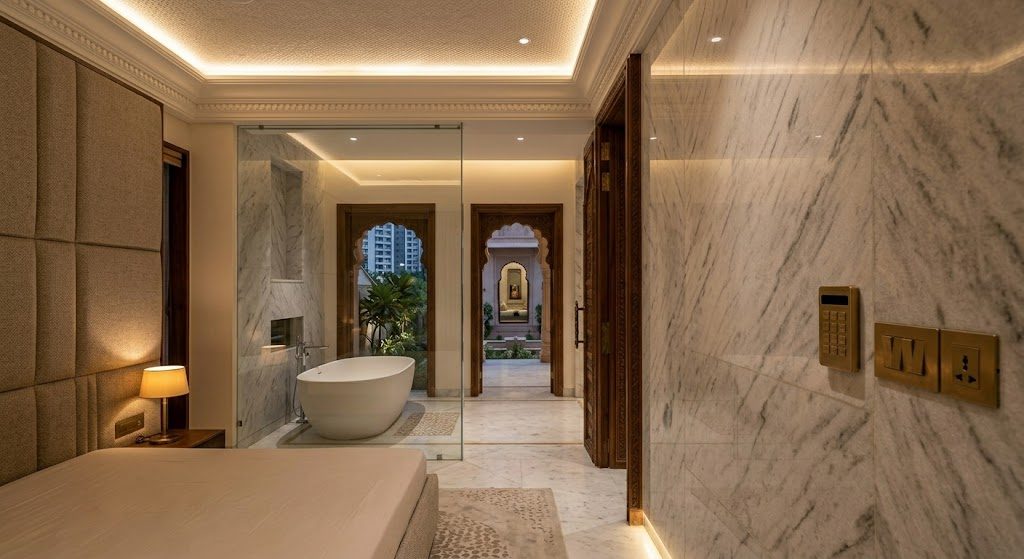
Hotel-Inspired Residential Design
Bringing five-star hospitality design into the Indian home — the master suite, bath, and arrival experience
There is a particular feeling you get walking into a suite at the Taj Mahal Palace in Mumbai, an Oberoi in Gurugram, or an Aman anywhere in the world. The door closes behind you and the city falls away. The light is low and warm. The bed is enormous and dressed in linen you want to fall into. The bathroom is a room, not a cupboard — a freestanding tub, a rain shower behind glass, a stone vanity wide enough for two. Everything you might reach for is exactly where your hand expects it. This is not luxury as decoration. It is luxury as a script for how the body should feel — and increasingly, it is what affluent Indian homeowners want to live inside every day.
This guide is about translating that five-star feeling into a real Indian home — one of the most-requested directions in luxury residential work today, and a natural extension of what we set out in our pillar guide on what defines luxury interiors in India. It covers what actually makes hotel design feel luxurious; how to rebuild the hospitality master suite, the spa bathroom and the arrival ritual at home; the materials, lighting scenes and obsessive detailing hotels rely on; the wellness trend driving all of it; and — crucially — what does and does not survive the move from a serviced suite to a lived-in family home with a pooja room, a working kitchen and no overnight housekeeping team. It closes with honest 2026 cost bands.
The core idea: a hotel suite feels luxurious not because of what it contains but because of how it choreographs you — a sequence of arrival, rest, bathing and grooming, each given its own zone, its own light, and its own ritual. You are not copying a hotel's furniture. You are borrowing its discipline.
Why "hotel-inspired" became the leading luxury-residential brief
For a decade the aspirational reference for an Indian luxury home was a magazine villa or an imported sofa. Today it is a hotel suite — and specifically the suites of a handful of houses whose names function as shorthand for "the best": the Taj and Oberoi for Indian grandeur, the Four Seasons and Ritz-Carlton for international polish, Aman and Six Senses for the wellness-led, stripped-back end. When a client says "I want the master to feel like our suite at the Oberoi," they are describing something precise even if they cannot name it: deep rest, sensory calm, and the sense of being looked after.
This is luxury that is felt rather than displayed. The hotel reference is so powerful precisely because hospitality designers have spent decades A/B-testing comfort on millions of guests. They know exactly how high a bedside switch should sit, how warm the bathroom floor should be, how many lumens flatter a face at the mirror. A home can borrow that hard-won research wholesale.
The trend also rides the broader move toward wellness and quiet luxury: the flex is no longer a visible logo but an invisible quality of experience. A hotel-inspired home is the architecture of being well — and that is a far more durable aspiration than any single trend.
What actually makes hotel design feel luxurious
Strip away the brand and a great suite is doing seven specific things. Each is reproducible at home.
| Hotel move | What it really is | How to bring it home |
|---|---|---|
| The arrival sequence | A choreographed entry that resets you | Foyer ritual: framed threshold, drop zone, scent, warm light |
| Zoned single suite | Sleep, dress, bathe, refresh — each defined | Master planned as a suite, not a bedroom plus an attached bath |
| Layered lighting scenes | Never one bright ceiling light | Multiple circuits on a keypad: arrival, dressing, relax, night |
| The bathroom as a room | Bathing treated as a ritual, not a function | Freestanding tub, walk-in shower, double vanity, separate WC |
| Premium bedding | The bed is the product | Quality mattress, headboard wall, layered linen, blackout |
| Concealed function | Tech and clutter hidden | TV lift or behind art, minibar joinery, cable-free surfaces |
| Repeatable detail | The same standard everywhere | Consistent reveals, switch heights, materials, finishes |
The thread running through all seven is control of experience. A hotel decides what you see, smell, touch and reach in what order. Most homes leave this to chance; luxury homes choreograph it.
The arrival ritual: the first ten seconds
Hotels obsess over arrival because first impressions anchor everything that follows. The lobby sequence — doorman, scent, light, a focal artwork, then the reveal of the space — is engineered. At home, the foyer is your lobby, and the same five-beat sequence applies.
Threshold. Mark the entry with a change of floor material underfoot — a stone or inlay band, a generous mat — and a framed doorway. The body should register "I have arrived somewhere."
Drop zone. A console with a tray for keys and phone, a discreet charging point, and concealed storage for shoes and bags. In Indian homes this is also where footwear comes off — design it generously so the entry never looks like a shoe rack.
Scent and light. A single signature fragrance at the door (a reed diffuser or a quiet electric diffuser) and a warm 2700K wash, never a cold tubelight. Hotels keep one scent forever; pick yours and stay loyal.
A focal moment. One framed artwork or a lit niche on the entry sightline. Not a gallery — a single held point.
The reveal. The foyer should open onto the living view with a beat of compression then release, exactly as a lobby opens to an atrium. Even in a compact flat, a half-height shoe console or a fluted screen can create that held-then-released moment.
This entire sequence is what makes a home feel received rather than just entered.
The hospitality master suite at home
The single biggest hotel-inspired move is to stop thinking of a "bedroom with attached bath" and start designing a suite — one continuous experience zoned into sleep, dress, bathe and refresh. The plan below shows the standard hospitality arrangement adapted for an Indian home.
The bed and headboard wall
The bed is the hero. Hotels invest disproportionately here because guests judge a stay on sleep. At home:
- Mattress first. A genuinely good mattress (premium Duroflex, Sleepwell, Sealy, Kurlon's high-end ranges, or imported) does more for the "five-star feeling" than any finish. Budget for it like furniture, not a consumable.
- Headboard wall. Run an upholstered or fluted-panel headboard wall the full width — floor to a metre or so above the bed — flanked by reading lights and bedside USB points. This single gesture instantly reads "suite."
- Layered linen. Hotel beds are layered: fitted sheet, flat sheet, a duvet, a runner, and a stack of pillows. Specify a high-thread-count cotton or linen; this is where the hand actually meets luxury.
- Blackout plus sheer. A double curtain track — a sheer for day, a true blackout layer for sleep — is the most-missed hotel detail in Indian homes. Operable from the bed, ideally motorised.
The coffee and minibar station
A small joinery run with a stone counter, a bar fridge, an espresso machine and a concealed tray turns "I have to go to the kitchen" into "morning coffee in my suite." In a joint-family home this is also a small mercy — a private refreshment point that does not disturb a shared kitchen at 6 a.m.
The concealed TV
Luxury hides technology. Options, in rising order of cost: a frame-style TV that displays art when off; a TV behind a sliding panel or two-way mirror; or a motorised lift that drops the screen into the coffee-station joinery. The surface should never read as "entertainment unit."
Walk-in wardrobe and dressing
A walk-through dressing room between the bedroom and the bath is the most hotel-like spatial move of all. Internally it wants a proper systems approach to storage — Häfele, Hettich or Blum dressing systems with pull-out trouser racks, jewellery drawers with felt inserts, vertical lit shoe stacks, and an island with a stone top if space allows. The lighting here must be bright and high-CRI (3500K+, CRI 90) so colours read true when you dress.
A luxury suite is not a bedroom that happens to be expensive. It is four rituals — sleeping, dressing, bathing, refreshing — each given a room, a light and a reason to slow down.
The hotel bathroom at home
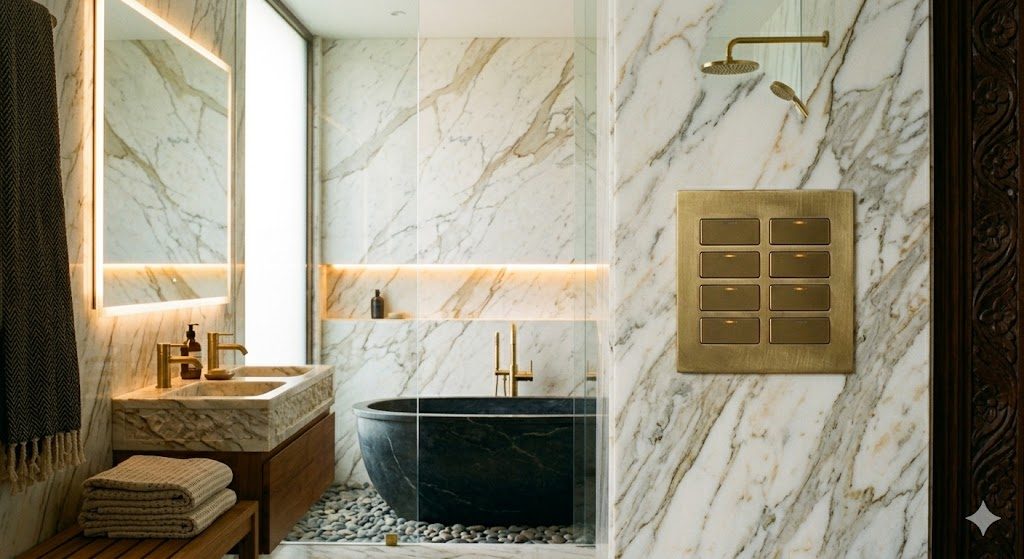
If the suite is the headline, the bathroom is the proof. Nothing signals hotel-grade luxury faster than a bathroom that is a room — a freestanding tub, a walk-in shower behind glass, a stone double vanity, a separate WC. The anatomy below shows the three-zone logic hotels use, adapted for home.
The non-negotiables, drawn straight from five-star practice:
| Element | Hotel standard | India spec / brands |
|---|---|---|
| Freestanding tub | The visual anchor | Jaquar, Kohler, Duravit, Toto; floor-mount filler |
| Rain + hand shower | Overhead drench plus a handset | Grohe, Hansgrohe, Jaquar; thermostatic mixer |
| Double vanity | Two basins, his-and-hers storage | Stone or sintered top; Kohler/Duravit/Toto basins |
| WC compartment | Its own door and exhaust | Wall-hung pan, concealed cistern; smart WC + health faucet |
| Backlit mirror | Flattering, even, CRI 90+ at the face | Backlit or front-lit vertical at the mirror |
| Niche lighting | Glow, not glare | LED-lit niches at tub and shower |
| Heated towel rail | A small five-star tell | On a timer; mains or hydronic |
| Stone surfaces | Large-format, few grout lines | Marble, large-format porcelain or sintered slabs |
The two disciplines that separate a hotel bathroom from a merely expensive one are zoning and thermal comfort. Keep the wet zone (tub and shower) physically apart from the dry grooming run so the vanity and floor stay usable; give the WC its own door and exhaust; and in cooler cities (Delhi-NCR, Pune in winter) consider underfloor heating and ensure exhaust is sized to keep stone surfaces dry. A thermostatic mixer that holds a set temperature is the unglamorous fitting that most makes a shower feel hotel-grade.
For the look — the stone, the palette, the brassware finish — our luxury bathroom moodboards guide goes deep on assembling a coherent scheme. The point here is the spatial anatomy: a bathroom planned as three lit zones, not a single tiled box.
Layered lighting and scenes — the hotel's secret weapon
Ask any hospitality designer what most separates their work from a typical home and the answer is light. A suite never has one bright ceiling fixture; it has many small sources on multiple circuits, and a keypad that recalls scenes — combinations of those circuits at set brightnesses and colour temperatures.
| Scene | What it does | Composition |
|---|---|---|
| Arrival | Welcomes, orients | Warm path + cove light, 2700K, ~40% |
| Dressing | Bright, true colour | Vertical wardrobe + mirror light, 3500K, CRI 90, 100% |
| Relax | Winds you down | Tub niche + cove glow only, 2200–2700K, very low |
| Night | Safe, sleep-friendly | Low floor wash, 2200K, motion-triggered |
The hardware is now affordable in India: Lutron, Wipro, Legrand, Schneider and similar systems give you keypad scenes and dimming on standard wiring. The discipline is in the design — deciding which fixtures belong to which scene before the electrician chases the walls. Plan it room by room with our lighting planner, and for the broader craft of designing light in a premium home see our dedicated guide on designer lighting for luxury homes. Get the layers and scenes right and a modest room reads expensive; get them wrong and the most expensive room reads like an office.
Materials, palette and the discipline of consistency
Hotels achieve calm partly through palette discipline. A luxury suite typically runs a tight envelope — two or three stones, one or two woods, a metal finish, a single accent — repeated everywhere. The eye reads coherence as quality. The lesson for home is restraint: choose a small material family and hold to it across the suite.
| Layer | Hotel default | Residential translation |
|---|---|---|
| Floor | Large-format stone or warm wood | Marble, large porcelain, or engineered oak |
| Walls | Quiet plaster, fabric, or fluted wood | Lime plaster, upholstered headboard, veneer |
| Stone | One or two, vein-matched | Statuario / Carrara look, or a warm travertine |
| Metal | A single finish throughout | Brushed brass, matte black, or champagne |
| Accent | One restrained note | A deep velvet, a single artwork, a plant |
The other half of the hotel secret is repeatable detail. Hotels run thousands of identical rooms, so they perfect a detail once and repeat it flawlessly — the same shadow-gap reveal, the same switch height (typically around 1100–1200 mm), the same skirting, the same tap. At home you have one room, but the same obsession pays off: even reveals, aligned grout lines, consistent switch and socket heights, mitred stone corners, no exposed cables. This consistency is exactly the quiet-luxury sensibility — the luxury is in the tolerance, not the price tag. The same detailing rigour applies whether you are doing a single suite or a whole villa, where this discipline must hold across many more rooms.
The wellness and spa trend
The newest layer of hotel-inspired design is wellness. Driven by Aman, Six Senses and the spa wings of the Oberoi and Four Seasons, the brief has expanded from "comfortable" to "restorative." At home this shows up as:
- A genuine spa bath — the freestanding tub, the rain shower, the warm floor, the niche glow — used as a daily reset, not a once-a-year soak.
- Circadian lighting that shifts warm and dim in the evening to support sleep, a direct borrow from wellness-led hotels.
- A small ritual corner — a meditation or stretch nook, a tea station, a reading chair by the window — which in many Indian homes overlaps gracefully with a quiet pooja or contemplation space.
- Air, water and sound — a quiet exhaust, a water softener so fittings and skin stay good, acoustic softness from rugs and drapery so the suite is genuinely quiet.
Wellness is what keeps "hotel-inspired" from being mere imitation. A hotel suite is for a night; a wellness-led suite at home is built to make you well over years.
What to borrow — and what does NOT translate
This is the section most "hotel-look" projects get wrong. A hotel is a serviced, transient, single-occupant box with housekeeping, no cooking, and no family life. An Indian home is permanent, multi-generational, devotional and self-serviced. Borrow the experience; reject the assumptions.
| Hotel assumption | Reality at home | The adaptation |
|---|---|---|
| Daily housekeeping resets the room | You make your own bed, dust your own stone | Choose low-maintenance finishes; design for real cleaning |
| No kitchen, no clutter | A working family kitchen, daily cooking | Plan generous, concealed storage; do not fake a clutter-free life |
| Single or couple occupancy | Joint family, children, guests | Acoustic separation, more storage, durable surfaces |
| No devotional space | Pooja is central to the home | Integrate a dignified pooja space, not an afterthought |
| Transient, impersonal | Your memories, art, books live here | Layer personal objects; a home is not a show suite |
| Disposable luxury | You pay the upkeep forever | Specify for longevity and serviceability, not just photos |
Two failures recur. First, the all-white, prop-styled "hotel" look that cannot survive a Tuesday — porous white marble around an Indian cooking household, no real storage, surfaces that demand staff you do not have. Second, importing the impersonality — a suite is deliberately anonymous so any guest can inhabit it; a home should hold your art, your books, your light. The right move is to borrow the discipline and the rituals (zoning, layered light, the spa bath, the arrival sequence) while keeping the home warm, personal, devotional and genuinely livable. Adapt the spa bath to Indian bathing habits (a health faucet, a bucket option in a second bath), and let the pooja space have the same lit-niche dignity you would give a hotel's focal artwork.
Budget reality
Hotel-inspired luxury concentrates spend in two places: the master suite and its bathroom. You do not need to do the whole home — a beautifully executed suite plus spa bath delivers most of the feeling. Indicative 2026 India bands, for a single master suite and bath of around 350–600 sq ft, finishes only (excluding civil/structural changes):
| Scope | Indicative 2026 cost |
|---|---|
| Master-suite refresh (headboard wall, layered lighting, curtains, bedding, dressing upgrade) | ₹8,00,000 – ₹15,00,000 |
| Master suite + mid spa bath (freestanding tub, walk-in shower, double vanity, branded fittings, stone) | ₹15,00,000 – ₹25,00,000 |
| Full hotel-grade suite + spa bath (large-format stone, top-tier Jaquar/Kohler/Duravit/Grohe, smart WC, scenes, underfloor heat, walk-in dressing with island) | ₹25,00,000 – ₹40,00,000+ |
Where the money actually goes, in rough order: stone and surfaces; sanitaryware and brassware (a freestanding tub plus thermostatic shower set plus smart WC alone can run ₹3,00,000–₹8,00,000+); the dressing system; layered lighting and scene control; bespoke joinery for the headboard, coffee station and concealed TV; and quality bedding. The mattress and linen are the cheapest "five-star" upgrade per rupee — never economise there.
Get it right, in order
1. Plan the suite, not the bedroom. Zone sleep, dress, bathe and refresh before you choose a single finish; settle the walk-through dressing-to-bath sequence first.
2. Spend on the bed and the bath. The mattress, the bedding, the tub and the shower fittings carry the feeling; these are the load-bearing investments.
3. Design the light in scenes. Decide arrival, dressing, relax and night scenes and their circuits before wiring; plan them with the lighting planner.
4. Hold a tight palette and obsess over detail. Two stones, one wood, one metal — repeated with even reveals and consistent switch heights, hotel-style.
5. Conceal the technology. TV behind art or on a lift, cables gone, the minibar joinery quiet — luxury hides function.
6. Adapt honestly for Indian family life. Real storage, durable finishes, a dignified pooja space, a health faucet — borrow the ritual, reject the assumptions that need staff you do not have.
7. Specify for longevity. You maintain this yourself for years; choose serviceable fittings and resilient surfaces over photogenic but fragile ones.
A suite planned this way is far easier to visualise — and to budget — before you commit a rupee. DesignAI lets you generate and walk through your master suite and spa bath in your own dimensions, test layered lighting scenes and material palettes side by side, and hand your contractor a clear, hotel-grade brief so the freestanding tub, the dressing run and the lighting scenes all land exactly as drawn.
References
- Bureau of Indian Standards (2016) National Building Code of India 2016, Part 9: Plumbing Services. BIS, New Delhi.
- Bureau of Indian Standards IS 2064: Selection, Installation and Maintenance of Sanitary Appliances — Code of Practice. BIS, New Delhi.
- Illuminating Engineering Society The Lighting Handbook (residential and hospitality recommendations on layered lighting, colour temperature and CRI). IES, New York.
- Watson, L. & Kirby, M. Designing the Hotel Experience (principles of hospitality spatial sequencing and guest-room design). Industry reference.
- Jaquar, Kohler, Duravit, Grohe and Toto — published technical and specification catalogues for sanitaryware and brassware (2025–2026).
- Häfele, Hettich and Blum — dressing-system and wardrobe-hardware technical catalogues (2025–2026).
Continue through the Luxury Interiors cluster: start with what defines luxury interiors in India, then explore quiet-luxury design, luxury bathroom moodboards, designer lighting for luxury homes and luxury villa interior planning.
Export this guide
Related Guides — Deep-dive reading
What Defines Luxury Interiors Today?
Beyond price tags — the materials, craft, proportion, light and restraint that separate true luxury from expensive
Luxury InteriorsSmart Storage Interiors — A 2026 Working Reference for Indian Homes
Inventory-driven · Floor-to-ceiling · Hardware-engineered · Zone-mapped
Room PlanningLuxury & Statement Lighting: Drama, Sculpture & Scale (2026)
How to design lighting that actually feels luxurious in an Indian home — layered scenes, deep shadow-and-highlight contrast, hidden sources and premium materials — and how to place one sculptural statement fixture as the jewel of a room without over-lighting the whole thing.
LightingRelated Tools — Try Free
Circadian Light Meter
Patient-centric circadian lighting visualizer for Indian healthcare design — time-of-day × intensity → CCT, melanopic lux (EML / mEDI), melatonin suppression, and an alertness curve. Calibrated against WELL v2 L03 Circadian Lighting Design, CIE S 026:2018, Brainard 2001, and Lucas et al. 2014.
Circadian ToolAcoustic Privacy (STC) Visualizer
Indian healthcare acoustic visualizer — compare wall assemblies and noise sources, see received SPL after STC attenuation, and check FGI 2018 / IS 1950 / NABH speech-privacy compliance with live dual-canvas waveform.
Acoustic ToolCross-Ventilation Analyzer
Estimate airflow and air changes per hour (ACH) from room size, window areas, layout, and local wind — with NBC 2016 Part 8 compliance check.
Ventilation Calculator