
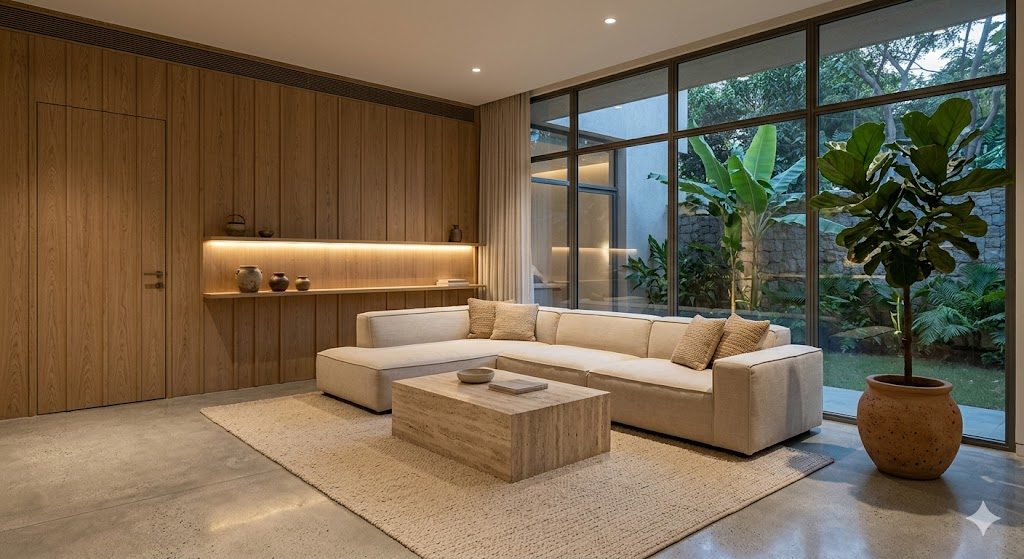
Luxury Minimalism in Indian Homes
Achieving warm, liveable minimalism in the Indian context — without it feeling cold or impractical
Walk into a genuinely good minimal home in Mumbai or Bengaluru and the first thing you notice is what is missing. No clutter on the console. No wires snaking behind the TV. No towering CD racks, no decorative-but-dusty showpieces, no skirting board collecting a grey line of grime. Just warm oak, a slab of travertine, a single ceramic vessel catching the evening light, and a calm you can almost hear. It looks effortless. It is anything but.
This guide is about a very particular thing — luxury minimalism, adapted honestly for the way Indians actually live. Not the frozen, all-white, Pinterest-perfect version that photographs beautifully and is miserable to inhabit. We will cover what luxury minimalism really means, why imported Scandinavian and Japanese minimalism so often fails in Indian homes, how to translate it into a warm and liveable Indian idiom, the unforgiving discipline of detailing it demands, how to handle pooja spaces and shoe piles and dust without breaking the language, the material and colour palette that makes it sing, and — crucially — why it costs far more than the bare look suggests.
The core idea is this: luxury minimalism is "less but better", never "less and cheaper". You are not removing things to save money — you are removing things so that the few that remain can be exceptional, and concealing everything else so that the eye rests. Done right, it is one of the most expensive looks in residential design, because the cost migrates from what you see to what you do not.
What luxury minimalism actually is
Minimalism, as a design language, is reduction to the essential. But "luxury" minimalism adds a second, non-negotiable clause: what remains must be rich. The German industrial designer Dieter Rams compressed the whole philosophy into three words — "Weniger, aber besser", less but better. The reduction is in the quantity of objects and visual noise; the richness is in the quality of every surface, material and joint that survives the cull.
This is the distinction that separates it from cheap minimalism. A bare rented flat with white-painted walls and a single IKEA shelf is minimal, but it is not luxurious — it is just empty. Luxury minimalism takes the same restraint and pours the entire budget into materiality and detailing: full-height bookmatched veneer instead of paint, a honed natural-stone counter instead of laminate, handleless joinery with a 2mm reveal instead of a screwed-on knob. If you have read our pillar on what defines luxury interiors in India, you will recognise the logic — luxury is restraint plus craft, not accumulation. Minimalism is simply that principle taken to its purest expression.
It sits very close to two neighbouring languages. It overlaps heavily with quiet luxury interior design — both reject logos, gloss and visual shouting in favour of material confidence — and it is the disciplined sibling of warm minimal interiors, which is the broader, softer family this guide sits inside. Where quiet luxury can still be layered and full, luxury minimalism is defined by what it leaves out.

| Cheap / cold minimalism | Luxury / warm minimalism | |
|---|---|---|
| Driving motive | Save money, look "modern" | Spend on the essential, conceal the rest |
| Walls | White paint, flat | Lime plaster, oak veneer, microcement |
| Storage surface | Open shelves, things on display | Full-height concealed joinery, clear surfaces |
| Counter | Laminate, plain quartz | Honed natural stone, large-format porcelain |
| Hardware | Visible handles, knobs | Handleless, push-to-open, hidden |
| Texture | One flat finish everywhere | 3–4 tactile materials within reach |
| Feeling | Bare, tense, showroom | Calm, generous, restful |
Why imported minimalism fails in Indian homes
Scandinavian minimalism was born in cold, low-light, small-household, low-dust Northern Europe. Japanese minimalism grew from a culture of spatial economy, ritual emptiness and very particular storage habits. Both are beautiful. Both, transplanted unaltered into an Indian home, tend to fail — and it is worth being honest about why, because each failure point tells you exactly what to adapt.
Joint and extended families. A Nordic flat is designed for one or two people. An Indian home frequently houses three generations, with guests arriving unannounced and staying a fortnight. More people means more possessions, more shoes at the door, more cooking, more everything. A storage scheme sized for a minimalist couple collapses under a joint family in a month.
More possessions, by culture. Indians keep things — inherited brass, festival décor, the good crockery used twice a year, gifts that cannot be discarded without offence, children's growing belongings. The Marie Kondo fantasy of owning forty objects is culturally alien for most. The honest design response is not to demand fewer possessions; it is to provide enough concealed volume to absorb them.
Festivals and seasonal décor. Diwali means diyas, rangoli, marigold torans, fairy lights. Christmas means a tree. A wedding in the family means the house transforms. A home that can only hold its breath in one frozen, decoration-free state is not built for Indian life. Warm minimalism must be a calm baseline that décor can be added to and stripped from cleanly — which again means storage, and surfaces clear enough to host the décor without competing.
Dust and climate. This is the silent killer. Indian cities — Delhi-NCR especially — generate enormous quantities of fine dust. Minimalism's clear horizontal surfaces and dark, matte finishes show every speck. A glossy white Scandinavian sideboard that stays pristine in Copenhagen needs wiping twice a day in Gurugram. High humidity in Mumbai and Chennai swells solid wood and lifts veneer. The palette and detailing must be chosen for this reality, not against it.
Entertaining and staff. Indian homes entertain at scale and most run with domestic staff — a cook, a maid, sometimes a full-time help. The kitchen takes a beating that a show-kitchen minimalism cannot survive, which is precisely why the dual-kitchen and utility solution exists (covered below). Design that ignores how the house is actually worked is design that will be defeated within a year.
Cold minimalism asks you to own less. Warm minimalism lets you own as much as you like — and simply hides almost all of it. The first is a lifestyle demand most Indian families will quietly refuse. The second is an engineering problem a good designer can solve.
The Indian adaptation: warm minimalism
The fix is not to abandon minimalism — it is to warm it and equip it. "Warm minimalism" keeps the restraint, the clean lines and the clear surfaces, but swaps the cold Nordic palette for a warm, tactile, handcrafted one, and backs it with enough concealed storage to make the clear surfaces sustainable. The discipline stays; the temperature and the practicality change.
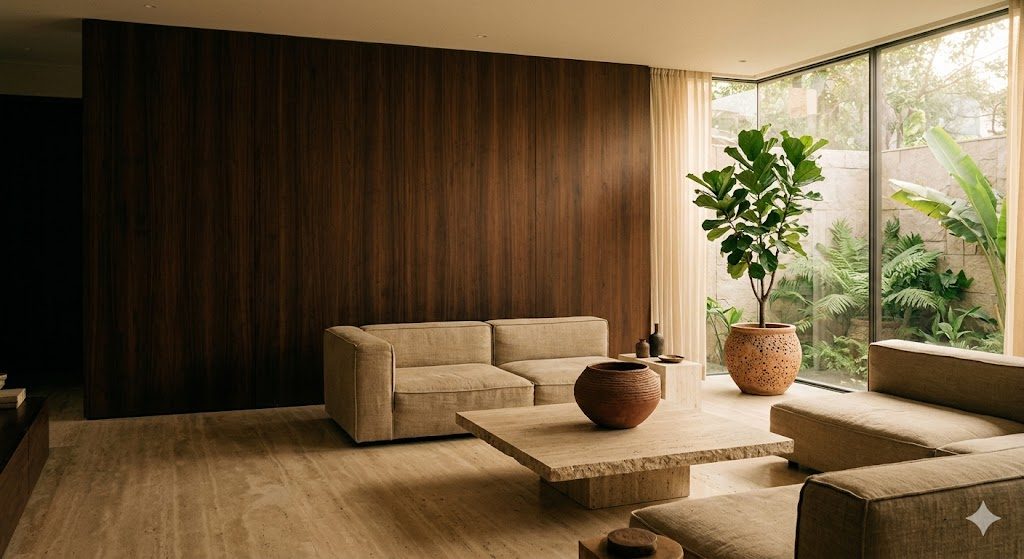
The substitutions are specific:
| Cold minimal element | Warm minimal substitution (Indian-grounded) |
|---|---|
| Cool grey walls | Warm white, oat, lime-plaster, microcement in beige/taupe |
| White lacquer joinery | Oak / teak / walnut veneer, fluted wood, cane inserts |
| Polished white vitrified floor | Honed Kota, tumbled limestone, warm large-format porcelain, oak engineered wood |
| Chrome and gloss | Brushed brass, antique bronze, matte black, raw steel |
| Bare empty surfaces | A few curated handcrafted objects — Channapatna, terracotta, studio ceramics |
| No greenery | One or two architectural indoor plants (areca, ficus, rubber) |
| Single flat texture | Layered texture — linen, jute, boucle, raw cotton, stone, wood grain |
The result reads as quiet and disciplined, but it is warm to the eye and soft to the touch. The handcraft matters enormously: a single handmade ceramic vessel or a Channapatna wood object on an otherwise empty surface does more emotional work than a shelf full of mass-produced décor, and it roots the room in India rather than in a catalogue. This warmth is also what keeps it liveable — for a deeper treatment of the bedroom specifically, see our warm minimal bedroom ideas for India, and for the architectural shell that supports it, minimalist architecture in the Indian context.
The principles, in order of importance
Strip everything else away and luxury minimalism rests on a short list of principles. Break any one and the room collapses — either into cold sterility or into the cluttered modern look it was meant to escape.
1. Concealed, abundant storage. This is principle zero, the one everything else depends on. Surfaces stay clear only because there is enough hidden volume to swallow the abundance. Full-height, floor-to-ceiling joinery on at least one wall per room.
2. Clean, uninterrupted lines. Long horizontal runs, aligned reveals, doors that read as wall planes. The eye should travel without snagging.
3. Monochrome base plus texture. Colour is restrained to a tight warm-neutral family; visual interest comes from texture and material depth, not from a palette of hues.
4. Negative space, deliberately. 50–70% of surface area is intentionally empty. Empty is not a failure to furnish — it is the luxury itself, the breathing room that the few objects need to register.
5. Fewer but better objects. One curated piece per zone, not three. Each object earns its place. This is where bespoke matters — see bespoke furniture explained.
6. Hidden services. Wiring, AC, LED drivers, routers, switches — all chased into walls or concealed. No visible clutter of technology.
7. Flush detailing throughout. Handleless joinery, shadow gaps instead of skirting, concealed hardware. Nothing protrudes that does not have to.

The discipline of detailing — minimalism exposes everything
Here is the hard truth that separates real luxury minimalism from its imitations. In a maximalist or traditional room, a sloppy joint hides behind a lamp, a rug, a console of objects. In a minimal room there is nowhere to hide. Empty out the visual noise and every reveal, every mitre, every alignment is suddenly on display, lit and unmissable. Minimalism does not forgive bad detailing — it broadcasts it. This is why minimalism is, paradoxically, the hardest and most expensive language to execute well.
The detailing climbs a ladder. Builder-grade work — visible handles, chunky 100mm PVC skirting, wide uneven joint gaps — looks merely cheap when you strip the room bare. To enter genuine luxury-minimal territory you need at minimum flush detailing, and ideally handleless, shadow-gap, seamless work.

The non-negotiable details:
| Detail | Builder default | Luxury-minimal standard | Why it matters |
|---|---|---|---|
| Cabinet opening | Knob / handle | Handleless — push-to-open or gola/J-profile | Removes the single most clutter-y visual element |
| Skirting | 100mm PVC / wood beading | Shadow gap (10–15mm recess) or flush 8–12mm | The grime line and the chunky band both vanish |
| Door-to-wall junction | Visible architrave / frame | Flush door, shadow-gap reveal | Door reads as a continuation of the wall plane |
| Wall-to-ceiling | Cornice / moulding | Crisp shadow-gap groove | Clean intersection, no decorative band |
| Hardware | Exposed hinges, channels | Concealed soft-close, touch-latch | Nothing mechanical on show |
| Joint reveals | 4–6mm, uneven | 2mm, consistent everywhere | Consistency is the whole game |
Executing this needs a carpenter or joinery vendor who can actually deliver tolerances — not every contractor can. Across Mumbai, Bengaluru, Delhi-NCR and Hyderabad, expect to pay a premium of roughly 30–60% over standard modular work for handleless, shadow-gap, site-finished joinery. A handleless wardrobe that costs ₹1,400–1,800 per sq ft in melamine-faced board climbs to ₹2,500–4,500 per sq ft in matte-veneer with concealed hardware and aligned grain. The cost is real, and it is the price of the look surviving close inspection.
Managing the Indian reality
A guide that ignored the messy practicalities would be dishonest. Warm minimalism in India lives or dies on how well it absorbs the parts of daily life that have no equivalent in a Copenhagen flat. None of these need break the language — each has a concealed solution.
The pooja space. A pooja unit is, visually, the opposite of minimalism — bright, ornamented, active. The minimal solution is a dedicated niche or a full-height shutter unit that closes flush into the wall when not in use, finished in the same veneer as the surrounding joinery, with concealed warm lighting inside. Open, it is a complete mandir; closed, it is a clean wall plane. For an apartment, a 600–900mm wide concealed pooja cabinet does this elegantly.
Shoe storage. Indian homes accumulate shoes at the entry — and minimalism cannot have a shoe rack on display. A full-height or bench-height concealed shoe cabinet at the foyer, ventilated, often doubling as a seat, is essential. Size it generously; under-sizing it is the single most common warm-minimal failure.
Dual kitchens and the utility. This is where Indian planning diverges sharply from the West. The minimal, handleless "show" kitchen stays pristine because the heavy, smoky, masala-frying cooking and the dishwashing happen in a separate utility or wet kitchen behind it. The clear counters of the main kitchen are only sustainable because the mess is exiled next door. This is non-negotiable for any serious cooking household.
Dust. Plan the palette and detailing for it. Avoid high-gloss and very dark matte surfaces on horizontal planes — both flag every speck. Favour honed mid-tone stone, mid-tone matte veneer and textured finishes that read as calm even when not freshly wiped. Minimise open shelving (dust magnets) and prefer closed, gasketed joinery. Keep clear surfaces few and easy to wipe.
| Practical Indian need | Minimal-compatible solution | Typical 2026 cost band |
|---|---|---|
| Pooja space | Concealed full-height mandir unit, flush shutter | ₹45,000 – ₹1,50,000 |
| Shoe storage | Ventilated foyer shoe cabinet / bench | ₹30,000 – ₹90,000 |
| Heavy cooking | Separate utility / wet kitchen | ₹1,50,000 – ₹4,00,000 |
| Bulk / festival storage | Concealed loft + full-height joinery | ₹1,200 – ₹2,200 / sq ft |
| Dust control | Honed mid-tone finishes, gasketed closed storage | Palette choice, not a line item |
To size the concealed volume your family actually needs before you commit, run the numbers through our storage calculator — under-provisioning storage is the failure that quietly destroys the clear-surface look six months after move-in.
Material and colour palette
The palette is where warm minimalism gets its soul. The discipline is to stay within a tight warm-neutral family and let texture and material grade — not colour variety — carry the interest.
| Layer | Recommended (warm, India-suited) | Avoid |
|---|---|---|
| Walls | Warm white, oat, taupe; lime plaster, microcement, fluted oak veneer | Cool grey, bright white, gloss |
| Floors | Honed Kota, tumbled limestone, oak engineered wood, warm large-format porcelain | High-gloss white vitrified |
| Joinery | Matte oak / teak / walnut veneer, cane, fluted wood | White lacquer, high-gloss laminate |
| Stone / counters | Honed travertine, beige limestone, warm marble, neutral quartz | Loud-veined statement marble (this is not the language) |
| Metals | Brushed brass, antique bronze, matte black | Chrome, polished gold |
| Textiles | Linen, raw cotton, boucle, jute, wool | Synthetic sheen, bright prints |
| Accents | One or two architectural plants; handcrafted ceramic / wood objects | Clusters of small décor |
A note on stone: luxury minimalism generally prefers calm, honed surfaces over dramatic book-matched veining. If you are weighing a natural-stone counter against an engineered one, our comparison of Italian marble versus quartz for India is the place to start — for this language, lean toward the quieter, honed end of either family.
A note on lighting, because it makes or breaks the warmth: stay at 2700K–3000K, layer ambient with concealed task and accent light, and never light a warm minimal room with flat 5000K overhead panels — daylight-white LED is the single fastest way to turn warm minimalism back into the cold version you were trying to escape.
Why minimalism costs more than it looks
Clients routinely assume that "less stuff" means "less money". The opposite is true, and the reason is structural. In a conventional fit-out the cost is spread across many visible elements — furniture, décor, finishes — and any one of them can be average without the room failing. In luxury minimalism the cost concentrates into two invisible places: concealment and detailing.
Every clear surface implies a concealed volume somewhere absorbing what would otherwise sit on it — so you are paying for full-height joinery you barely see. Every flush junction implies extra carpentry tolerance, more skilled labour and more rejected attempts. Every hidden service implies wall-chasing, false ceilings, conduit and planning that a surface-mounted approach skips. And every one of the few objects that survives the cull has to be genuinely good, because there is nothing to distract from it.
| Cost driver | Conventional fit-out | Luxury-minimal fit-out | Net effect |
|---|---|---|---|
| Storage | Some open, some bought furniture | Extensive full-height concealed joinery | Higher |
| Carpentry tolerance | Standard | Tight 2mm reveals, handleless, shadow gaps | Much higher (30–60% premium) |
| Services concealment | Mostly surface / minimal chasing | Heavy chasing, false ceilings, hidden drivers | Higher |
| Number of objects | Many, mixed quality | Few, each exceptional | Per-object higher |
| Material grade | Mixed | Consistently premium on every visible surface | Higher |
As a rough 2026 guide, a genuinely well-executed warm-minimal interior in a metro lands in the ₹3,000–6,000 per sq ft band for the fit-out, and the truly bespoke, hotel-grade end pushes well beyond — squarely in luxury territory, not budget. If your budget is tighter, warm-minimal is still achievable, but be honest about which rung of the detailing ladder you can afford and concentrate the spend on the surfaces within arm's reach.
The mistakes that ruin it
Three failures account for almost every warm-minimal disaster.
Cold and sterile. The most common. The restraint is there but the warmth is not — cool greys, gloss white, flat single textures, 5000K light, no handcraft, no plant. The room is technically minimal and emotionally dead. The fix is material temperature: warm woods, natural stone, layered texture, handcraft, warm light. Reduce, then add warmth back in — never warmth in the form of more objects, always in the form of better material and softer light.
Impractical storage. Under-provisioning the concealed volume. The renders look clear; six months later the surfaces are buried because there was never enough hidden space for real life. The fix is to size storage for the actual household and its festivals and guests before committing to clear surfaces — clear surfaces are a consequence of generous storage, not a substitute for it.
Exposed bad detailing. Committing to the minimal look without the joinery vendor to deliver it. Visible chunky skirting, uneven reveals, screwed-on handles, misaligned grain — all of it screams in an empty room. The fix is to either buy the detailing or choose a less exposing language; there is no honest middle. If your carpenter cannot deliver flush, do not pretend at minimalism.
Get it right, in order
1. Size the concealment first. Before any aesthetic decision, audit what your household actually owns and run a storage calculator. Provision generous, full-height, concealed storage. Everything else depends on this.
2. Solve the Indian practicalities. Lock in the pooja unit, foyer shoe storage and the separate utility / wet kitchen at planning stage — retrofitting them later breaks the language.
3. Choose a warm, dust-smart palette. Warm neutrals, honed mid-tone stone, matte veneer, layered texture. Avoid gloss and very dark horizontals.
4. Commit to one rung of the detailing ladder — and fund it. Decide between flush and handleless/shadow-gap, then budget the 30–60% premium. Do not start minimal detailing you cannot finish.
5. Vet the joinery vendor on tolerance, not price. Ask to see existing handleless, shadow-gap work in the flesh. This single decision makes or breaks the result.
6. Layer warm light. 2700K–3000K, ambient plus concealed task and accent. Ban flat 5000K overhead.
7. Curate, then stop. One or two exceptional, ideally handcrafted, objects per zone. Resist the urge to fill the calm you worked so hard to create.
Getting warm minimalism right is fundamentally a planning and detailing problem, not a shopping one — which is exactly the kind of decision-making DesignAI is built to support. Visualise a clear, warm-neutral scheme, test concealed-storage layouts against what your family actually owns, and pressure-test the palette and lighting temperature before a single carpenter is booked, so the calm you see in the render is the calm you get to live in.
References
- Rams, D. (2014) Less but Better / Weniger aber besser. Gestalten.
- Pawson, J. (2006) Minimum. Phaidon Press.
- Bureau of Indian Standards (2016) National Building Code of India 2016 (NBC), Part 4 — Fire & Life Safety; Part 8 — Building Services. BIS, New Delhi.
- Bureau of Indian Standards. IS 303: Plywood for General Purposes and IS 710: Marine Plywood. BIS, New Delhi.
- Tanizaki, J. (1933, reprint 1977) In Praise of Shadows. Leete's Island Books.
- Indian Green Building Council (IGBC) (2024) IGBC Green Homes Rating System. CII, Hyderabad.
- Brownell, B. (2017) Transmaterial Next: A Catalog of Materials That Redefine Our Future. Princeton Architectural Press.
Explore more in the Luxury Interiors cluster: start with the pillar on what defines luxury interiors in India, then read quiet luxury interior design, warm minimal interiors and bespoke furniture explained.
Export this guide
Related Guides — Deep-dive reading
What Defines Luxury Interiors Today?
Beyond price tags — the materials, craft, proportion, light and restraint that separate true luxury from expensive
Luxury InteriorsStorage Planning Before Interior Design
Why storage must be planned first — audited, budgeted and given its floor area — before a single layout, colour or sofa is chosen. The homeowner's plan-it-first master guide for Indian homes.
StorageWarm Minimal Interiors — A 2026 Style Guide for Indian Homes
Restraint with warmth · Oat & oak & linen · Curated negative space
Design StylesRelated Tools — Try Free
False Ceiling Cost Estimator
Live ₹/sqft across 8 ceiling types — POP, gypsum, designer, metal, PVC, wooden — with cove and spot lighting for 20 Indian cities.
Cost CalculatorApartment Interior Planning Checklist
51-item checklist across structural, ceiling, lighting, furniture, storage, electrical, kitchen, bathroom.
ChecklistCircadian Light Meter
Patient-centric circadian lighting visualizer for Indian healthcare design — time-of-day × intensity → CCT, melanopic lux (EML / mEDI), melatonin suppression, and an alertness curve. Calibrated against WELL v2 L03 Circadian Lighting Design, CIE S 026:2018, Brainard 2001, and Lucas et al. 2014.
Circadian Tool